The Meridian Report logo
The presidency and money

One question in four parts: what the money is, and why nothing stops it

Since 2025 a documented series of financial flows has moved from governments and government linked buyers toward the president\u2019s family companies, from a gifted $400 million aircraft to a $2 billion settlement run through the family\u2019s stablecoin. This series assembles the record in order: first the behaviour and the reasons it draws no penalty, then every named flow, then the fifty year history of how previous presidents handled the same conflict, and finally the constitutional clause that governs it all and has never once been enforced by a court.

Where the series stands

Status verified 27 September 2026.

Documented.
A $400 million aircraft accepted into the fleet. A state backed fund’s $2 billion settlement run through the family’s stablecoin. Roughly $895 million of token purchases by four named buyers. A 75 percent revenue allocation to the president’s own vehicle in the venture’s own paper. Six American vetoes of Gaza ceasefire drafts. All from filings, announcements and named deals.
Unchanged.
No court has ever ruled on what the emoluments clauses require. The first term’s three lawsuits died on cause of action, standing and mootness, and the Supreme Court vacated the last of them in January 2021 without a merits word. Every flow documented in this series has moved without a judge ever being asked whether it is lawful.
Open.
The aircraft’s post term disposition. Whether a state backed fund counts as a foreign state under the clause. The resolutions before Congress that would create a cause of action. What the ventures’ eventual accounting shows about who sits behind the later tranches. None of the four has moved yet.

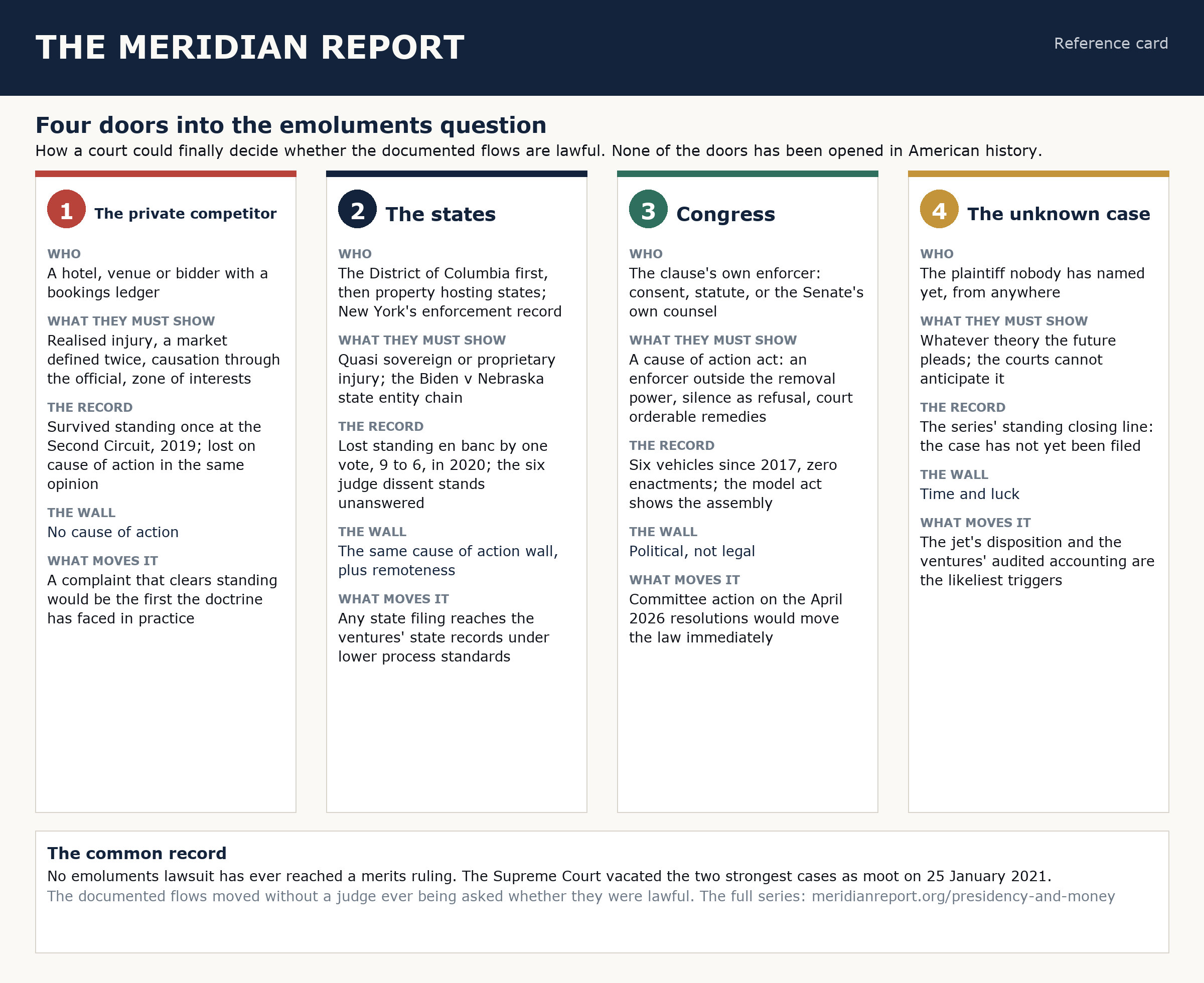
The reference card

The whole subject distilled onto one page: the four doors into the emoluments question, who stands behind each, what they would have to show, the record of how each was tried, and what would move it. Shareable as a single image.

Reference card: the four enforcement paths into the emoluments question, private competitor, states, Congress, and the unknown case, with what each must show, the record, the wall and what moves it

The four enforcement paths, compiled from the verified records examined in this series, September 2026.

The four parts, in order

Part I · The behaviour

The choreography of command: why Trump and Netanyahu behave as if no one can stop them

The American president arrived late to a summit of world powers this June and announced that he is the boss. The Israeli prime minister addressed a hall of diplomats whose governments had just recognised the state he says should never exist, and told them they had made a bad investment. Both moments circulated worldwide within minutes, and both men were rewarded for them. This report reconstructs the documented record behind the two most examined reputations in democratic politics, tests the structural reasons other governments absorb the behaviour, and separates what the evidence supports from what it cannot. It finds no mystery: the conduct pays, the costs are paid by others, and the institutions that could constrain each man are the ones they have spent their careers bending.
26 September 2026 \u00b7 24 min read
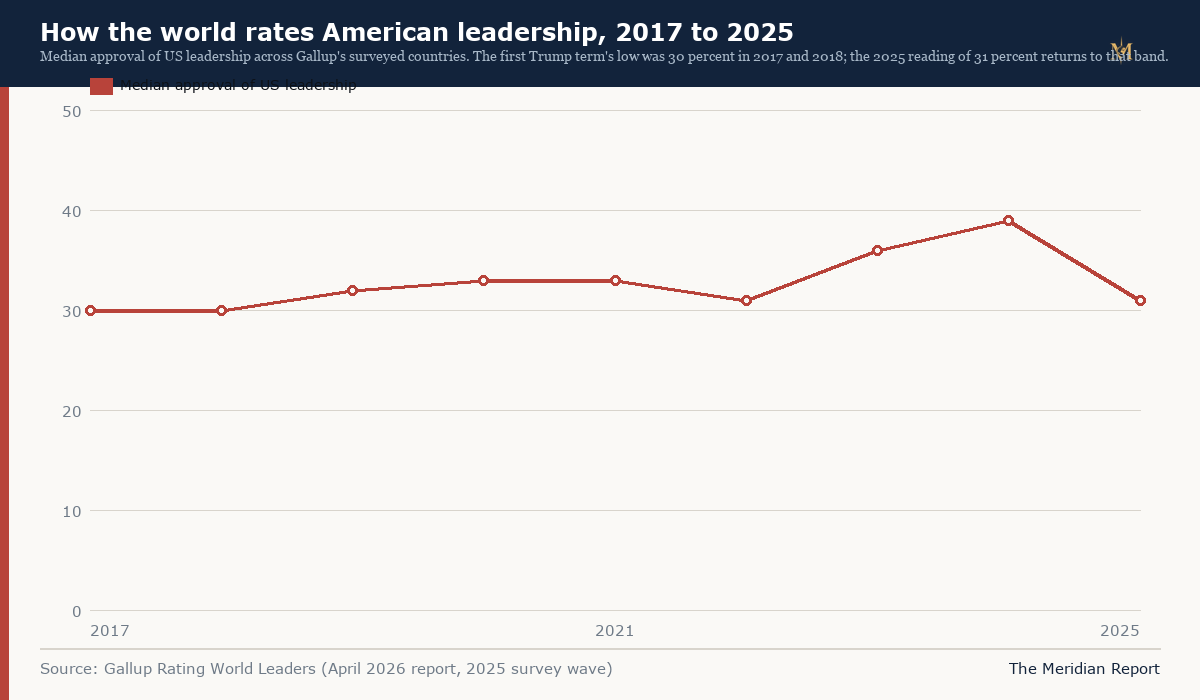
How the world rates American leadership, 2017 to 2025

How the world rates American leadership, Gallup’s global median, 2017 to 2025. Part I also carries the Security Council veto record and the 2025 military spending ledger.
Part II · The flows

The tribute ledger: every named flow into the Trump family's businesses since 2025

A state gifted the United States a $400 million aircraft nine days after the family's company announced a $5.5 billion resort with that state's development partners. A state backed Abu Dhabi fund settled a $2 billion investment in the family's stablecoin. An entity describing itself as Emirati bought $100 million of the family's token, and the man who bought more of it than anyone was under federal investigation at the time. This report assembles the documented record, from filings, announcements and named deals only, of the money that has moved from governments and government linked buyers toward the president's family companies since he returned to office, and it states plainly what each flow proves and what it does not.

26 September 2026 \u00b7 10 min read
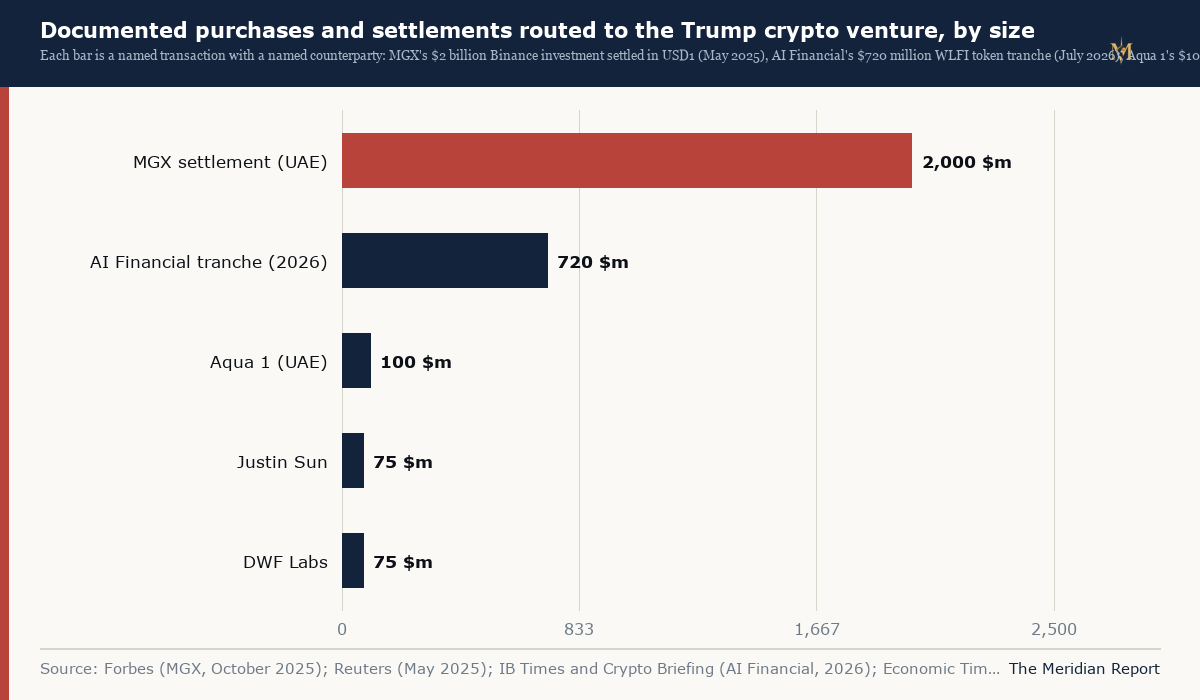
Documented purchases of the family token by named buyers

The documented token purchases by named buyers since November 2024. Part II also charts the revenue split behind the token and the announced values of the licensed projects.

Part III · The history

The warehouse standard: how presidents separated their wallets from the state, and what broke the system

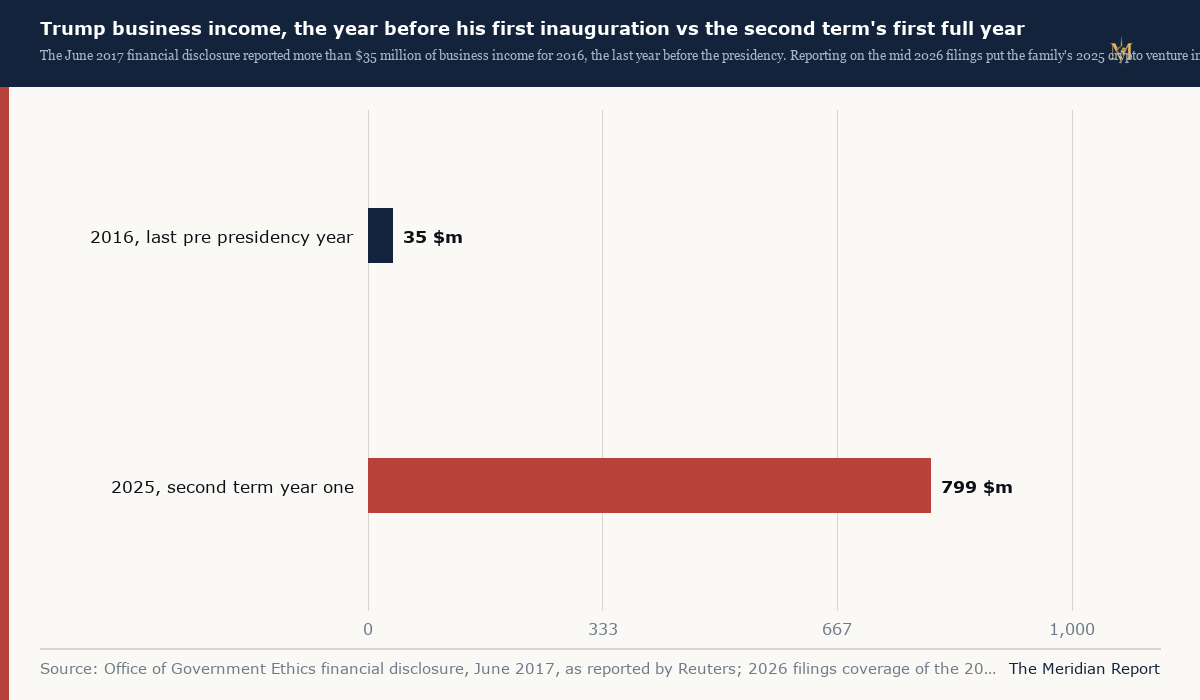
For fifty years, from Truman's era to Obama's, every American president either sold his operating businesses, put his assets beyond his own sight, or deliberately diversified them into things a president could not favour. Jimmy Carter's warehouse deal cost his family more than a million dollars in debt and the farm itself, and he made it anyway. This report reconstructs the history of that regime, era by era, from the haberdasher who left the White House poor to the trust documents of 2017, and identifies the four conditions that made the old arrangements work. All four are gone, and the comparison between the last pre presidency disclosure and the second term's filings shows by how much.

27 September 2026 \u00b7 11 min read
Business income in the last pre presidency disclosure versus the second term filings

Business income in the last pre presidency disclosure against the second term’s first year, both from the filings themselves. Part III also charts how far the old blind trusts actually reached.

Part IV · The law

Any present, of any kind whatever: what the emoluments clause actually requires, and the four paths that could finally enforce it

The constitution's oldest anti corruption rule has never been enforced by a court in American history. It says no federal official shall accept any present, emolument, office or title of any kind whatever from any king, prince or foreign state without congressional consent, and it is written in the most absolute language in the document. Yet a $400 million aircraft sits in the presidential fleet, a state backed fund's $2 billion settlement ran through the president's stablecoin, and the clause itself has never been applied to any of it, because no one has standing to sue and no cause of action exists to sue with. This explainer sets out what the text actually says, the two century interpretive war over its key word, why every previous lawsuit died without a merits ruling, and the four paths, one statutory, one doctrinal, one political and one unknown, by which the Qatar jet and the crypto flows could still reach a verdict.

27 September 2026 \u00b7 12 min read
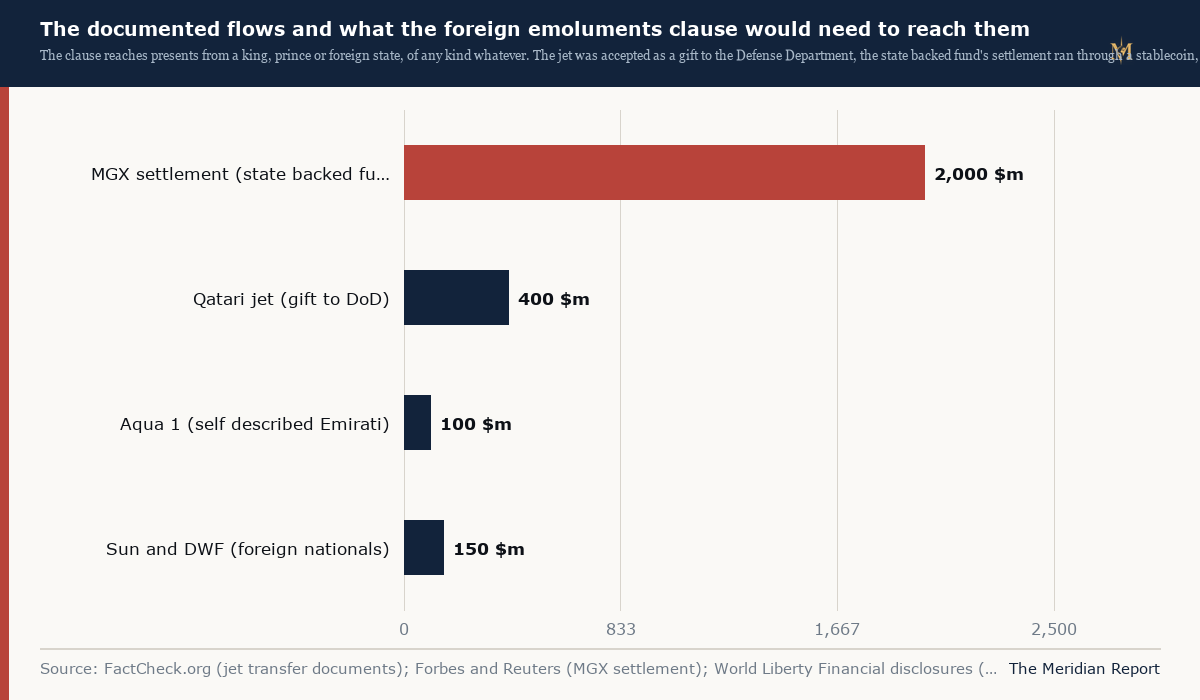
Each documented flow mapped to the legal question it tests

Each documented flow mapped to the legal question it actually tests, and to the enforcement path that could reach it.

What would change the picture

Four developments would move the record, and each lands in the relevant part of the series.

  1. 1.

    A filing in any court. The standing doctrine has always accepted competitive injury in principle and never faced it in practice. A hotel, a venue or a bidder alleging foreign money tilted a contract would be the first plaintiff with a door into the merits. Part IV explains the doctrine such a filing would run into.

  2. 2.

    The aircraft’s disposition. The transfer placed the jet with the Department of Defence and left its after office fate undecided. A returned airframe, a retained one, or a disclosure under the Foreign Gifts and Donations Act answers the question the explainer frames as the clause’s hardest case.

  3. 3.

    Congress moving on a cause of action. The clause’s own consent mechanism, and the resolutions modelled on the 2020 Senate bill, are the one path that needs no court. A committee vote, or a consent or prohibition bill reaching the floor, would change the law section’s answer immediately.

  4. 4.

    The ventures’ accounting. An audited breakdown of who sits behind the later token tranches, or MGX’s own characterisation of its status, would narrow the two readings the ledger deliberately leaves open. The disclosure filings, not the press releases, are where that answer will appear.

The series\u2019 companion guides

Part IV sets out the four paths by which the flows could reach a verdict. The guides above take four of them in turn: the standing doctrine that governs a private competitor, the state angle that came within one vote of the courtroom door, the statute Congress would have to write to supply the enforcement the clause has never had, and the discovery machinery that would put the ventures' own records in a courtroom.

Frequently asked questions

What is the presidency and money series?

Four pieces that answer one question in sequence: why the behaviour draws no penalty, what money has actually moved, how every previous president handled the same conflict, and what the constitution says about it. The pieces are built to read in order but each stands alone.

Has any court ruled that these flows are illegal?

No. No emoluments lawsuit has ever received a merits ruling in American history. The first term’s three suits failed on cause of action, legislative standing and mootness, and the Supreme Court vacated the last of them in January 2021. What the series documents is the flows themselves, from filings, announcements and named deals, and what each flow proves and does not prove.

What does the constitution actually require?

Article I, section 9, clause 8 bars any federal official from accepting any present, emolument, office or title of any kind whatever from any king, prince or foreign state without the consent of Congress. The fight is over three words: what counts as a present, what counts as an emolument, and which relationships count as a foreign state. Part IV sets out the text, the two century interpretive war and the four paths that could yet produce a verdict.

What would settle the open questions?

Any of four developments: a plaintiff with standing, a merits ruling, a congressional consent or prohibition, or the ventures’ own accounting. None has occurred. The developments most likely to settle the two concrete questions are the aircraft’s eventual disposition and the resolutions before Congress.

Sources

  1. US Office of Government Ethics, the president\u2019s 2025 financial disclosure and the qualified blind trust regulations under the Ethics in Government Act of 1978
  2. World Liberty Financial, the Gold Paper setting out the venture\u2019s 75 percent revenue allocation
  3. The White House, announcement of the aircraft transfer to the Department of Defence (May 2025)
  4. Prime Minister\u2019s Office of Pakistan, press release on the World Liberty Financial letter of intent (26 April 2025)
  5. Blumenthal v Trump, 949 F.3d 14 (D.C. Cir. 2020) (en banc), the legislative standing rule
  6. Supreme Court of the United States, orders vacating the emoluments judgments as moot (25 January 2021)
  7. Congressional Research Service, the Foreign Gifts and Donations Act and the minimal value regime
  8. SIPRI Military Expenditure Database, 2025 shares of world military spending
  9. Gallup, global ratings of US leadership, 2017 to 2025