
When Harry Truman left the White House in January 1953, his principal asset was his standing in the army reserves and his principal plan was to go home to Independence, Missouri, and live on a pension. The man had been a county judge, a senator and the president of the United States, and he had entered politics the way small businessmen of his generation sometimes did: through failure. The haberdashery he opened with his war friend Eddie Jacobson at 104 West 12th Street in Kansas City closed in September 1922, leaving him nearly bankrupt, and Truman, who refused to declare bankruptcy, spent roughly fifteen years paying off the partnership's debts. His presidency, in the strictest possible sense, presented no conflict of interest problem, because there was no enterprise left to conflict with. The United States had a president with no business to protect.
That starting point, a chief executive with nothing to shield, is the zero on the scale against which every later arrangement must be measured, What follows traces the fifty years in which the United States built a working system for presidents who did have businesses, and the ten in which the system stopped working. The record is instructive precisely because the old system was never a law. It was a set of practices that held because four conditions held, and the story of its collapse is the story of those conditions being removed one by one.
The clause without a court: 1787 to 1974
The framers wrote the constraint into the constitution itself. The foreign emoluments clause prohibits anyone holding office of profit or trust under the United States from accepting any present, emolument, office or title of any kind whatever from any king, prince or foreign state without congressional consent. The domestic clause prohibits the president from receiving any other emolument from the United States or any of them beyond his fixed salary. For nearly two centuries the clauses operated mostly in the negative, enforced by the sheer absence of presidents who arrived with global enterprises, and by the occasional congressional permission granted for foreign decorations.
What the era demonstrates is a structural weakness the modern debates inherit: the clause named no enforcement mechanism. No court, no inspector, no private right of action was specified, and when the clause was finally tested in the 2010s, that absence became the fulcrum on which the litigation turned. The framers built the standard and assumed the republic's manners would do the policing. For two centuries, they mostly did.
The workaround era: the Johnson arrangement
The first genuine test arrived not with a foreign gift but with broadcasting. In January and February 1943, Lady Bird Johnson used an inheritance to buy KTBC, a failing, low power, daytime only radio station in Austin, Texas, for $17,500. The station's subsequent rise, from that purchase to a broadcast empire that became the Johnson family's fortune, is the subject of Robert Caro's accounting and of persistent questions about the Federal Communications Commission's approvals along the way, questions recorded here without adjudicating. What matters for the history of presidential conflicts is the structure the family adopted when Lyndon Johnson reached the vice presidency and then the presidency: the assets were placed in his wife's name, and in 1964, under pressure, into a trust that was widely described by critics at the time and by scholars since as not meaningfully blind. The family kept its knowledge and its involvement. The label covered the arrangement; the arrangement did not blind the beneficiary.
The Johnson episode established the template for the workarounds that followed, and its lesson cut both ways. It showed how a president could keep an operating, regulated, favour sensitive business inside the family. It also showed the political cost, a permanent cloud that followed Johnson's legacy into the historians' volumes, and it taught the post Watergate reformers what to legislate against.
The machinery: what 1978 built
The reforms of 1978 were written by people who had watched Watergate, the leaks of financial advantage and the cabinet level conflicts of earlier administrations, and they created for the first time a federal ethics infrastructure. The Ethics in Government Act, signed on 26 October 1978, established the Office of Government Ethics, mandated public financial disclosure for senior officials including the president, and defined the qualified blind trust, a trust whose trustee manages assets without communicating their composition to the beneficiary, whose arrangement must be approved by the supervising ethics office, and whose trustee cannot be someone whose selection the beneficiary controlled in ways that preserved influence.
The machinery's first user was Jimmy Carter, and the record of his presidency is the era's most honest case study precisely because it is not spotless. Carter placed his assets in a trust managed by Charles Kirbo, his friend and former law partner, a choice critics immediately noted fell short of independence, and which scholars reconstructing the arrangement later described as semi blind rather than blind. The distinction matters: the arrangement's value rested on Carter's conduct rather than on the trustee's distance from him. The family's peanut warehouse operation posed the harder problem, an operating business whose value depended on management Carter could not continue to provide, and the family's eventual exit, the sale of the warehouse company in March 1981 for $1.2 million to an Illinois feed company, left the Carters with the debt the operation had accumulated, more than a million dollars by contemporary accounts. In May 1979, Carter went further than the law required, abandoning trust secrecy to publish his finances openly. The arrangement cost the family real money and real privacy, and the political lesson of the era was formed by that cost: the system worked when its subject accepted that it would.
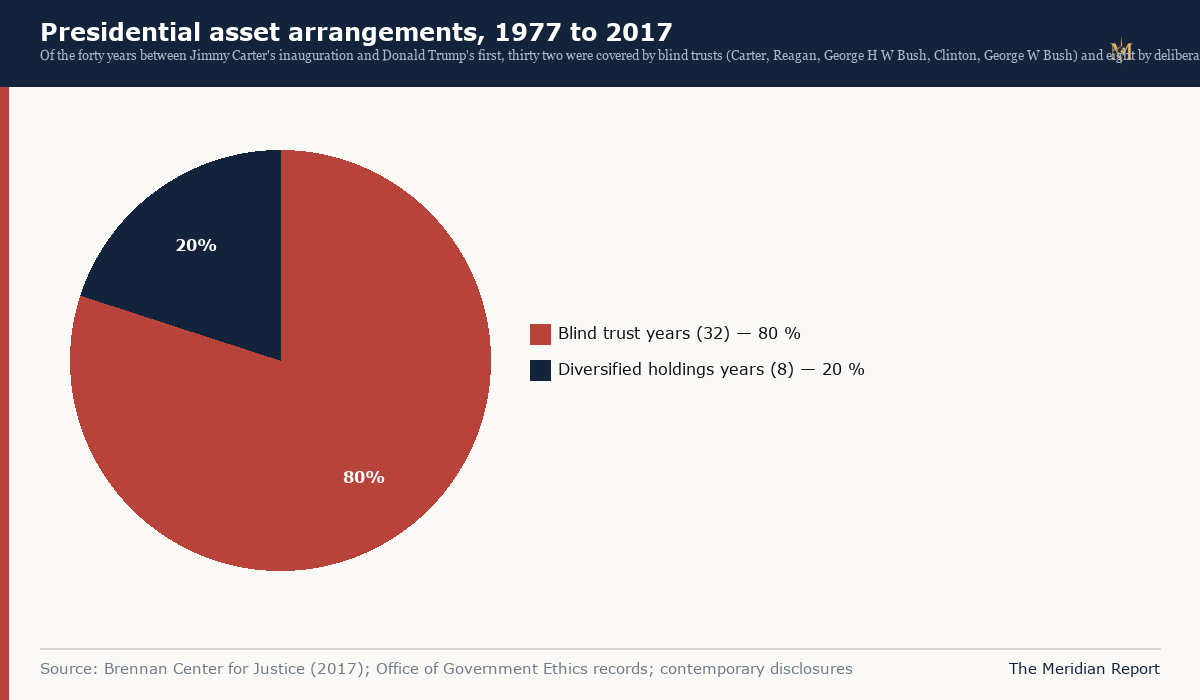
The successors ran the machinery with variations and occasional failures. Ronald Reagan entered office in 1981 with a blind trust; his California ranch arrangements and gifts to the first family drew criticism but the core holdings were blind. George H W Bush, whose family fortune sat in managed investments, used a trust. Bill Clinton's Whitewater episode demonstrated the machinery's blind spot for old real estate entanglements with unsavoury partners, a scandal that consumed years of his presidency without ever involving his governance decisions, and his post presidency monetisation, the speech fees and the foundation, began the modern pattern of cashing the presidency in after it ended rather than during it. George W Bush placed his holdings in a trust built on Treasury securities, an asset class chosen precisely because a president cannot favour it. Barack Obama chose a different model altogether, no trust but deliberate diversification into index style holdings and Treasury instruments, plus the continued royalty stream of two bestselling books, disclosed and politically unimpeachable.
Across those forty years, from January 1977 to January 2017, the Office of Government Ethics recorded a continuous practice: every president either blinded, diversified or sold. The string is the era's real monument. It was never a statute. It was a norm, and the next administration proved that a norm is only as durable as the willingness of the man it binds.
What made the old regimes work
Set the successes side by side and four conditions separate them from the failures.
The first is the beneficiary's consent to blindness. Every working trust worked because its subject wanted not to know. The trustee's independence, Carter's Kirbo problem notwithstanding, mattered less than the principal's decision to treat ignorance as the price of office. Truman's generation brought the extreme version, men whose finances were small and whose ambitions for them were smaller.
The second is the convertibility of the assets. Stocks, bonds, index funds and even a peanut farm can be sold or replaced with fungible instruments without destroying their value. The blind trust is a machine for converting specific, favour sensitive assets into anonymous ones. Where the asset is convertible, the machine works.
The third is disclosure with consequence. The 1978 act's disclosure regime functioned because a revealed conflict carried political cost inside the official's own party and government, because the press treated the revelation as a story, and because the ethics offices' opinions were treated as binding by the officials themselves.
The fourth is the courts as backstop. It was understood, if never tested, that a gross violation of the emoluments clauses would find its way to a judge. The understanding disciplined behaviour without ever needing to be exercised.
The break: 2017 and the revocable trust
Donald Trump's first term broke all four conditions in a single arrangement, and the documents were public within weeks. The president did not sell the Trump Organization and did not blind it. His assets passed to the Donald J. Trump Revocable Trust, with his eldest son running it in consultation with the president, the trust's terms allowing the president to draw profits at any time without public accounting, as ProPublica's February 2017 reconstruction from the liquor licence filings established. Trump tweeted that new hotels would not be added while he was in office, a commitment whose meaning the hotel chain's own announcements tested within months. The Washington hotel, leased from the federal government he now headed, became the emblem: foreign governments and domestic interests booked its rooms and ballrooms, and the question of whether those bookings were payments to the president became the subject of two major lawsuits.
The litigation's history is the fourth condition's collapse in the record. CREW sued in January 2017 on the foreign emoluments clause; the attorneys general of Maryland and the District of Columbia followed with their own suit over the hotel. The Fourth Circuit ruled against the states' standing in 2019, en banc, holding that the legislators and local governments could not show injury of the kind the courts would accept. On 25 January 2021, the Supreme Court vacated the lower decisions and ordered everything dismissed as moot, because Trump had left office. No court ever ruled on what the emoluments clauses require of a president who keeps his companies. The backstop, understood for two centuries as existing, was demonstrated not to exist.
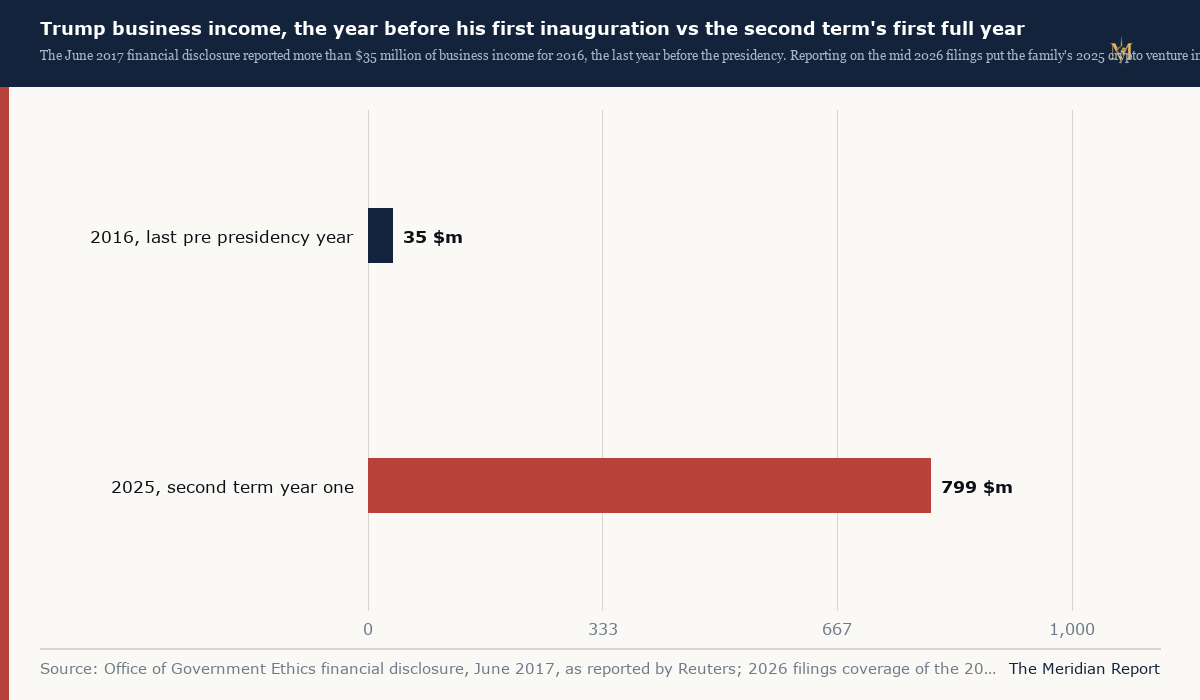
The size of the break is measurable in the disclosures themselves. The June 2017 financial disclosure, the first of the presidency, reported more than $35 million of business income for 2016, the last year before the inauguration, across the hotel, golf and licensing portfolio. Nine years later, as the series' ledger of documented flows records, the family's crypto ventures alone produced $799 million of income in the second term's first year, on a 75 percent revenue share written into the venture's own governing document, with a state backed fund's $2 billion settlement and named foreign buyers inside the flow. The comparison across two different disclosure universes is direction rather than equivalence, and the direction is a twentyfold increase in the money running through the president's own ventures while he held office.
The second term completed the inversion. The ethics offices still exist and still issue opinions; the disclosure regime still produces filings; what ended is the practice those institutions were built to govern. The four conditions are each gone: the beneficiary does not consent to blindness, the assets are not convertible, disclosure carries no consequence within the governing party, and the courts have been demonstrated, by standing doctrine and mootness, to be no backstop at all for this class of claim. What replaced the regime is not lawlessness but a different law: the market's. The presidency's own pricing, in rooms, tokens, memberships and towers, is now discovered openly, and the buyers understand the product.
What a working regime would require now
The record does not leave the question abstract, because the reform literature converges on the four conditions' restoration, and each has a known mechanism. Divestiture with credit: the state buys the conflicting assets at independent valuation, as the securities world's fair value proceedings do, so that the seller is compensated and the conflict is genuinely extinguished. Enforcement standing: the emoluments clauses' obvious flaw, that no one can sue, was diagnosed precisely by the 2019 and 2021 litigation, and the remedy is legislative, a statutory grant of standing to defined plaintiffs. Disclosure teeth: the existing regime already produces the numbers, as the $799 million filing shows; what it lacks is any penalty attached, and campaign finance law offers the model of per violation fines. None of these requires a constitutional amendment. All of them require the one thing the historical record shows has always been decisive: a subject willing to be bound. The fifty years of practice from Truman to Obama were built by men who accepted costs, Carter's warehouse debt, the trust secrecy, the indignity of selling what a father built, because the alternative was a presidency that priced itself. The current system has made the opposite choice, and the filings, as the same ledger records, show what that choice earns.
What this history cannot establish
The historical record establishes what each administration did and what it cost; it cannot establish motive across centuries, and none is inferred here. The KTBC questions remain questions, documented but unresolved; the Carter trust's imperfections are described as its critics describe them, with the family's own account of its finances alongside; the 2017 trust's terms are those of the documents, and the profits their language permitted are not asserted to have been drawn. The comparison of disclosure universes across 2017 and 2026 is direction, not equivalence, and the direction is the finding that matters. What the history can say is narrow and sufficient: a republic that once produced presidents who paid a million dollars to keep a warehouse at arm's length now produces filings that price the presidency's ventures at three quarters of a billion a year, and every step between those two facts is in the record.
Reading the whole series
The presidency and money is a four part investigation: the behaviour, the flows, the history, and the law. The other parts and their charts are collected at The presidency and money.