Nine days before the White House announced that Qatar's ruling family had offered the United States a Boeing 747-8, the Trump Organization announced a $5.5 billion golf resort on Qatar's eastern coast, its first development in the emirate, built inside a master development whose anchor investor is a state linked fund. Nine days is not causation, and no claim of it is made here. It is, however, the interval at which two of the largest stories in the modern history of conflicts of interest announced themselves to the world, and it frames the question that follows: since January 2025, a steady stream of money and money like instruments has moved from governments, state linked funds and government adjacent buyers toward the president's family businesses, and the sum of the named, confirmed transactions is now large enough to constitute a structural feature of American foreign relations rather than a series of anecdotes.
What follows is a ledger, not an indictment. Every entry is a named flow, confirmed by a named party, cited to a filing, an announcement or an on the record statement. Where a number is a party's own claim, it is attributed. Where the arithmetic converts a purchase into family income, the calculation is shown. And where the record could support an inference of influence but does not prove one, the inference is marked as exactly that. The subject is too important and too documented to be argued by insinuation.
The vehicle: a crypto venture with a 75 percent pipe
The largest channel is World Liberty Financial, the decentralised finance venture founded in 2024 by the president's sons and associates, in which a Trump entity holds the dominant ownership stake. Its mechanics matter more than its branding. The venture's governing document, its Gold Paper, allocates 75 percent of net revenues to DT Marks DEFI LLC, the Trump family's revenue vehicle. The president's own financial disclosure, filed with the Office of Government Ethics in June 2025, reported $57.4 million of income from the venture for the period. Reporting on the mid 2026 disclosures put the family's 2025 crypto income at $799 million across ventures, a figure this report attributes to the filings' reporters rather than recomputes.
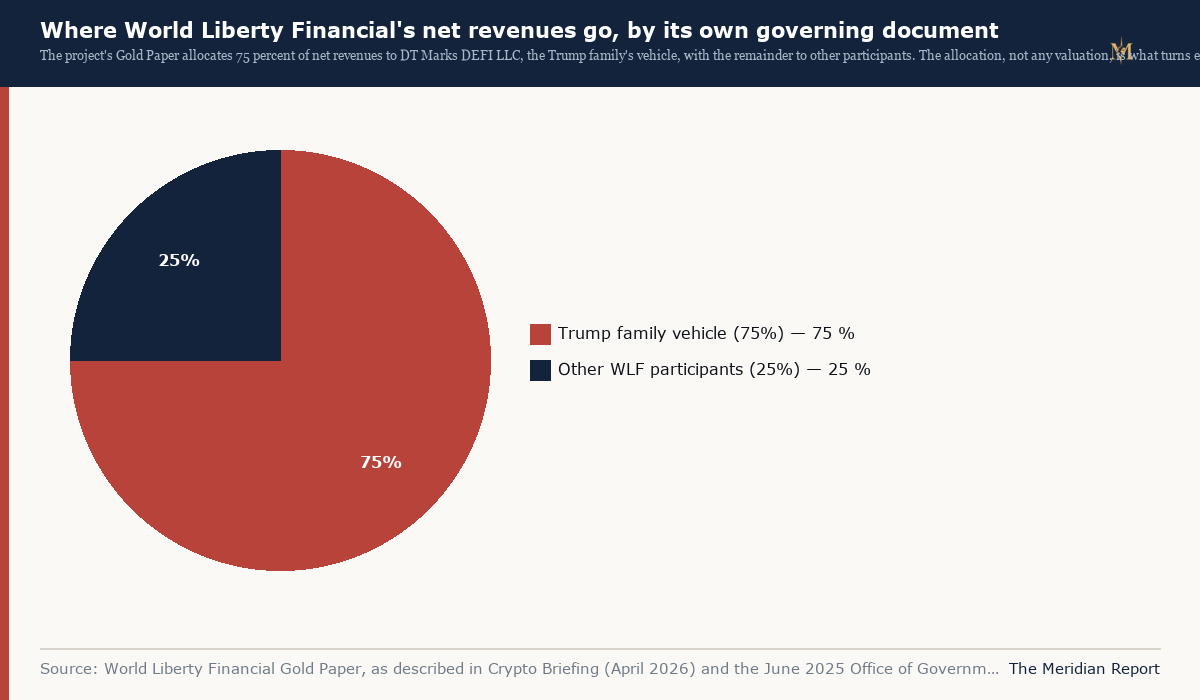
The consequence of the structure is arithmetical and does not depend on anyone's estimate: every dollar a buyer pays the venture generates up to seventy five cents of revenue entitlement for the family vehicle, less the venture's costs. When a state linked fund, a foreign billionaire or an anonymous offshore entity buys the family's token, the purchase is, by the venture's own design, a purchase from the family. That is the pipe. What follows is what has flowed through it, and what has flowed around it.
The state settlement: $2 billion in the family's stablecoin
On 1 May 2025, at a Token2049 conference appearance in Dubai, Zach Witkoff, the venture's co founder and the son of the president's special envoy, announced that USD1, the venture's dollar stablecoin, had been selected as the settlement instrument for a $2 billion investment by MGX, the state backed Abu Dhabi investment fund, into Binance, the world's largest crypto exchange. Reuters reported the announcement. MGX later confirmed the detail itself, telling Forbes in October 2025 that it had used USD1 to close the investment. Senators Warren and Merkley formally sought the deal's records, noting that the stablecoin's issuer had effectively been paid a role in a state transaction because of whose family stood behind it.
What this entry proves: an investment fund owned by the government of the United Arab Emirates settled a $2 billion transaction using the Trump family's stablecoin, and confirmed it. What it does not prove: that the choice was made to curry favour, or that the family earned $2 billion, which it did not. The stablecoin issuer's income comes from the reserves backing the coins in circulation, a yield the parties have not publicly quantified for this transaction. The entry sits in the ledger as a confirmed act of patronage by a sovereign linked buyer toward a presidential family's financial product.
The named token buyers: a hundred million here, seventy five there
Four purchases by named parties form the second block of the ledger. The largest is the most recent: in July 2026, an entity called AI Financial bought a $720 million tranche of WLFI tokens in what the trade press called a fire sale, generating an estimated $540 million for the family vehicle under the 75 percent structure, estimates this report attributes to the analysts who made them. In June 2025, the Aqua 1 Foundation, describing itself as a UAE based investment vehicle whose principal the reporting identified as a Chinese born crypto financier, bought $100 million of tokens, the largest individual purchase of that phase. In November 2024, before the inauguration, the Chinese born billionaire Justin Sun bought $75 million, becoming the private phase's largest buyer, and the market making firm DWF Labs bought a further $75 million. Sun's purchases continued into 2025, and his total across phases passed $100 million.
Sun's entry carries its own shadow, and the record is precise about it. The Securities and Exchange Commission had sued Sun in 2023 for fraud and market manipulation; in early 2025 the commission agreed to a pause of the case, and reporting through 2025 and 2026 established that enforcement tensions around Sun were deprioritised. The sequence, the largest buyer, then the pause, then the continued purchases and public association with the venture, is documented. The causation is not, and the report asserts none. It notes only that in any ordinary administration the combination would have triggered a recusal architecture, and that no such architecture has been described by the parties.
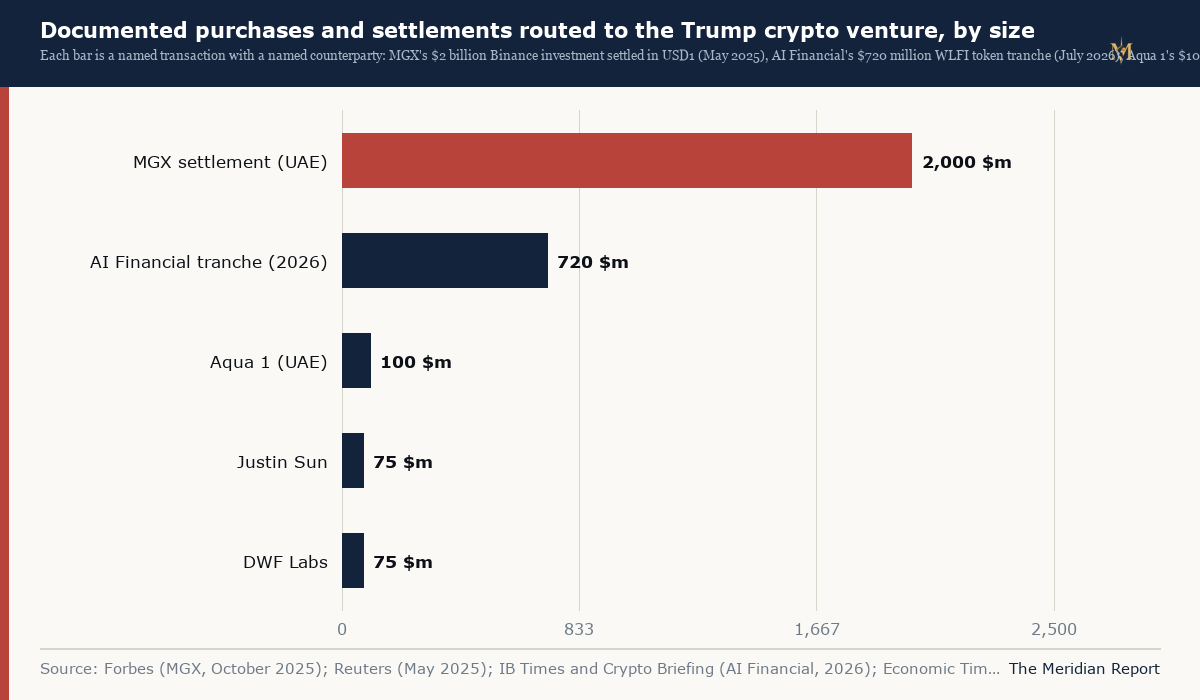
The Aqua 1 entry carries a different shadow: opacity. The foundation's principals were identified only through investigative reporting, its corporate filings are minimal, and no government has confirmed it as an instrument of state. It appears in this ledger as a named buyer whose self description is Emirati and whose money is real, and the report declines to call it more than that.
The aircraft: $400 million to the state, in the family's airspace
The most discussed entry is technically not a payment to the family at all, and the report treats it with the precision the controversy has lacked. On 11 to 14 May 2025 the White House announced that Qatar's ruling family had gifted the United States a Boeing 747-8 for use as an interim Air Force One. The aircraft is a gift to the Department of Defense: FactCheck.org's analysis of the transfer documents, obtained through a judicial records fight, found it was accepted as such, with refitting costs borne by the Air Force. The president said any suggestion he personally benefited was premature; critics called the arrangement unconstitutional under the foreign emoluments clause; the Supreme Court's shadow docket jurisprudence has so far left such questions unresolved. The jet entered presidential service, and reporting in August 2026, including a statement by Eric Trump, established that the aircraft will not go to the presidential library after the term, with its final disposition left open by the White House.
What this entry proves: a foreign state made the largest gift in the history of the republic's presidency to the institution the president heads, in the same month his family's company signed its largest Gulf development deal with that state's partners. What it does not prove: that the president will keep the jet, which the White House says is undecided, or that the gift influenced any decision. Its place in the ledger is as the emblem of the pattern, the visible tip of a system in which the family's commercial entanglements and the state's diplomatic relationships have become indistinguishable from the outside.
The property pipeline: licensing the name into the Gulf
The third block is the family's oldest business, licensing, now operating at Gulf scale. The Dar Global partnership, the Trump Organization's key foreign relationship per the New York Times' November 2025 profile, has produced Trump Tower Jeddah, announced December 2024 with a $1 billion headline value, Trump Plaza Jeddah, announced September 2025 at $1 billion, with reporting describing a broader Saudi pipeline into Riyadh, and the tower in Dubai. The Simaisma resort in Qatar, announced 30 April 2025, is a $5.5 billion development with state linked partners in which the Trump Organization's role is the Trump brand and its management fees. None of the announcements discloses the family's fee take, which is standard in licensing and is exactly why the entries are recorded here as announced values rather than income.
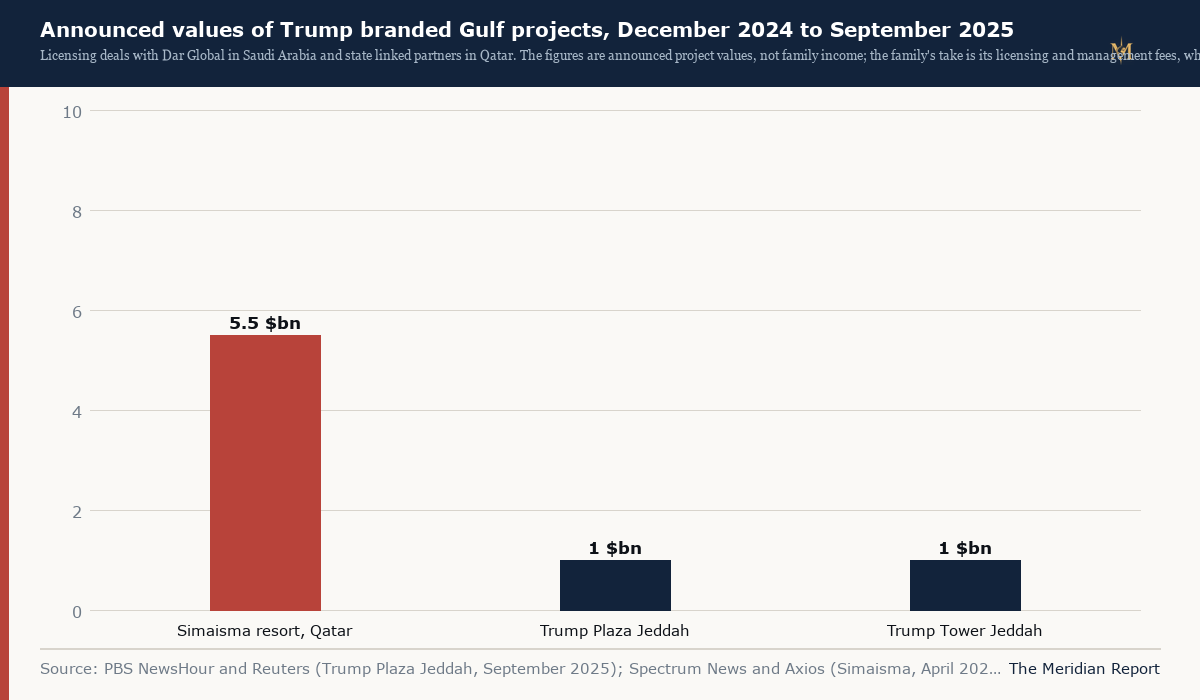
The political geography of this block is the point. Three of the four largest announced projects sit in the two Gulf states whose security relationships with Washington the president personally controls: the Qatar file, from the blockade's end to the base relationship to the mediation politics of the Gaza war, and the Saudi file, from the defence pact to the nuclear conversations. The report does not assert that a tower was traded for a treaty. It records that the same counterparties appear on both ledgers, which is a fact, and that no previous administration has allowed the overlap, which is also a fact.
The envoy's own ledger
One entry concerns an official rather than the family, and belongs here because the family venture is the counterparty. Steve Witkoff, the president's special envoy to the Middle East and co founder through his sons of the venture, earned nearly $107 million in 2025 from a holding company affiliated with World Liberty Financial, per his own financial disclosure as reported. He is the official who nominally manages the Gulf portfolio on which the venture's buyers and partners sit. The disclosure is public, the number is his own filing, and the conflict it documents is the clearest single illustration of the system this report describes: the man negotiating with the states is a co founder of the vehicle the states are buying into.
The Pakistan exhibit: the state that signed
The ledger's strangest entry is a signature. On 26 April 2025, a delegation from World Liberty Financial, including the Witkoffs, signed a letter of intent with the newly created Pakistan Crypto Council in a ceremony attended by Pakistan's finance minister, the governor of its central bank and the chairman of its securities commission, as Pakistan's own Prime Minister's Office recorded in a press release. Within weeks, the country whose military chief would fly to Washington in June and nominate the president for the Nobel Peace Prize had made a Trump family venture a counterparty of state, and the tariff and crypto dividend described in the first part of the series followed. The letter of intent's substantive commitments are limited, and the report records them as what they are, an announcement rather than an investment. Its evidentiary value is different: it shows a government treating commercial access to the president's family as a step in statecraft, in writing, on its own website.
What the ledger totals, and what it does not
Sum the confirmed entries and the scale comes into view: $2 billion settled through the family's stablecoin, roughly $895 million in named token purchases across four buyers, a $400 million state gift accepted by the government, $7.5 billion in announced project values across three states, and one official's $107 million year. Against the 75 percent revenue structure, the token flows alone convert into hundreds of millions of family income, figures the family's own disclosures corroborate at scale. No president has left office wealthier from a single term, and the mechanism, unlike every previous post presidential monetisation, runs concurrently with the presidency rather than after it.
What the ledger does not contain is the word because. The public record establishes every flow and none of the motives. It is possible that every buyer named here acted from commercial judgment alone, that every policy outcome intersecting with these counterparties would have occurred under any administration, and that the appearance of tribute is an artefact of simultaneity. It is also possible that the flows are what they appear to be, and the foreign ministries of three continents are pricing access to the American executive in the currency of its first family's balance sheet. The record supports both readings, and collapsing the ambiguity for the sake of a better paragraph would be dishonest to both. What the record does say is that the ambiguity itself is the policy failure: a republic that once demanded blindness between the president's wallet and the state's business now conducts both in public, at scale, with the documents posted and the ethics lawyers reduced to calculating percentages. The constraint that used to be a clause is now a ledger entry, and the ledger grows with every filing.
Reading the whole series
The presidency and money is a four part investigation: the behaviour, the flows, the history, and the law. The other parts and their charts are collected at The presidency and money.