
Every enforcement theory ends at the same practical gate. A competitor with a bookings ledger, a state attorney general with a theory, a Congress with a model statute, none of them can prove the linkage between foreign money and the presidency without documents, and the documents are held by private companies whose controlling shareholder is the president of the United States. What follows maps what is actually reachable, in three passes: what the public already has, what is locked, and how the machinery of compelled disclosure works when the person at the top of the venture is also the person at the top of the executive branch.
The public paper trail, no subpoena required
The record's first lesson is that a substantial part of the venture file is already public, assembled by ordinary disclosure law rather than litigation.
The annual disclosures. The president files the OGE Form 278e public financial disclosure report, and the Ethics in Government Act makes those reports public, with the filing procedure, deadlines and public availability governed by 5 CFR Part 2634. The form's value ranges are broad, usually a thousand dollar or ten thousand dollar band per asset, but the structure it reports is not: which entities exist, which the official holds interests in, and what positions the ventures occupy. The periodic transaction reports amend that picture as things move. The series' earlier articles have already put the disclosed figures to work: the $57.4 million the venture generated in the first disclosure year, the $799 million across ventures reported for 2025.
Next to them sits the securities file: the token offering left its own public record. The Form D filed with the SEC in late 2024, viewable on EDGAR, shows the offering's structure: a Regulation D exemption, sales to accredited investors, nontransferable tokens, and the reported proceeds figure. Any later offering documents, risk disclosures and the Gold Paper itself are published by the venture. The Form D does not identify the purchasers, but it establishes the legal machinery the sale ran through, which is what a discovery plan would target.
The chain itself is the third family. Crypto transactions are recorded on public ledgers. Every token transfer, every wallet-to-wallet movement, every treasury action of the venture's contracts is visible to anyone, timestamped and permanent. What the chain does not show is the legal person behind an address, and that gap is exactly where compelled disclosure would aim: at the issuer's own records matching addresses to buyers, and at the exchanges where tokens were bought or sold.
Last are the ground records. The licensed projects, the hotels and the golf properties exist inside ordinary commercial law. Corporate registrations name the entities and their managers. Land records show acquisitions. Licence and permit files sit with state and local regulators. Development agreements that have been announced, the Jeddah towers, the Simaisma resort, are documented in the parties' own announcements. None of this is the full picture, and all of it is the skeleton the rest of discovery hangs on.
The locked categories
The documents that decide financial cases are not public, and the list is short and well defined.
Tax returns, federal and state, sit with the filer and the revenue services. The books and accounts behind the disclosed value ranges, the invoices, the general ledgers, the consolidating schedules, sit with the company and its accountant; the accountant's workpapers are themselves a category with privilege questions of their own. The trust instruments, the 2017 trust and any successor, with their amendments and distribution records, sit with the trustee. Bank statements and wire records sit with the banks. Internal communications, the emails and messages in which decisions were made, sit with the company and its officers. And the identity behind the chain addresses, as noted, sits with the issuer and the exchanges.
One structural point deserves emphasis. The value ranges on the public forms are wide, and the private books are narrow. The distance between them is precisely the space in which a conflict question lives: whether a payment was a commercial licensing fee or something else cannot be resolved from a disclosure that reports the licensing business in a ten million dollar band. Every discovery plan in this area is, at bottom, a plan to cross that distance.
The machinery: what the Supreme Court built in 2020
The controlling precedent arrived as a pair on 9 July 2020, and together the two decisions map the routes.
Trump v Vance addressed the state criminal route: a grand jury subpoena to the president's personal accountant for his financial records. The Court held, 8 to 1, that a president is not absolutely immune from such a subpoena, and that no heightened standard applies; the documents must still be relevant to a grand jury investigation, but the office does not shield the papers. For a private plaintiff the route is unavailable in its criminal form, but the holding's logic, that the presidency does not immunise private records from ordinary process, is the foundation everything else stands on.
The congressional route ran through Trump v Mazars: House subpoenas to the president's accountant for his financial records in support of possible legislation. The Court did not quash them. It vacated and remanded for the lower courts to weigh four considerations: whether the legislative purpose adequately supports the requests, how comprehensive the requests are relative to that purpose, whether the requests impose meaningful burdens, and whether the subpoena bears on a matter on which Congress can legislate, with options short of enforcement, such as narrowing or negotiation, to be weighed. CRS's assessment of the decision records the burden question's refinement in later cases: courts now ask whether the subpoena imposes meaningful burdens, the formulation from Judge Bullock's opinion below, which Mazars endorsed. The route is open to Congress, on paper, with more friction than before.
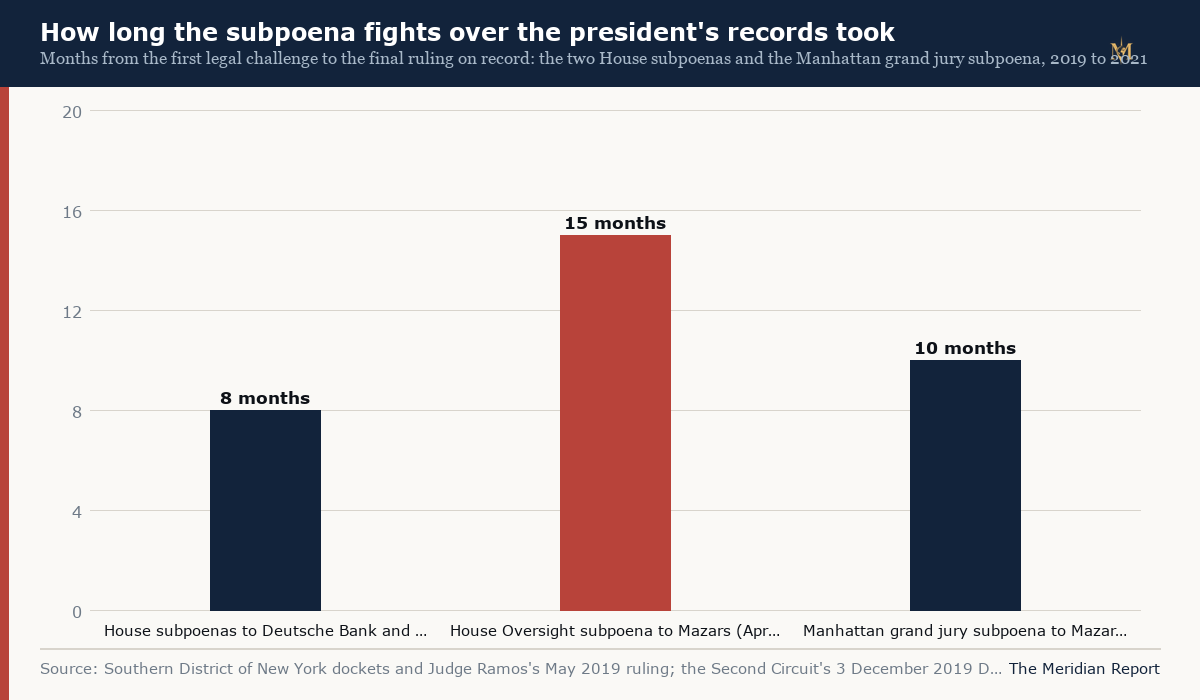
For a private plaintiff the route is the third party subpoena, and it has actually been run against these ventures' banks. In the Deutsche Bank and Capital One litigation, House committees subpoenaed the banks for the president's and his businesses' financial records, the president sued the banks himself, Judge Ramos ruled in May 2019 that the subpoenas had a legitimate legislative purpose, and the Second Circuit affirmed in substantial part on 3 December 2019. The lesson generalises: subpoenas to third parties, banks, accountants, exchanges, title companies, proceed against the holder of the records, and the holder's incentive is to comply rather than litigate, as the banks' own conduct in that litigation showed. A private plaintiff with a surviving cause of action would subpoena the same perimeter: the accountant, the banks, the exchanges, the insurers, the licensors.
Depositions of the man himself are governed by Clinton v Jones, 520 U.S. 681 (1997): a sitting president has no immunity from civil litigation over private conduct, but the court must accommodate the office's schedule, and the Court pointedly noted that such accommodation is the district judge's task. In practice that means a deposition happens, but at a time and place of the court's managing, and the first term's litigation showed what the accommodation looks like in the real world, years of scheduling, not an outright bar.
The rules a case against this president inherits
Four constraints shape any discovery plan aimed at the ventures, and each traces to the record.
Timing is the first inherited constraint. The mooting power, established when the Supreme Court vacated the two strongest emoluments cases in January 2021, applies to discovery plans too: a case that wins its subpoena fights after the term ends has won nothing. The chart above records what the fights cost last time, eight to fifteen months, and a plaintiff planning around an election calendar has to assume the clock.
Scope discipline is the second. Mazars's four factors reward narrow requests tied to a pleaded theory and punish anything that looks like a fishing expedition. The documents that carry the load in any such case, the linkage documents, which foreign sources paid which ventures, are the requests that survive; requests for everything the companies own are the ones that die.
Privilege and work product are the third. The accountant's papers and the company's internal communications carry claims a court will have to adjudicate, and the crime fraud exception has its own litigation history in these ventures' orbit. A discovery plan that budgets for privilege fights, and asks for the transactional records that carry fewer privilege risks before it asks for the communications, is the plan that produces documents.
State process is the fourth, and often the cheapest. The ventures operate under dozens of state and local regimes, licences, land use, tax, and each regime has its own compulsory process with its own standard, often lower than the federal constitutional floor. State attorneys general are the plaintiffs closest to the door, and the state records are also the cheapest to reach, because much of the file already sits with state regulators.
Where the records stop
The map above covers machinery, not outcomes. No court has ever ordered the ventures' books produced in an emoluments case, because no emoluments case has ever reached the stage where such an order issues. The precedent establishes that the president's private records are reachable in principle; the first term's litigation establishes what the fights cost and where they were won; and the ventures' own filings establish what the public portion of the record contains. What nobody knows, because it has never been tested, is how the current Court would weigh a Mazars subpoena aimed at a sitting president's active businesses, or how long a full discovery cycle would run against the mooting power. The documents exist. The routes to them are mapped. The rest is a case that has not yet been filed.
Reading the whole series
The presidency and money is a four part investigation: the behaviour, the flows, the history, and the law. The records above are its evidence base; the sequence is collected at The presidency and money. The doctrine guide is at How to build a plaintiff the emoluments clause cannot shake off, the states' article at The one-vote problem, and the model statute at The missing statute.