
When the president of the United States arrived at the G7 summit in Evian this June, he was late, and he explained the delay himself. Other leaders had come to talk. He had come, he told the room with the cameras rolling, because everyone wants him there. They know who the boss is, he said, and the room laughed, and the clip was on every screen in the world before the working lunch ended.
The moment belonged to a recognisable genre. In May 2017, at the opening of NATO's new headquarters in Brussels, television cameras filmed Trump placing a hand on the arm of Montenegro's prime minister, Dusko Markovic, and pushing himself to the front of the leaders' group photo. Markovic later called it natural, and the clip outperformed every communique the summit produced. In September 2025, addressing the General Assembly, the president told the assembled governments that their countries are going to hell, that they run high unemployment, that they are failing, and that America is the hottest country in the world right now. In 2024 he mused about bombs going off in the United States and not a single world leader calling to ask how America was doing. In February 2017, asked about the Washington Post's report that he had revealed highly classified intelligence to Russian visitors, he stood beside the Canadian prime minister and said he had absolute proof, access to things that nobody else has. Just a week earlier, asked about his policy on Iran, he had glanced toward the visiting Israeli prime minister and said there is going to be calm before the storm, and refused every follow up with a smile.
The pattern has a name in the coverage: showmanship, dominance, egotism. It has produced a widely held popular theory that goes something like this: this man believes he is above every other country, he humiliates allies because nobody stops him, and the silence of other capitals is fear or weakness. The theory is not crazy. But it is also not an explanation, and a report that stopped there would be performing exactly the trick it studies: dramatic, quotable and empty.
The reconstruction here is narrower. It takes the documented record of display conduct by two leaders whose reputations for it are the largest in democratic politics, Donald Trump and Benjamin Netanyahu. It tests the popular theory against the evidence. It examines the structural conditions, military, economic, institutional and mediatic, that make the behaviour affordable for one man and survivable for the other. It treats other governments' quiet as a policy to be explained rather than a mystery to be lamented. And it keeps one discipline throughout: everything asserted here happened on the record; everything interpretive is attributed; nothing psychological is presented as fact.
The popular theory contains one large truth, and most of what follows establishes it: the behaviour is not irrational, and the quiet is not weakness. Both are outputs of the same machine.
What the record shows: a decade of choreography
The display conduct attributed to Trump is not a recent development or an artefact of hostile editing. It spans two administrations and a private life of real estate branding, and the highest value moments were filmed by the press pools that follow him.
The Montenegro incident is the canonical physical example, because it happened in one continuous shot at a summit of allied heads of government. The president, walking with the group into the new headquarters for the family photo, accelerated, placed his right hand on Markovic's arm and pushed himself forward into the front row. The New York Times and the Associated Press published the footage within hours. What matters is not the shove but the responses. NATO's secretary general at the time called the allies' commitment to the alliance unquestionable, in an apparent attempt to close the story. Markovic himself converted the humiliation into diplomacy, saying it was natural and that Trump's position as the leader of the strongest country made it expected. The lesson, absorbed by every chancellery in Europe within a day, was that the cost of protest exceeds the benefit, that the clip will circulate either way, and that the United States will not apologise.
The verbal record is larger. The hottest country speech, delivered to the 80th General Assembly in September 2025, told the assembled world that their countries are going to hell, that their immigration policies have destroyed them, that America is the hottest country anywhere, and that they should end the Ukraine war immediately because it is making them look bad. Reporters noted that the hall, which had emptied early in previous years when his speeches ran long, sat through this one. The 2026 address, fact checked line by line against the recordings, advertised a doctrine of personal command: he will decide Iran's future, he will end the war in Europe, he will open Cuba to freedom, and every promise in the speech had the same date attached, the American midterms of 3 November.
The small physical theatre accumulates into a legible grammar. The late arrivals, which the Evian entrance confirmed as policy rather than accident, since he repeated the device he had used at his own inauguration and at NATO's Hague summit in June 2025, where the family photo was staged so that he stood at the centre of the frame with every other leader arranged around him. The refusal of summit structures he does not control: in June 2025 he shortened the G7 in Kananaskis to a single day of his own presence, and the chair, Canada's Mark Carney, reorganised the summit around the constraint rather than fight it. The gifts that stage his centrality: at Evian, the French host reportedly presented him with a framed copy of a document associated with his own inheritance, a courtly gesture that the coverage noted had been requested weeks earlier. Each of these is a small fact. Their accumulation across a decade is the finding: the stage is always rebuilt so that he is at its centre, and the other governments have learned to hold the hammer and nails.
What makes the grammar legible rather than merely rude is its selectivity. The conduct is aimed almost exclusively at leaders of countries that need something from the United States, and it is noticeably absent toward the two or three leaders who hold their own leverage over him. The summit entrances, the nicknames, the public corrections of other heads of government are reserved for allies whose dependence is structural: the Europeans who need American security cover, the Asian allies inside the American umbrella, the smaller economies inside the dollar system. Toward Xi Jinping the register has been consistently different: this week's Washington summit produced warm protocol, a two month truce extension and no public diminution at all, because China controls something Trump needs, and both sides know what it is. Toward Putin the register has oscillated with the state of the Ukraine file, but the public flattery of 2018 has not been repeated; this week Washington invited Putin to the G20 in Miami and the Kremlin replied that it appreciates the kind invitation, a sentence that inverts the homage the boss expects from everyone else.
The selectivity is the tell. Pure egotism would be indiscriminate. Calculated dominance is calibrated to leverage, and the record shows calibration.
Why the clips travel: the media machine the behaviour rides
The second component of the explanation is the audience economy that rewards the conduct. The Montenegro shove and the Evian boss line are not viral by accident. They are native products of the platform ecosystem that emerged fully formed during Trump's first term, and the 2025 to 2026 period has industrialised what 2017 proved.
The mechanics are not mysterious, and they are worth stating plainly because they are the part of the explanation that most commentary leaves implicit. A short clip of a powerful man doing something formally impermissible carries the three attributes that every recommendation algorithm selects for: visual immediacy, moral arousal and brevity. The shove takes four seconds and requires no translation, no context and no literacy in alliance politics. The boss line takes two seconds and functions in every language. Both are, in the precise sense, optimal content: they maximise engagement per unit of attention, and the platforms that distribute them are optimised for exactly that. Reuters' and Politico's summit coverage now routinely tracks the clips separately from the policy, because the clips are what the public consumes. The Times of India's hot mic roundup from Evian, cataloguing the summit's unscripted audio moments as entertainment, would have been unimaginable as a genre in 2015. It is now standard.
Trump's instinct for this environment predates the algorithms. His career in New York tabloids taught him that a reputation for extravagance converts directly into column inches, and that being written about adversely is nearly as valuable as being written about favourably, provided the name stays in the headline. The political application followed the same law. Every late arrival, every insult, every impermissible remark generates coverage that his opponents cannot buy, and the coverage is not diminished by being negative because the algorithm does not distinguish. The result is a political style that cannot be shamed, because shame requires a shared standard, and the environment that rewards the behaviour has no memory and no standard, only engagement.
The second term has added an infrastructure. The White House's own communications operation now cuts and distributes the dominance clips as official content, from the parody AI video of the vice president to the DOJ press office's taunting posts, a normalisation of troll formalised in 2025 and documented across the second term's first year. The state is now one of the creators. When the president posted a fake video of himself bombing his critics from a fighter jet, the clip came from an official account, and the news cycle treated it as policy communication, which in a sense it had become.
The audience economy explains the consistency of the conduct. A behaviour that is rewarded every time it is performed, by audiences measured in the hundreds of millions and by an engagement based press that must follow the engagement, does not extinguish. It becomes the brand. The brand, in turn, is the political asset: the percentage of the American electorate that reads the dominance displays as strength, as the restoration of a hierarchy they feel has been inverted, is the core of Trump's coalition, and the displays are addressed to it in code that the rest of the world decodes as insult. Both readings are correct. The shove says I am above you to Montenegro and it says I will never be humiliated again to the audience in Ohio. The dual address is the design.
The leverage: what the other side of the table cannot say
The third component is the material one, and it is the one that the popular theory most consistently underweights. Trump does not behave this way because the world tolerates it. The world tolerates it because the structural position of the United States makes the behaviour nearly costless to him and expensive for everyone else, and the record of the past two years is a demonstration of the arithmetic.
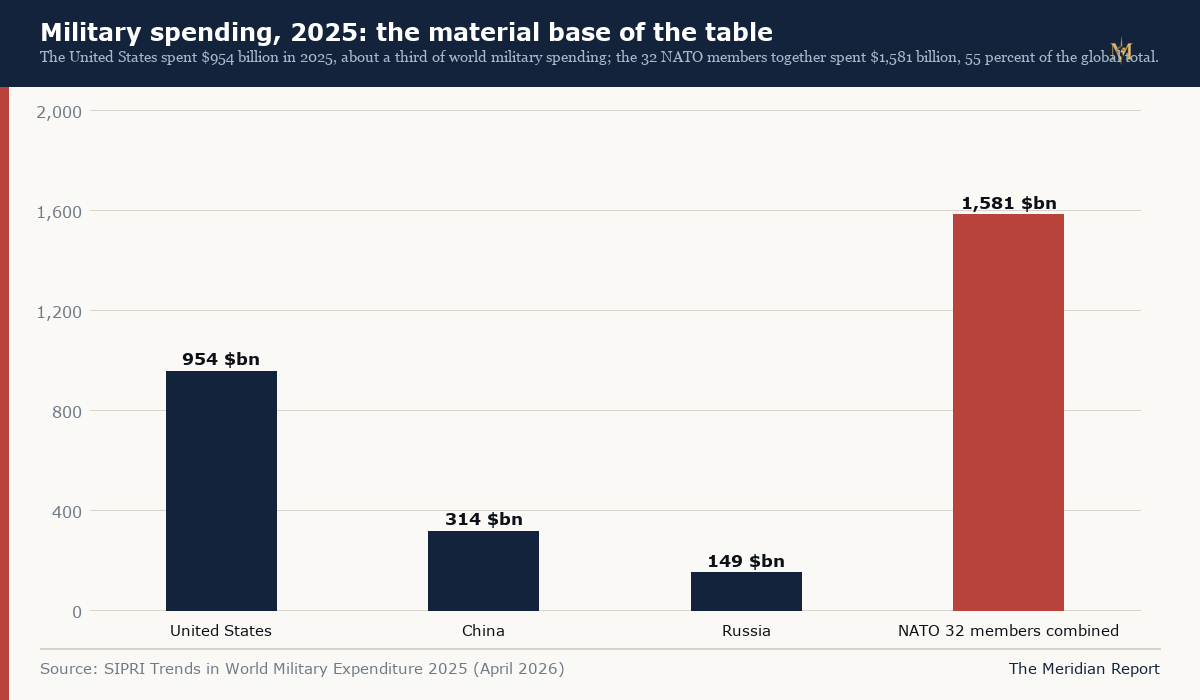
Begin with the hard numbers. The United States spent $954 billion on its military in 2025, according to the Stockholm International Peace Research Institute's April 2026 assessment, roughly a third of world military expenditure and more than the next nine countries combined. The 32 NATO members together spent $1,581 billion, 55 percent of the global total, and the alliance's European members remain, despite a decade of exhortation, dependent on American logistics, American intelligence, American nuclear signalling and the American defence industrial base. This is not a claim that the alliance is hollow. It is a claim about the shape of dependence: Europe's security architecture runs through Washington, and the man in Washington knows it.
The economic dependencies are as large. The European Union's single market exports roughly $600 billion a year to the United States, and the American market remains the destination for which the continent's export industries are tooled. In July 2025, threatened with a 30 percent tariff, the Union negotiated a settlement that accepted a 15 percent tariff on most exports, a rate five times the pre Trump average, and its member governments defended the deal as the least bad outcome. The 15 percent became the reference for every subsequent negotiation, including this summer's transatlantic technology files. The Union's own commission assessed, in internal analyses reported across the European press, that a trade war was unwinnable in the timeframe that mattered politically. Whatever one thinks of the judgment, the arithmetic behind it is real.
The technological chokepoints are smaller numbers with larger effects. The advanced semiconductor supply chain runs through American export control jurisdiction, as China's rare earth countermeasures and this week's summit demonstrated in both directions: Washington's chip rules against Beijing did not come up in the readouts, because both governments prefer the settled deterrence of mutual leverage to the discovery of whose constraint binds first. The dollar's share of global reserves, the clearing system, the extraterritorial reach of American sanctions: each is a structural fact that turns any American administration into the counterparty with the exit option, and turns every other government into the one that must calculate what saying no costs.
The cultural layer is the newest and the least quantified, but the evidence of the past two years is consistent. American platforms set the terms of political communication on every continent; American entertainment, athletic leagues and technology brands carry the flag into every living room; and the specific products of American political culture, from MAGA's aesthetic to the podcast circuit that now hosts ministers and prime ministers, are exported and imitated. When the president says America is the hottest country in the world, he is not only flattering his base. He is describing a soft power position that no other government's propaganda can replicate, and the audience data, American content's global share, supports him.
Stack the layers and the behaviour becomes legible as a rational strategy performed inside a genuine asymmetry. The display says what the structure already is. Other governments can see that the shove is a description of the balance sheet, and their response options are correspondingly narrow: protest and be filmed losing, or absorb and negotiate the substance. They absorb. The substance underneath, tariff rates, force postures, technology rules, base access, is where the real contests happen, and it is contested hard, in documents rather than in photographs. The quiet at the photo opportunity is the sound of the contest having moved somewhere with cameras banned.
Why they are quiet: the accommodation manual, reconstructed
The quiet of other capitals is the report's central question, because it is the popular theory's central grievance. The answer the record supports is that the quiet is a learned strategy with a visible instruction set, adopted independently by every major American partner, and its results are in.
The clearest exhibit is the North Atlantic alliance's behaviour across 2025 and 2026. The Hague summit of June 2025 was designed, by its secretary general's own account, to give the president a personal victory: the allies committed to 5 percent of GDP in defence spending, a number the secretary general celebrated in a message to the president that he signed off, in his own words, as Daddy. The message leaked, the summit held, the allies got what they had come for, which was the continuation of American security guarantees through a summit that might have become a crisis, and the president got the number, the photo and the tribute. The Guardian's live coverage captured the trade without editorialising, because no editorial was needed: the Europeans had decided that a bit of theatre was the price of the roof.
The G7 in Canada three weeks later ran the same protocol. Prime Minister Carney, a former central banker with no instinct for flattery, co hosted the summit around the single day the president was willing to attend, gave him the early bilateral slot that anchors every other meeting, and closed the summit with agreements on the files the members could settle without him. Politico's coverage noted the design explicitly: the summit's success was measured by the absence of surprise. The Kananaskis model became the template, and Evian in 2026 executed it: a late arriving president, an early bilateral, a boss line that the chair laughed at, and a communique on Russia sanctions that the members needed more than the theatre cost them.
The bilateral accommodations follow the same logic with local variations. Pakistan's field marshal, having consolidated power, flew to Washington in June 2025 and formally nominated the president for the Nobel Peace Prize, and the dividend arrived quickly: a trade deal, a crypto partnership for the family's ventures, and American cover in the India crisis that followed. Saudi Arabia's crown prince came to Washington in November 2025 and left with the defence pact and the major non NATO ally designation he had sought for years, having arranged a state visit of flawless ceremony. The Gulf money trail into the president's family businesses, which reporting across 2025 and 2026 has documented in the billions, is the purest form of the accommodation: the tribute is financial, direct and unhidden. The Qatari offer of a luxury aircraft for presidential use, reported by ABC News in May 2025 and accepted through the Justice Department, drew public criticism and changed nothing, because the criticism had no enforcement mechanism behind it.
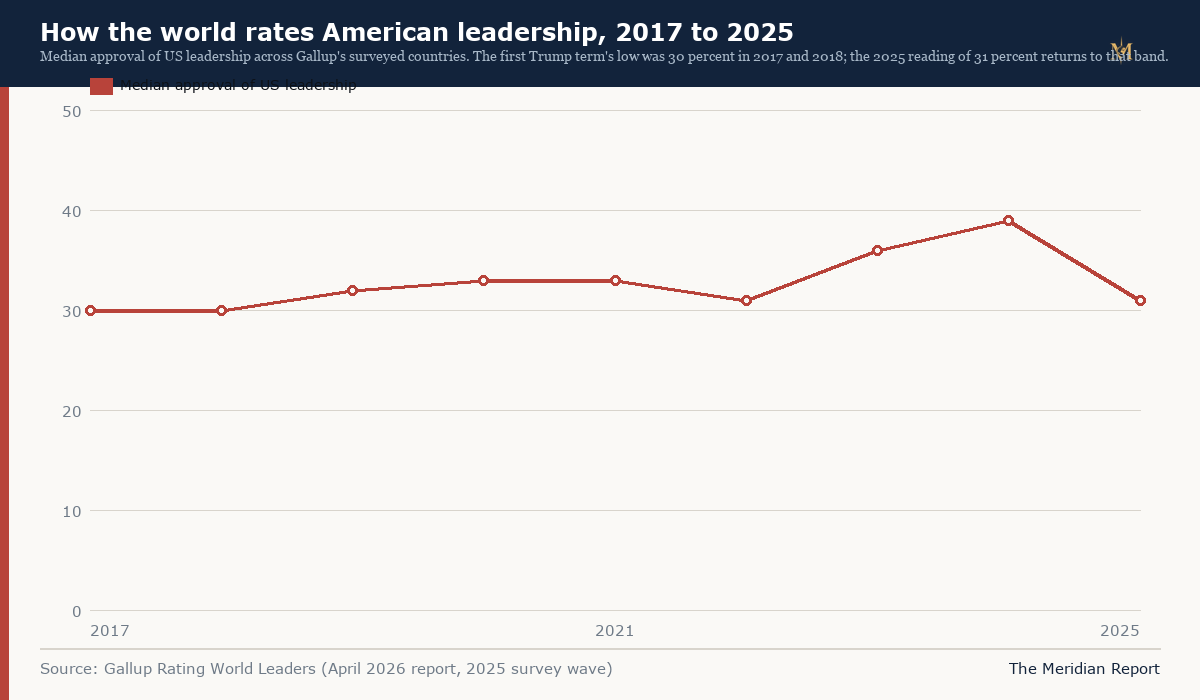
The European Union's file is the largest, because its dependencies are the deepest. The Union's strategy across the second term has been visible in sequence: absorb the tariff shock, settle at 15 percent, rearm through the ReArm programme and the 5 percent commitment, diversify where possible, and keep every channel to Washington open. The strategy's results are mixed by any honest audit: the continent is spending more on defence than at any time since the Cold War, its trade terms are worse, its regulatory autonomy is under direct American pressure, and its internal cohesion has held better than Washington expected. Its leaders' public tone toward the president has been uniformly warm, from von der Leyen's courtly golf diplomacy to the summit choreographies, and the gap between that tone and world opinion, where Gallup's 2025 survey measured median approval of American leadership at 31 percent overall and 21 percent within NATO countries, and Pew's 36 country study this June found falling confidence in the president personally, is the widest the transatlantic relationship has recorded. The governments know the gap exists. They have calculated, correctly in their own judgment, that their publics' disdain is not a policy instrument.
The manual's underlying premise deserves stating in the analysts' own words, because it is the strongest answer to the popular theory. The premise is that the behaviour is a constant, like weather, and that policy should be designed for the weather rather than against it. Every major capital now staffs for Trump the way it once staffed for earthquakes: scenario plans for the outburst, the late arrival, the insult, the tariff tweet; channels to the family and the court; flattery budgets calibrated to the principal's demonstrated appetites. The quiet is the output of these plans, not the absence of them. It is not that nobody resists. It is that resistance has been repositioned to where it is affordable, in arbitration filings, in retaliatory studies, in procurement decisions, in the slow construction of alternative architectures, rather than in the photograph where the shove happens.
The Netanyahu file: the same grammar, a smaller stage
The report's second subject presents a controlled experiment in the same mechanics performed under different structural conditions, which is what makes the comparison analytically useful rather than merely provocative.
Benjamin Netanyahu's display conduct is less photographed but as well documented, and its logic is identical: the public performance of superiority to the institutions that should constrain him. The record includes the longest running corruption trial in Israel's history, in which he personally testified across 98 hearings over eighteen months before concluding his testimony in June 2026, on charges of bribery, fraud and breach of trust in three cases that he denies and that allege, among other things, the trading of regulatory favours for favourable media coverage, the negotiated distortion of one of the country's largest news sites, and an electoral arrangement whose quid pro quo was positive coverage. It includes the decision to address a joint session of the United States Congress in the middle of a war, over the objection of the American administration hosting him, in July 2024. It includes the September 2025 strike on Doha, the capital of the state mediating the ceasefire Washington was proposing, conducted while the Hamas delegation was meeting to discuss the American proposal, which drew a public rebuke from Trump himself and which the Israeli prime minister defended within days as necessary, telling his own cabinet that Israel would strike its enemies wherever they are. It includes the September 2026 General Assembly address, delivered after the speeches of two dozen governments recognising Palestinian statehood, in which he told the hall their recognition was a bad investment, demanded that the UN building be cleaned of what he called its ugly and antisemitic presence, and threatened France, Canada and Australia by name with consequences for their recognition votes.
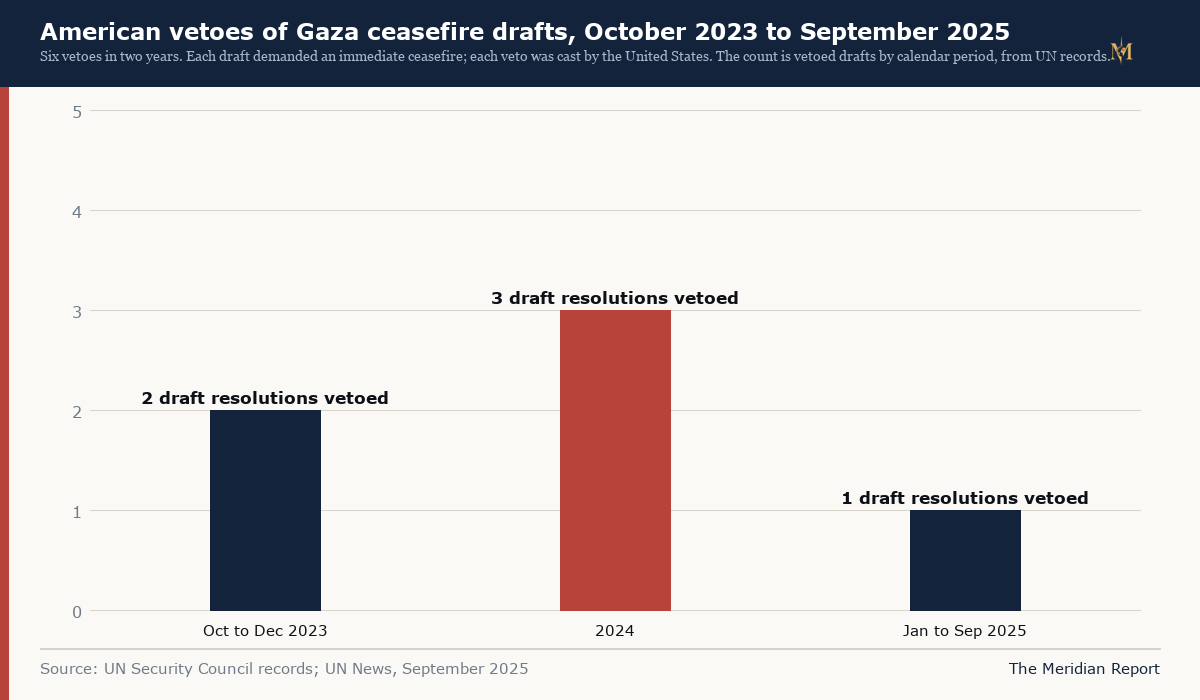
The structural protections that make this conduct affordable are different from Trump's but as concrete. The first is the American shield at the United Nations: since October 2023 the United States has vetoed six Security Council drafts demanding an immediate ceasefire in Gaza, most recently in September 2025, each veto foreclosing the one instrument, binding Council action, that could compel a change in Israeli policy. The second is the dismantling of the legal channel: after the International Criminal Court issued arrest warrants for Netanyahu and his former defence minister in November 2024, the president signed an executive order in February 2025 imposing sanctions on the court itself, and this month, in the days around the General Assembly, the administration prepared sweeping further sanctions, reported by Al Jazeera from Washington sources, aimed at the court's financing and operations. The third is the material pipeline: $3.8 billion a year in the standing memorandum of understanding, supplemented by wartime supplementals that Congress has passed in successive packages, plus the munitions transfers that no American administration has suspended. The fourth is domestic: an Israeli political system in which the governing coalition's discipline has held through two years of war, where the prime minister's Likud party and its allies have absorbed every scandal without defection, and where the October 2026 election the country now faces will test the coalition rather than the war's conduct.
The constituency mechanics also rhyme. Trump's court is the American right's media system; Netanyahu's is built on two pillars, the Israeli right's own ecosystem and a direct cultivation of the American conservative movement that has no precedent in Israeli history. The cultivation is documented at every stage: the Palm Beach meetings with right wing influencers in the autumn of 2025, photographed and posted by the participants; the private letter from Charlie Kirk, published in full by Newsweek, warning the prime minister months before Kirk's assassination that Israel was losing the American right's youth; the prime minister's response, a systematic programme of American tours, podcast appearances, pastor conferences and, according to Justice Department filings reported this September, a paid influencer operation called the Esther Project, funded through conduits and aimed at the exact audiences where the polling showed the erosion. His claim, at his 2025 UN appearance and in the American media appearances that followed, to be the most popular politician in America is unverifiable in any poll. It is also, in its audacity, the same speech act as the boss line: a assertion of centrality that the speaker's audience experiences as affirmation and everyone else experiences as provocation, and that the platforms reward identically in both directions.
The stage is smaller and the stakes are existential in a way Trump's are not. Trump's conduct defends a brand and a freedom of action; Netanyahu's defends a legacy and, his critics argue with documentation, a personal liberty, since a conviction in the trial that has now completed its testimony phase would carry prison, and the two exits his critics name, a pardon from Israel's president, which the president has said is not his to give, or an American intervention, remain speculative. The war's conduct, the Doha strike, the threats against allied governments by name from the UN podium, the defiance of the court, are all performed before the same audience that Trump's displays address, the base that rewards strength without apology, and against the same institutional backdrop that has learned to absorb them. The difference is that Netanyahu's institutions are more fragile: his coalition is his to lose, his trial is live, and his country's proportional system means the base that shields him is a plurality rather than a majority. The October 27 election is the experiment's next reading.
What the parallels teach: the anatomy of unaccountability
Set the two files side by side and the mechanism that produces both becomes visible. Neither man is behaving irrationally. Both are performing, with high skill, the optimal strategy available inside a structure that rewards what they do and does not punish what they have done. The structure has five components, and the two cases share all five.
Leverage comes first: a material position that makes confrontation expensive for the counterparties and cheap for the performer. Trump's is the United States' accumulated position, military, monetary, market and cultural. Netanyahu's is Israel's position inside the American system, the alliance, the pipeline, the veto, the domestic constituency in both countries.
Constituency is the second, an audience whose loyalty the display consolidates and for whom the display is the point. Trump's base reads dominance as restoration; Netanyahu's base reads defiance as survival. In both cases the display is not a lapse in front of the audience but a performance for it, and the international humiliation that neutral observers register as cost is registered by the audience as value.
Then there is institutional capture or preemption: the courts, legislatures and enforcement bodies that would normally price such behaviour have been either reshaped, as with the ICC sanctions and the American department of justice's transformation, or endured, as with the Israeli trial, whose completion of the testimony phase leaves a verdict that the political system will process politically.
The attention economy is the fourth, converting every transgression into distribution. The shove travels, the boss line travels, the bad investment line travels, and the travel is the reward, because distribution is the currency in which both men have always been paid.
And fifth is the accommodation of the counterparties, which converts what should be a cost into an income. Every government that absorbs the insult without consequence teaches the performer that the insult is free, and the record of 2025 to 2026, the summits, the tributes, the nominations, the gifts, the deals signed by leaders photographed smiling beside the man who shoved their colleague or threatened their recognition votes, is a curriculum in that lesson.
The five components explain why the behaviour persists, but they also explain something the popular theory misses: the behaviour is not the pathology. It is the symptom of the structure, and it will outlast any individual who perfects its performance. The boss line did not originate with Trump; it is what the American position sounds like when spoken aloud. The bad investment line did not originate with Netanyahu; it is what unconditional support sounds like when spoken aloud. The men are accurate readers of their own leverage, performing the structure in public, and the structure is the thing to watch.
Where it breaks: the real constraints the record already shows
A report on two men's impunity owes its readers the other finding, the one that emerges from the same research: the impunity has edges, and the edges are visible in the record now.
The American edges are three. The first is the calendar: the midterms of 3 November are six weeks away, and every analysis of the second term's foreign policy, including this week's verification of the UN address, identifies the election as the variable every counterpart is pricing. The congress that can investigate, subpoena and refuse appropriations is the one institution whose capture is incomplete, and its majority's composition is the largest single uncertainty in the system. The second is the bond market, whose verdicts arrive without cameras: the August 2025 firing of the statistics agency's head drew exactly the institutional pushback the analytics predicted, from the market's repricing of American data credibility, and the second term's fiscal expansion, now running deficits above six percent of output, is the lever that eventually moves the dollar and the yields that no display can override. The third is allied drift: Greenland's ratification process in the Danish parliament, the European enforcement actions now appearing in trade arbitrations, and the quiet diversification of reserves, payment systems and technology sourcing that Gallup's approval numbers understate. The drift does not confront the boss. It merely reduces, year by year, the share of the world that has no choice.
The Israeli edges are sharper and closer. The election of 27 October is a direct reading of the constituency: current polling shows a fragmented Knesset in which the governing bloc's majority is uncertain, and the prime minister's personal standing is the bloc's largest single question. The completed testimony phase of the trial leaves the verdict as a live legal fact in a system whose courts have demonstrated independence across decades. And the international position, while still shielded, has narrowed: the recognitions wave that the UN address attacked is now the position of most of the democratic world, the sanctions on the court are the behaviour of one government, and the American public's own division on the war, measurable in every poll this year, makes the shield a coalition asset that a future administration could convert. None of these edges guarantees anything. All of them are visible in the record, and all of them are reasons the performance continues: the display is what a man does when the structure protects him, and it intensifies when the structure begins to tilt.
The limits of the record
The limits of the evidence are wide here, and they belong in the open. No public evidence establishes what either man believes about himself; the psychological interpretations, confident man versus insecure man, strategist versus egoist, are the possession of their authors, and this report has attributed rather than adopted them. No public evidence establishes the private conversations in which other leaders' acquiescence is negotiated; the accommodation manual reconstructed here is inferred from public outcomes, documented deals and leaders' own public statements, and its internal workings are known only to the participants. No public evidence establishes the motives behind the Doha strike, the dictation of the Evian entrance, or the funding paths of every operation named; where filings and reporting establish the existence of a programme, the report says so, and where only inference is available, the report marks it. The verdict in the Jerusalem trial has not been delivered. The October elections have not been held. This report describes a structure as the record shows it in September 2026, and it will be revised as the record moves.
Reading the whole series
The presidency and money is a four part investigation: the behaviour, the flows, the history, and the law. The other parts and their charts are collected at The presidency and money.