
The foreign emoluments clause is the constitution's first anti corruption rule and its most absolute sentence. No person holding any office of profit or trust under the United States shall, without the consent of Congress, accept of any present, emolument, office or title of any kind whatever from any king, prince or foreign state. The delegates wrote it after the Continental Congress's years of watching foreign ambassadors distribute honours and cash to American officials, and the framers debated it more intensely than any other clause in Article I, section 9. Its language is total: any present, of any kind whatever, from any foreign state. It names no threshold below which acceptance becomes lawful, exempts no office, and offers no defence of good intentions. A delegate who wanted to accept a diamond snuff box from the king of France needed Congress's permission first, and in 1790 the first Congress granted it, for gifts the French minister presented to treaty negotiators.
Two and a half centuries later, the United States government has accepted a Boeing 747-8 from Qatar's ruling family, announced 11 to 14 May 2025, and a state backed Abu Dhabi fund has settled a $2 billion investment using the president family's own stablecoin, and the clause has been applied to neither, because in its entire history no court has ever enforced it against anyone. This explainer is about that gap: what the text requires, why the courts have never said, and the four paths by which the jet and the crypto flows could still meet a verdict.
The text, precisely
Three words in the clause carry the entire modern controversy, and each is a battlefield.
The first is present. The clause reaches presents, emoluments, offices and titles, and the emoluments litigation of the first term turned the first word into a distinct category: a present is a gift, something transferred for nothing or for less than value. The jet's defenders argue that an aircraft converted into a state aircraft is a gift to the United States, not a present to an officer; its critics argue that the distinction between the state and the officer is exactly what the clause polices, and that a gift structured by the recipient's own administration cannot bootstrap its way out of the text. CRS's report on the litigation records the government's narrower position, that emoluments, the clause's second key word, means things arising from an office rather than anything of value, and that arm's length transactions fall outside.
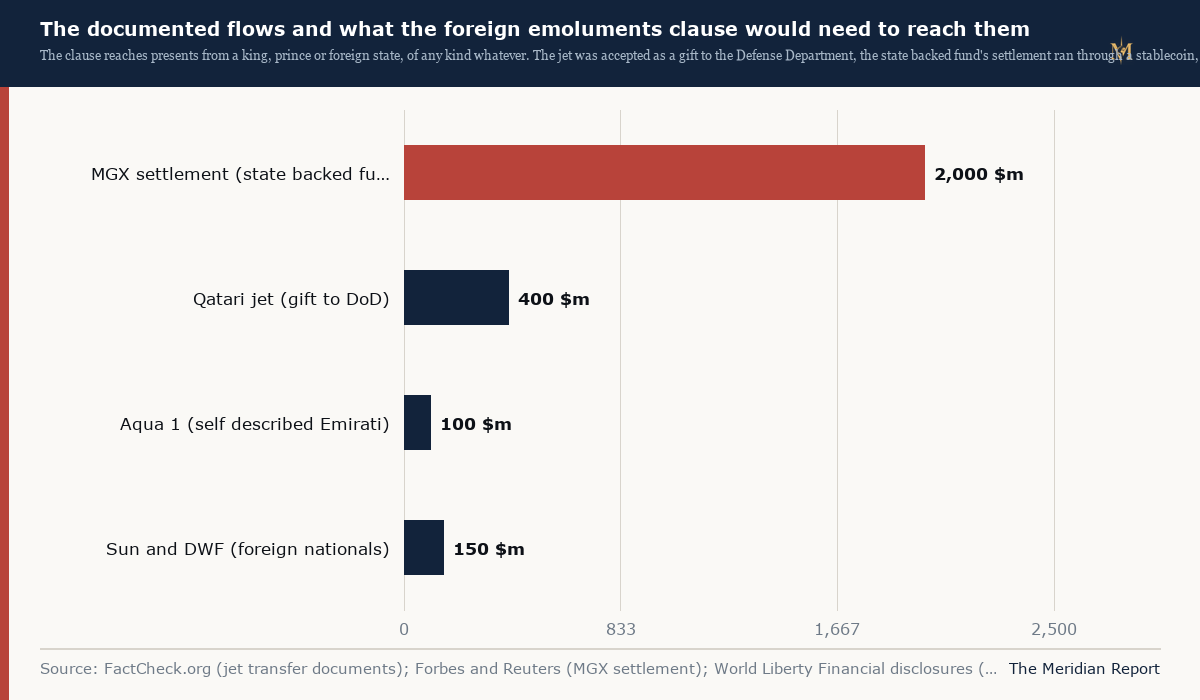
The second word is emolument. The interpretive war is between the broad reading, anything of value, the reading adopted by the Office of Legal Counsel in every published opinion of the modern era and by the plaintiffs in all three first term suits, and the narrow reading, profit arising from an office, the reading advanced by the defendants and by scholars like Seth Barrett Tillman. The Fourth Circuit's en banc panel reviewed the founding era sources without deciding, and no court has ever adopted one reading as binding law. The practical stakes are visible in the flow chart below: under the broad reading, a discounted hotel room, a favourable settlement fee or a stablecoin reserve return is an emolument; under the narrow reading, none of them obviously is.
The third word is the one no headline ever mentions: under. The clause binds any person holding any office of profit or trust under the United States, and a generation of scholarship, most prominently Jennifer Mascott's, argues the phrase reaches every federal employee from the president down. The presidency's inclusion was assumed in the first term's litigation by both sides and has never been the hard question. The hard questions are standing and cause.
The two clauses, and the one that is never mentioned
The constitution contains two emoluments clauses, and the second is the quieter scandal. The foreign clause, Article I, section 9, clause 8, is the one the jet tested. The domestic clause, Article II, section 1, clause 7, is the one the crypto revenues test. It prohibits the president from receiving any other emolument from the United States or any of them beyond his fixed salary, "any of them" meaning the states, and its purpose was to prevent the chief magistrate from being paid by any government other than his salary, a rule the framers thought essential after the states' treatment of revolutionary era commanders. The clause has no modern enforcement history at all, and the second term's flows raise its question directly: the president's businesses collect revenue from domestic transactions whose pricing the presidency inflates, and the filings document the scale. No suit has ever tested whether a president's business revenues from private parties count, because the clause's most natural reading reaches government payments, and the private party gap is where the modern controversy actually lives.
The enforcement void, demonstrated
The clause's weakness is not interpretive but structural: no court has ever applied it, and the first term's three suits demonstrated why.
CREW sued in January 2017, alleging that the president's businesses were receiving presents and emoluments from foreign governments through the Washington hotel and related properties. The administration's defence won on a technicality with a century of history: Article III standing and the absence of a cause of action. The district court had allowed the suit to proceed, but the theory that any citizen could sue to enforce a constitutional prohibition, without a statute authorising the suit, ran into a doctrine that requires Congress to create such suits or the courts to find them in the constitution's history, and neither existed. The case ended, like all the others, in mootness after the term.
The states' suit, brought by Maryland and the District of Columbia over the Washington hotel's competition with local venues, got the furthest. The district court allowed it; the Fourth Circuit, sitting en banc, ruled 9 to 3 against the states' standing in July 2019, holding that the competitive injury to hotels was not traceable to the clause's violation and that the states' quasi sovereign interest was too abstract. On 25 January 2021, the Supreme Court vacated the lower rulings and dismissed the case as moot because the term had ended. The Fourth Circuit's standing analysis is the modern law of the clause, and it is a dead end for the states' theory.
The legislators' suit, Blumenthal v Trump, produced the cleanest rule. 216 members of Congress claimed that the clause made them the gatekeepers whose consent was being usurped. The district court agreed that they had standing. On 7 February 2020, the D.C. Circuit, sitting en banc, held that the members lacked standing: their alleged injury, the deprivation of a constitutionally assigned power to consent or withhold consent, was an institutional injury shared by the chamber, not a personal one, and the chambers' political remedies, subpoenas, appropriations, the power of the purse, were available. The en banc decision, 949 F.3d 14, is the ruling the modern law of standing rests on, and it remains good law per Cornell's Constitutional Annotated. The Supreme Court declined to hear the appeal that October.
The scoreboard after four years and three suits: no merits ruling on the clause's meaning, ever. The two structural findings, no citizen cause of action, no legislator standing, are the reason a $400 million aircraft can be accepted, and a $2 billion settlement can run through a family stablecoin, without a single judge ever being asked to say whether the clause permits them. The void is not a theory. It is the documented history of the clause's litigation.
The jet: the clause's hardest case
The Boeing 747-8 enters this landscape as the clause's hardest case, and the analysis runs in both directions with real force.
The argument that the clause does not reach it is ownership and purpose. The transfer documents, obtained by FactCheck.org through litigation, establish that the jet was accepted as a gift to the Department of Defense, a gift to the United States, for conversion into an interim presidential aircraft, with refitting costs borne by the Air Force. Under the framers' concern, foreign influence over American officers, a state owned aircraft operated by the United States government as a state asset is a gift to the state, not a present to an officer, and the clause's text, which prohibits presents to a person holding office, does not on its face prohibit gifts to the government. The government's own position, that the jet is a state asset whose use by the president is incidental to his office, is coherent with the narrow reading of emolument.
The argument that the clause reaches it is the framing itself. The clause polices the donor's attempt to influence, and the donor's purpose here was explicit: the gift was offered in the month the president's family company signed its largest Gulf development deal, and its acceptance was structured by the recipient's own administration to fit the clause, which is the act the clause was written to prevent an officer from undertaking. The critics' reading, that the jet's value, use, symbolism and post term disposition all centre on one officer, is the broad reading of the clause applied to the facts, and the White House's own refusal to state the aircraft's post term destination keeps the question open. The Foreign Gifts and Donations Act's machinery, under which federal employees may keep nothing above the $525 minimal value, exists precisely to prevent officers from accepting things of value, and the jet's acceptance under a theory that the government itself, not the employee, is the recipient, is the legal structure the critics say the statute forbids in spirit and the clause forbids in text. No court has ruled, and the transfer's architecture was built in full awareness that none likely would.
The crypto flows: the clause's hole
The stablecoin settlement and the token purchases present the opposite problem: not a hard case but a hole in the clause's text. The clause reaches presents from a king, prince or foreign state. The buyers in the documented ledger are a state backed fund, a self described foundation, and two foreign nationals, and the clause's text does not reach any of them as written except possibly the first.
MGX is the live question. The fund is chaired by a national security adviser to the UAE president, holds a state mandate, and describes itself as state backed. If a court treated MGX as an instrument of the Emirati state, its $2 billion settlement through the president family's stablecoin would be a thing of value from a foreign state, and the questions become factual: what the reserves backing the coins earned for the family vehicle, and whether the settlement's selection of the family's product was arm's length. The government's answer is that the clause's emolument means something arising from an office, that a commercial settlement at market terms is not one, and that the fund's state connections do not convert a business transaction into a present. The distinction is the narrow reading again, and the CRS report on the litigation records that the arm's length defence was the government's core position in the first term's cases and was never tested on the merits.
The private foreign buyers, Sun, DWF Labs and Aqua 1, sit outside the clause's text entirely, because they are not states. The clause's drafters, policing eighteenth century European courts, never contemplated foreign private money buying assets from the president's family, and the clause's text, written to reach the diplomacy of monarchies, does not reach the political economy of cryptofinance. This is the hole the second term's flows have demonstrated: the constitution's absolute rule has an exemption shaped exactly like a private buyer.
The four paths to a verdict
The gap between the clause's text and its enforcement can be closed by four mechanisms, and the record shows each in motion.
The first is statutory, and it is the closest to the problem. A cause of action statute, granting a defined class of plaintiffs the right to sue over clause violations with remedies of divestment and disgorgement, would supply the missing piece the first term's cases proved absent, and versions have been introduced in 2026 by House Judiciary Democrats alongside Senator Blumenthal's S.Res.807, which demands itemised disclosure of foreign payments to the president's ventures. Raskin's April 2026 resolutions, targeting the UAE entanglements by name, are the model: political documents with legal architecture. The obstacle is the arithmetic of the majority, and the record is unambiguous that none has advanced.
The second is doctrinal: a plaintiff with a competitive injury. The Blumenthal rule denied legislators' institutional standing but left the competitive plaintiff untouched, and the states' theory failed on traceability, not on the category of economic injury. A hotel operator, a venue owner or a competitor business injured by the presidency's own pricing, with damages traceable to a specific foreign payment, is the plaintiff the doctrine has always accepted in principle and never faced in practice. No such case has been reported in the second term, and its absence is itself a finding: the doctrine's plausible plaintiff has not yet been produced.
The third is political: the consent mechanism the clause itself provides. The clause does not prohibit foreign presents; it prohibits them without congressional consent, and a Congress that wished to could hold recorded votes on each foreign payment to the president's ventures, forcing every member to go on the record. The 2026 resolutions gesture at this, and the mechanism's power is that it requires no court at all. Its limit is the same majority arithmetic, and the fact that the clause's own remedy depends on the branch the clause was designed to protect from the executive.
The fourth is unknown, and honesty requires saying so. The clause has survived two and a half centuries without a merits ruling because every case has died on procedure, and the case that finally reaches the merits may come from nowhere, a state attorney general with a novel theory of standing, a bankruptcy trustee untangling a failed venture, a future administration's own Justice Department defending or abandoning the arm's length defence. The jet's disposition after the term, still officially undecided, and the token ventures' eventual accounting are the two live triggers the record names. Until one of them matures, the most absolute sentence in the constitution remains what it has always been: a standard without a court.
What this explainer cannot say
The law's honest answer to the headline question is that nobody knows. No court has held that the jet violates the clause, and no court has held that it does not; the same is true of the stablecoin settlement and every other flow in the documented ledger. What the record establishes is the text's absolute language, the interpretive war's stakes, the litigation's structural findings, and the government's own defensive architecture, the gift to the state framing, the arm's length defence, the mootness that ended the only cases that reached appeal. The distinction between a violation and an unenforced violation is the entire history of this clause, and this explainer has kept it: the flows are documented, the text is absolute, the enforcement is absent, and the four paths by which the absence could end are in motion, with none yet arrived.
Reading the whole series
The presidency and money is a four part investigation: the behaviour, the flows, the history, and the law. The other parts and their charts are collected at The presidency and money.