
For fifty years the American presidency came with a working answer to the question of the president's wallet. The series' previous article reconstructed that answer, era by era, and the question its ending poses is the one that follows: if the constitution's oldest anti corruption rule has never been enforced by a court, who could enforce it? The honest answer is that nobody has ever managed it, and the reason is not that the clause is unclear. It is that the courtroom door has been the obstacle, and the door is governed by a doctrine that is knowable in advance.
What follows is written for the reader who wants to understand how such a case would actually be built. It is not legal advice and it predicts nothing. It works through the doctrine as the courts have applied it, uses the first term's litigation as the only real world evidence anyone has, and marks clearly where the doctrine's demands are documented and where a plaintiff would be constructing an argument the courts have never accepted or rejected.
The three elements every plaintiff must satisfy
Article III limits the judicial power to actual cases and controversies, and the Supreme Court's standing doctrine, consolidated in Lujan v Defenders of Wildlife, 504 U.S. 555 (1992), reduces the requirement to three elements. The plaintiff must have suffered an injury in fact, meaning a concrete and particularised and actual or imminent invasion of a legally protected interest. The injury must be fairly traceable to the challenged conduct. And a favourable decision must be likely to redress it. Each element is independent, and a failure at any one ends the case.
The doctrine's character matters for everything that follows. It is plaintiff specific and fact intensive. It is policed at the pleading stage, where a complaint can be dismissed before any evidence is heard. And it has grown more demanding over the modern era: the same Court that recognised competitor standing in principle has spent three decades narrowing who gets through. The emoluments litigation of the first term is the best documented demonstration of how the squeeze works in this exact setting.
The competitor rule: Hunt and what it does and does not promise
The most promising doctrinal foundation for an emoluments plaintiff was laid in an apple dispute. In Hunt v Washington State Apple Advertising Commission, 432 U.S. 333 (1977), the Supreme Court held that a state commission representing apple growers had standing to challenge a North Carolina grading law that stripped the Washington industry of competitive advantages it had earned through expensive inspection programmes. The Court accepted that a market participant can be injured where a law redistributes competitive advantage within a defined market, and that such injury is judicially cognisable without waiting for proof of insolvency.
Hunt's promise is real. It means American law recognises competitive injury as a concrete injury in fact in the right configuration, and the first term's CREW litigation proved the point in an adjacent setting. Hunt's limits are equally real, and they are the limits a modern plaintiff would have to engineer around. The Washington commission's injury was traceable to a state statute, a causal chain with one link. An emoluments claim's causal chain runs from a foreign payment, through an official's business, through a market, to a competitor's revenue, and the doctrine's requirement of fair traceability has been fatal to chains the Court found far less speculative than that one. Clapper v Amnesty International, 568 U.S. 398 (2013), is the leading authority: a plaintiff cannot build standing on a speculative chain of inferences, each link reasonable in isolation, the chain improbable as a whole.
What the first term's plaintiffs actually established
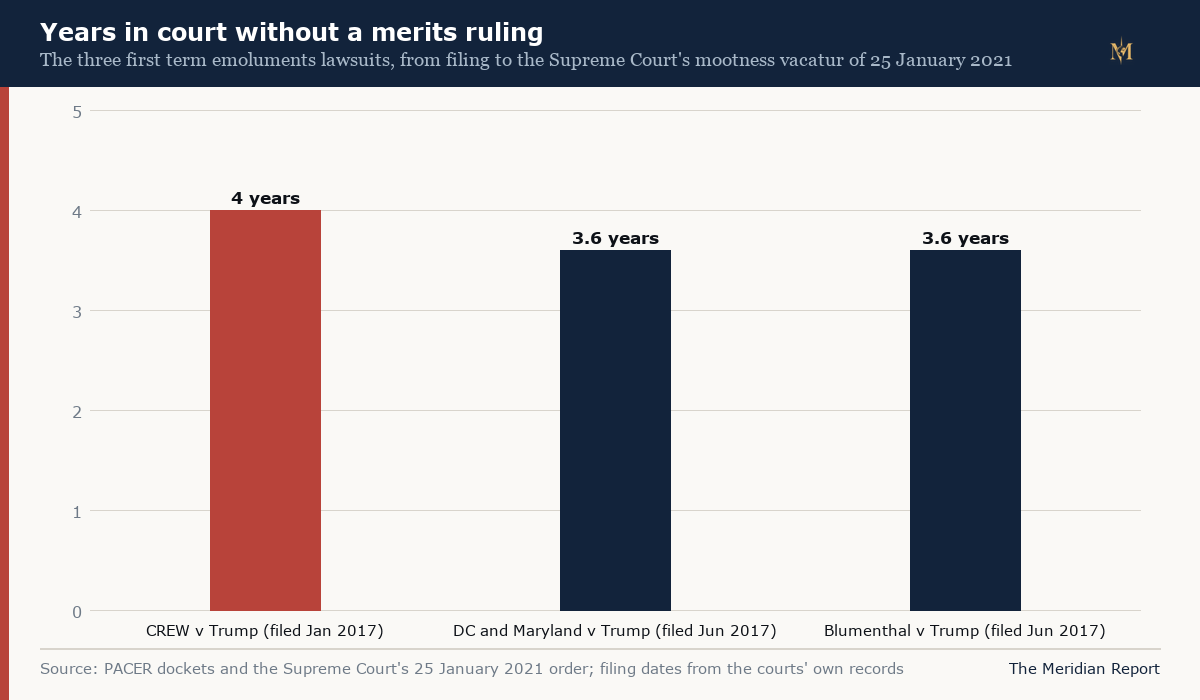
Three emoluments lawsuits were filed against the first Trump presidency, and none reached a verdict. The procedural record they left is the only empirical evidence anyone has about how the doctrine treats this setting, and it rewards precise reconstruction.
CREW v Trump, filed in January 2017, carried the most plaintiff appropriate construction anyone has yet attempted. Alongside the watchdog group itself, the complaint named restaurant and hotel operators, a banquet company, an events booker and a shareholders group, on the theory that the president's Washington hotel competed directly with their businesses for events, galas and bookings. Judge George Daniels dismissed the case in December 2017 on standing and related grounds. On appeal, a Second Circuit panel held in September 2019 that the hospitality plaintiffs had adequately alleged standing: their hotel competition allegations, if true, established concrete competitive injury. CREW v Trump, 953 F.3d 178. The same panel went on to hold that the emoluments clauses create no private right of action, an alternative holding that would have ended the case on remand. The Supreme Court granted review, then vacated the judgment as moot on 25 January 2021 when the term ended, so the reasoning survives as the most detailed judicial treatment of the competitor theory while the judgment itself no longer stands as binding law.
The states' case, District of Columbia v Trump, was brought by the District of Columbia and Maryland as quasi sovereign plaintiffs, alleging harm to their economies and tax bases from the president's DC hotel and from foreign governments' patronage of it. Judge Messitte's March 2018 standing opinion allowed the case past the threshold, and discovery proceeded further than in any other emoluments suit. The Fourth Circuit's initial panel ordered dismissal in July 2019; the full en banc court held in May 2020, 9 to 6, that the states lacked standing, 980 F.3d 381. The majority found the chain from a foreign payment to a state's tax receipts too remote. Six judges dissented at length, arguing the states had pleaded the most concrete quasi sovereign injuries the doctrine has confronted in this setting. The judgment was vacated as moot in January 2021.
Blumenthal v Trump carried 216 members of Congress. The D.C. Circuit en banc held in September 2020 that legislators lack standing to sue over injuries shared by all members equally, 949 F.3d 14, and that holding remains good law today because it was never vacated. A congressman's vote against a certification, the court suggested, might be a different story, but no such case has been brought.
The scoreboard, stated exactly: competitors survived standing once at the appellate level but lost on cause of action in the same opinion. States lost standing 9 to 6. Legislators lost standing en banc, permanently. Nobody ever reached a merits ruling, because the Supreme Court erased the first two cases as moot before review and the third was never granted. The doctrine's door has never been opened all the way, and it has never been locked all the way either.
What a plaintiff would actually need to show
Built on that record, a competitive plaintiff would need to satisfy each element with the specificity the first term's complaints approached and, at the decisive moments, missed. Five requirements emerge from the documented record.
The first element is a realised injury, not a projection. The complaints that survived pleaded lost bookings, lost events and displaced demand in specific terms. The strongest version would document particular functions that chose another venue, with contemporaneous records, in the period when the flows in question were moving. Projected future losses invite the Clapper objection; realised losses answer it. This is why a plaintiff with a bookings ledger is stronger than a plaintiff with an economist's model, and why the injury should already have occurred before filing rather than being forecast.
The second is a market defined twice. The competitor theory lives or dies on market definition, and the record shows courts accepting it when the market is drawn narrowly. A plaintiff competing for the same events, in the same city, at the same price points, during the same period, presents a direct competition story a court can verify. A plaintiff in the same industry generally presents a remote one. The market definition must also be temporally bounded: competition during the years the flows moved, not competition in the abstract. Both circuits saw complaints that drew the map carefully; the ones that survived standing drew it most carefully of all.
The third is a causal story that runs through the official, not the office. This is the emoluments setting's unique difficulty. A competitor harmed because the presidency attracts patronage has a claim against popularity; the clause reaches harm produced by the official's acceptance of the flows. The plaintiff's discovery target is the linkage: which governments paid, into which ventures, and what that patronage did to prices, capacity and bookings in the defined market. The first term's plaintiffs sought exactly this discovery, and the en banc Fourth Circuit's holding shows what happens without it: the chain is deemed remote at the pleading stage. A modern plaintiff would need to plead the linkage with documents in hand where possible, which the current venture disclosures make more feasible than it was in 2017, when the flows had to be inferred.
The fourth is membership in the zone of interests. Lexmark International v Static Control Components, 572 U.S. 118 (2014), requires that a plaintiff fall within the class of parties the provision protects. Both circuits to engage the question treated it as a serious obstacle for emoluments plaintiffs. The Second Circuit assumed, without deciding, that economic competitors fall within the clauses' zone; the Fourth Circuit never reached it. The text gives no obvious answer: the clause runs in favour of the United States, enforced through Congress's consent power, and says nothing about competitors. A modern complaint would have to brief this question first and most carefully, because it is the one the Supreme Court flagged in granting review in the CREW case before mootness intervened.
The fifth is redressability without a cause of action. The final element requires that the relief requested, an injunction against further acceptance, would likely redress the injury. That element is analytically distinct from the cause of action problem, but they meet in practice: the Second Circuit's 2019 holding means even a plaintiff with perfect standing needs a source of law to enforce. Congress could supply one by statute, as it has for analogous anti corruption provisions. The resolutions before Congress proposing exactly that are the reason the cause of action question may not stay open much longer. Without one, a plaintiff must persuade a court to imply what the Second Circuit declined to imply, and the Supreme Court's signal in granting review suggests the question interested it.
Why nobody has built this plaintiff yet
The record suggests three honest answers to the obvious question of why the strongest configuration has never been assembled. First, timing: the first term's cases were built in the opening months of 2017, before any of the documentary record that now exists, and they were erased before the discovery that might have supplied the linkage could complete. Second, cost: a competition case against a sitting president means years of discovery against the executive branch and its private ventures, at a scale few hotels can fund and none can insure against. Third, the mooting power: any case filed against a sitting president can be extinguished by the end of a term, which means the plaintiff's counsel must expect to win and still see the judgment vacated. That structural feature, the Supreme Court's own mooting of the two strongest cases in January 2021, is itself part of the doctrine's practical architecture, and any honest assessment of the competitor route has to price it in.
Where the doctrine stops
The limits of what the doctrine can answer should be stated as carefully as its contents. No court has ever held that a competitive plaintiff can sue under the emoluments clauses; the Second Circuit's finding of standing was vacated and is not binding anywhere. No court has ever decided whether the clauses' zone of interests includes market competitors; the one court to address it assumed the point and moved on. And nothing here predicts how the current Court would rule on any element, because the composition that would decide a new case has never been asked. What the record establishes is narrower and more useful: the doctrine's requirements, the points at which each first term case actually failed, and the two questions, zone of interests and cause of action, that any future complaint must resolve first. The rest is construction, and the courts will say whether the construction holds.
Reading the whole series
The presidency and money is a four part investigation: the behaviour, the flows, the history, and the law. The doctrine above serves its fourth part; the sequence is collected at The presidency and money.