
Every emoluments lawsuit in American history has died before a judge addressed whether the clause was violated. The standing doctrine kept most plaintiffs out of court, and that wall has been covered elsewhere in this series. But standing was never the only locked door. Even the plaintiffs who got through it, the CREW competitors at the Second Circuit, the DC and Maryland attorneys general at the discovery stage, found the room beyond it empty: no statute to sue under, no implied right the courts would recognise, nothing for a judge to order even if every allegation were true. This is the cause of action problem, and it is the reason the aircraft's legality and the stablecoin settlement's legality are not merely unresolved questions but unlitigable ones. What follows dissects the wall and drafts what would have to be built through it. The model statute appears in full, and its character should be stated plainly at the outset: it is a drafting exercise, built on the vehicles Congress has already considered, not pending legislation and not legal advice.
Why the clause needs a statute at all
The foreign emoluments clause is a rule without a remedy. Article I, section 9, clause 8 directs that no federal official accept a foreign present or emolument without congressional consent, and it assigns enforcement to exactly one institution: Congress, whose consent is the licensing mechanism. Congress may consent, may refuse, may condition, may prohibit. What the text does not do is authorise anyone else to do anything. No agency is created, no penalty is specified, no court is addressed, no private right is granted.
The courts read that silence strictly. In CREW v Trump, 953 F.3d 178 (2d Cir. 2019), the Second Circuit held the clauses imply no private right of action, applying the modern presumption against judicial implication: since the 1970s the Supreme Court has treated legislative silence as legislative refusal, holding in Sosa v Alvarez Machain, 542 U.S. 692 (2004), that creating private rights of action is better left to legislative judgment. The Second Circuit's holding was never tested on the merits because mootness erased the case, but the reasoning is the modern mainstream, and it means the clause's enforcement runs, at present, through exactly one door: the consent power, used or unused by Congress.
The gap has a daily cost. A president can accept a $400 million aircraft, a state backed fund can settle $2 billion through the family stablecoin, foreign buyers can purchase hundreds of millions in tokens, and no prosecutor has a charge to file, no regulator a citation to issue, no plaintiff a count to plead. The clause says none of it is lawful without consent. The legal system offers no vehicle for that statement to be tested, because the one institution with the power to supply the vehicle has never done so.
What Congress has already tried, and what each vehicle lacks
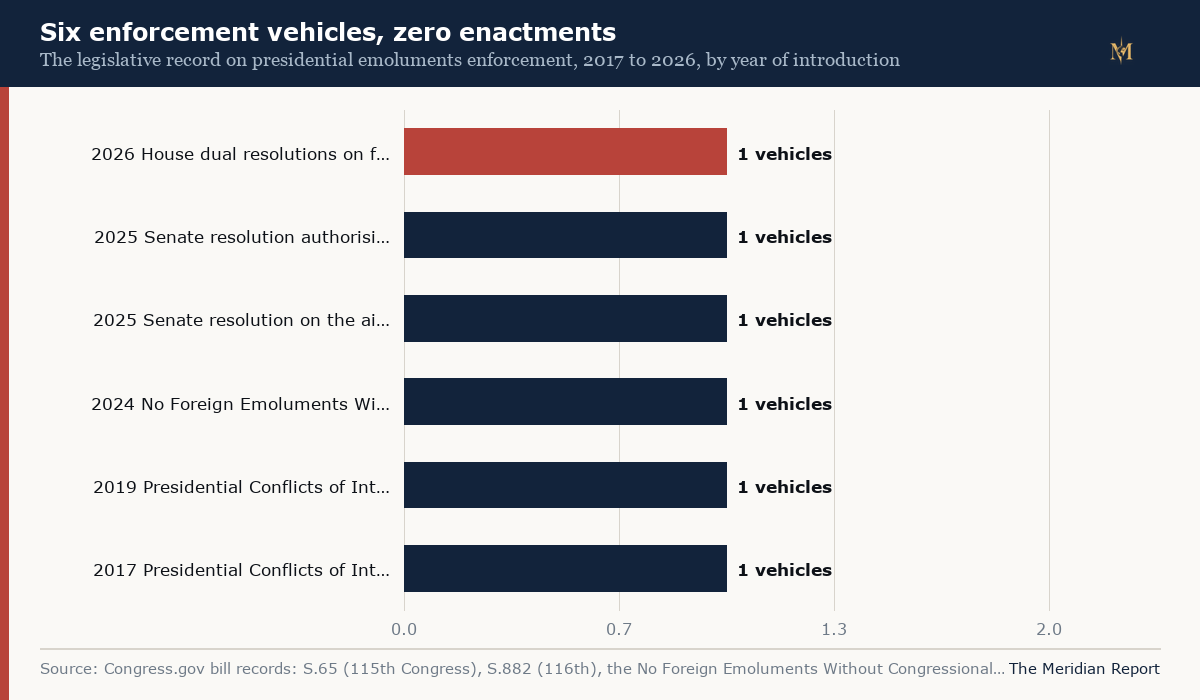
Congress has considered the problem six times across three Congresses, and the record shows two distinct architectures emerging.
The divestiture architecture came first. The Presidential Conflicts of Interest Act, S.65 in the 115th Congress and S.882 in the 116th, required the president and vice president to place conflicting assets in qualified blind trusts, mandated disclosure, and addressed recusal. What it did not contain was a cause of action or a consent regime for foreign payments. It assumed the ethics framework and left the constitution to the courts, which is precisely the seam the litigation fell through.
The consent architecture came second, and it is the closer fit to the clause. The No Foreign Emoluments Without Congressional Consent Act, introduced in May 2024 by Senator Blumenthal and Representative Raskin, required congressional consent before accepting foreign emoluments, with reporting duties to make the flows visible. Two Senate resolutions followed in May 2025: one declared that the clause's purpose renders the acceptance and transfer of a foreign state's aircraft unlawful without consent, putting the specific aircraft on the legislative record, and S.Res.219 took the institutional route, authorising the Senate Legal Counsel to bring a civil action in the Senate's name to enforce the foreign clause, importing the enforcement machinery Congress built for its own institutional defence in 1978. The April 2026 House resolutions returned to the demand for compliance without creating any enforcement vehicle at all.
The pattern across all six vehicles is the missing middle. The divestiture bills regulated without creating an enforcer. The consent bills created duties without creating a plaintiff. The Senate counsel resolution created a plaintiff without reaching the domestic clause or the private flows. No vehicle has combined consent machinery, an enforcement plaintiff, judicially cognisable definitions and remedies a court could actually order. That combination is what a statute would have to be.
The drafting problems any statute must solve
Four problems have to be solved before the text can be written, and each has an answer somewhere in current law.
The first problem is who sues, and the choices are an agency, the Congress itself, state attorneys general, or private plaintiffs. An agency model collides with the cabinet problem: the agencies report to the official being regulated, the structural flaw in relying on executive branch ethics enforcement against an executive. The congressional model exists in the Senate counsel resolution, and its limitation is institutional: it reaches only what a chamber chooses to litigate, at the pace of politics. State attorneys general hold real subpoena power and the strongest documented record against the company, as the states' article showed. Private plaintiffs, the competitors with realised injuries, survived standing once already. The drafting answer the record supports is layered: sovereign enforcement through an office that does not report to the president, plus a private right of action limited to plaintiffs who can already meet Article III's demands, so the statute adds a cause of action without pretending to relax the constitution's own standing floor, the line TransUnion LLC v Ramirez, 594 U.S. 413 (2021), drew when it held Congress can create rights but cannot conjure plaintiffs out of thin air.
The definitions section decides everything, so the second problem is what counts. The interpretive war over emolument, broad as anything of value versus narrow as profit from office, is documented in the series' fourth part, and a statute cannot be neutral about it, because the defendants' narrow reading is designed to exclude exactly the flows at issue: licensing fees, token sales, stablecoin settlements. A statute can sidestep the war by adopting the broad reading as its own and defining covered flows by reference to categories, gifts, payments, revenue shares, asset transfers and affiliated entity transactions, rather than by the contested constitutional term alone. Whether such a statute can reach back to the constitutional clause's own scope is a different question the courts would decide, but a statutory prohibition need not prove the constitutional violation to bite: the statute can make the disclosure and consent machinery mandatory for foreign governmental flows while the constitutional argument proceeds in parallel.
The relief problem is unique to the presidency, and it is the third problem: what a court can order. Injunctive relief against a sitting president's official acts runs into the separation of powers, and damages would come from where? The enforcement precedent points to declaratory judgments, mandatory divestiture timelines, consent requirements enforced by orders that a flow not be accepted, and referral provisions, remedies that operate on the flows rather than the officeholder's official conduct. The divestiture and recusal statutes governing ordinary executive branch employees, 18 U.S.C. 208 and 209, supply the mechanics, with the crucial caveat the CRS has documented: those statutes expressly or effectively carve the president out, which is the statutory hole any new law is filling.
The clause's own mechanism supplies the fourth problem, and a statute must decide its form: joint resolution, simple resolution, or silence as refusal. The historical practice is consent by joint resolution when Congress has granted it, and the drafting default matters enormously: a statute that treats silence as consent invites rubber stamping by inaction, while a statute that treats silence as refusal enforces the clause's own structure, under which acceptance without consent is the violation.
The model statute
What follows is the drafting exercise, in full, built on those precedents. It is proposed as analysis.
AN ACT to provide for the enforcement of the foreign emoluments clause of the constitution of the United States.
SECTION 1. SHORT TITLE. This Act may be cited as the Foreign Emoluments Enforcement Act.
SEC. 2. FINDINGS. Congress finds that article I, section 9, clause 8 of the constitution prohibits any person holding any office of profit or trust under the United States from accepting any present, emolument, office or title of any kind whatever from any king, prince or foreign state without the consent of Congress; that the clause assigns its enforcement to Congress through the consent mechanism; that Congress has never established a procedure for seeking or granting such consent, with the result that the prohibition is unenforceable in practice; and that the absence of enforcement burdens the states, the markets in which presidential ventures compete, and the integrity of federal procurement and foreign relations.
SEC. 3. DEFINITIONS. In this Act: (a) covered official means the president, the vice president, and any officer or employee as defined by section 2104 of title 5, United States Code, other than an individual commissioned officer of the armed forces serving in a military capacity. (b) foreign governmental source means any foreign state, its political subdivisions, any agency or instrumentality thereof, any sovereign wealth fund, and any entity majority owned or controlled by a foreign government. (c) covered flow means any gift, present, emolument, payment, revenue share, royalty, licensing fee, asset transfer, debt forgiveness, preferential transaction, or transaction with an affiliated entity, in money or in kind, direct or indirect, from a foreign governmental source to a covered official or to any entity in which a covered official holds a direct or indirect interest exceeding five per centum. (d) consent means an Act of Congress expressly consenting to a described covered flow, enacted after the disclosure required by section 4.
SEC. 4. DISCLOSURE AND CONSENT. (a) No covered official shall accept a covered flow unless Congress has enacted consent for it. (b) Silence and inaction are not consent. (c) Within 30 days of any offer of a covered flow, the covered official shall disclose the offer, its source, its terms and the entities involved to the Comptroller General and to both houses of Congress. (d) The Comptroller General shall publish each disclosure and each consent in the Federal Register.
SEC. 5. ENFORCEMENT. (a) The Comptroller General of the United States, acting through the General Counsel of the Government Accountability Office, may bring a civil action in the appropriate United States district court for declaratory judgment, mandamus, or such other equitable relief as the court finds proper, against any covered official who accepts or proposes to accept a covered flow without consent. (b) A civil action may also be brought by any state attorney general in the name of the state, and by any private person who alleges injury to a competitive or economic interest, provided that such person satisfies article III of the constitution. (c) A prevailing plaintiff shall recover costs and reasonable attorney fees.
SEC. 6. REMEDIES. In an action under section 5 the court may: (1) declare the acceptance or proposed acceptance void as to the covered flow; (2) order divestiture of the interest generating the flow within a period not less than 90 days, to a qualified blind trust meeting the requirements of the Ethics in Government Act of 1978 or to independent management; (3) order that the value of the flow be paid into the treasury; (4) enjoin the covered official from any official action affecting the source of the flow; and (5) order any further relief necessary to effectuate the purposes of the foreign emoluments clause. Nothing in this section authorises the criminal prosecution of a sitting president.
SEC. 7. REPORT TO CONGRESS. The Comptroller General shall report annually to Congress on all disclosures received, consents sought, consents granted, and enforcement actions, and on any covered flow the Comptroller General identifies that was not disclosed.
SEC. 8. SEVERABILITY AND CONSTRUCTION. If any provision of this Act is held invalid, the remainder shall continue in effect. Nothing in this Act shall be construed to limit the foreign emoluments clause's own force, and no remedy in this Act shall be construed as the exclusive remedy for conduct that also violates the constitution.
Five drafting choices in that text bear weight. The Comptroller General is the enforcer because the office sits outside the president's removal power, which is the structural fix for the cabinet problem; an ethics office inside the executive cannot police the executive's head. Silence as refusal in section 4(b) is the clause's own logic: acceptance without consent is the violation, so consent must be an affirmative act. The five per centum ownership threshold in the definition is borrowed from the disclosure thresholds in current ethics law, though its line drawing is the drafting choice most open to challenge, since a sophisticated counterparty can structure a flow through entities below any threshold, and the disclosure duty in section 4(c) is the backstop. The competitive or economic interest plaintiff in section 5(b) imports the standing doctrine unchanged rather than attempting to relax it, because TransUnion holds that Congress cannot conjure Article III injuries that do not exist, and the first term's record shows the competitors can clear the constitutional floor. And divestiture with a 90 day floor is the remedy the first term's litigation was always seeking: it operates on the flows, not the officeholder's official acts, which is the design that survives the separation of powers objections that killed injunctive theories in the first term's cases.
What the statute would and would not settle
The honest ledger. A statute of this shape would settle the enforcement vacuum: the flows would become disclosable, the consent question would become a matter of legislative record, and the aircraft's or the settlement's status would be litigable for the first time. It would not settle the interpretive war over the constitutional term emolument, because a statute's broad definitions bind statutory enforcement, not the constitutional question, and the Supreme Court would still have to decide what the clause itself reaches. It would not survive unchanged: any statute regulating the president heads to litigation on separation of powers grounds on the day of signature, and the divestiture and injunction provisions are the ones a court would test first. And it would not be passed under the current Congress, which is the fact that makes it a drafting exercise rather than a bill. What it shows is that the missing piece is not constitutional invention. Every element the emoluments clauses lack, an enforcer, a plaintiff, a procedure, a remedy, exists somewhere in current federal law, applied to some other problem. The statute is only the assembly, and the assembly has been waiting for a Congress that wants it.
The limits of the exercise
The model statute is analysis, not legislation, and its weaknesses are stated where they are known: the threshold in the definitions, the reach of statutory definitions into the constitutional question, and the separation of powers testing that any enforcement provision will face. Nothing here predicts legislative action, and the six vehicles' fate, none enacted across three Congresses, is itself the best available evidence of the political probability. What the piece establishes is narrower: the precise legal reason no emoluments case has ever been decided, the architectures Congress has already drafted, and the shape of the assembly that would close the gap. Whether any Congress chooses to close it is not a legal question at all.
Reading the whole series
The presidency and money is a four part investigation: the behaviour, the flows, the history, and the law. The enforcement questions raised across it conclude here. The series page is at The presidency and money. The doctrine guide is at How to build a plaintiff the emoluments clause cannot shake off, the states' article at The one-vote problem.