
Who, in practice, could force the emoluments question to a verdict? The previous article in the sequence took the private competitor route and found it doctrinally open but practically unclosed. There is one other class of plaintiff with a documented record in this exact litigation, and it nearly succeeded: the states. The District of Columbia and Maryland lost their standing argument by a single vote, 9 to 6, in the most consequential emoluments decision ever issued, and the dissent's reasoning has never been answered on the merits because the case was erased before it could be. The state angle, as the record presents it, is examined below: which governments hold the strongest positions, what the current ventures put within reach of state law, and what a standing theory built on both the old case and the new Court's own precedent would have to combine.
The doctrine that nearly worked
American law gives states a distinctive position in federal court. Under Snapp v United States, 453 U.S. 234 (1981), a state may sue as parens patriae, on behalf of its residents, where it alleges injury to a quasi sovereign interest: the health, welfare and economic wellbeing of its population. Massachusetts v EPA, 549 U.S. 497 (2007), added a dollop of flexibility for states claiming injury to their own territory and regulatory programmes, and its special solicitude language has been argued over ever since. The doctrine's permissive reputation among practitioners comes from the environmental era, when states used it to reach federal agencies that private plaintiffs could not.
The Fourth Circuit's en banc majority in District of Columbia v Trump, 980 F.3d 381 (2020), put the doctrine's limits on the record. The court accepted that the District and Maryland had pleaded real interests, in their economies, their tax bases and their hospitality markets. It found the causal chain fatal: from a foreign government's payment, through the president's business, to a state's tax receipts, was too remote under Article III's demands, and the vote was 9 to 6. The six judge dissent argued the injuries were the most concrete quasi sovereign claims the doctrine has ever confronted in this setting, and that the majority's remoteness holding made state standing nearly illusory wherever the defendant is the president himself. That dissent is the most developed judicial argument ever made for the states' side of this question, and it remains available to any future plaintiff.
Which states have the strongest claims
The strongest standing positions under existing doctrine belong to jurisdictions where the ventures themselves sit, because those are the states that can plead direct, proprietary injuries rather than derivative ones.
The District of Columbia holds the strongest position on the documented record. It is the seat of the hotel that anchored the first term's litigation, the jurisdiction whose consumption and tax base the first complaint described, and the jurisdiction the en banc dissent would have allowed to proceed. Its attorney general has already sued this administration repeatedly since 2025 over unrelated federal actions, a record that matters practically, because it shows a plaintiff with experience litigating against the executive and no fear of the political cost.
A tier behind sit the states hosting properties and events: any state where a licensed project, a golf property or a hosted event takes place can plead proprietary injuries to its own markets and tax base with a causal chain one link shorter than the DC complaint's. New York occupies a special position in this class because its attorney general has already litigated the company itself twice, to a $25 million settlement in the Trump University action and to a liability finding affirmed on appeal in the civil fraud case, with the penalty portion voided in August 2025 and the case otherwise alive.
For the crypto ventures the map changes character entirely. Token sales, stablecoin settlements and licensing arrangements are not anchored to any state's hotels or events, so no state can plead the direct proprietary injury the hospitality setting offered. What states retain are their consumer protection and securities powers, which reach the ventures wherever they sell to a state's residents, and their licensing authority over the money transmission and trust activities the ventures' products may require. Those are enforcement theories under state statute, not standing theories under the constitution, and the distinction matters: they let a state reach the ventures' conduct without ever needing the emoluments clause.
The state enforcement record against the company
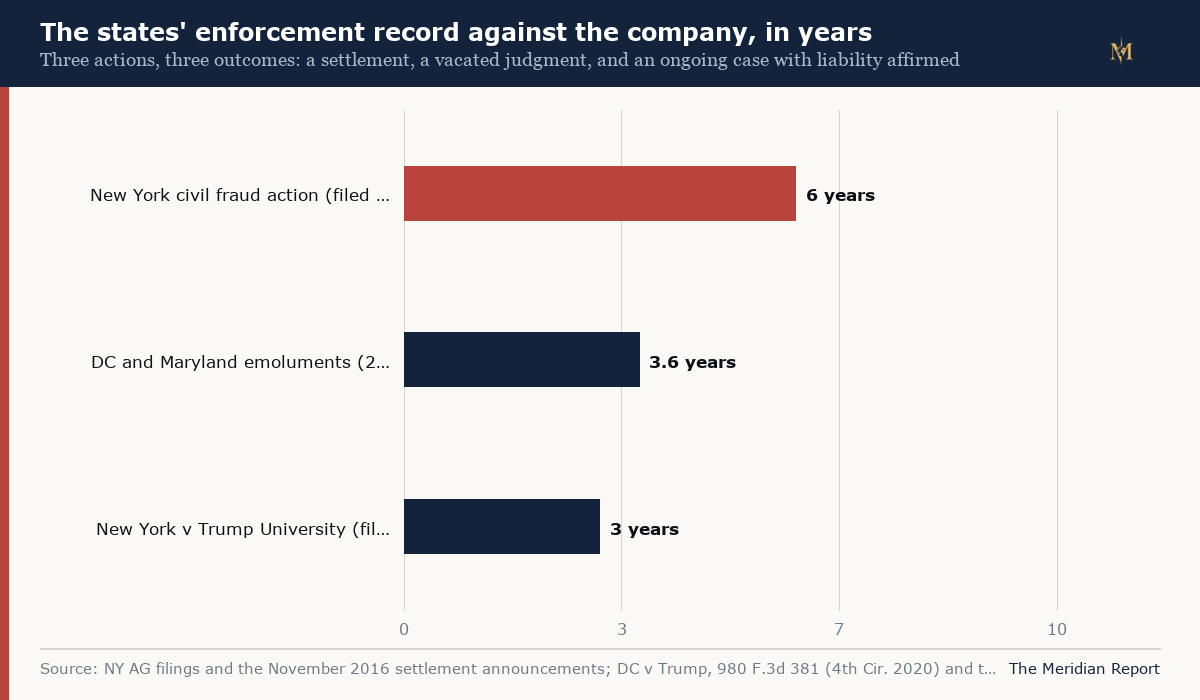
The states' record against the president's companies is documented and it is not nothing. Three results define it.
New York v Trump University was filed in 2013 and ended in November 2016 with a $25 million settlement, including $1 million paid to the state as a penalty. The New York civil fraud action, filed in 2020, produced a judgment among the largest in the state's history, affirmed on liability by the First Department in August 2025 while the penalty was voided, with injunctive relief upheld. And the DC and Maryland emoluments case reached the discovery stage, the furthest any emoluments plaintiff has travelled, with document preservation subpoenas served on the businesses in November 2017.
The pattern in the record is that states reach the company most effectively when they sue under their own statutes, consumer protection, securities and fraud, rather than under the constitution's anti corruption clauses. The emoluments route died on standing in the Fourth Circuit. The state statute routes produced the settlement and the affirmed liability. A state planning the next move has the record in front of it: the constitutional theory carries the headline and loses the motion to dismiss, while the statutory theories survive motions and reach discovery, where the emoluments facts, who paid, into which ventures, would surface as evidence in a case about something else.
What a novel theory would have to combine
The Court's own recent precedent points at the theory. In Biden v Nebraska, 600 U.S. 477 (2023), the Court found Missouri had standing through injuries to MOHELA, a state created loan servicer whose financial harm, the Court said, directly injured the state that created it and to which its revenues flowed. The Court accepted a causal chain running through an entity, at the instance of a state, against a presidential action. The state side of the emoluments bar has never used that precedent, and a complaint built on it would run differently from the 2017 one.
The theory, assembled from the documented record, would combine four elements. First, a state or the District with a venture physically inside its borders, so the injury is local and proprietary rather than diffuse. Second, an entity or fund whose revenues flow to the state, so the Biden v Nebraska entity chain is available: a state pension's hospitality holdings, a state chartered venue authority, a state university endowment competing for the same events. Third, a defined market, in the guide's earlier terms, where the venture competes against state linked interests, with the market defined temporally around the documented flows. Fourth, a discovery plan aimed at the linkage documents the current venture disclosures have partly surfaced, the same documents a private competitor would need, available to a sovereign plaintiff with subpoena power and the resources of an attorney general's office.
What that theory cannot do is conjure a cause of action. The Second Circuit's holding that the clauses imply no private right of action would face a state plaintiff with sovereign interests and stronger claims to enforcement authority, but the holding is textually grounded and a state would need either Congress's statutory cause of action or a court willing to distinguish the precedent. The resolutions before Congress remain the missing piece, and a state plaintiff with a surviving standing theory would give those resolutions a plaintiff waiting for them.
What the state angle cannot do
Three limits deserve their own statement. The emoluments clauses themselves run against federal officials and are enforced, so far as they have ever been enforced, through Congress's consent power; a state court or state statute cannot create a constitutional violation where none exists, and no state has ever been held to have standing under the foreign clause. The quasi sovereign route, the strongest doctrinal foundation, was tried and lost by one vote, and the current Court's narrowing trend gives no reason to think the six vote dissent would grow. And the statutory routes that have actually recovered money reach the ventures' conduct toward consumers and lenders, not the constitutional question; a state can make the ventures pay and never once put the emoluments clause in front of a judge. That is the trade the state angle offers: enforcement with the constitution attached as evidence, or constitutional litigation with standing as the price of admission. The record shows states have never yet been given the chance to take both at once.
Reading the whole series
The presidency and money is a four part investigation: the behaviour, the flows, the history, and the law. This is the states' part of it; the whole sequence is collected at The presidency and money. The doctrine guide for the private plaintiff route is at How to build a plaintiff the emoluments clause cannot shake off.