
A signed agreement promises new military bases. A press release calls a project fully funded. A budget office says the money has not been requested. All three statements can be true at once, and the document that separates them is public, free and searchable: the Department's annual Construction Programs budget volume, known as the C-1. The volume repays reading as a working document, and Pituffik Space Base in Greenland makes the worked example, because the base appears in the current volumes in exactly the way that confuses first time readers: once in last year's request, once in this year's law, and nowhere in next year's proposal.
Where the volume lives, and the domain change that can break your bookmarks
The Pentagon's budget materials sit on the comptroller's website under Budget Materials, organised by fiscal year, with the Construction Programs volume among them. The address has been in motion: the department is now the Department of War, and the documents domain has moved to comptroller.war.gov, while the volume's own preface still directs readers to the old comptroller.defense.gov address printed before the rename. Both realities matter in practice. The old domain can refuse automated access, and the working locations are the Budget Materials index and the volumes themselves at comptroller.war.gov, under defbudget, the fiscal year, and the filename FY2027_c1.pdf.
The anatomy of the volume
The C-1 is a single PDF, around 450 pages in the current edition, and its structure repeats in a pattern that never changes:
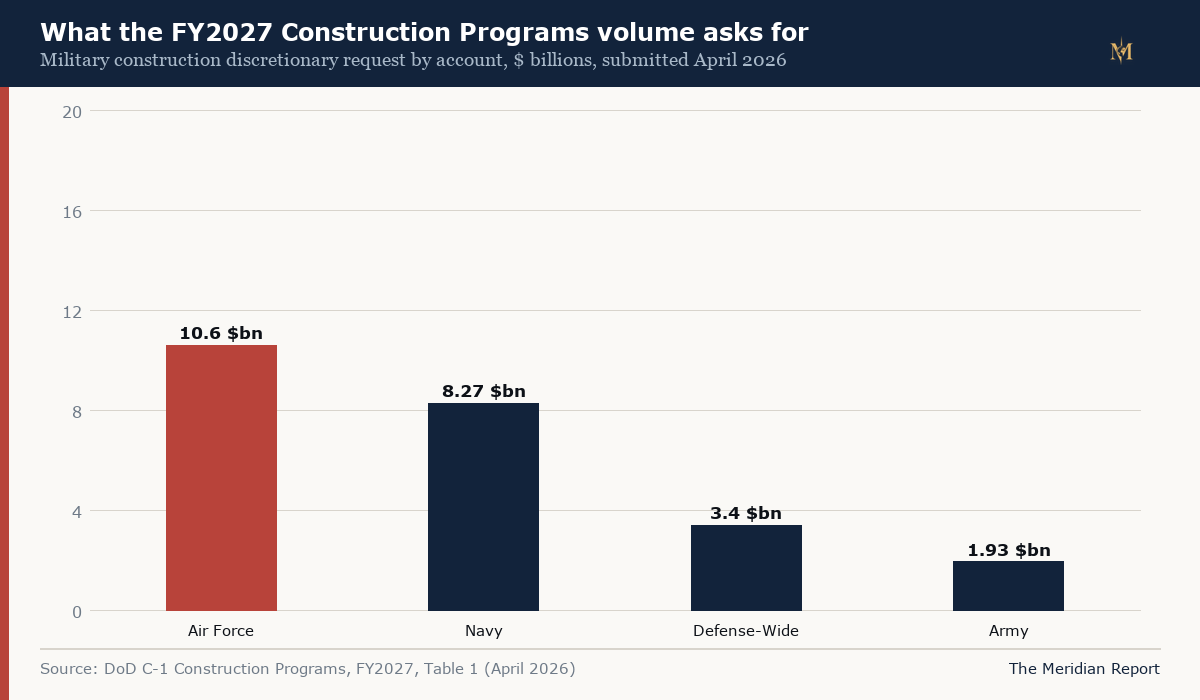
The opening summary tables give the whole department's military construction and family housing request by account. Table 1 for fiscal 2027 shows the discretionary request at 26.4 billion dollars, with the Air Force account, the one that funds Pituffik, at 10.6 billion.
The state and installation tables follow, and they are the heart of the volume. Each service gets a set of tables that list, line by line, the installation, the state or country, the project title and the dollar request. Greenland appears here as its own state level grouping, and under it, Pituffik SB.
The out year columns sit to the right of the request year in the installation tables, showing what the same project is expected to cost in the following years of the five year plan. A project with all four columns filled is a multi year commitment; a project with only the first column filled is a single year ask.
The prior year comparison tables come last, and they are the trap. Each volume carries complete restatements of the two previous fiscal years, headed Summary for 2025 and Summary for 2026, each stamped As of with a month, in this edition April 2026. These tables exist so that committee staff can see what was requested, authorised, appropriated and enacted in earlier cycles. They are history.
The worked search: Pituffik
Search the fiscal 2027 volume for Pituffik and every hit lands in comparison tables. The page headers carry the tell: Summary for 2026 and As of April 2026, with four identical numbers, 32,000, in the columns labelled Authorisation Amount, Authorisation for Appropriation Amount, Appropriation Amount and Total Obligation Authority Amount, all in thousands. That is the runway approach and landing system project, 32 million dollars, as it was enacted for fiscal 2026 in the appropriations law of 12 November 2025. The identical values across all four columns are the signature of enacted money: the request, the authorisation, the appropriation and the obligation authority all ended the cycle at the same figure.
A reader who stops at the search hits will conclude, wrongly, that the fiscal 2027 budget funds Pituffik. The correct statement, verified line by line in the volume, is that the fiscal 2027 request contains no Pituffik project. The 32 million dollar runway line is fiscal 2026 history, resting in the comparison tables. What the volume does show for the year ahead is the Air Force topline of 10.6 billion dollars, the account into which any future Greenland project would have to be born.
Reading the numbers: what each column means
The four number columns repeat throughout the volume, and their meaning is the difference between a request and a funded project:
Authorization Amount is what the department asked Congress to authorise in the cycle shown.
Auth for Appn Amount is the authorisation for appropriation, the figure cleared to be appropriated.
Appropriation Amount is what was actually appropriated in the law.
TOA Amount, Total Obligation Authority, is what can legally be committed by contract.
In a request table, the first column is the ask and the later columns are the department's proposal. In an enacted comparison table, all four converge on the same number, the enacted figure. In a request year table for a project new to the plan, the numbers may differ between columns, because the department can propose one authorisation level and a different appropriation level, for example when military personnel construction rides one account and facility construction another.
From the volume to the law: the two places a project can live
Here is the part that catches everyone. The C-1 is a proposal document, and even an enacted appropriation does not name projects in the statute. The fiscal 2026 appropriations law, Division D of the package enacted on 12 November 2025, provides for Military Construction, Air Force the sum of 3,926,273,000 dollars, to remain available until 30 September 2030, with conditions on planning and design spending. The statute's own text names no installation and no project. The binding project detail lives in two places outside the statute: the explanatory statement that accompanies the law, which directs that a stated sum be for the projects and activities in a specified table, and the C-1's own enacted comparison tables, which restate the project by project allocation.
The practical reading discipline follows. When a project gets enacted money, the dollar figure appears in the law as an account total, while the project's identity lives in the explanatory statement table and in the C-1's comparison tables. A search of the statute alone will find the account total and miss the project, which is why the volume and the law are read together.
Cross checking the volume against contracts and spending
The C-1 tells you what the department proposes and, in its comparison tables, what was enacted. It does not tell you what has been built. Three further records close that gap:
USAspending, the treasury's public spending database, lists obligations and outlays by award, so a reader can see whether the 32 million dollar runway project has actually been contracted, to whom, and for how much.
Defense contract announcements, published on the department's news pages, name each awarded contract, its value and the installation where work will be performed. The Army Corps of Engineers, which executes most military construction, publishes its own contracting opportunities and award notices through its business pages.
Together with the C-1, these three records form a pipeline a reader can walk in order: proposed in a budget volume, authorised and appropriated in law, obligated in a contract, and eventually outlaid in payments. A project that has cleared the first stage but not the second exists on paper. A project with an executed contract is real regardless of what any announcement said.
The three checks for any base
The method compresses to three checks, and the Pituffik example runs through all of them:
Check the volume. Search the current C-1 for the installation. Read the page header to decide whether the hit is a new year request or a prior year comparison. If the fiscal year in the header is the cycle being debated, the project is proposed; if it is stamped As of an earlier date, it is history.
Check the law. Find the appropriation account in the enacted law and read the availability window, five years for military construction, and the conditions. Then look to the explanatory statement for the project tables, because the statute will not name the project.
Check the contract. Search USAspending and the department's contract announcements for the project or installation name. An obligation against the project is the first hard evidence that a building will happen.
A funding claim that survives all three checks is a fact. A claim that stops at a press release is not yet money, whatever it says. The difference, in the Greenland case, is the difference between a signed agreement that promises bases and a budget machinery that has not yet been asked to build one, a gap our Pituffik tracker follows line by line. The machinery itself is explained stage by stage in our guide to military construction budgeting, and the capability the money would build is in the radar explainer.