
Every dollar the United States has verifiably committed to its Greenland base was committed before the agreement that promises more. That is the finding a records review produces, and it is the reason the president's no-cost claim is, so far, technically true: the two new defence areas the agreement creates exist in no published budget line, no submitted request and no released estimate. The build the agreement enables, meanwhile, is already running on contracts worth billions, most of them awarded to a Greenlandic joint venture and a British services firm years before the signing. The standing account runs below: the verified baseline, and every new award, solicitation, budget line and estimate as it is announced.
The verified baseline
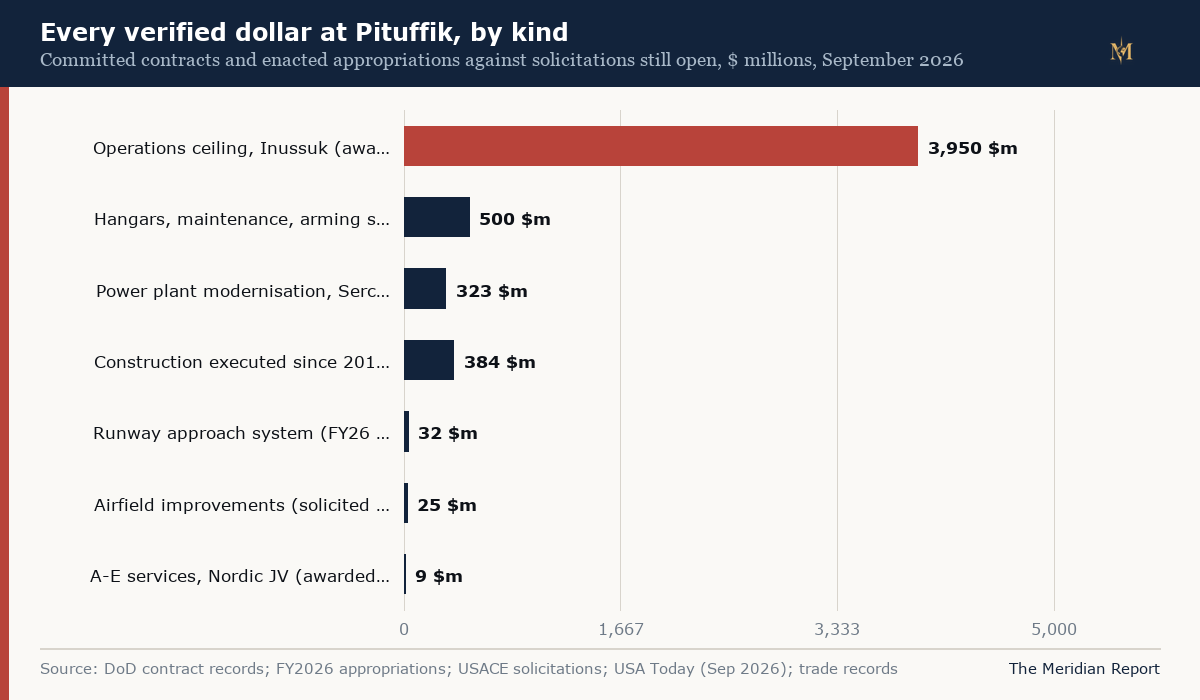
Seven kinds of money are verifiable at Pituffik, and they are not additive, because each is a different kind of commitment: awarded contracts with ceilings, enacted appropriations, and solicitations whose value is a maximum, not a spent dollar.
The largest line is operations. In December 2022 the Air Force awarded Inussuk A/S, a Greenlandic joint venture, a 12-year contract with a $3.95 billion ceiling to operate and maintain Pituffik through 2034, per the department's own contract record. At the full ceiling that is roughly $329 million a year, and it is the reason a Greenlandic firm is the base's largest contractor. The agreement's Article IV, which requires defence-area contracts to go to Greenlandic sources to the maximum extent possible, formalises a pattern that already exists.
Power is the modernisation anchor. In August 2024, Serco won a four-year, roughly $323 million contract from the US Army Corps of Engineers New York District to manage the modernisation of the base's back-up electrical power plant, the single largest known construction award at the base and a prerequisite for anything that raises the base's power demand, which new radars, expanded facilities and larger garrisons all do.
Then there is the long tail of recapitalisation. The Department of the Air Force's own programme record counts roughly $384 million of construction executed since 2016, dormitory recapitalisation, a new civil engineer facility, and associated infrastructure, the unglamorous rebuilding of a base whose facilities date mostly to the Cold War.
Only one line is construction money in law. The fiscal 2026 appropriations provide $32 million for a runway approach and landing system at Pituffik: the budget volume's enacted comparison tables restate the project line by line, with the request, authorisation, appropriation and obligation authority all converged on the same figure, inside an Air Force account of $3,926,273,000 available until 30 September 2030. The statute itself writes the account total without naming projects, so the project identity rests on the enacted tables and the law's explanatory statement. This is the one appropriation directly tied to the airfield improvements the expanded mission would use.
Ahead of any award sit the planned projects. In January 2026 the Air Force solicited projects of up to $25 million for airfield improvements at Pituffik, flight operations infrastructure that precedes any traffic increase. A USACE solicitation for renovation of Building 99 is also live on the procurement system.
The pipeline since the signing
The first procurement anticipating the expanded mission surfaced in the fortnight after the agreement was announced, and both items point the same direction.
The pipeline's headline number is the $500 million solicitation. A USACE purchasing solicitation, reported by USA Today on 23 September, seeks Danish or Greenlandic contractors for new heated hangars, a maintenance facility and a weapons arming station at Pituffik, work worth up to $500 million. The pieces fit the mission they serve: hangars and an arming station are what a base needs before it can station aircraft rather than refuel them, and today's base hosts visiting fighters, such as the Wisconsin Air National Guard F-35As that stopped over earlier this month, without stationing them, especially through a polar night that can reach minus 50. The figure is a solicitation ceiling, not an award; the article notes the project is in very early stages. It is nonetheless the first procurement number that anticipates the expansion, and it is an order of magnitude above the few tens of millions a CSIS adviser guessed for the new sites.
Beside it runs the delivery-method market research. USACE New York District posted a Sources Sought notice, W912DS26S0045, on 15 September 2026, three days before the deal announcement, seeking industry feedback on the best delivery method for design and construction at Pituffik structured around an Initial Operational Capacity phase. Responses are due 2 October 2026. The notice states that only Danish and Greenlandic firms may respond, the procurement system's first public expression of the Article IV preference the agreement would later codify, and the IOC framing signals a phased build with a defined first operational milestone.
The engineering bench. In August 2026, before the agreement, the Air Force awarded a maximum $9 million architect-engineer services contract to three Nordic firms, COWI Greenland, ISC Consulting Engineers and Ramboll Greenland, per trade press records of the award. A-E contracts are the design layer that precedes construction, and a Nordic joint venture holding one at Pituffik extends the pattern the base operations contract established. The award is trade-reported; the definitive contract record has not yet surfaced in public databases, so it is recorded here with that caveat.
What is not yet on any ledger
The agreement's own construction, the two new defence areas at Narsarsuaq and Mestersvig, still has no public number. The fiscal 2027 military construction request, submitted in April 2026, five months before the signing, contains no Greenland project. Nobody in the Pentagon, the White House or either armed services committee would tell The Center Square, which reviewed the records for its 23 September report, what the new sites will cost or when Congress will be asked to fund them. The administration's own analyst community has begun the guessing: a senior CSIS adviser's rough estimate for expanding the two small existing sites was a few tens of millions of dollars, against the president's description at the General Assembly, hours before signing, of two very major military bases, and now against a half billion dollar solicitation for the existing base alone. The distance between those numbers, tens of millions, half a billion, and very major bases, is precisely what the coming budget requests will resolve, one way or the other.
The modalities talks that Article IV requires, where location, scope and size are actually decided, are the process that turns the agreement into budget lines. Under the text, the two sides have 90 days to agree implementation details at the Permanent Committee before disputes escalate to deputy minister and minister level. Those talks, not the signature, are where the money gets sized.
Why this tracker exists
Three separate claims now circulate about the cost of the American build in Greenland: that it costs nothing, that it will cost a few tens of millions, and that it means two very major bases. Each is a claim about documents that have not been written yet. The documents that will eventually settle the question are known in advance: military construction budget requests each spring, DoD contract announcements as awards are made, the USACE solicitations that precede them, and the appropriations text that turns requests into law. Each is recorded as it appears, with the source and the date, so the record accumulates in one place rather than in press releases.
The verified baseline above is the floor, roughly $5.2 billion in committed contracts and executed construction covering the existing base through 2034, every dollar traceable, plus a further half billion in solicited work not yet under contract. What the tracker watches for next: the first budget line that names Narsarsuaq or Mestersvig, the first contract award for either site, the 2 October responses deadline on the delivery-method market research, and the first estimate from the Pentagon or the Congressional Budget Office that sizes the build. When any of those lands, it goes into the account, and the no-cost claim meets its first document.
Update, 24 September 2026: the $500 million hangar and maintenance solicitation, the USACE delivery-method market research notice and the $9 million architect-engineer award added to the baseline; the chart extended to seven lines. Earlier entries unchanged.
Our coverage of the agreement itself is in the signing report and the main analysis; the capability the build serves is in the radar explainer.