
When the Greenland defence agreement was signed on 22 September, the announcement carried a promise of two very major military bases at Narsarsuaq and Mestersvig, and the question that followed it, from reporters and from members of Congress alike, was what those bases would cost. The honest answer at signing was that nobody outside the Pentagon could say, because the two new defence areas appear in no published budget line. The reason is not secrecy. It is the machinery of American military construction budgeting, in which a project can exist in a signed treaty and still have no money, because every dollar must be born years earlier and pass through more checkpoints than almost any other kind of federal spending. The fiscal 2026 cycle, the one that currently funds Pituffik, shows the machinery from the inside.
Every project is born as a form, years before any money moves
A military construction project begins its life the same way regardless of size: as a DD Form 1391, the standard project data sheet that records what is to be built, where, why the requirement exists, and how much it is estimated to cost. An installation identifies a need, a civil engineer squadron drafts the 1391, and the document then climbs a ladder of screens at the major command, the service headquarters and finally the Office of the Secretary of Defense, competing against every other project the service could fund. Congressional Research Service reports on the process describe this pipeline in detail, and the Congressional Research Service's standing review of military construction authorities, R44710, is the reference for everything in this section.
What survives the ladder enters the service's five year plan, the Future Years Defense Program, and this is the first timing fact that matters for reading Greenland coverage: the fiscal 2027 budget request was assembled during calendar 2025 and reflects project decisions made years before that. The agreement signed in September 2026 names two new defence areas that no American engineer had been told to plan for on any fiscal 2027 form. The absence of a budget line for them is not an oversight. It is the calendar working as designed.
The president's budget: where a plan becomes a public request
By statute, 31 U.S.C. 1105, the president must submit the budget between the first Monday in January and the first Monday in February. The Department of Defense's budget materials include a volume titled Construction Programs, known as the C-1, which lists every proposed military construction project by installation, state and cost, and it is here that a project makes its first public appearance. A reader who wants to know whether the Pentagon is planning anything at Pituffik, or Narsarsuaq, or anywhere else, can simply search the C-1.
The deadline is one the executive branch has treated loosely in recent years. The fiscal 2027 budget, legally due on 2 February 2026, was submitted in April 2026. The delay matters for the Greenland question in a concrete way: the fiscal 2027 request, which the Pentagon sent to Congress five months before the agreement was signed, contains no project for either new defence area, a fact verified in our standing tracker of every Pituffik dollar. The fiscal 2028 request, due in early 2027, is the first regular vehicle in which they can appear.
Congress writes two laws, and a project needs both
Here the machinery splits, and the split confuses more readers than anything else in the process. Military construction requires authorisation, which is legal permission, and appropriation, which is money, in two separate laws.
The authorisation comes in the annual National Defense Authorization Act. Title 10 of the United States Code, section 2802, requires military construction projects inside the United States to be specifically authorised by law, and the NDAA's military construction title does that authorising annually. For fiscal 2026, the NDAA was signed on 18 December 2025.
The appropriation comes from the Military Construction, Veterans Affairs and Related Agencies subcommittee, the smallest of the twelve annual appropriations bills, and its path through fiscal 2026 is the worked example. The president requested $18.9 billion for military construction and family housing. The House passed its version on 25 June 2025 at $18.0 billion, about 5 percent below the request. The Senate Appropriations Committee reported its version on 17 July 2025 at $19.8 billion, about 5 percent above it. The two chambers then did not resolve the difference for months, and the money was finally enacted on 12 November 2025 at $19.7 billion, inside a broader continuing resolution package, five weeks after the fiscal year had already begun on 1 October.
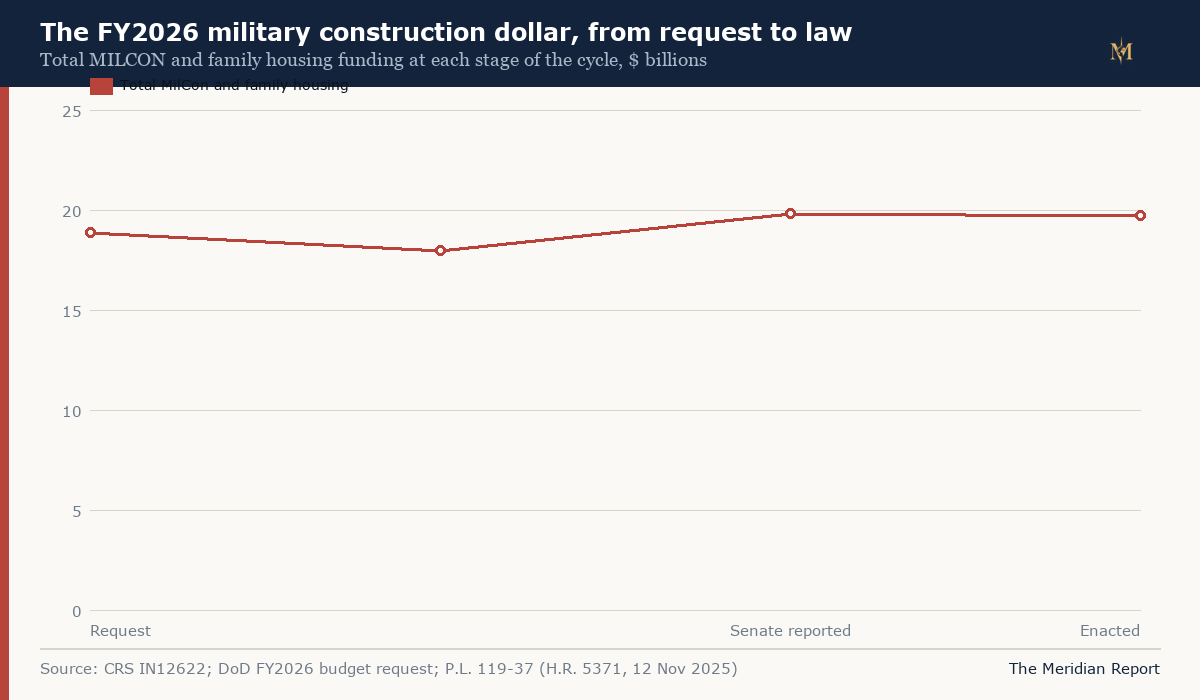
Two habits worth carrying away from that timeline. First, a request is not money: the enacted figure differs from the request, and both congressional versions differed from it in opposite directions. Second, enactment dates slip: fiscal 2025's military construction money also arrived through a full year continuing resolution, in March 2025, nearly half a year into the fiscal year it funds. When reading any story about a promised base, the date that matters is the enactment date of an appropriations law that contains the project's line, and nothing earlier.
The same dollar at four prices
The aggregate numbers hide where the negotiating actually happened, so the account that funds Pituffik is worth following on its own. The Air Force military construction line was requested at $3.72 billion for fiscal 2026. The House cut it to $3.17 billion. The Senate raised it to $4.09 billion. The enacted law settled at $3.93 billion, about 6 percent above the request and nearly a quarter above what the House had proposed. The Navy and Marine Corps account took a far deeper swing, requested at $6.01 billion and cut to $4.10 billion in the House before the Senate and the enacted law restored most of it.
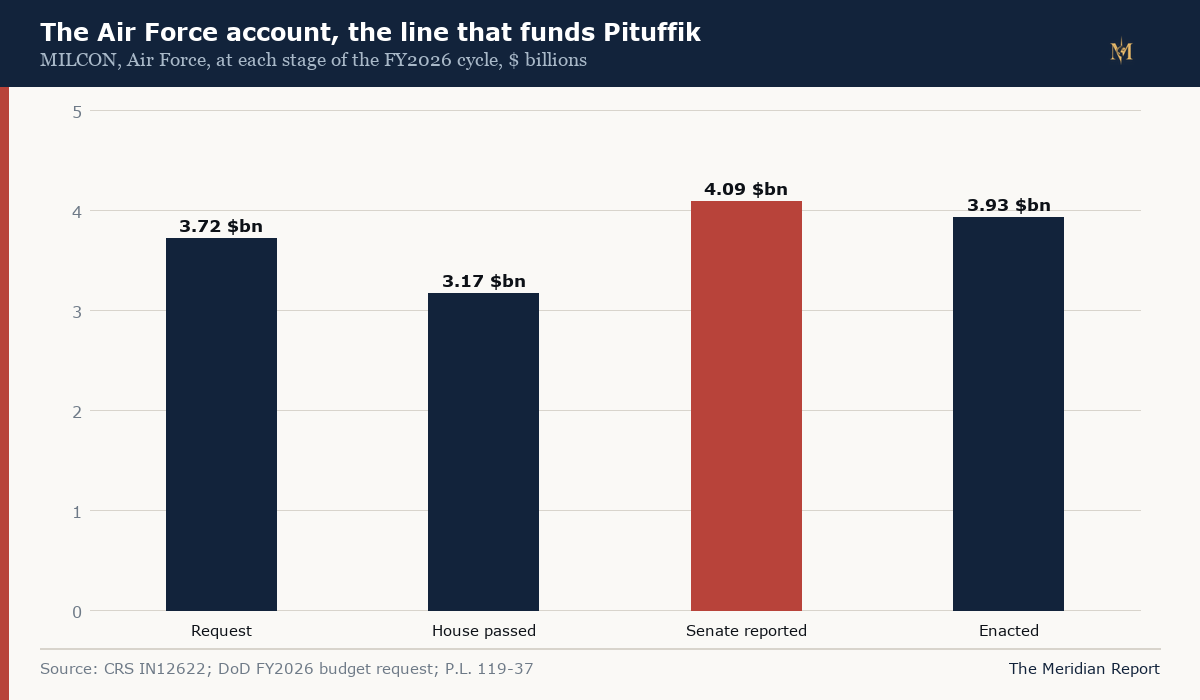
The enacted law's tables are where a specific base finds its specific money, but with one structural wrinkle the statute itself will not name a project. The fiscal 2026 military construction law provides the Air Force account, $3,926,273,000 to remain available until 30 September 2030, without listing installations; the binding project detail lives in the explanatory statement's table and in the budget volume's enacted comparison tables. Pituffik's runway approach and landing system, $32 million, appears in those tables with all four columns converged on the same figure, which is why the amount can be stated as fact rather than estimate. The lesson generalises: a project's funding can shrink, grow or die at any of the four stages, request, House, Senate and enactment, and the only stage that creates purchasing power is the last one.
What the money can do once it exists
Appropriation is not the finish line either, because appropriated and spent are different states. Federal funds must first be obligated, meaning committed by contract, and most federal accounts expire for obligation after a single fiscal year. Military construction appropriations are the exception: they remain available for obligation for five fiscal years, an acknowledgement that design, environmental review and contracting for a physical building take years. That is also why enacted money is compatible with an empty building site. A project funded in one November can still be years from its first construction contract, and the outlay, the money actually leaving the treasury, lags the enactment by however long the engineering takes.
Movement between projects after enactment is possible but controlled. The Pentagon can reprogram funds between military construction projects, and can propose new starts through budget amendments, but both routes require notification to, and in defined cases approval by, the congressional committees, which is why they are publicly documented. For the Greenland build, reprogramming or a budget amendment is the one path that could put money on Narsarsuaq or Mestersvig ahead of the fiscal 2028 request, and any such move would be visible in the notifications. Our tracker watches for exactly that.
Where the Greenland build enters the machinery
The fiscal 2027 cycle is itself unfinished. The House passed its MilCon-VA bill, H.R. 8469, on 15 May 2026. As of late September, with the fiscal year ending on 1 October, the Senate had not passed a version, and the likely bridge is a continuing resolution, the pattern of both previous years. Until a fiscal 2027 law is enacted, the funding story of the coming year is open, and the first document that can change the Greenland answer is the fiscal 2028 request, due in early 2027, which will either contain the first Narsarsuaq and Mestersvig project lines or will not.
That gives any reader a four question test to apply to the next announcement about the new bases. Is the project in the service's plan? Does it have a line in a president's budget request? Is there authorising language in an NDAA? Is there an appropriation with a dollar figure in an enacted law? A project that answers yes to all four has real money. A project that answers fewer has a press release. The tracker at the link below follows each of those checkpoints as the Greenland build moves through the machinery, and every future update there can be checked against the four questions above.
Follow the money at the Pituffik construction and budget tracker, read what the signed agreement actually says in its published text, and see the sensor capability the funding exists to build.