
In January, the president of the United States was openly discussing taking Greenland, by purchase if possible and by pressure if necessary. Denmark's government was scrambling to reassure its own Arctic citizens, Greenland's politicians were insisting the island was not for sale, and NATO diplomats were quietly warning that a founding ally was threatening another founding ally's territory.
On Tuesday 22 September, on the sidelines of the United Nations General Assembly in New York, the same three governments signed a document that ends that crisis without resolving any of the questions underneath it.
The ceremony had been scheduled for Tuesday morning, with all three leaders present, and the outcome is precise. The United States receives permanent security rights in Greenland. Denmark and Greenland keep the island. Neither side describes the other's version of events, because the two versions are different, and both are now formal.
What the signature changes today
Three things became formally true when the pens lifted, and a fourth became clear when the text was published the same day.
The agreement's first lasting change is to replace ambiguity with commitment. From 1951 until now, the American military presence in Greenland rested on a Cold War treaty written for a different threat and a bilateral relationship that Washington spent twenty months destabilising. The new text restates those rights in a document signed by all three parties, and its preamble reaffirms, in the operative language of a signed instrument, the sovereignty and territorial integrity of the Kingdom of Denmark and the right of the people of Greenland to self-determination, noting explicitly the Self-Government Act's Article 21 independence procedure. That is now treaty text, not a press statement.
Its second lasting change is that the published text corrects the announcement-week characterisations. Early summaries described installation rights as unilateral, Washington able to establish additional installations without separate Danish or Greenlandic approval. Article IV of the text says something narrower. Narsarsuaq and Mestersvig are agreed in principle, but their modalities are to be mutually agreed. Any further defence area requires a proposal and a decision by mutual agreement in the Permanent Committee, with a 90 day escalation ladder to deputy minister and minister level if the committee cannot agree. Unmanned installations outside the defence areas do move through accelerated approval procedures, the closest the text comes to the unilateral framing, but they are still reviewed by the Kingdom and Greenland. The discretion the text actually grants Washington is real but bounded, and the distinction matters for every construction project that follows.
Third, the economic perimeter closes, but through Greenlandic law. The text bars non-NATO states from manned or unmanned installations and from a persistent military presence. On investment, Article X blocks control, significant influence or access to non-public information by non-allied investors within particularly sensitive sectors, defined to include critical infrastructure and resource extraction, but it is to be ensured by Greenland, in cooperation with Danish authorities, through Greenland's own current and future investment screening laws. The commitment is international; the enforcement mechanism is domestic and Greenlandic. Nuuk's implementation choices will define how tight the perimeter actually is.
The text also contains two provisions that announcement coverage underplayed. The preamble names the establishment of a Golden Dome defence system among the agreement's purposes, the first treaty-level hookup of Greenland's geography to the American missile defence architecture programme. And Article XI states that the agreement does not have an end date, and that if Greenland becomes independent, Denmark and Greenland shall together ensure the new state remains in NATO and affirmatively assumes all Danish rights and obligations under the agreement from the date of independence. A future sovereign Greenland would be born into the defence arrangement by the text's own terms, a provision with no precedent in the Nordic defence cooperation agreements and the one most likely to be contested in the ratification debates.
What the signature does not change
Sovereignty, first. Nothing in the public descriptions of the agreement transfers territory, property or legal authority. Frederiksen's formulation in New York was blunt: Denmark is not giving up sovereignty, and cooperation with the United States and sovereignty over Greenland are compatible. Greenland's Prime Minister Jens-Frederik Nielsen said the deal reflects Greenland's interests and its place in international cooperation. President Trump, for his part, described the agreement as giving the United States permanent control over Greenland's security, which is a different sentence, about a different object, and the distance between those sentences is exactly where the deal's future politics live.
Money, second. The United States pays nothing for the new rights. Any construction or deployment carries its own costs as ordinary military spending, but there is no purchase price, no lease payment and no compensation to Copenhagen or Nuuk. The text adds one economic sweetener: Article IV requires American contracts for defence-area construction and servicing to go to Greenlandic sources to the maximum extent possible, with the 2020 diplomatic notes to be updated to secure that commitment.
Ratification, third, and this is the part the ceremony obscured. Signature is not law, and Article XII says so in terms: the agreement enters into force on the diplomatic note informing Washington that the necessary parliamentary procedures are complete in the Kingdom together with Greenland. In Denmark, the Folketing must approve. In Greenland, the Inatsisartut is expected to debate its own consent, because the Self-Government Act gives Greenland decisive influence over the matters the agreement touches. Until both parliaments finish, the signed text binds its signatories politically but not domestically. The opposition that spent two years resisting American pressure now has the full text to scrutinise, line by line, starting with the permanence and independence-inheritance provisions that go further than anything in the Nordic defence cooperation agreements.
The company the deal keeps
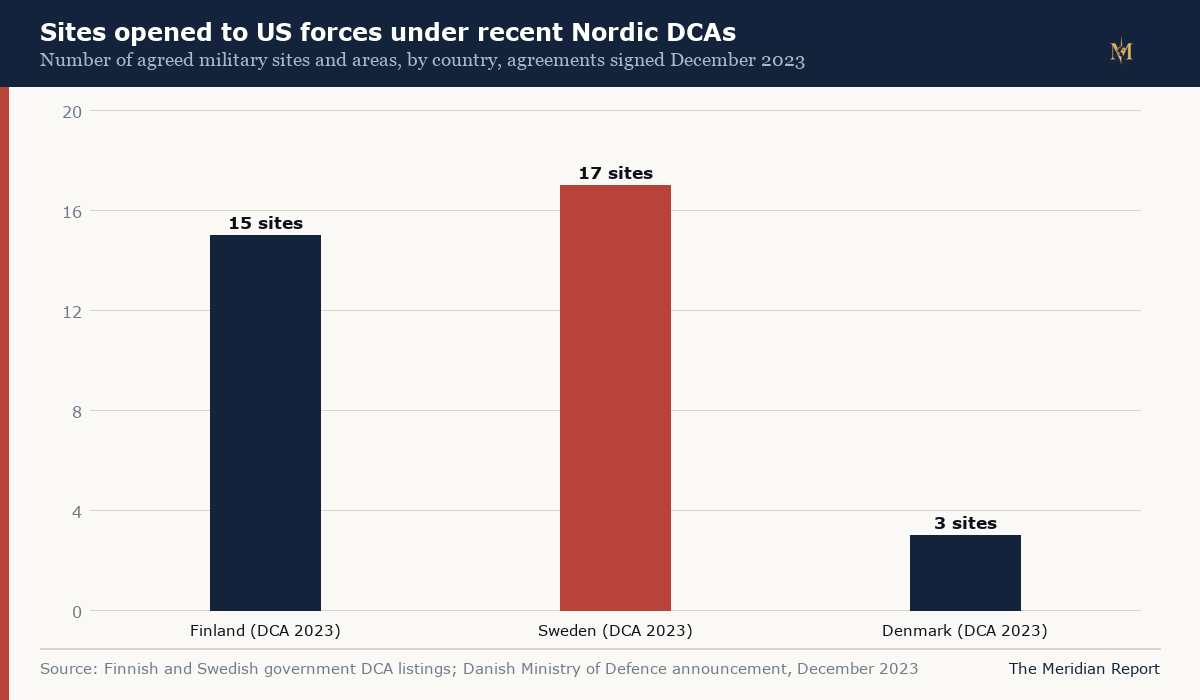
The agreement is not an outlier in form. Denmark, Finland and Sweden each signed defence cooperation agreements with Washington in December 2023. Finland opened fifteen sites and areas to American forces, Sweden seventeen, Denmark three airbases at Karup, Skrydstrup and Aalborg. Finland's agreement took effect in September 2024 and Sweden's the following month. What distinguishes the Greenland text from that family is not the genre but the circumstances: it supplements a standing 1951 treaty regime rather than creating access from scratch, it follows a twenty-month campaign of American pressure that included open discussion of acquisition, and it runs into a self-governing territory whose parliament must be consulted on the affairs it touches.
The pressure campaign that produced it, in one paragraph
The agreement is the terminus of a sequence that began in late 2024 and escalated through 2025: public American statements about acquiring the island, a Danish election in March 2026 fought partly on the Greenland question, the collapse of trust polling in Denmark toward the United States, and a series of American probes into Greenlandic infrastructure and politics that Copenhagen repeatedly protested. The response from Copenhagen and Nuuk was consistent: no sale, no cession, no negotiation over sovereignty, and a standing offer of deeper defence cooperation. The signed deal is, almost exactly, that standing offer, accepted on Washington's terms after Washington failed to obtain anything more.
What each side wanted, and who got it
The American administration wanted permanence, discretion and exclusion: rights that survive Greenland's constitutional evolution, freedom to build without asking, and legal machinery to keep China and Russia out. The signed text delivers all three, and the administration's own officials describe it in exactly those terms, with the Secretary of State calling it a permanent guarantee of American security interests in the Arctic at no cost to the American taxpayer.
Denmark wanted the crisis closed without a sovereignty concession. The signature achieves that, and the government's reading is that a signed, defined, treaty-limited cooperation document constrains future unilateral American claims better than the pre-2025 ambiguity did. That is one interpretation, and it will be tested the first time Washington's definition of security necessity collides with Nuuk's definition of consent.
Greenland wanted self-determination respected in writing. The published preamble does exactly that, reaffirming the sovereignty and territorial integrity of the Kingdom and recognising the Greenlandic people's right to self-determination under international law, with the Self-Government Act's independence procedure cited by name. Whether that language constrains anything beyond its declaratory force is the question the ratification debates will answer, and Greenlandic politicians have themselves urged the public to weigh the full document rather than the ceremony.
What to look for next
The text is out, so the provisional reading is over; what remains are the decisions. The Folketing vote, where the size of the opposition and any reservations attached tell Copenhagen's real price, particularly around Article XI's independence clause. The Inatsisartut debate, where Greenland's parliament either validates the consultation promise or demonstrates that the agreement outran its own consent process. And the diplomatic note of entry into force, which Article XII makes the legal finish line. These three steps are what verification now consists of.
The Arctic remains the cheapest place on Earth to store a grievance and the most expensive to build anything. The grievance is now signed over, in part. The building is about to start.
The full background, from the 1951 treaty baseline to the twenty month pressure campaign that produced this signature, is in our main analysis, Control without sovereignty, updated with the same text. For what the agreement means for the radar and space surveillance mission at Pituffik, including the Golden Dome language, see our capability explainer. Every stage of the story, from the signed text to the budget lines, is collected on the Greenland file.