
An agreement covering the future of the world's largest island was announced on 18 September 2026, and by the end of the day the three governments whose signatures it will carry were describing it in three incompatible ways.
President Trump told reporters the deal "gives the United States permanent control over Greenland." Denmark's government said the agreement "does not and cannot transfer sovereignty over any part of the Kingdom." Greenland's government, the Naalakkersuisut, said its consent had been given for defence cooperation only, and repeated that the island's constitutional future "belongs to Greenlanders alone." The draft text has not been published. Signing is expected at the UN General Assembly the following week. No parliament has seen the document.
The gap between the President's wording and everyone else's is not a quirk of press coverage. It is the central fact about this agreement: the dispute over what it means began before the text was released, and the parties' own statements — read against the treaty that has governed the US military presence in Greenland since 1951 — allow a precise account of what is actually known, what is genuinely new, and what remains unestablished.
That account matters beyond the Arctic. The agreement is the first time Denmark has formally expanded the US defence footprint in Greenland since 1951, and the first time an American president has publicly claimed a sovereignty effect from a bilateral defence instrument with a NATO ally. Whether the claim survives in law is checkable — against the text when it is released, against the ratification record, and against the constitutional process Denmark and Greenland follow. This report sets out the baseline for making that check.
What was announced, and what has not been
The verified sequence is short. On 18 September 2026, after roughly two weeks of final-stage negotiation, Washington and Copenhagen announced a defence agreement covering Greenland. Politico reported that the deal expands US military access and construction rights on the island, adds new radar and missile-warning infrastructure in the Pituffik area, and includes provisions on joint search-and-rescue and disaster response; NPR, citing officials briefed on the draft, reported an expanded US garrison at Pituffik Space Base and staged upgrades to civilian airports at Nuuk and Kangerlussuaq for dual military use. The parties confirmed the deal's existence and its general shape. They did not release the text.
Three things have not happened. The text has not been published, so no outside analysis can yet distinguish between rights that are new and rights that restate 1951. The agreement has not been signed; the ceremony is expected at the General Assembly. And it has not been ratified — in Denmark, a defence agreement of this scope goes to the Folketing for approval, and in Greenland the Inatsisartut is expected to debate its own consent, since the Self-Government Act reserves mineral-resource and, in practice, base-questions to consultative processes with Nuuk. Every characterization currently in circulation — including "permanent control" — is therefore a claim about a document that has not been released.
What the parties did say is itself evidence. The US State Department's readout describes "expanded defence cooperation." The Danish and Greenlandic statements address only sovereignty — both say it was not transferred. Neither party has publicly contradicted the other's core claim. The contradiction is between the President's phrase and the treaty parties' statements, and it remains unresolved in the public record.
The words "control" and "sovereignty" in the same sentence
A sovereignty claim has a defined shape in law: title over territory, exercisable without the permission of another state. "Permanent control" has no such definition. Read narrowly, indefinite exclusive military use of agreed areas is a thing the United States has lawfully held in Greenland for seventy-five years. Read broadly, the phrase implies the extinguishing of Danish sovereignty — which would require instruments of cession that no party claims exist.
The 1951 baseline is the fastest way to see the difference. The Defence of Greenland agreement, signed on 27 April 1951 and still in force, grants the United States:
- the right to construct, maintain and operate defences in agreed "defense areas";
- stationing of US forces in Greenland;
- US Jurisdiction — the treaty's capitalized legal term — over members of the US forces and certain civilian employees within those areas, subject to defined exceptions;
- navigation of US vessels and aircraft "in and around Greenland without restriction" and, within defence areas, "without the concurrence of Denmark";
- supply of its forces free of duty; and
- an unqualified right to improve and enlarge the defence areas as circumstances require, in consultation with the Danish authorities.
That is the instrument under which Pituffik Space Base has been continuously US-operated since 1951, through every crisis in US–Danish relations since. It is, on any honest reading, already a form of permanent American military control over defined parts of Greenland — exercised under Danish sovereignty and NATO integration.
The analytical consequence is that the new deal cannot be assessed by asking whether it grants "control." The 1951 treaty already does. The assessable questions are narrower: whether it adds territory to the defence areas, whether it deepens exclusive rights beyond 1951's, whether it touches civilian infrastructure or mineral policy — both areas where Danish and Greenlandic law reserve decisions — and whether any provision purports to run indefinitely ("perpetuity" language would be new) or with a termination clause. None of these questions is answerable until the text is published. What is answerable now is that nothing in the parties' own statements describes a transfer of sovereignty, and that a transfer would be legally void without steps the record shows have not occurred.
Why Denmark cannot sell Greenland even if it wanted to
The most common question raised by the President's phrasing — could Denmark simply have sold the island? — has a constitutional answer that cuts off the scenario entirely, and it is the reason both governments' denials can be so categorical.
Greenland ceased to be a Danish colony in 1953 and became an autonomous part of the Danish Realm in 1979, with self-government extended in 2009. The Self-Government Act's section 21 is explicit: Greenland's parliament initiates the process of independence; the Danish government and the Folketing can only negotiate and approve an arrangement that Greenland has itself chosen; and the act's final provision on the subject places the decision with the residents of Greenland in a referendum. Danish sovereignty over Greenland is, in the constitution's own architecture, held on Greenland's behalf and releasable only at Greenland's instance.
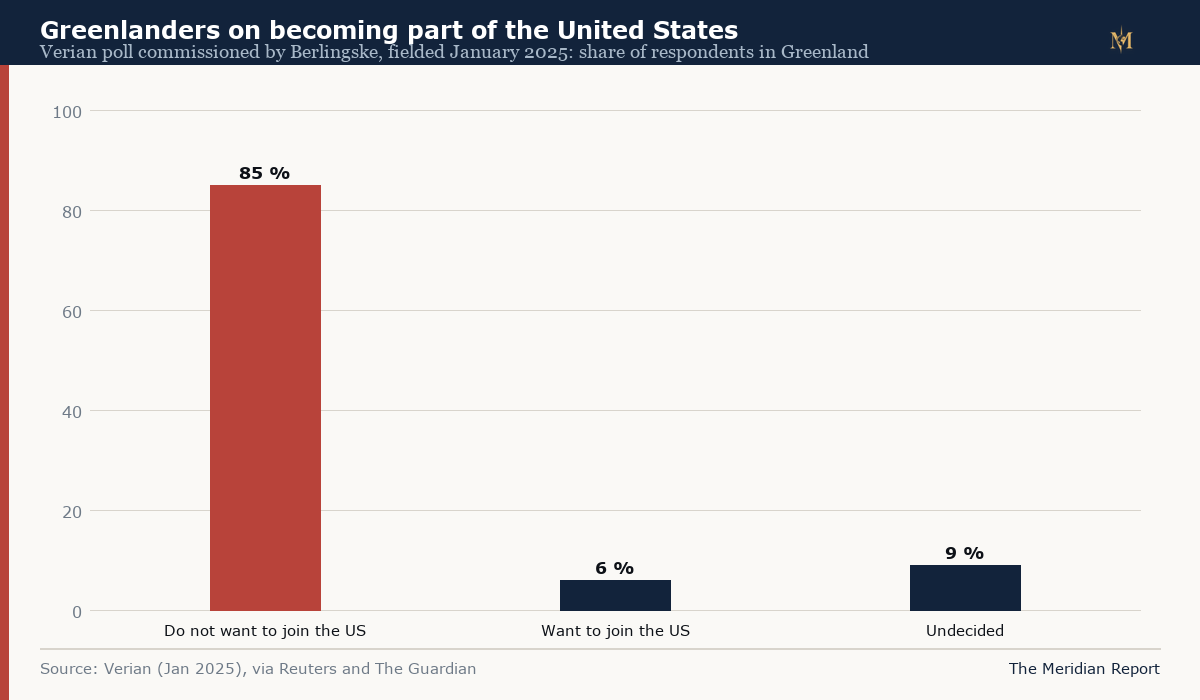
No poll of Greenlanders has ever supported US absorption. The Verian survey commissioned by Berlingske in January 2025 found 85 percent of Greenlanders did not want their island to become part of the United States, 6 percent in favour, 9 percent undecided — and a majority simultaneously favouring eventual independence from Denmark, which is a different question. No referendum has been scheduled. The Folketing cannot lawfully approve a cession Greenland has not requested, and no Greenlandic party that contested the March 2026 elections campaigned on joining the United States.
The 1946 precedent is instructive from the other side. Secretary of State James Byrnes offered Denmark $100 million in gold for the island — roughly $1.6 billion in today's purchasing power — and the Danish government declined, in a declassified memo the State Department has since published. Denmark was war-impoverished and the sum was enormous. The reply recorded that the Danish people would find the transfer of Greenland unacceptable. The population whose consent matters has been consulted, in effect, twice.
The 1953 precedent: what building the base cost the people nearest it
The last time the defence areas were built from scratch, the people living there had no parliament to consult. In 1953, as Thule air base rose on the northwest coast, Denmark relocated the Inughuit settlement at Uummannaq north to Qaanaaq to make room for the installation — 87 to just over 100 people by the counts used in the later litigation, moved from their old hunting grounds to a purpose-built town with minimal compensation. The case, litigated for half a century as Hingitaq 53, produced a 1999 High Court award of DKK 500,000 to the tribe plus compensation to individual families and a formal apology from the Danish Prime Minister that year; in 2003 the Supreme Court ruled the 1953 expropriation itself lawful, and in 2006 the European Court of Human Rights declared the applicants' case inadmissible. The apology stands; so does the base.
The contrast with 2026 is documented rather than rhetorical. This time Greenland's government was consulted before the announcement, its consent is part of the deal's public record, and the Inatsisartut is expected to debate the agreement — because the 2009 Self-Government Act places the island's domestic affairs with Nuuk in a way the colonial status of 1953 did not. The case is the historical reference point for anything that enlarges the US footprint on the island, and the Self-Government Act's consent requirements are its legal answer.
The twenty months that produced the agreement
The deal did not appear from a standing start. It followed a documented pressure campaign measurable in policy steps, statements and elections, reconstructed here from the contemporaneous record:
| Date | Step in the campaign |
|---|---|
| August 2019 | Trump first proposes buying Greenland; Frederiksen rejects the idea publicly within days, and a planned state visit is cancelled |
| November 2024 | Trump reopens the campaign in his victory speech |
| January 2025 | Calls between Trump and Frederiksen that European officials describe as fraught |
| February 2025 | Denmark adds DKK 50 billion to its Arctic defence package |
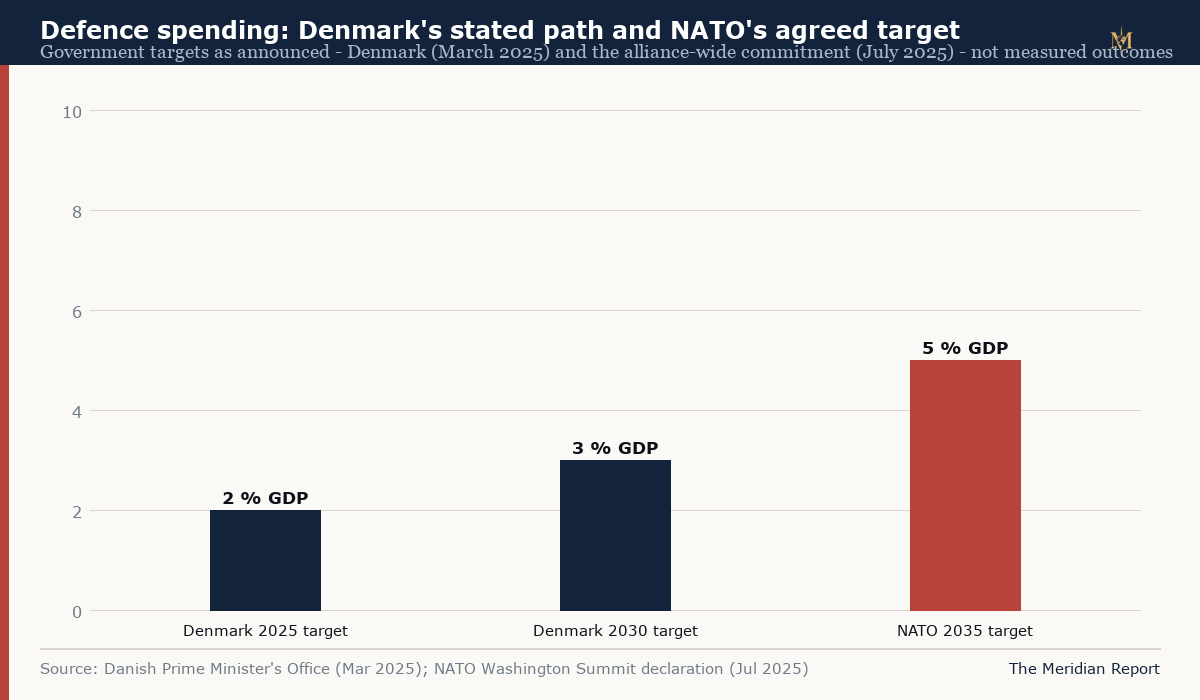
| March 2025 | Denmark announces a path to 3 percent of GDP in defence spending by 2030; Greenland elects Demokraatit first on a slow-independence platform (11 March) |
| 28 March 2025 | Vance visits Pituffik and criticizes Denmark publicly for what he calls inadequate defence of the island |
| 31 March 2025 | Pituffik commander Colonel Susannah Meyers emails base personnel that the Vice President's comments are "not reflective" of the installation |
| 11 April 2025 | Meyers is relieved of duty for "a loss of confidence in her ability to lead" |
| April 2025 | The administration directs US intelligence agencies to sharpen collection on Greenland's independence movement and Danish intentions, per reporting the Director of National Intelligence does not deny |
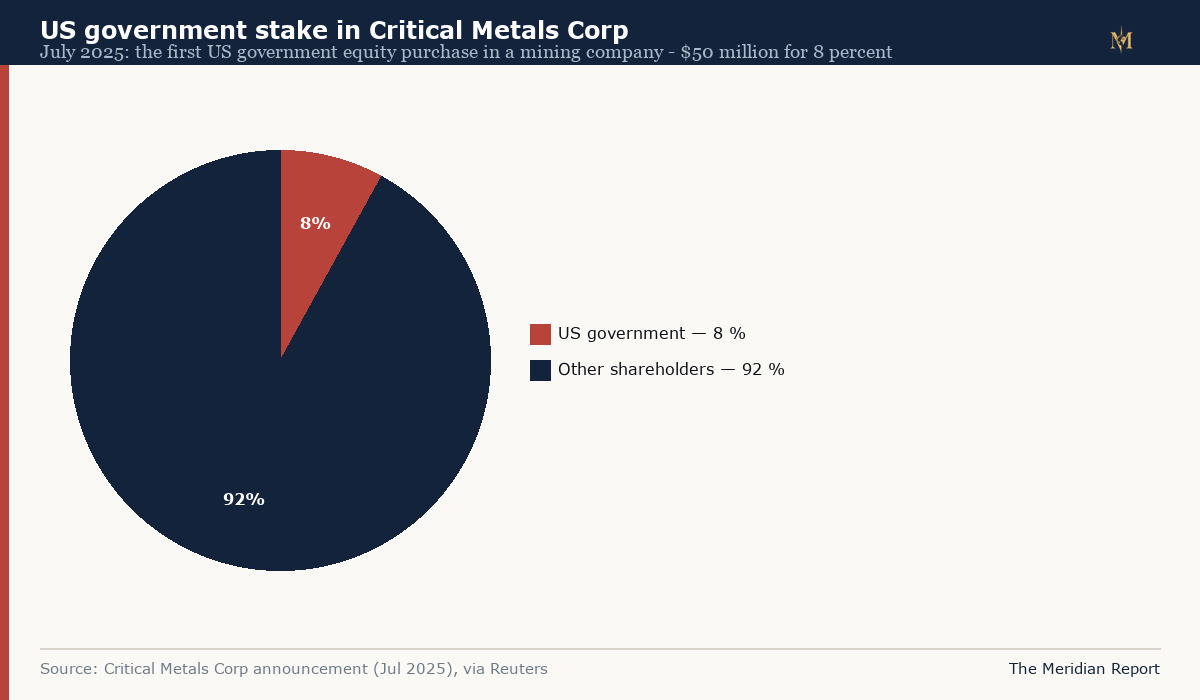
| July 2025 | Denmark joins the NATO-wide pledge of 5 percent (counting infrastructure) by 2035; the US government buys 8 percent of Critical Metals Corp for $50 million |
| September 2025 | The State Department expels the Danish defence attaché over alleged contacts with Greenlandic politicians; the Danish Foreign Ministry calls the step "utterly unacceptable" |
| February 2026 | Denmark's intelligence service assesses that US interest in Greenland's resources has become a factor in Arctic espionage targeting Denmark |
| 24 March 2026 | Danish general election: Frederiksen's bloc wins 84 seats against 77, short of the 90 needed for a majority, in a campaign clouded by the Greenland dispute |
| 3 June 2026 | A minority coalition government led by Frederiksen is appointed |
| 18 September 2026 | The defence agreement is announced; the text is not released |
Two trends converged underneath that record. Copenhagen bought influence over its own defence of the Arctic partly by meeting American capability demands, and Washington gained a Danish interest in closer integration with US Arctic infrastructure. The September 2026 agreement is the point where those two curves met.
The domestic politics ran in the same direction on both sides of the Atlantic. Denmark's general election in March 2026 was fought partly on the Greenland crisis, and the resulting coalition was weaker and more dependent on centrist parties than its predecessor. Polling in Denmark through 2025–26 (Pew, mid-2025) recorded collapsing confidence in the United States as a security partner alongside still-solid NATO support. A minority government facing an assertive Washington had every electoral incentive to convert the Arctic dispute into a signed, defined, treaty-limited cooperation document — the kind of artefact that constrains future unilateral claims. That is one interpretation, and it is the government's own supporters' account; the government's stated rationale is deterrence. The two are compatible.
What the deal is most plausibly about: the base, the radar, and the gap it fills
Strip out the sovereignty language and the agreement's confirmed content is infrastructure. That content answers to a specific capability problem, and it is worth setting out precisely because it is verifiable.
Pituffik Space Base is the northernmost US installation: built as Thule Air Base between 1951 and 1953, renamed in 2023, and home to the 12th Space Warning Squadron's AN/FPS-132 early-warning radar alongside satellite-control facilities — the northernmost elements of North America's missile-warning and space-surveillance network. The Arctic's strategic significance has risen with both ice retreat and the re-militarization of the High North — Russian long-range aviation and submarine activity, Chinese polar research and dual-use presence, and the growing volume of missile-warning and satellite-tracking traffic that passes over the pole.
The announced provisions — expanded garrison, new radar and missile-warning infrastructure, dual-use civilian airports — map directly onto that gap. A bilateral defence agreement that secures construction rights, logistics corridors through Nuuk and Kangerlussuaq, and legal status for an enlarged US workforce is the standard instrument for closing such a gap. It is also, not incidentally, the standard instrument's standard name: "defence cooperation agreement," the same genre as the ones the United States has signed with Nordic countries since 2023–24.
The genre has recent precedent with the same counterparty. Denmark, Finland and Sweden each signed Defence Cooperation Agreements with Washington in December 2023: Finland's grants US forces access to fifteen military areas, Sweden's to seventeen, both include construction and prepositioning rights, and Finland's took effect in September 2024. The Greenland agreement differs from those instruments in two ways that matter. It supplements a standing 1951-treaty regime rather than creating peacetime access from scratch, and it runs into a self-governing territory whose parliament must be consulted on the affairs the agreement touches — a step the Finnish and Swedish instruments do not require.
The sovereignty reading adds nothing to that analysis that the 1951 baseline does not already contain — except for one question that only the text can answer: whether the new defence areas enlarge the geographic footprint, and whether any provision is drafted to survive a Danish or Greenlandic attempt to end it. If the deal simply enlarges the areas and modernizes the rights, it is an infrastructure treaty wearing a sovereignty argument made about it by one signatory's head of state. If it contains perpetuity language or exclusive economic rights, it will be the first such instrument between the parties and will require real constitutional scrutiny in Copenhagen and Nuuk. The released text will settle this within weeks.
The minerals premise, and what the record shows
The deal's political selling point in Washington is minerals. The actual record is more mixed than the rhetoric, on both sides.
The deposits are real. Greenland holds internationally significant rare-earth and critical-mineral occurrences, and the US government has already put equity into one: in July 2025 it bought an 8 percent stake in Critical Metals Corp — the ASX/Nasdaq-listed developer of the Tanbreez project in southern Greenland — for $50 million, the first such purchase by the US government in a mining company and an explicit component of its critical-minerals strategy. The Tanbreez deposit's rare-earth ore body is among the largest in the world by contained metal.
The production record, however, is nil, and the counter-evidence is concrete. No mine has been built in Greenland in the modern era of exploration. The most advanced project, Kvanefjeld — majority-owned by Greenland Minerals, controlled by China's Shenghe Resources — lost its licence after Greenland's parliament banned uranium mining in 2021, since the deposit's economics depended on uranium by-production.
Tanbreez remains pre-development; its owner's own filings show production is contingent on financing, port access and a permitting process Greenland controls. And the Chinese footprint the deal is nominally hedging against has narrowed, not grown: the Nuuk airport consortium bid was withdrawn in 2018, Shenghe's project is shelved, and no Chinese company currently operates infrastructure in Greenland. A NATO official briefed on the agreement told reporters there was "no indication" China or Russia had plans for a military presence in Greenland — the premise the deal's hardest version would need.
What the minerals discussion does establish is a policy instrument, not a supply chain: Washington has purchased an option on a future mine, and the defence agreement will presumably further condition US financing and offtake for Greenlandic projects — all subject to Greenland's own resource-consent law, which the Self-Government Act reserves to Nuuk. Anyone reading the deal as delivering minerals is describing a timeline that does not exist; anyone reading it as securing influence over the future permitting process is describing what the instruments actually do.
Greenland's own position, and the numbers
The island's 57,000 people are the deal's most-consulted stakeholders and its least-institutionalized party. The polling is one-sided and has been stable: 85 percent against US absorption (Verian, January 2025), majorities for eventual independence from Denmark on Greenland's terms, and no measurable pro-US party in the Inatsisartut. The March 2025 parliamentary election — held under the campaign's shadow — returned the Demokraatit party first, with 30 percent of the vote and 10 of 31 seats, on a platform of slower-paced independence; Naleraq, the fastest-independence party, came second; the coalition under Jens-Frederik Nielsen that emerged negotiates with Copenhagen rather than seeking a new sovereign patron. The one ballot Greenlanders have cast on the question since 2024 was, in effect, a vote for gradualism.
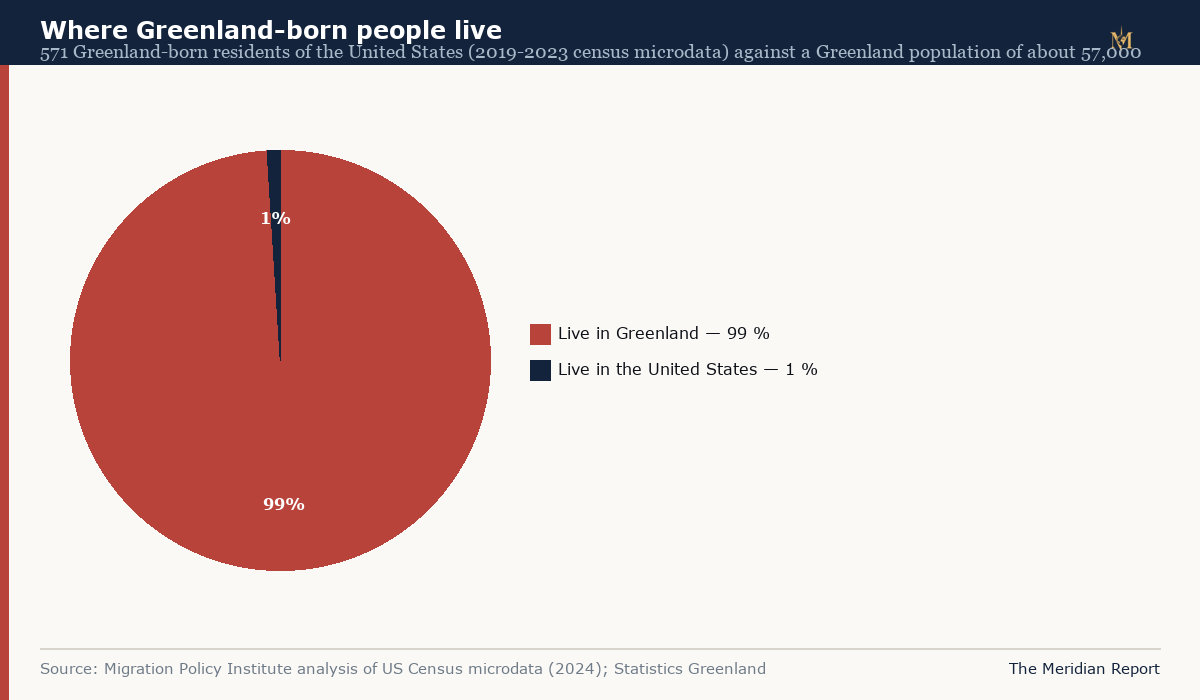
One number deserves more attention than it gets, because it quantifies how theoretical the "join America" scenario is. US census microdata analysed by the Migration Policy Institute puts the Greenland-born population of the United States at 571 people — about one percent of Greenlanders, in a country of 335 million. There is no Greenlandic diaspora in the United States to absorb, employ or lobby for integration. The structural ties that usually underpin absorption scenarios — migration networks, labour markets, family chains — do not exist.
What Greenland wants from the deal is visible in its own statement: defence cooperation under Danish sovereignty, economic development on Greenlandic terms, and the constitutional process for independence preserved. Nuuk's leverage is real — nothing about minerals, airports or land can be built without its consent — and both the Danish and American instruments leave that consent intact.
The fiscal knot underneath the constitutional one
The economics that make Greenland's eventual independence thinkable and unready at the same time are simple enough to state with available figures, and they frame what the deal can and cannot buy.
Denmark transfers about DKK 4.7 billion a year (roughly $720 million at the September 2026 exchange rate of about 6.5 krone to the dollar) to Greenland as a block grant — fixed in 2009 and not indexed, so its real value has fallen by roughly a third. The grant covers around half of Greenland's public budget, with fishing royalties supplying most of the rest. Every published fiscal analysis since 2016 that has examined independence scenarios has found the same arithmetic: at current service levels, no realistic combination of mineral royalties, fisheries expansion and tourism closes the gap for decades, which is why section 21 negotiations are expected to be long and why no Greenlandic government has set a referendum date.
A US defence presence changes this arithmetic at the margins — airport construction, logistics contracts, and eventually mine-linked royalties if a project is ever permitted and built — but it does not change it structurally, because the largest fiscal line (public services) is unaffected and the mineral upside is contingent on development that has not begun. The deal's economic significance for Greenland is as leverage: a second rich patron whose interest in the island raises the price both Washington and Copenhagen pay for Nuuk's cooperation. That leverage has been visible since 2019 and is now institutionalized. The mineral revenue line, meanwhile, is currently zero: no producing mine exists on which royalties could be assessed, and the two most advanced deposits — Kvanefjeld shelved, Tanbreez pre-development — sit years from production even under favourable assumptions. Whatever the defence agreement eventually does to Greenland's public finances, it does it through consent-gated development, not through the grant itself.
What would confirm or weaken each reading
Two readings of the agreement now coexist in the public record, and both make claims checkable in advance.
The narrow reading — an infrastructure treaty extending 1951 — is confirmed if: the released text enlarges defence areas but restates sovereignty explicitly; contains termination or review clauses; routes any civilian-infrastructure provisions through Greenlandic consent; and is ratified by the Folketing with language Copenhagen can cite as closing the sovereignty question. It is weakened if: the text contains perpetuity or exclusivity language beyond 1951, economic rights over resources, or any provision purporting to bind Greenland without its parliament's approval.
The broad reading — a step toward US primacy over the island — is confirmed if: the President's "permanent control" phrasing appears in any signed instrument; the text is withheld beyond the signing; ratification in Copenhagen is contested or delayed; Greenlandic consent is obtained without the Inatsisartut's full debate; or subsequent US policy treats the agreement as extinguishing Danish consultation rights. It is weakened by any of the mirror-image conditions — published text, explicit sovereignty clause, ordinary ratification, and Greenlandic parliamentary approval on the record.
The two readings converge on the same near-term observable: the text. Its release, expected within days of the General Assembly signing, will move most of what is currently disputed into evidence.
The Nordic DCAs also supply a ratification benchmark. Sweden's agreement entered into force in August 2024, eight months after signature, following parliamentary approval; a comparable timetable in the Kingdom would put the Greenland agreement's entry into force around mid-2027, with Folketing approval and the Inatsisartut's debate in the first half of that year.
What the available evidence does not establish
Honesty about the limits of the current record is what makes the checkable claims above worth having. As of 20 September 2026, the following cannot be established from public sources:
- Whether the draft contains any sovereignty-adjacent language at all, because the text is unpublished. No analysis of "what the deal means" can yet be more than inference from the parties' statements.
- Whether "permanent control" was improvisation, negotiation framing, or a description of a clause. The White House has not repeated or withdrawn the phrase in an official document.
- The precise map of any new defence areas, and whether the agreement's infrastructure provisions touch Greenlandic resource consent. Politico's and NPR's accounts agree on categories (radar, garrison, airports) but not on areas.
- Whether the agreement includes economic instruments — offtake guarantees, financing windows, or equity facilities — beyond the July 2025 Tanbreez purchase.
- The deal's ratification path: whether Copenhagen will seek Folketing approval by ordinary majority, whether the Inatsisartut's consent will be formalized, and on what schedule.
- How the agreement interacts with the Defence Cooperation Agreement Denmark signed with Washington in December 2023 — whether it amends, parallels or supersedes that instrument — is not addressed in any public statement.
- Whether any enlargement of the defence areas requires new land arrangements with affected communities, the legal flashpoint of 1953, is not addressed in any public statement.
None of these gaps blocks the report's established findings, which rest on the parties' statements and the constitutional record. But each one is a place where a confident account of the deal could be built on inference alone, and the record does not yet support inference.
The agreement in one paragraph
Denmark has signed a defence agreement that extends a 75-year-old American military presence in Greenland, under conditions that leave Danish sovereignty and Greenlandic consent formally intact. The President has described the same document in terms that, read literally, contradict both. The text is not yet public, so the contradiction is currently a disagreement about language rather than law — but the law is clear about what would be required for the President's version to be true: instruments of cession that neither party claims exist, approved by a Folketing that cannot lawfully give them and an Inatsisartut that has never been asked. The measurable reality in September 2026 is unchanged sovereignty, expanded basing, a purchased option on minerals that remain in the ground, and an island of 57,000 people whose constitutional position — and whose own preferences, measured repeatedly — will decide what any of this eventually means.
Frequently asked questions
Did the United States buy Greenland in September 2026? No. The agreement announced on 18 September 2026 is a defence deal, not a purchase or a cession. Denmark's government, Greenland's government and the US State Department's own readout all say no sovereignty changed hands. A sale would also be legally impossible under Denmark's constitution without Greenland's consent: section 21 of the Self-Government Act gives Greenland alone the decision to seek independence, and the Folketing can only approve what Greenland has itself decided.
What did Trump mean by "permanent control"? The phrase comes from the President's own announcement on 18 September. Neither party's official statements define it, and it has no established meaning in the law of treaties. If it refers to indefinite, exclusive US military use of expanded defence areas, that is consistent with — and broader than — rights the United States already holds under the 1951 treaty. If it were meant as sovereignty, it would contradict the treaty parties' own statements and would require constitutional steps in Denmark and Greenland that have not taken place.
What rights does the United States already have in Greenland? Substantial ones, dating to the 1951 Defence of Greenland agreement: construction and stationing of forces in agreed defence areas; US Jurisdiction over members of its forces and certain employees within those areas; navigation of US vessels and aircraft in and around Greenland without restriction and, within the defence areas, without the concurrence of Denmark; and supply of its forces free of duty. Pituffik Space Base has been continuously US-operated since 1951.
Can Greenland become independent, and how? Yes, through a process defined in the 2009 Self-Government Act. Greenland's parliament initiates negotiations on an independence arrangement; the Danish government and the Folketing must then consent. Section 21 also provides that the final decision rests with Greenland's residents in a referendum. No referendum has been scheduled. Polls since 2025 have found large majorities of Greenlanders against joining the United States — 85 percent in the January 2025 Verian survey — alongside majorities favouring eventual independence from Denmark on their own terms.
How much does Denmark pay Greenland each year? The block grant is about DKK 4.7 billion a year (roughly $720 million at the September 2026 exchange rate of about 6.5 krone to the dollar), fixed in 2009 and not indexed to inflation. Its real value has fallen by roughly a third since 2009. It covers around half of Greenland's public budget; fishing royalties supply most of the remainder. No published fiscal analysis produced since 2016 concludes that Greenland's public finances would be sustainable without the grant at current service levels — one reason independence negotiations under section 21 are expected to be lengthy.
What about the minerals — doesn't Greenland have the rare earths the US wants? Greenland holds significant deposits, and the Tanbreez project's US-listed developer sold an 8 percent equity stake to the US government for $50 million in July 2025 — the first US government equity purchase in a mining company. But no mine has yet been built in Greenland, the largest advanced project (Kvanefjeld) lost its licence after Greenland banned uranium mining in 2021, and the Chinese-linked footprint in the territory has actually narrowed since 2018. The minerals premise of the deal is an investment thesis, not a production record.
Sources
Primary and official: Agreement relating to the Defense of Greenland, 27 April 1951 (full text, Wikisource transcription of the US treaty series); Greenland Self-Government Act (2009), section 21; US State Department readout of the 18 September 2026 agreement; Danish Government and Naalakkersuisut statements of 18–19 September 2026; NATO Washington Summit declaration (July 2025); Danish Ministry of Foreign Affairs and Prime Minister's Office announcements (March 2025); Danish Defence Intelligence and Security Service assessments (2025–26); declassified 1946 State Department correspondence on the Byrnes offer.
Polling and data: Verian Group poll commissioned by Berlingske (January 2025, via Reuters and The Guardian); Pew Research Center Global Attitudes (2025, Danish views of the US and NATO); Migration Policy Institute analysis of US Census microdata on the Greenland-born population (2024); Statistics Greenland population series; Reuters, The Guardian and Sky News election reporting (Greenland, March 2025); Reuters and Al Jazeera election reporting (Denmark, March–June 2026).
Reporting: Reuters, Politico, NPR, Al Jazeera, The Guardian, AP, and Danish and Greenlandic media coverage of the 18–19 September 2026 agreement and the 2024–26 pressure campaign; Reuters on the Critical Metals Corp equity purchase (July 2025) and the Kvanefjeld licence decision (November 2021); AP on the 1946 purchase offer.
This report will be updated when the agreement's text is published and when ratification documents become available. The next scheduled verification point is the UN General Assembly signing.