
In the spring of 2024 a transmission planner at a European utility sat in a meeting that had, until then, been about civil engineering. The route for a new 380 kilovolt line had been agreed. The pylons were specified. What had not been settled was the transformer at each end, and the quotation for the first of them had just come back with a delivery date in 2028. The line would be ready in 2026. The planner's problem was no longer where to put the steel. It was how to explain to a regulator that the electricity would have nowhere to land.
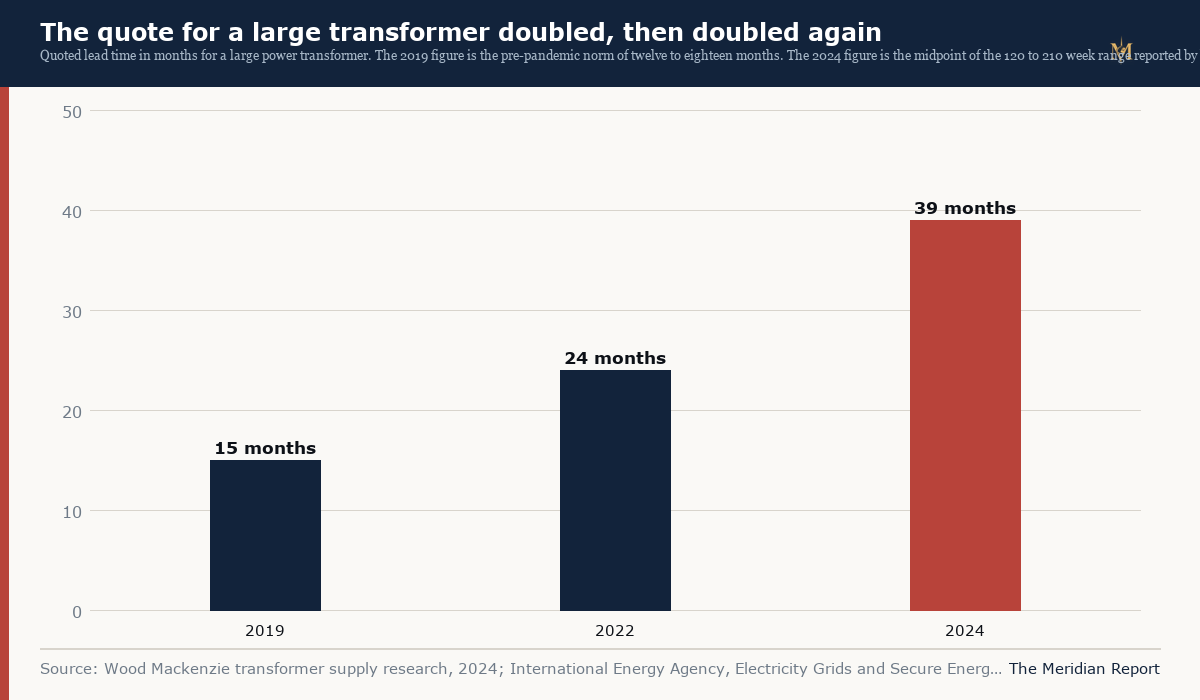
That sequence, a line finishing before the equipment that makes it useful, has become ordinary. The lead time for a large power transformer, the kind that steps voltage between transmission levels and carries hundreds of megavolt amperes, rose from about twelve to eighteen months before 2020 to a reported range of 120 to 210 weeks in 2024. The lower bound is two and a half years. The upper bound is four. The price of the equipment rose with the wait. Transformer supply research published in 2024 put large power transformer prices at roughly 60 to 70 per cent above 2020 levels, with distribution transformers rising further in some markets.
None of this is a mystery to the engineers who buy the equipment. It is a problem of physical capacity, skilled labour and specification, in that order, and it has been building since 2021. What is less widely understood is how completely the equipment cycle has reorganised the way electricity projects are financed, sequenced and approved. A transformer is not a component that arrives when needed. It is a reservation made years in advance, and the reservation has become the first decision in a project rather than the last.
What a transformer order actually commits
A large power transformer is not a commodity with a catalogue number. It is a design brief. The buyer specifies the rated power, the voltage ratio, the impedance, the cooling class, the tap changer arrangement, the winding material, the loss guarantees, the seismic qualification, the noise limits and the site conditions, and the manufacturer designs a unit that meets them. A 400 megavolt ampere, 400 kilovolt unit weighs several hundred tonnes including oil, stands perhaps fifteen metres tall and is built to last thirty to forty years. It cannot be shipped assembled in most cases, and it cannot be tested in place.
Manufacture begins with the core, which is stacked from thin sheets of grain-oriented electrical steel, each insulated from its neighbour, in a geometry designed to keep the magnetic flux inside the iron. The windings are wound from copper or aluminium conductor, dried, impregnated and assembled around the core. The whole assembly is dried under vacuum, tanked, filled with insulating oil and tested. The tests include impulse voltage, temperature rise, partial discharge and ratio measurement, and they take weeks. A unit that fails a test is not scrapped, but it is delayed while the fault is found and repaired, and the slot it occupied in the factory is consumed either way.
That process is why the manufacturing lead time is not the same as the delivery lead time. The factory has to schedule the design, the core steel, the windings, the tank fabrication, the drying, the test bay and the transport, and the test bay is a bottleneck in its own right because each unit occupies it for weeks. A plant that can build twenty units a year has twenty test slots a year. Adding a winding line does not add test slots. Adding test bays is capital expenditure with a long payback and a specialised work force, and it is not the kind of investment a manufacturer makes on the strength of a two-year order spike.
The buyer's commitment is equally long. A utility that places an order pays a design and engineering charge, commits to a delivery window, and often has to accept a price adjustment mechanism for copper, steel and labour. It may have to post a reservation fee for a slot that it will not use for three years. If the project is delayed by a planning appeal, the utility cannot simply move the transformer to another site: the unit is designed for the impedance and the fault level of the network it was ordered for. Resale is possible but limited, because the market for a bespoke 400 megavolt ampere unit is a market of a few dozen potential buyers worldwide.
The lead time moved from the factory to the balance sheet
When lead times were short, the transformer was a procurement detail near the end of a project. When they are four years, the transformer becomes a financial instrument. A developer that wants to energise a wind farm in 2028 has to secure a transformer slot before it has a power purchase agreement, which means spending money on equipment before the revenue contract exists. That inverts the normal sequence of project finance, in which the contract justifies the expenditure.
Utilities have responded with reservation agreements. Instead of ordering a specific unit, a utility buys an option on capacity in a manufacturer's order book, sometimes years ahead, and specifies the unit closer to the delivery date. Framework agreements between large utilities and the three or four manufacturers that dominate the high voltage market have become multi-year capacity allocations rather than price agreements. The effect is that the order book is not a list of transformers. It is a list of claims on the factory, and the claims are held by the largest buyers.
That structure favours incumbents. A municipal utility or a small developer cannot reserve capacity four years ahead without a balance sheet that can carry the commitment, and it cannot promise the volume that makes a framework agreement worth signing. It buys through intermediaries, pays a premium, or waits for a cancellation. In the United States, where the transmission system is fragmented across hundreds of owners, the aggregation problem is acute: a manufacturer would rather negotiate one contract for forty units with a large holding company than forty contracts for one unit each.
The alternative to waiting is to reduce the specification. A utility can accept a higher loss guarantee, a lower impedance tolerance, a standard cooling class or a smaller unit, and a manufacturer can then build it from a design it already knows. Some buyers have done exactly that, trading a fraction of a per cent of efficiency for a year of delivery time. The arithmetic usually favours the trade, because a transformer that arrives a year earlier allows a line to carry power a year earlier, and the value of that power exceeds the lifetime cost of the additional losses. But the decision has to be made by an engineer who has spent a career treating loss guarantees as a hard constraint, and it has to survive an audit that asks why the specification was weakened.
The shortage is in the steel before it is in the factory
The narrowest gate in the chain is not copper and it is not labour. It is grain-oriented electrical steel, the material that makes up the core. Ordinary steel is isotropic: its magnetic properties are the same in every direction. Grain-oriented steel is rolled and annealed so that the crystals align with the rolling direction, which reduces the energy lost as heat each time the magnetic field reverses. A transformer core built from it loses less, runs cooler and can be smaller for the same rating. Without it, every transformer on the network would be heavier and less efficient.
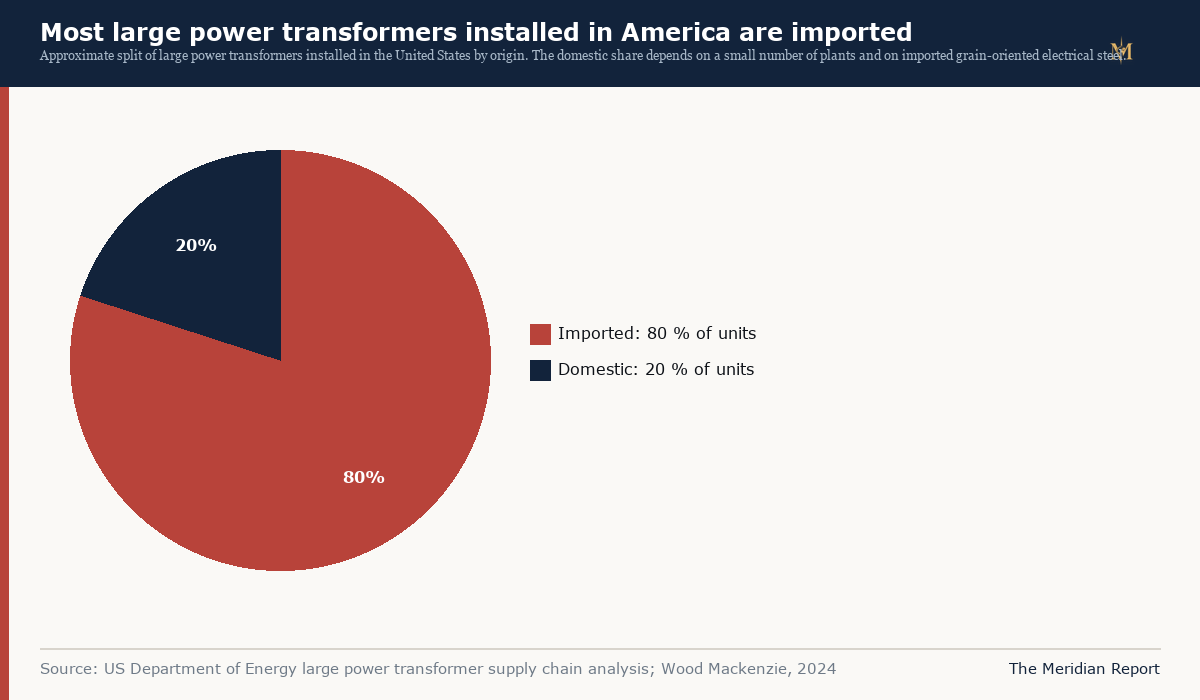
The number of plants that can make it is small. The process requires precise control of composition, rolling temperature, reduction ratio and annealing, and the know-how is concentrated in a handful of firms: Nippon Steel and JFE in Japan, POSCO in South Korea, ThyssenKrupp in Germany, Baosteel in China, NLMK in Russia, Stalprodukt in Poland and Cleveland-Cliffs in the United States. Cleveland-Cliffs describes itself as the only producer of grain-oriented electrical steel in the United States, and American transformer manufacturers import a large share of their core steel. The Department of Energy has for years put the import share of large power transformers at around 80 per cent, and the steel is part of why.
A new grain-oriented steel line is not a shed with a rolling mill. It is a multi-year capital project with a specialised annealing line, and the output has to be qualified by transformer manufacturers, which means samples, tests and a period in which the steel is used in units that a utility will then accept. The qualification period alone can run to eighteen months. Capacity announcements in the United States and Europe since 2022 have added tonnage, but they have added it at the margin, and the tonnage has to serve both transformer cores and the motors and generators that use the same family of steels.
The steel constraint explains something that otherwise looks like irrational behaviour. Manufacturers have been reluctant to quote short lead times even when they have spare winding capacity, because they cannot be sure of the core steel. A transformer factory without steel is a factory with a full order book and nothing to build. That is also why the price of the finished unit rose faster than the price of the steel: the scarcity rent sits at the point in the chain where the queue is longest, and the queue is longest where the fewest plants can add capacity quickly.
The queue and the shortage are different problems
There is a temptation to fold the transformer shortage into the better known story of interconnection queues. The two are related, but they are not the same, and confusing them leads to the wrong remedy.
An interconnection queue is an administrative and engineering queue. A generator applies to connect to the network, the network operator studies the impact, the applicant pays for upgrades, and the project receives a connection date. The queue in the United States held about 2,600 gigawatts of generation and storage capacity at the end of 2023, according to Lawrence Berkeley National Laboratory's annual survey, and only about one in seven projects requesting interconnection between 2000 and 2019 reached commercial operation. In Great Britain, the transmission connection queue reached roughly 700 gigawatts in 2024 against a peak demand of about 60 gigawatts. Those numbers are not measures of equipment shortage. They are measures of speculative applications, slow studies and a first come, first served rule that rewarded applying early over being ready.
A transformer shortage is a physical constraint. It does not care about queue position. A project can hold a connection date and still wait for a transformer, and it can hold a transformer and still wait for a connection date. In practice both bind at different times, and the interaction is what makes projects slip twice. A developer that ordered a transformer for a 2026 connection date, then lost its queue position in a reform that prioritised projects with planning consent, has a transformer and no date. A developer that won a date in the same reform may have no transformer.
The reforms now underway address the administrative queue. Great Britain moved to a system that assesses projects against readiness criteria and offers dates in a queue ordered by those criteria, and the network operator has been removing projects that cannot demonstrate progress. The United States has been moving, unevenly, toward cluster studies and financial commitments. These reforms shorten the administrative wait. They do not add a single transformer, and in the short run they may increase demand for equipment, because projects that were stalled in the queue now have dates and need hardware.
There is a second interaction that matters more for the politics. A data centre does not need a generator interconnection in the same way a wind farm does, but it does need a connection, and the connection often requires a new substation, a new transformer and upstream reinforcement. The load does not wait four years for a transformer, so the utility has to choose between serving the load with equipment it had allocated elsewhere, delaying the load, or delaying the maintenance it had planned. That choice is being made now in regulatory proceedings across the United States and Europe, and the equipment shortage is the reason it is unavoidable.
The price did not revert
A shortage that lasts a year is a disruption. A shortage that lasts five years changes behaviour. The transformer market has now been tight for long enough that buyers no longer plan on the old assumption, and the change in planning is doing as much to keep prices high as the underlying shortage.
The first behavioural change is that utilities are buying earlier. A utility that used to order a transformer eighteen months before energisation now orders it three years before, which adds to the order book and makes the lead time look longer even if physical capacity is unchanged. Some of the reported lead time extension is demand pulled forward rather than production lost. The second change is that utilities are holding more spares. A stock of spare transformers is expensive, because each one is a bespoke unit that may never be used, but the cost of an unplanned outage has risen, and the calculus has shifted. A third is that utilities are refurbishing units they would previously have replaced, which extends the life of assets that were already near the end of it.
Prices have followed. Transformer prices are usually indexed to copper, steel and labour, but the indexation does not capture the scarcity rent, which is negotiated rather than published. Buyers report that the rent is real and that it is not uniformly distributed: a standard distribution transformer bought in volume is priced very differently from a one-off 765 kilovolt unit. The manufacturers, for their part, have reported strong order intake and improved margins in their transformer businesses, which is what a capacity constrained market looks like from the inside.
The question that matters for electricity bills is who absorbs the increase. In a regulated transmission business, the cost of the equipment enters the rate base and is recovered over decades, so the immediate bill impact is small and the long-run impact is a slightly higher network charge. In a competitive generation market, the developer passes the cost into the auction bid, and the auction clears at a higher price. For a large industrial customer connecting directly, the cost often appears as a connection charge that has to be paid before the first unit of electricity arrives. The distributional effect is therefore regressive in an unexpected way: the customers with the least ability to wait pay the most for speed.
Where the constraint has started to ease
The picture is not uniform, and the differences matter. Distribution transformers, the smaller units that step voltage down to households and businesses, have seen the most new capacity. Several manufacturers expanded American plants after 2022, driven by utility demand and by federal industrial policy, and lead times for standard units shortened in some regions. The American market also saw new entrants and imports, particularly from Mexico, Canada and Asia, and the price premium for domestic units narrowed.
Large power transformers have not followed the same path. The number of plants that can build a 765 kilovolt unit is tiny, the qualification cycle is long, and the test bay capacity is expensive. Hitachi Energy announced in 2024 that it would invest about 1.5 billion dollars in transformer manufacturing, including new and expanded plants, and other manufacturers have announced their own programmes. Those investments will add capacity in the late 2020s. They will not add it in time for projects that need a unit in 2026.
The other source of relief has been demand destruction of a kind nobody wanted. Offshore wind projects cancelled or delayed in 2023 and 2024 released transformer slots into the market, and some of those slots were taken by data centres and by transmission reinforcement. That is a real reallocation, and it is a reminder that the equipment shortage is also a competition between the projects a society has decided to build. When a project is cancelled, its place in the queue does not disappear. It is reassigned.
Why standardisation is harder than it sounds
The obvious answer to a bespoke manufacturing bottleneck is to make the product less bespoke. If utilities agreed on a small set of standard transformer designs, manufacturers could build to stock, batch the cores and windings, and shorten delivery. The idea has been circulating for years, and the European Commission's grid action plan and various American utility consortia have pushed it.
It runs into a real engineering obstacle. A transformer's impedance is chosen to limit fault current and to coordinate with the protection settings of the network around it. Two utilities with different protection philosophies need different impedances, and a standard unit that suits one network may not suit the other. Voltage ratios vary with the local transmission levels. Climate and seismic requirements vary. The result is that even within one country, the number of distinct designs is in the thousands, and each design has to be engineered, tested and approved.
Standardisation therefore works best at the level of components and interfaces rather than whole units: a standard tank, a standard bushing family, a standard cooling package, standard test protocols, and a modular design that lets a manufacturer assemble a unit from qualified building blocks. That is a slower kind of standardisation, and it requires utilities to give up the belief that every network is unique. Some are experimenting with it. The scale of the prize is large enough that the experiments will continue.
There is a second route that avoids the specification problem: buy fewer, bigger units. A utility that replaces three 200 megavolt ampere transformers with two 300 megavolt ampere units reduces the number of orders, though not necessarily the total capacity, and it concentrates the risk of a single failure. That trade is being made in some network plans, and it is the kind of decision that looks obviously correct until a unit fails and the network loses a third of its capacity at once.
The replacement backlog competes with the new load
A transmission network is not only a set of lines waiting to be built. It is a set of equipment waiting to be replaced. Large power transformers have a design life of thirty to forty years, and a substantial share of the units now in service in Europe and North America was installed between the late 1950s and the late 1970s. Those units were sized for the load of their era, cooled with the practices of their era and specified for a network that had far fewer power electronic converters connected to it. They are reaching the end of their service life at the same time as the network is being asked to carry more power, from more variable sources, over longer distances.
The replacement demand is easy to overlook because it does not appear as a new project. It appears in a maintenance plan, as a condition assessment and a recommended replacement date, and it competes for the same factory slots as the new line and the data centre connection. A utility that has to replace a failing 1968 unit at a city substation cannot defer the replacement indefinitely, because the alternative is a summer peak with no spare capacity. It also cannot easily use the occasion to build a larger unit, because the substation footprint, the foundations and the protection settings were designed for the old one.
The competition has a political dimension that the new-build debate often misses. Replacing a transformer does not increase the amount of electricity a network can carry, so it does not show up as progress toward a connection target or a renewable generation goal. It does prevent a failure. Utilities that have deferred replacement to free capital for new connections have discovered that deferred replacement is not a saving, it is a liability with an uncertain maturity date. The transformer shortage has made that liability visible, because a unit ordered late for a replacement has the same four year queue as a unit ordered late for an expansion.
There is an engineering response that does not require new manufacturing capacity: condition monitoring and life extension. Dissolved gas analysis, thermal imaging, bushing monitoring and partial discharge testing can extend the safe life of a unit by years, and a utility that knows the condition of its fleet can prioritise the units that genuinely need replacing. The limits of that approach are real, because a unit with degraded cellulose insulation cannot be restored to new condition, but the difference between replacing a transformer at year thirty five and replacing it at year forty five is a decade of avoided demand on a constrained supply chain.
The last hundred miles are also slow
The factory gate is not the end of the lead time. A large transformer leaves the plant on a specialised trailer or a rail car, and the route has to be surveyed before it is used: bridge load ratings, overhead line clearances, roundabout geometry and road width all constrain where a unit of several hundred tonnes can travel. A route that works for a 200 megavolt ampere unit may not work for the 400 megavolt ampere replacement, which is one reason utilities sometimes choose two smaller units over one larger one even when the larger unit is technically preferable.
The survey and the permits take months, and they are usually commissioned late, after the equipment order is placed. A utility that discovers in the final year of a four year wait that the last bridge on the route cannot take the load has added a year to a project that was already late. Some networks now survey the transport route at the same time as they place the order, which sounds obvious and was not standard practice when transformers arrived in eighteen months and the route was always the same.
Sea transport adds another layer. Units shipped from Asia to Europe or North America travel as heavy lift cargo, which depends on a small number of specialist vessels and on port cranes rated for the weight. Port congestion and vessel availability were both disrupted after 2021, and the heavy lift market is thin enough that a single large project can absorb the available capacity for a season. The equipment is robust, but the logistics around it are not.
What the numbers do not establish
The lead time figures are survey responses, not a census. They describe what buyers were quoted, not what manufacturers delivered, and they mix units of very different size and complexity. A four year quote for a 765 kilovolt unit and a four year quote for a 200 megavolt ampere unit mean different things, and a single number hides the distribution.
The price figures are indices built from a sample of transactions, and they carry a mix effect. If the average order shifted toward larger and more complex units, the index would rise even if the price of any given unit was flat. The reported increases are large enough that mix cannot explain all of them, but the precise number should be treated as an estimate rather than a measurement.
The queue figures are applications, not projects. A gigawatt in an interconnection queue may be a serious proposal with land, finance and a customer, or it may be a speculative placeholder. The fall in queue length after a reform is not necessarily a fall in intended capacity; it can be a fall in applications that were never going to be built.
And the claim that the shortage is the binding constraint on the energy transition is a claim about relative constraints, not an absolute one. Planning consent, grid operating limits, supply of skilled labour, turbine supply and financing costs are all binding at different points. The transformer is the constraint that is easiest to measure, because it appears as a date on a purchase order, and easy to measure is not the same as most important. What the record does establish is narrower: the equipment cycle has become long enough that it now shapes which projects get built and when, and the shaping happens years before anyone cuts a sod.
Sources
- International Energy Agency, Electricity Grids and Secure Energy Transitions, October 2023.
- International Energy Agency, World Energy Investment 2024.
- European Commission, EU Action Plan for Grids, COM(2023) 757 final, November 2023.
- Lawrence Berkeley National Laboratory, Queued Up, 2024 edition.
- National Energy System Operator, connection queue reform publications, 2024 to 2025.
- Office of Gas and Electricity Markets, Connections Reform programme.
- Cleveland-Cliffs, annual report and grain-oriented electrical steel disclosures.
- IEEE Standard C57.12.90, Test Code for Liquid-Immersed Distribution, Power, and Regulating Transformers.
- Hitachi Energy, transformer manufacturing investment announcement, 2024.
- Wood Mackenzie, transformer supply and lead time research, 2024.