
On 1 January 2025 a legal obligation took effect at every airport in the European Union: fuel suppliers had to ensure that at least two per cent of the aviation fuel they put into the system was sustainable. The obligation is small, and it was met. Almost all of the fuel that satisfied it was made from used cooking oil or animal fat, through a process that has been industrial for about fifteen years and that turns waste fats into a hydrocarbon indistinguishable enough from kerosene to be blended into it.
The next milestone is six per cent in 2030. Then twenty per cent in 2035. Then thirty four in 2040, forty two in 2045 and seventy in 2050. The first increment was met with a feedstock that is collected from restaurant fryers and rendered from slaughterhouses, and the supply of that feedstock is not a policy variable. It is a function of how much food is fried and how many animals are slaughtered, and it is already being fought over by the road transport industry, which can use the same molecules and often values them more highly.
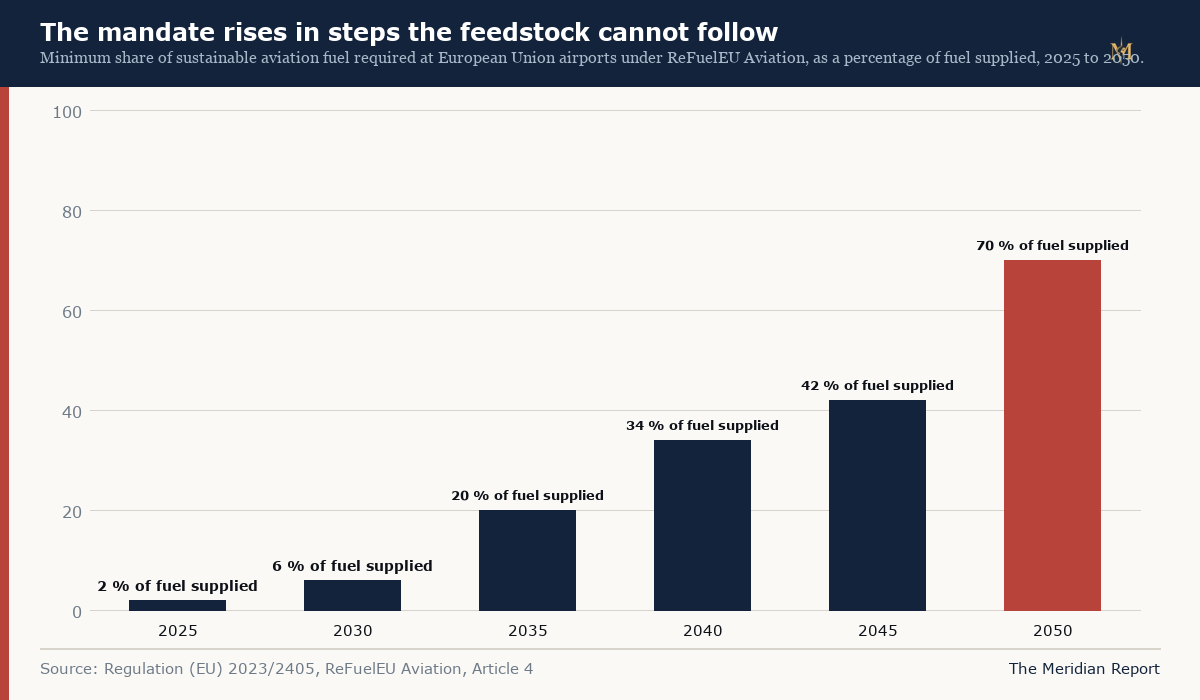
That is the central tension in aviation decarbonisation. The policy has been written as if the constraint were demand, and the constraint is supply. Airlines are required to buy a product that is made from a waste stream whose total volume is known, whose collection is expensive, whose traceability is contested and whose alternative use is subsidised. The mandate can be met for the first few percentage points. The arithmetic beyond that requires a different industry.
What the fuel is, and what it is not
Sustainable aviation fuel is not one product. It is a family of fuels that meet a specification, ASTM D7566, which defines how a synthetic hydrocarbon can be blended with conventional jet fuel and what the blend has to contain. The specification exists because a jet engine is a safety critical device, and a fuel that burns slightly differently, freezes at a different temperature or lacks the aromatic compounds that swell rubber seals can cause a failure that no airline will accept.
The dominant pathway is HEFA, which stands for hydroprocessed esters and fatty acids. The feedstock, whether used cooking oil, tallow, or a refined vegetable oil, is treated with hydrogen at high temperature and pressure to remove oxygen and to saturate the molecules. The product is then fractionated into a kerosene range and blended. The process is well understood, the capital cost is moderate relative to a refinery, and the product is a drop in fuel.
The other pathways are further from commercial scale. Alcohol to jet converts ethanol or methanol into hydrocarbons. Gasification and Fischer Tropsch converts municipal solid waste or biomass into synthesis gas and then into liquid fuel. Power to liquid, sometimes called e-kerosene, combines green hydrogen with captured carbon dioxide to make a synthetic crude that is then refined. Each has a different feedstock, a different cost and a different level of technical maturity, and each is qualified under a separate annex to the specification.
The blend limit matters more than it sounds. Most pathways are approved for a maximum of 50 per cent synthetic fuel in the blend, because the synthetic product has fewer aromatic compounds than conventional kerosene. A mandate of 70 per cent in 2050 is therefore not achievable with the current specification unless the limit is raised or the synthetic fuel is formulated to contain aromatics. Both are being worked on. Neither is yet approved for routine use.
The mandate path is steeper than the supply curve
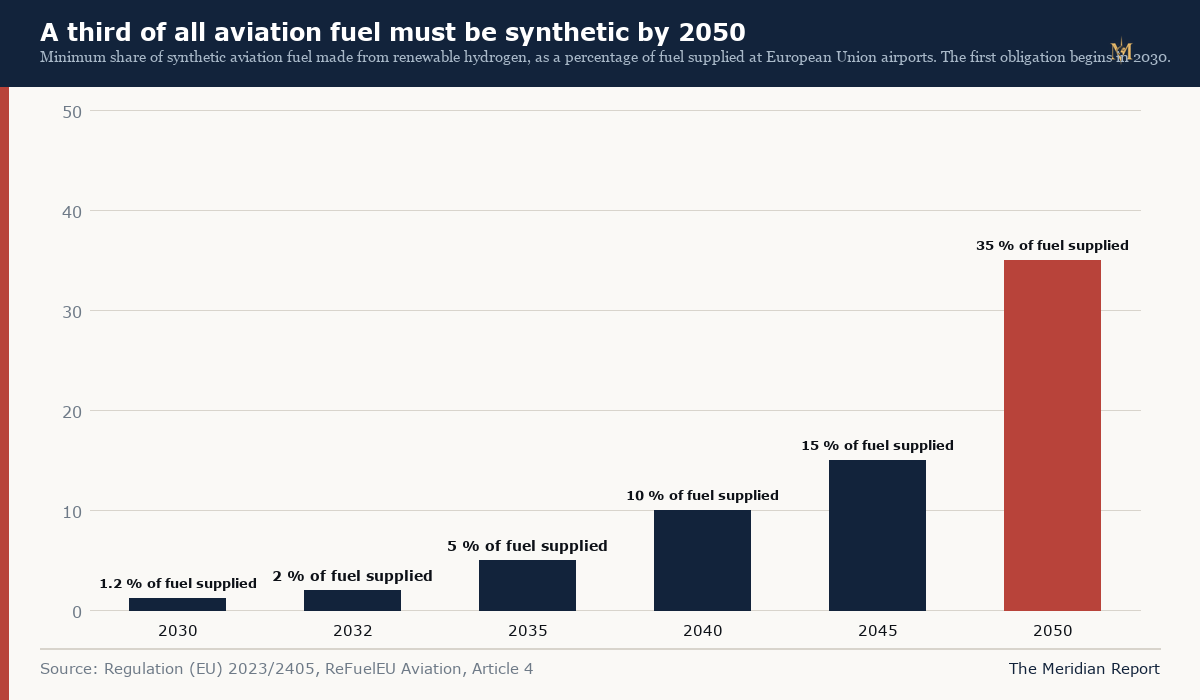
The European Union's regulation is the most detailed. It places the obligation on fuel suppliers rather than on airlines, which means the supplier that delivers fuel to an airport has to demonstrate the blend. It includes a sub-mandate for synthetic aviation fuels made from renewable hydrogen, starting at 1.2 per cent in 2030 and rising to 35 per cent in 2050. It allows flexibility mechanisms, including the ability to count fuel uploaded at one airport against obligations at another within the union.
The United Kingdom has its own mandate, starting at 2 per cent in 2025 and rising to 10 per cent in 2030 and 22 per cent in 2040, with a buy out mechanism that lets a supplier pay a fixed price instead of supplying the fuel. The buy out price is set by the government and is intended to cap the cost to consumers while keeping pressure on suppliers to blend.
The supply side is the problem. The International Air Transport Association has estimated that global sustainable aviation fuel production was around one million tonnes in 2024, which is about 0.3 per cent of jet fuel use, and projected around two million tonnes in 2025. The industry's own target is 100 million tonnes by 2030 in some scenarios, which would be a hundredfold increase in six years and would require every announced project to be built on time.
The gap between the mandate and the production is not a forecast of failure. It is a description of the arithmetic that has to be closed by investment, and the investment depends on feedstock, on policy stability and on the price that airlines are willing to pay.
HEFA is a waste disposal business
The economics of HEFA are the economics of waste collection. The feedstock is not grown for the purpose in most cases. It is collected from restaurants, food factories, rendering plants and municipal waste systems, and the collection cost is a large share of the total. A used cooking oil collector has to visit thousands of sites, test the oil for contamination, transport it to a processing plant and clean it before it can be converted. The oil itself has a low value at the point of collection and a much higher value at the plant gate, because the plant needs it and the supply is limited.
That structure explains why the price of the fuel is tied to policy elsewhere. In the United States, renewable diesel made from the same fats and oils qualifies for credits under the Renewable Fuel Standard and under state programmes such as California's Low Carbon Fuel Standard. When those credits are high, a refiner will pay more for used cooking oil than an aviation fuel producer can afford, and the aviation producer either pays the higher price or loses the feedstock. The aviation mandate does not create the feedstock; it competes for it with a truck fleet that has its own mandate.
The same competition exists in Europe, where the renewable energy directive sets targets for transport fuels and counts some waste based fuels toward them. A molecule of used cooking oil can be turned into road diesel or into jet fuel, and the market allocates it to whichever use has the higher subsidy. Aviation's disadvantage is that it has fewer alternatives: a truck can run on electricity, and a plane cannot, at least not on the routes that matter for emissions.
Used cooking oil has a traceability problem
The supply of used cooking oil is limited, and the reported supply has grown faster than the number of restaurants. That discrepancy has consequences.
In 2024 the European Union imposed anti-dumping duties on biodiesel imports from China, after an investigation found that the products were being sold below cost and that the feedstock declarations were not reliable. The investigation raised a question that applies to the whole waste based fuel industry: how do you prove that a shipment of used cooking oil is what it says it is, and that it was not virgin vegetable oil that has been passed through a fryer to qualify?
Certification schemes exist. They audit collectors and processors, they require mass balance accounting and they issue sustainability certificates that travel with the fuel. The schemes are only as good as the auditors, and the auditors are paid by the operators they audit. The European Commission has been tightening the rules, and the United States has its own traceability requirements under the renewable fuel programme, but the underlying problem remains: a waste stream is easy to adulterate and hard to verify at the point of import.
For aviation, the problem is more serious than for road fuel, because the mandate counts on waste. If a significant share of the claimed used cooking oil is not waste, then the emission reduction attributed to the fuel is overstated, and the airline that buys it has paid for a benefit that does not exist. That is a reputational risk as much as a regulatory one, and it is why the certification schemes are under pressure to move from document audits to physical testing.
The next pathways cost more, and the cost is the point
If the waste stream cannot supply the mandate, the next increment has to come from something else. The candidates are alcohol to jet, gasification of waste, and power to liquid. All three are more expensive than HEFA, and the difference is not a small premium.
Power to liquid is the most expensive and the most scalable in principle. It requires green hydrogen, which requires renewable electricity, and it requires captured carbon dioxide, which requires either a industrial source or direct air capture. The conversion of hydrogen and carbon dioxide into a liquid fuel loses most of the energy in the process, so the electricity requirement per tonne of fuel is very large. The result is a fuel that can cost several times the price of kerosene, depending on the price of electricity and the cost of the capture.
The European Union's sub-mandate for synthetic fuel acknowledges the cost by starting small: 1.2 per cent in 2030, 2 per cent in 2032, 5 per cent in 2035. That schedule gives the industry time to build, and it also gives it a guaranteed customer for a product that would otherwise be uneconomic. Whether the industry can build at that pace is the open question, because a power to liquid plant is a chemical plant with a hydrogen supply, and neither the electrolyser nor the carbon capture supply chain has been built at the scale the mandate assumes.
The airport is the last mile
A mandate on fuel supplied is also a mandate on airport infrastructure, and the infrastructure is not designed for two products. Most large airports receive jet fuel through a hydrant system, a network of pipes under the apron that fills aircraft from a central fuel farm. The system assumes one specification. Adding a second product means either a separate tank, a separate line and a separate refuelling truck, or a blending operation at the fuel farm that produces a single specification compliant blend for every aircraft.
The blend approach is what most airports are doing, because it requires the least new infrastructure. The fuel supplier delivers sustainable fuel to the airport, blends it at the tank farm to the mandated percentage and pumps the blend through the existing hydrant system. That works as long as the blend is homogeneous, the certification is in place and the percentage is the same for every flight. It breaks down when an airline wants a higher blend than the mandate for a particular route, because the hydrant system cannot deliver two products at once without a separate line.
Segregated supply exists at a few airports, usually for demonstration flights or for corporate customers willing to pay. It is expensive, because it duplicates storage and transport for a small volume. The cost falls on the airline that wants it, and the demand is limited by the price.
The infrastructure cost is real but it is not the binding constraint. Airports can blend to two per cent with modest investment. The problem arrives at the blend limits and at the volumes required by the later mandates, when the fuel farm needs more tank capacity for the sustainable component than it has, and when the pipeline that feeds the airport needs to carry a product it was not designed for. Those are capital projects with planning timelines, and they are being planned now against a supply of fuel that does not yet exist.
The used cooking oil market is now a policy market
Used cooking oil used to be a disposal problem with a small value. It is now a globally traded commodity whose price is set by the intersection of three policies: the European renewable energy directive, the American renewable fuel standard and the California low carbon fuel standard, plus the aviation mandates that sit on top.
The trade pattern reflects the policy. China became a large exporter of used cooking oil to Europe and the United States, because its restaurant sector generates a large volume and its domestic biofuel mandate was smaller than its supply. The European Union's anti-dumping investigation into biodiesel imports found that the trade was distorted, and the duties that followed changed the flow. The United States imported large volumes for renewable diesel, and the incentive to claim a waste feedstock created a verification problem that the Environmental Protection Agency has been trying to close.
The price effect is straightforward. When renewable diesel credits are high, the oil goes to road fuel. When aviation mandates create a premium, some of it goes to aviation. The aviation industry cannot outbid a road fuel producer that receives a credit worth more per tonne, unless the aviation mandate creates its own premium through scarcity or through a penalty for non-compliance. The mandates do create such a premium, which is why the price of the fuel is above the price of the feedstock plus processing.
That is a market working as designed. It is also a market in which the aviation industry is a price taker on a waste stream it does not control, and in which the volume available to aviation depends on decisions made by energy ministries about road transport. The two per cent mandate was met because the volume was small. The twenty per cent mandate will be met only if the waste stream grows, the competing uses shrink, or a different feedstock arrives.
Converting a refinery is faster than building one
One reason the industry believes it can scale is that it does not have to build every plant from scratch. A conventional refinery has the hydrotreating, fractionation and hydrogen infrastructure that a HEFA plant needs, and several refineries in Europe and North America have been converted or co-processed renewable feedstocks in existing units.
The conversions are faster than greenfield construction, but they are not free. A conversion requires new feedstock handling, a pre-treatment plant to remove contaminants, additional hydrogen and a fractionation section to produce a jet cut rather than a diesel cut. The capital cost is in the hundreds of millions of dollars for a plant producing a few hundred thousand tonnes a year, and the timeline is two to four years, which is shorter than a greenfield refinery but not short enough to meet a mandate that rises in five year steps.
The economics depend on the product mix. A plant that can make diesel, naphtha and jet fuel will choose the mix that maximises revenue, and jet fuel is not always the highest value product. The aviation mandate creates a demand for jet, and the co-products have their own markets. A plant that is built for road fuel and co-processes a jet cut is a flexible asset, and flexibility is valuable in a market where policy can change the relative price of the products overnight.
Co-processing is the fastest route to volume and the least transparent. When renewable feedstock is fed into a unit that also processes fossil crude, the resulting fuel is a blend, and the sustainability accounting has to allocate the renewable content to the products. The rules for that allocation differ between jurisdictions, and the aviation industry has been cautious about accepting co-processed fuel under its certification schemes because the chain of custody is harder to prove.
What airlines actually pay
The cost of the mandate is not the price of the fuel multiplied by the volume, because airlines do not buy at a single price. It is the difference between the sustainable fuel price and the kerosene price, multiplied by the mandated volume, plus the cost of the infrastructure to blend and deliver it.
At a two per cent blend, the cost per flight is small. At twenty per cent, it is material, and at seventy per cent it is a different business. The incidence depends on the route, because a long haul flight burns more fuel per passenger and the fuel is a larger share of the ticket price, and on the competition, because an airline on a route with a low cost competitor cannot pass the cost on.
Airlines have responded by signing offtake agreements with producers, sometimes years before the plant is built, and by investing in producers directly. Those agreements transfer the risk of the plant's construction to the airline, in exchange for a share of the output. They are the closest thing the industry has to a supply contract, and they are also a bet that the producer can deliver, which several announced projects have not.
What the accounting does not capture
The emissions accounting for sustainable aviation fuel is based on life cycle analysis: the emissions from producing the fuel, including the collection and processing of the feedstock, compared with the emissions from the kerosene it replaces. The result is a percentage reduction that varies by feedstock and by methodology, and the variation is large enough to change the policy conclusion.
A fuel made from used cooking oil might be credited with an 80 per cent reduction. A fuel made from palm oil, which some schemes allow, might be credited with a much smaller reduction once land use change is counted, and might not be allowed at all under the European rules. The accounting is contested, the methodologies differ between jurisdictions, and the same fuel can have a different carbon intensity depending on where it is counted.
Book and claim adds another layer. Under a book and claim system, the environmental attribute of a quantity of fuel can be sold separately from the physical fuel, so an airline can claim a reduction for fuel that was delivered somewhere else. The system is necessary for a global industry with a limited number of production sites, and it creates a risk of double counting if the attribute is sold more than once. The registries that track the attributes are still being built, and the rules for transferring them between jurisdictions are not settled.
What happens if traffic grows faster than the blend
The mandate regulates the carbon intensity of fuel, not the quantity of flying. If aviation traffic grows at three or four per cent a year, the fuel burned in 2035 will be substantially greater than today, and a twenty per cent blend will produce a smaller reduction than the percentage suggests. The emissions from the sector can rise even if every mandate is met.
That is not an argument against the mandates. It is an argument for measuring them against the right baseline. A policy that reduces the carbon intensity of a growing industry has to reduce it faster than the industry grows, and the current schedules do not obviously do that. The European Union's own impact assessment for the regulation recognised the issue and relied on the assumption that the sustainable fuel would displace kerosene rather than add to it, which is true per litre and not true per year.
The counter-evidence: efficiency is doing more work than fuel
The aviation industry's emissions per passenger kilometre have fallen steadily for decades, through better engines, lighter airframes, higher load factors and more efficient operations. A new aircraft generation can be fifteen to twenty per cent more efficient than the one it replaces, and the replacement cycle is long but continuous.
That matters because the fuel mandate is not the only lever. If the fleet turns over on schedule and traffic grows modestly, the efficiency gain can offset a significant share of the growth. The mandate then becomes a way to reduce the residual, rather than the main instrument. The risk is that the efficiency gain is assumed rather than delivered, and that the mandate is set as if the residual were the whole problem.
The part of the problem the fuel does not touch
Aviation's climate effect is not only the carbon dioxide in its exhaust. Nitrogen oxides, soot and water vapour at altitude produce contrails and cirrus cloud changes that warm the atmosphere, and the scientific estimate of that effect is large enough that it cannot be left out of a serious accounting. The exact magnitude is uncertain, and the uncertainty is one reason policy has focused on carbon dioxide, which is easier to measure and easier to regulate.
Sustainable fuel changes the non-carbon part of the effect as well as the carbon part, because it burns more cleanly and produces fewer soot particles, which changes the contrail formation. The direction is favourable and the size is not well established. A mandate that counts only carbon dioxide therefore undervalues the fuel in one respect, and an airline that markets the fuel on the basis of contrails is claiming a benefit that the measurement does not yet support.
The other demand-side measures are cheaper and less fashionable. A more efficient aircraft, a higher load factor, a slower cruise speed and a routing that avoids the most sensitive airspace all reduce the effect without requiring a new fuel industry. They are limited by the fleet, by the schedule and by the air traffic system, and they are not a substitute for the fuel. They are a reminder that the mandate is one instrument among several, and that the cheapest instruments are often the ones that do not produce a photograph of a fuel truck.
What the numbers do not establish
The production figures are estimates compiled by industry bodies from company reports and project announcements. A plant that is announced is not a plant that is built, and a plant that is built is not a plant that runs at capacity. The gap between announcement and output has been wide in this sector.
The mandate percentages are shares of fuel supplied, not shares of emissions reduced. A two per cent blend of a fuel that reduces emissions by 70 per cent reduces the emissions of the fuel supplied by 1.4 per cent, and the arithmetic of the later mandates is more demanding than the headline percentage suggests.
The feedstock supply estimates are contested. Different studies use different assumptions about collection rates, competing uses and the share of waste that is genuinely available, and the range of estimates is wide enough that the policy conclusion can change with the assumption.
And the claim that the mandates are achievable is a claim about a supply chain that does not yet exist at the required scale. The record establishes that the first increment was met, that it was met mostly with waste fats, and that the next increments require feedstocks and pathways that are more expensive and less mature. Whether they arrive on schedule is not a question the current data can answer.
Sources
- Regulation (EU) 2023/2405 on ensuring a level playing field for sustainable air transport.
- International Air Transport Association, sustainable aviation fuel production and outlook statements, 2024 and 2025.
- International Civil Aviation Organization, CORSIA and sustainable fuel certification.
- ASTM International, D7566 Standard Specification for Aviation Turbine Fuel Containing Synthesized Hydrocarbons.
- European Commission, ReFuelEU Aviation implementation and feedstock analysis.
- UK Department for Transport, Sustainable Aviation Fuel Mandate.
- US Department of Energy, Sustainable Aviation Fuel Grand Challenge.
- European Union, anti-dumping measures on biodiesel imports, 2024.
- International Energy Agency, aviation tracking report, 2024.