
In the spring of 2024 a European utility signed a fuel contract for a reactor that would not be refuelled until 2027. The contract covered the uranium, the conversion, the enrichment and the fabrication, and it was structured as four agreements because four different companies would perform the work. The uranium was the easy part. There was plenty of it, the price was known and the seller was a mining company with a long record. The conversion slot was harder. The enrichment slot was harder still, and the fabrication line had to be booked separately.
That sequence is the nuclear fuel cycle, and it is not a single market. It is four industries stacked on top of each other, each with its own plants, its own skills, its own permitting regime and its own queue. A reactor operator buys the output of all four, and the security of its fuel supply is the security of the weakest link. For most of the last thirty years the weakest link was the price, which was low enough that nobody worried about the chain. Since 2022 the weakest link has been capacity, and the capacity takes years to build.
The distinction matters because the public argument about nuclear power is usually conducted at the level of reactors and uranium. A country is said to be energy secure if it has reactors and a supply of uranium, and the fuel is treated as a commodity that arrives when needed. The fuel cycle is where that assumption fails. A country can have reactors, mines and a stockpile of uranium oxide and still be unable to fuel them, because the oxide has to be converted, the gas has to be enriched and the enriched product has to be fabricated, and those three steps are concentrated in a small number of plants in a small number of countries.
Four industries behind one fuel assembly
The first industry is mining and milling. Uranium ore is dug out of the ground, or dissolved and pumped to the surface in an in situ leach operation, and the uranium is concentrated into a yellow powder that the industry calls yellowcake and the market calls U3O8. The product is a commodity, it trades in a spot market and a term market, and it is priced per pound of uranium oxide. Mining is cyclical, capital intensive and geographically concentrated: Kazakhstan produces the largest share, followed by Canada, Namibia, Australia, Uzbekistan and Russia.
The second industry is conversion. The yellowcake is converted into uranium hexafluoride, a compound of uranium and fluorine that becomes a gas at a modest temperature. The gas is the feed for enrichment, and it has to be pure enough that the enrichment plant is not contaminated. Conversion is a chemical plant business, and there are very few of them: Honeywell's Metropolis Works in Illinois, Cameco's Port Hope in Ontario, Westinghouse's Springfields in England, Orano's Pierrelatte in France, and plants in Russia, China and a few other countries. The capacity is measured in tonnes of uranium per year, and the plants have been running close to their limits.
The third industry is enrichment. Natural uranium is about 0.7 per cent uranium 235 by mass, and most power reactors need between 3 and 5 per cent. Enrichment raises the concentration by separating the slightly lighter uranium 235 atoms from the slightly heavier uranium 238 atoms, and the separation is done by spinning the gas in a centrifuge at very high speed. The centrifuge is the most closely guarded machine in the civil nuclear industry, and the plants that house them are large, expensive and slow to build.
The fourth industry is fabrication. The enriched uranium is converted into uranium dioxide powder, pressed into pellets, sintered, loaded into tubes, assembled into fuel rods and bundled into a fuel assembly. Each reactor design has its own assembly geometry, its own enrichment, its own burnable poisons and its own cladding, so fabrication is a bespoke manufacturing business with a qualification process that takes years. The plants are in the United States, France, Germany, the United Kingdom, Sweden, Spain, Russia, China, Japan and South Korea.
A fuel assembly therefore embodies four supply chains. When one of them is tight, the reactor operator discovers it at the point of contract renewal, and the remedy is not a purchase order. It is a multi-year reservation in a plant that may not exist yet.
Where the supply actually is
Uranium is not scarce. The Red Book, the joint Nuclear Energy Agency and IAEA survey of uranium resources, has for decades reported identified resources sufficient for a century of current consumption, and the price determines how much of that is economic. The industry distinguishes between resources, which are geological estimates, and production, which is what mines actually deliver. The gap between the two is the reason a price rise produces a supply response with a lag of years rather than months.
Kazakhstan is the largest producer, with output in the tens of thousands of tonnes of uranium a year and a production model built on in situ leaching and on partnerships with Russian and Chinese companies. Canada produces from high grade deposits at Cigar Lake and McArthur River, which are among the richest in the world. Namibia, Australia, Uzbekistan and Niger are significant producers. Russia produces from its own deposits and, more importantly for the fuel cycle, controls conversion and enrichment capacity that much of the world has relied on.
The spot price of uranium is a noisy indicator. It collapsed after the Fukushima accident in 2011, when Japan shut down its reactors and Germany decided to close its own, and it stayed low for most of a decade. The low price shut mines, reduced exploration and left the market reliant on secondary supply, including the drawdown of inventories and the dilution of weapons grade material under the Megatons to Megawatts programme. When the secondary supply ran down and utilities began to restock, the price rose, and the rise exposed the fact that the mines had been underinvested for years.
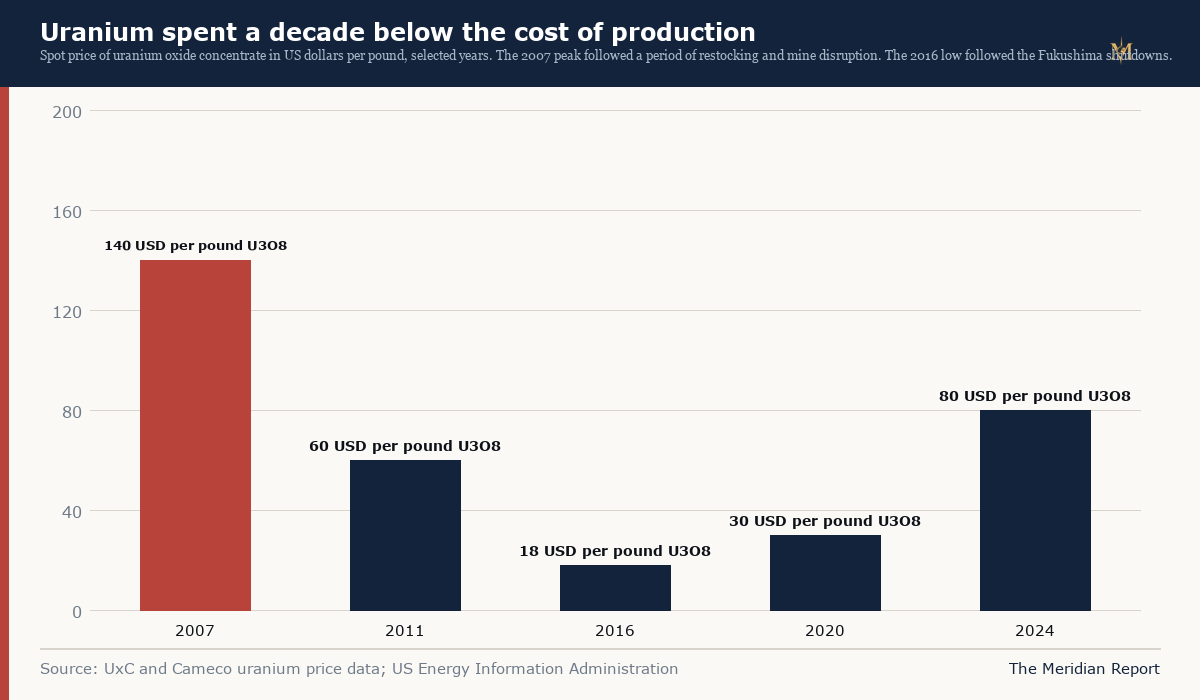
The price history matters for the fuel cycle because it explains the capacity. A low uranium price made conversion and enrichment look like commodities too, and the companies that owned the plants had no reason to build more. The plants that survived did so by running at high utilisation and by consolidating. When demand returned, the industry discovered that it had a mine supply problem and a conversion problem and an enrichment problem at the same time, and that each of them would take years to solve.
The conversion bottleneck is the least visible
Conversion is the stage that most people outside the industry have never heard of, and it is the stage that has been tightest. The plants are chemical facilities that handle fluorine, which is corrosive and dangerous, and they operate under nuclear regulatory regimes that make a new plant a decade long project. The capacity is concentrated in a handful of sites, and several of them are old.
The numbers tell the story. Global conversion capacity is in the range of 60,000 to 70,000 tonnes of uranium a year, and demand from reactors is in the same range. A market that is balanced on paper is a market with no spare capacity in practice, because plants need maintenance outages, because the product has to be stored and transported, and because the geographic distribution of capacity does not match the geographic distribution of demand. When one plant goes down, the shortage is felt everywhere.
The price of conversion rose sharply after 2021. It had been a minor line item in a fuel contract for decades, and it became a negotiated constraint. Utilities that had never thought about conversion began to ask their suppliers whether the conversion was included, and the answer was often that it was not, or that it was included at a price that would be reset at the next renewal.
The response has been a set of expansions. Cameco and Orano have invested in their plants, Honeywell has worked to restore capacity at Metropolis, and new projects have been announced in the United States and Europe. The timeline for a conversion expansion is measured in years, and the permitting and construction are only part of it: the plant has to be qualified by the enrichment companies that will receive the gas, and the qualification is a technical process with its own schedule.
The deeper problem is that conversion is a chemical industry with a nuclear licence. It needs fluorine handling, uranium handling, criticality safety and a regulatory culture that most chemical companies do not have. The companies that operate the plants are therefore few, and the barriers to entry are not primarily financial. A government that wants a conversion plant has to find an operator with the skills, and the skills are concentrated in the same companies that already run the existing plants.
Enrichment is where the chain becomes strategic
Enrichment is the stage that turns uranium into a strategic material. The same centrifuge technology can produce low enriched uranium for power reactors or highly enriched uranium for weapons, and the difference is a matter of how long the gas stays in the cascade and how the plant is configured. That dual use is why enrichment is subject to export controls, safeguards and intelligence attention, and why a country's enrichment capacity is a political fact as well as an industrial one.
The physics is elegant and the engineering is brutal. A centrifuge spins a cylinder of uranium hexafluoride gas at a speed that produces a centripetal acceleration hundreds of thousands of times gravity. The heavier molecules concentrate near the wall and the lighter ones near the axis, and a scoop at each end withdraws the enriched and depleted streams. A single centrifuge produces a small separation, so the plant connects thousands of them in a cascade, with each stage feeding the next. The machines run continuously for years, and a failure means a shutdown of the stage.
The unit of account is the separative work unit, which measures the effort of separation rather than the mass of product. The number of SWUs required depends on the feed assay, the product assay and the tails assay. A plant that runs lower tails, which means leaving less uranium 235 in the waste, uses more SWUs and less natural uranium. A plant that runs higher tails uses fewer SWUs and more uranium. The operator chooses the combination that minimises cost given the price of uranium and the price of SWUs, which is why the enrichment market and the uranium market are linked through a technical parameter that most observers never see.
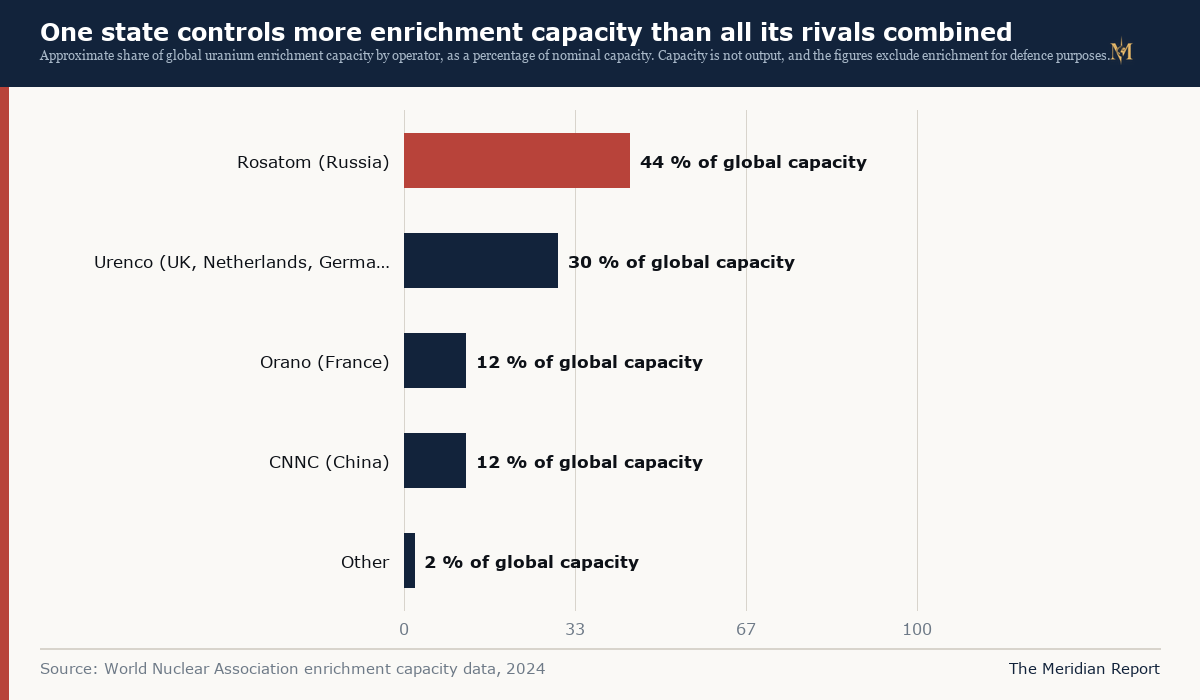
The capacity is concentrated. Rosatom's enrichment subsidiary, through the TENEX trading company, controls an estimated 40 to 45 per cent of global capacity. Urenco, which is owned by the British, Dutch and German governments, controls around 30 per cent. Orano controls around 12 per cent, and China National Nuclear Corporation around 12 per cent. The remainder is small, experimental or dedicated to defence.
Those shares are capacity, not trade. A utility in the United States may buy enrichment from a European company, and the European company may buy conversion from another, and the uranium may come from Kazakhstan. The chain crosses borders at every stage, which is why sanctions on one stage can be circumvented through another and why the effort to disentangle the chain is so complicated.
The Russian uranium that fuelled America for twenty years
The reason the Western fuel cycle is short of capacity is a deal signed in 1993. The United States and Russia agreed to convert 500 tonnes of highly enriched uranium from dismantled warheads into low enriched uranium for American reactors. The programme was called Megatons to Megawatts, it ran for twenty years, and it supplied about half of the enrichment used by American utilities for much of that period. At its peak, roughly ten per cent of all electricity in the United States came from material that had been inside a Soviet warhead.
The programme was a triumph of disarmament and a disaster for the American enrichment industry. It gave utilities a cheap, reliable source of enriched uranium at the same time as the domestic industry was struggling with old gaseous diffusion plants, rising electricity costs and competition from centrifuge technology. The United States Enrichment Corporation, the state-owned company that ran the Paducah and Portsmouth plants, was privatised, ran into financial difficulty and went through bankruptcy. The Paducah diffusion plant closed in 2013. The Portsmouth plant had closed in 2001. The country that had invented the technology was left with one commercial enrichment plant, owned by a European consortium, and a small demonstration cascade.
The same pattern appeared in Europe, though less dramatically. Utilities bought Russian enrichment because it was cheap and because the contracts were flexible. The Russian share of European enrichment rose, and the domestic capacity was rationalised. Urenco kept its plants in the Netherlands, Germany and the United Kingdom running, and Orano kept its plant at Pierrelatte, but neither built the capacity that would have been needed if Russian supply had to be replaced.
The result is a market in which the largest supplier is also the state that the buyers are trying to sanction. That is the definition of a strategic dependency, and it took a war to make it visible.
What the 2024 import ban did, and did not do
The Prohibiting Russian Uranium Imports Act became law in May 2024, and its restrictions took effect in August. The act bans the import of low enriched uranium produced in Russia or by a Russian entity, and it allows the Department of Energy to grant waivers when a utility has no alternative supply and the import is in the national interest. The waivers run until January 2028, and the Department has said it will use them narrowly.
The structure of the ban is a recognition of the problem. A complete ban would have forced American utilities to find capacity that did not exist, and the resulting shortage would have threatened the operation of reactors that provide about 18 per cent of the country's electricity. The waiver process is a transition mechanism, and the transition is the construction of replacement capacity in the United States and among its allies.
The ban also changed the price. Enrichment is sold on long term contracts, and the price of a contract signed after the ban reflects the cost of the replacement capacity rather than the cost of the Russian plant. Utilities that had been paying a price set by the cheapest supplier discovered that the replacement was more expensive, and the difference is the cost of security. It is not a large cost per megawatt hour, because enrichment is a small share of the total fuel cost and fuel is a small share of the cost of nuclear electricity. It is a large cost in capital, because the replacement capacity has to be built before the contracts can be signed.
The European response has been slower and less complete. The European Union has sanctioned Russian entities in many sectors, and it has debated restrictions on nuclear fuel, but several member states operate reactors that were designed for Russian fuel and have long term contracts with Russian suppliers. The result is a split market: some countries have reduced their purchases, others have not, and the European enrichment industry has announced expansions that will take years to deliver.
Enrichment economics: the tails assay and the price of a machine
The enrichment market is unusual because the product is not a physical commodity in the ordinary sense. A utility buys a quantity of separative work and a quantity of uranium, and the supplier delivers enriched uranium hexafluoride with a specified assay. The contract specifies the feed assay, the product assay, the tails assay and the quantity of SWUs, and the utility pays for the SWUs and for the uranium separately, even when a single company supplies both.
The tails assay is the parameter that ties the two markets together. If the price of uranium is high relative to the price of SWUs, the operator runs lower tails, which means extracting more of the uranium 235 from the feed and using more SWUs. If the price of SWUs is high relative to uranium, the operator runs higher tails, which saves SWUs and wastes uranium. The choice is made at the plant, but it is determined by the contract and by the market prices.
That relationship means a shortage of enrichment capacity raises the value of the machines and changes the way uranium is used. A plant running flat out with high tails consumes more uranium and produces more enriched product than the same plant running low tails. The difference is not enormous, but in a tight market it is the difference between a utility getting its fuel and not getting it.
The price of a SWU has risen since 2021. The market is opaque, because most contracts are private and the published price assessments are based on surveys, but the direction is clear. The price of the centrifuge machine itself has also risen, because the supply chain for the machines is specialised and the manufacturers have limited capacity. A new enrichment plant is therefore expensive to build and expensive to finance, and it needs a long term contract to justify the investment.
Who is building, and how fast
The announced expansion list is long enough to be reassuring and short enough to be worrying.
Urenco is expanding capacity at its Eunice plant in New Mexico and at its European sites, with the American expansion aimed at the utilities that have to replace Russian supply. Orano is extending its Georges Besse II plant in France and has announced studies for additional capacity. Centrus Energy is expanding its Piketon, Ohio cascade, which produced the first American HALEU in late 2023 and has been the main domestic source of higher assay material. The Department of Energy has funded HALEU demonstration and is supporting a conversion facility and a fuel fabrication capability.
In Europe, the picture is more fragmented. The French, Dutch and British governments own Urenco, and the company's expansion is financed by its shareholders. Orano is majority owned by the French state. The German government has been ambivalent about nuclear power since it closed its last reactors in 2023, and the Dutch government has supported expansion at Urenco's Almelo site.
The timelines are the important part. A centrifuge plant takes three to five years to build once the decision is made, and the decision requires a contract book that covers the capital. The contracts are long term, often ten to fifteen years, and utilities have been slow to sign because they had cheaper options and because a long term contract is a commitment that their regulators scrutinise. The result is a chicken and egg problem: the plant needs contracts, the contracts need the plant, and the government has to bridge the gap with guarantees, offtake or direct investment.
The bridge is being built, but slowly. The first new capacity is expected in the late 2020s, and the full replacement of Russian supply is a project for the 2030s. In the meantime, the waivers keep some Russian material flowing, and the market prices the risk into the contract rather than removing it.
Conversion is the stage that decides the schedule
If enrichment is the strategic stage, conversion is the stage that sets the schedule. A centrifuge plant cannot run without uranium hexafluoride, and the conversion plants that make it are fewer and older than the enrichment plants.
Honeywell's Metropolis Works in Illinois is the only conversion plant in the United States. It has been operating since the 1950s, it has had safety and environmental issues, and it has been the subject of investment and restoration programmes. Cameco's Port Hope plant in Ontario is the other North American facility, and it supplies both Canadian and American customers. In Europe, Orano's Pierrelatte plant and Westinghouse's Springfields plant supply the French and British markets and export to others.
The capacity is tight enough that a conversion outage is a market event. When a plant goes down for maintenance, the enrichment plants that depend on it have to draw down inventory, and the utilities that depend on those plants have to reschedule. The inventories that buffer the system are not large, because holding uranium hexafluoride is expensive and regulated.
The expansion projects are underway. Cameco and Orano have announced investments, Honeywell has restarted capacity, and the Department of Energy has funded a new conversion facility. The timelines are three to five years, and the permitting is the long pole. A conversion plant handles fluorine and uranium, and the licensing process is as demanding as the one for a reactor in some jurisdictions.
The dependency between conversion and enrichment is the reason the fuel cycle cannot be fixed one stage at a time. A new enrichment plant without conversion capacity is a plant that cannot get feed. A new conversion plant without enrichment capacity is a plant that cannot sell its product. The two have to be built together, and the companies that build them are not the same companies, which means the coordination has to happen through contracts, governments or both.
HALEU is a small market with a large strategic shadow
High assay low enriched uranium is the fuel that most advanced reactor designs need. Conventional power reactors use fuel enriched to between 3 and 5 per cent uranium 235. Advanced designs, including many small modular reactors, molten salt reactors and high temperature gas reactors, need assays between 5 and 20 per cent, and the fuel is called HALEU because the assay is high by civil standards.
The market for HALEU is tiny. There are no commercial reactors outside Russia and China that run on it at scale, so the demand is a projection rather than an order book. The Department of Energy has supported the construction of a demonstration cascade at Piketon, Ohio, operated by Centrus Energy, and it has funded programmes to produce HALEU from downblended weapons material and from new enrichment capacity. The first American HALEU was produced in late 2023, in quantities measured in kilograms rather than tonnes.
The strategic problem is that the only commercial supplier of HALEU outside the United States is Russia. Several advanced reactor developers have had to redesign their fuel, delay their schedules or secure government support because they could not buy the material. TerraPower, which is building a demonstration reactor in Wyoming, said in 2024 that its schedule had slipped because of the availability of HALEU, and it has been working with the Department of Energy on an alternative supply.
The quantities required are small relative to the conventional fuel market, which is why the private sector has been slow to invest. A HALEU plant needs the same centrifuge technology as a conventional plant, but the cascade is configured for a higher assay and the licensing is more demanding. The economics depend on a customer base that does not yet exist, and the customer base depends on reactors that have not yet been built. Governments are therefore the only actors that can break the circle, and they are doing so with money rather than with markets.
The HALEU case illustrates a general point about the fuel cycle. The chain is not a single market that clears at a price. It is a set of markets with different time horizons, different capital intensities and different levels of government involvement, and a shortage in one of them can persist for years even when the others are in surplus. A country that wants advanced reactors has to solve the HALEU problem before the reactor is built, and the solution is a government programme rather than a purchase order.
Fabrication is a qualification business
The last stage of the front end is fabrication. The enriched uranium is converted into uranium dioxide, pressed into pellets, sintered, ground to tolerance, loaded into tubes of zirconium alloy, sealed, assembled into fuel rods and bundled into a fuel assembly with spacers, end fittings and, in some designs, burnable poison.
The manufacturing is precise but not exotic. What makes it difficult is qualification. A fuel assembly is a safety component, and a new design or a new supplier has to demonstrate to the regulator that the fuel will perform as expected under normal operation and under accident conditions. The qualification programme includes irradiation tests, post irradiation examination, thermal hydraulic analysis and a licensing submission, and it takes years.
That is why the fabrication market is concentrated. Westinghouse, Framatome and Global Nuclear Fuel supply most of the Western market, with KEPCO Nuclear Fuel in South Korea, NFI in Japan and TVEL in Russia. Each supplier has a design that is qualified for a particular reactor type, and a utility that wants to change supplier has to repeat part of the qualification or accept a design that is already qualified for its reactor.
Westinghouse is the most interesting case. The company went through bankruptcy after the collapse of its nuclear construction projects in the United States, was bought by Brookfield and Cameco in 2023, and is now at the centre of the Western fuel strategy. It supplies fuel to reactors in Europe and Asia, it is developing a new fuel line for advanced reactors, and it has been contracted to supply fuel to reactors that were previously dependent on Russian fuel, including VVER designs in Eastern Europe.
The VVER problem is the sharpest example of the dependency. Several Central and Eastern European countries operate Soviet designed reactors that use Russian fuel assemblies. After 2022 they wanted to stop buying Russian fuel, and the alternative had to be designed, qualified and licensed for a reactor type that the Western suppliers had not served. Westinghouse has been working on that transition, and the first deliveries of alternative fuel have begun, but the process is slow and expensive.
Defence demand sits inside the civil chain
The fuel cycle is usually described in civil terms, but a significant share of the capacity exists because of defence requirements, and the two are entangled.
The United States produces tritium for its nuclear weapons in commercial reactors. The Tennessee Valley Authority's Watts Bar reactors have been used for tritium production since the early 2000s, with special fuel assemblies inserted into the core. The tritium is extracted and used to maintain the weapons stockpile. The arrangement is a quiet example of how civil and military nuclear programmes share facilities, fuel and expertise.
Naval reactors use highly enriched uranium, which is outside the civil market but inside the same industrial base. The American and British submarine programmes depend on a supply of HEU and on the fabrication capability that turns it into fuel. The AUKUS agreement has increased the attention on that supply chain, because Australia will need access to naval reactor technology and to the fuel and maintenance arrangements that go with it.
The defence demand is small in mass and large in strategic weight. It consumes capacity that could otherwise serve civil customers, it requires a level of security that raises costs, and it creates a customer that is insensitive to price. That combination is why defence programmes are often the anchor customer for a new capability, and why the civil market benefits from capacity that was built for a military purpose.
The back end is a separate industry with its own bottleneck
The fuel cycle does not end when the fuel leaves the reactor. Spent fuel is either stored, reprocessed or disposed of, and each option has its own industrial base.
Reprocessing separates the plutonium and unused uranium from the fission products, so that the material can be recycled into new fuel. France operates the La Hague plant, which reprocesses fuel for French and foreign utilities and produces mixed oxide fuel at the Melox plant. Russia operates the Mayak complex. Japan has been building the Rokkasho plant for decades, and its start has been delayed repeatedly. The United States has a policy against commercial reprocessing, though it has funded research into recycling.
The economics of reprocessing are contested. The plant is expensive, the recycled fuel is more expensive than fresh uranium fuel at current prices, and the benefit is a reduction in the volume and radiotoxicity of the waste that requires disposal. Countries with a large nuclear programme and a disposal problem, such as France, treat reprocessing as a way to reduce the burden on a geological repository. Countries with cheap uranium and a political aversion to plutonium, such as the United States, treat it as unnecessary.
The bottleneck in the back end is not capacity in the same sense as the front end. It is the absence of a disposal route in most countries, which means spent fuel accumulates at reactor sites in dry casks while the political process for a repository grinds on. Finland has built a repository at Onkalo and is operating it. Sweden has selected a site. France is developing one. The United States has a licence application for Yucca Mountain that has been politically stalled for more than a decade.
For the fuel cycle, the back end matters because it determines the cost of the whole system. A reactor operator that has to store spent fuel on site for decades carries a cost that does not appear in the fuel price. A country that reprocesses pays for the plant and for the waste forms. A country that builds a repository pays for the geology and the politics. None of those costs is in the price of a SWU, and all of them are part of the cost of nuclear electricity.
What a fuel contract actually contains
A fuel contract is not a single price. It is a set of terms that allocate risk between the utility and the supplier over a period of years, and the terms matter more than the headline number.
The first term is the quantity. A utility commits to buy a certain number of assemblies or a certain quantity of uranium, and the supplier commits to deliver it. The commitment is usually firm for a base quantity and flexible for an additional quantity, so the utility can adjust to its load factor and the supplier can plan its plant.
The second term is the price mechanism. Uranium is priced by reference to a published index, with a floor and a ceiling in some contracts. Conversion and enrichment are priced by reference to a market assessment or to a cost index. Fabrication is often priced as a fixed cost per assembly, adjusted for inflation. The combination determines how much of the price risk the utility carries.
The third term is the schedule. A fuel assembly has to be delivered before the refuelling outage, and the outage date is fixed by the grid operator and the regulator. A late delivery can force a postponement, which is expensive. The contract therefore includes delivery windows, penalties and, in some cases, a requirement that the supplier hold inventory.
The fourth term is the security of supply. A utility that is buying from a supplier in a country subject to sanctions needs a clause that allocates the risk of a disruption. The clause may require the supplier to find alternative material, to hold a strategic inventory or to compensate the utility. The negotiation of those clauses is where the politics of the fuel cycle becomes a commercial document.
The policy instruments, and what each can do
Governments have four main instruments for the fuel cycle: money, contracts, sanctions and stockpiles. Each addresses a different part of the problem.
Money is the simplest. A government can fund a conversion plant, an enrichment cascade or a fabrication line, and it can do so faster than a commercial investor because it does not need a return. The risk is that the plant is built without a customer and runs below capacity, which makes the unit cost high and the plant dependent on further subsidy.
Contracts are the more durable instrument. A government can sign a long term offtake agreement that gives the plant a revenue stream and allows it to raise capital. The Department of Energy has used this approach for HALEU, and the British government has used it for the Springfields plant. The risk is that the government locks in a price that is above the market and that the plant becomes a permanent charge on the taxpayer.
Sanctions are the sharpest instrument and the least reversible. A ban on Russian fuel forces the market to find alternatives, and it also raises the price and creates a transition problem. The American ban included waivers precisely because the alternative capacity did not exist, and the waivers are a recognition that the sanction is a process rather than an event.
Stockpiles are the buffer. A strategic reserve of uranium, conversion or enrichment can bridge a disruption while the capacity is built, and it can be released to stabilise a price. The United States maintains a strategic uranium reserve, and the European Union has discussed a stockpile of nuclear fuel. The size and the release rules determine whether the stockpile is a genuine buffer or a symbolic gesture.
None of the instruments addresses the deepest problem, which is the time it takes to build a plant and the skills required to operate it. Money can buy a building. It cannot buy a workforce with ten years of centrifuge experience, and it cannot shorten the qualification of a fuel assembly for a reactor that has never used it.
What the fuel cycle costs per megawatt hour
The fuel cycle is a small part of the cost of nuclear electricity, which is why the capacity problem was ignored for so long. A reactor's levelised cost is dominated by the capital cost of the plant, then by operation and maintenance, then by fuel. Fuel is typically a fifth to a quarter of the total, and the front end of the fuel cycle is a fraction of that.
The arithmetic is worth doing because it explains why utilities tolerated a fragile supply chain. A gigawatt reactor consumes roughly 20 to 25 tonnes of enriched uranium a year, depending on its load factor and the fuel design. The uranium content is about 200 to 250 tonnes of natural uranium equivalent, depending on the tails assay. At a uranium price of 80 dollars per pound, the uranium costs about 35 to 45 million dollars a year. Conversion and enrichment add a similar order of magnitude, and fabrication adds a few million more.
The total fuel cost is therefore in the range of 60 to 100 million dollars a year for a gigawatt reactor, against a capital cost of several billion dollars and a revenue stream of several hundred million dollars a year. A doubling of the fuel price, which is a large shock in fuel market terms, adds perhaps 50 to 80 million dollars a year, or a few dollars per megawatt hour. That is visible, and it is not existential.
The cost of a supply interruption is a different order of magnitude. A reactor that cannot refuel has to reduce power or shut down, and the lost revenue is measured in hundreds of millions of dollars a year. That asymmetry, small fuel cost and large interruption cost, is the economic argument for paying a premium for security. It is also the argument that utilities ignored when the supply chain was cheap and the interruption was hypothetical.
France treats the cycle as a single system
France is the only Western country that has maintained an integrated fuel cycle, and the integration is the reason its nuclear programme has been resilient.
Electricite de France operates the reactors. Orano mines, converts, enriches, fabricates and reprocesses. Framatome builds the fuel assemblies and the reactor components. The companies are separate but they are coordinated by the state, which owns a controlling stake in EDF and Orano and a minority stake in Framatome. The cycle is planned as a system rather than as a series of market transactions.
The result is that France has domestic capacity at every stage, including reprocessing, and it has a workforce that understands the whole chain. When the price of uranium rose, France could adjust its tails assay and its reprocessing mix. When the supply of Russian enrichment became a political problem, France had an alternative, even if the alternative was not large enough to replace the Russian share on its own.
The weakness of the French model is cost. The integrated cycle is expensive, the reprocessing plant is expensive, and the new reactors at Flamanville were delivered years late and over budget. The model also depends on the state's willingness to absorb the cost, which is a political variable rather than an industrial one.
France has announced a new programme of reactors, and it has been expanding its enrichment capacity. The programme is the clearest test of whether the integrated model can be replicated at a larger scale. If it succeeds, it will be the template for other countries. If it fails on cost, it will be a cautionary tale about the price of self-sufficiency.
Britain has the plants and not the strategy
The United Kingdom has an unusual position. It has a uranium conversion plant at Springfields, an enrichment plant at Capenhurst owned by Urenco, a fuel fabrication capability and a history of reprocessing at Sellafield. It also has a reactor fleet that is ageing and a new build programme that has been slow and expensive.
The British government has tried to use the fuel cycle as an industrial policy instrument. It has funded a HALEU programme, it has supported the conversion and enrichment capacity, and it has used contracts to keep Springfields open. The strategy is to be a supplier to the growing market for advanced reactor fuel, particularly in the United States, where the HALEU supply is limited.
The obstacle is scale. The British plants are small relative to the global market, and the investment required to expand them is large relative to the returns. The government has to decide whether it is building capacity for its own reactors, for export, or for strategic insurance, and the answer determines the business case. A plant that is built for strategic insurance will not be competitive, and a plant that is built for export needs customers that the United States and France are also courting.
The United States has the demand and a partial supply chain
The United States operates the largest reactor fleet in the world, about 94 units generating around 18 per cent of the country's electricity, and it has the largest single demand for enriched uranium. It has one commercial enrichment plant, Urenco's facility in New Mexico, a small Centrus cascade in Ohio, a conversion plant in Illinois owned by Honeywell, a fabrication industry that includes Westinghouse and Global Nuclear Fuel, and no commercial reprocessing.
That combination, large demand and thin domestic supply, is the reason the American fuel cycle is a policy problem. The country imports a large share of its enrichment, including from Russia until the 2024 ban, and it depends on allies for conversion and fabrication capacity. The dependence is not a secret. The Department of Energy has been funding domestic capacity, and the 2024 ban was designed to force the market to replace Russian supply.
The American response has been market led with government support. The Department of Energy has solicited contracts for domestic low enriched uranium, funded HALEU demonstration, and supported conversion and fabrication projects. The 2024 ADVANCE Act streamlined licensing for advanced reactors and for fuel facilities. The strategy relies on private companies building plants against government contracts, which is faster than a state owned programme and more fragile, because the companies can fail.
The fragility was demonstrated by the history of the American enrichment industry. The United States Enrichment Corporation was privatised, struggled and went through bankruptcy. Its successor, Centrus, survived on government contracts and on the uranium trading business. A second failure would leave the country with one commercial plant owned by a European consortium and a demonstration cascade, which is not a secure supply chain for the world's largest reactor fleet.
China is building the whole chain at once
China operates the fastest growing nuclear programme in the world, with dozens of reactors in operation and a similar number under construction, and it has built the fuel cycle to match. It mines uranium domestically and imports from Kazakhstan and Namibia, it converts and enriches, it fabricates fuel for its own reactors and it is developing fast reactors and reprocessing.
The Chinese model is integration by state ownership. China National Nuclear Corporation and its subsidiaries own the plants and the fuel cycle, and the government plans the capacity to match the reactor programme. The scale is large enough that the unit costs are low, and the integration means that a bottleneck at one stage is visible to the planner before it becomes a crisis.
China is also a supplier to other countries. It has exported reactors to Pakistan and Argentina, and it has offered fuel cycle services to countries that want them. The export model is attractive to countries that cannot build their own cycle, and it creates a dependency that mirrors the Russian model. Whether China becomes a reliable supplier or a strategic one is a question that the importing countries have not yet had to answer.
India solved the enrichment problem by avoiding it
India's nuclear programme is built on pressurised heavy water reactors, which use natural uranium dioxide and heavy water as a moderator. The fuel requires no enrichment, so India's fleet does not depend on a centrifuge plant. It depends on uranium mining, on heavy water production and on fabrication, and India has built all three.
That choice was made partly for reasons of resource independence and partly because India was excluded from the international nuclear trade for decades after its 1974 test. The result is a programme that is less efficient than a light water reactor programme, because heavy water reactors use more uranium and have a lower burnup, and more resilient, because it does not need enrichment.
India has also been developing a thorium cycle, which would use its large thorium reserves and reduce the demand for uranium. The programme has been slow and expensive, and it has not yet reached commercial scale. Its strategic logic is the same as the heavy water choice: reduce the dependence on a fuel cycle that India does not control.
South Korea and Japan show the value of a fabrication base
South Korea operates a fleet of reactors, fabricates its own fuel through KEPCO Nuclear Fuel, and has exported reactors to the United Arab Emirates. It does not enrich or convert at scale, so it depends on the international market for those stages, but it has a domestic fabrication capability and a design capability that allow it to maintain its fleet and to compete for export orders.
Japan has a large fleet, a fabrication industry, a reprocessing plant that has been under construction for decades and a stockpile of separated plutonium that is a subject of international concern. The Japanese programme has been shaped by the Fukushima accident, by the restart process and by the politics of plutonium. It shows that a country can have the front end and the back end and still struggle with the political and economic conditions for operating reactors.
The two cases illustrate a general point. A country does not need every stage of the cycle to have a nuclear programme. It needs a reliable supplier for the stages it does not have, and it needs a fabrication capability that can turn the enriched product into fuel for its reactors. The vulnerability is at the stage where it has neither.
The demand question: reactors are not the market
The fuel cycle capacity is built for a reactor fleet that is being extended rather than expanded. Most of the world's reactors were built between 1970 and 1990, and many of them have received licence extensions to sixty or eighty years. The fuel demand from those reactors is stable or declining as they retire, and the new build programme has been slower than the retirement rate in Europe and North America.
That matters for the business case for new capacity. A company that builds an enrichment plant is investing against a demand forecast that depends on reactor life extensions, on new build, on the price of alternatives and on government policy. The forecast is uncertain, and the plant takes years to build, so the investment decision is a bet on the policy environment a decade ahead.
The bet has become more attractive since 2022, because governments have decided that nuclear is part of the answer to energy security and decarbonisation. The number of reactors under construction has risen, the number of life extensions has increased, and the number of countries interested in small modular reactors has grown. The fuel demand from those reactors is small in the near term and large in the long term, and the capacity has to be built before the demand arrives.
That is the structural problem of the fuel cycle. The demand is a forecast, the supply is a plant, and the gap between them is a decade. The market cannot bridge the gap on its own, because the plant needs a contract and the contract needs a reactor, and the reactor needs a licence and a customer. Governments bridge it with money, contracts and guarantees, and the bridge is expensive.
The case against the shortage thesis
A serious account of the fuel cycle has to consider the evidence that the shortage is overstated, and there is a reasonable version of that argument.
The first point is that uranium is abundant and the price mechanism works. The 2007 spike to more than 100 dollars a pound produced a wave of exploration and mine development that was interrupted by Fukushima, not by geology. When prices rose again after 2020, mines restarted and production guidance increased. Kazakhstan has been producing below its permitted capacity for years because the market was weak, and it can increase output when the price justifies it. Canada's high grade mines have decades of reserves. The supply response is slow, but it is real.
The second point is that enrichment capacity has been underused rather than absent. Urenco and Orano have been running below capacity in some periods because the market was oversupplied with Russian material. The plants are there, and they can increase output with relatively modest investment in cascades and in the supporting infrastructure. The capacity that is being added now is not a new industry. It is the restoration of an industry that was allowed to shrink.
The third point is that demand may not grow as fast as the reactors under construction suggest. Many announced projects are delayed, cancelled or replaced. The small modular reactor designs that are expected to drive future fuel demand are mostly not yet built, and their fuel requirements are uncertain. If only a fraction of the announced reactors are completed, the fuel cycle capacity that exists plus the capacity under construction may be sufficient.
The fourth point is that secondary supply can fill gaps. The downblending of weapons material, the drawdown of utility inventories and the recycling of fuel all add supply that is not counted in the mine production figures. The Megatons to Megawatts programme showed how large that secondary supply can be, and there are still stocks of highly enriched uranium that could be downblended.
Those points are correct in isolation and incomplete together. The issue is not the existence of resources or the possibility of capacity. It is the time and the coordination required to turn one into the other, and the fact that the buyers and the sellers have different incentives.
The coordination problem is the real constraint
A fuel cycle is a chain of capital intensive plants, each of which needs a customer before it can be financed, and each of which serves a customer that needs the whole chain to work. That structure produces a coordination problem that no single actor can solve.
A utility that wants to sign a long term enrichment contract needs to know that the conversion capacity exists to feed it and that the fabrication capacity exists to use its product. The enrichment company needs to know that the utility will buy for long enough to pay back the plant. The conversion company needs the same assurance from the enrichment company. The government wants the security but does not want to own the plants.
In a vertically integrated system, such as China's or France's, the coordination happens inside the state. In a market system, such as the United States and the United Kingdom, it happens through contracts and government guarantees. The market system is more efficient when the chain is in surplus and less resilient when it is not, because the contracts that would coordinate the investment are the ones that are hardest to sign when the future is uncertain.
The result is a pattern that has repeated across the fuel cycle: a period of cheap supply, underinvestment, a shock, a government programme, a partial recovery and then a return to cheap supply as the urgency fades. The current cycle is unusual because the shock is geopolitical and the policy response has been sustained, but the pattern has not been broken.
What would change the picture
Three developments would materially change the assessment in this report.
The first is a sustained high uranium price. If uranium stays above 100 dollars a pound for several years, the mines will respond, the secondary supply will be drawn down and the incentive to build conversion and enrichment capacity will strengthen. A high price is the market's way of rationing a scarce good, and it is also the signal that investors need.
The second is a decision by a major government to own the capacity rather than to subsidise it. If the United States or the United Kingdom decided to build an enrichment plant as a state asset, the coordination problem would disappear, at the cost of the efficiency that competition brings. The decision would be a return to the model that France and China already use, and it would be politically difficult in countries that have spent decades privatising.
The third is a technological change that reduces the demand for enrichment. A reactor that runs on natural uranium, a fuel design that uses less enriched material, or a recycling process that recovers more of the energy from spent fuel would reduce the pressure on the middle of the chain. The technologies exist at various stages of development, and none of them is likely to change the picture this decade.
The indicators to watch
The most useful indicator is not the spot price of uranium. It is the volume of long term contracts signed by the enrichment companies, because a contract is a commitment that a plant will be built and a utility will be supplied. The contract volumes are published in the annual reports of Urenco, Orano and Centrus, and they are the best available measure of whether the capacity is being matched to demand.
The second indicator is the utilisation rate of the conversion plants. A plant running at 95 per cent of capacity cannot absorb a disruption, and a plant running at 75 per cent has room. The utilisation rates are not published in a consistent form, but they can be inferred from the companies' statements and from the maintenance schedules.
The third indicator is the price of a SWU relative to the price of uranium. The ratio determines the tails assay that operators choose, and a rising SWU price relative to uranium indicates that enrichment is the binding constraint. The ratio is a market signal that is more informative than either price alone.
The fourth indicator is the time between the announcement of a project and its first output. If the announced projects are delivered on schedule, the shortage is a transition. If they slip by years, as several have already, the shortage is a structural condition that the market has not solved.
The 2011 comparison, and why it is misleading
The last time the nuclear fuel cycle was in a crisis was after the Fukushima accident in 2011. The comparison is instructive and it is often drawn incorrectly.
In 2011 the crisis was one of demand. Japan shut down its reactors, Germany accelerated its phase-out, and several other countries paused their programmes. The price of uranium collapsed, the enrichment market went into surplus, and the capacity that had been built for a growing fleet was stranded. The industry's response was to cut costs, consolidate and wait for demand to return.
The current crisis is one of supply, and the demand is stable or growing. The price of uranium has risen because the secondary supply has run down and the mines have underinvested, not because demand has surged. The enrichment market is tight because the largest supplier is subject to sanctions, not because the world has built too few plants relative to demand. The two crises have opposite shapes, and the policy response has to be different.
The comparison matters because it explains why the industry was unprepared. The memory of 2011 was of a market that could not absorb capacity, and the companies that had survived it were reluctant to invest in new capacity. The governments that had lived through the price collapse were reluctant to subsidise an industry that had just been shown to be cyclical. The result was a chain that was optimised for a world in which supply was cheap and abundant, which is not the world that arrived in 2022.
What the record establishes
The evidence supports a narrower conclusion than the headline claim that the world is running out of nuclear fuel.
The world is not short of uranium. It is short of the capacity to convert, enrich and fabricate it outside Russia, and the shortage is concentrated in the stages that are hardest to build and least visible to the public. The capacity is being rebuilt, the timelines are measured in years rather than months, and the governments that are funding it have not yet solved the coordination problem between the stages.
The Russian dependency was created by a deliberate policy of buying the cheapest supply, and it was rational for thirty years. It became a vulnerability when the supplier became an adversary, and the response has been a combination of sanctions, subsidies and contracts that is expensive and incomplete. The waivers in the American ban are the clearest admission that the replacement capacity does not yet exist.
The fuel cycle is therefore a case study in the difference between a market and a supply chain. A market clears at a price. A supply chain has to be built, permitted, staffed and qualified, and none of those steps responds to a price signal within the time horizon of a reactor operator. The price tells you that the capacity is scarce. It does not tell you how to build it, and it cannot shorten the four years that a centrifuge plant takes to come online.
What the numbers do not establish
The capacity shares in this report are estimates compiled by industry bodies from company disclosures. They describe nominal capacity, not output, and they change with every expansion and every retirement. A share of 40 per cent is a description of a market position, not a measurement of a plant.
The price figures are assessments based on surveys of market participants, not exchange prices. The uranium spot price is a thin market that can move on a single transaction, and the SWU price is even less transparent because most contracts are private. The direction of the change is reliable; the level is not.
The cost per megawatt hour calculation uses a set of assumptions about burnup, tails assay, fuel design and load factor. A different set of assumptions would produce a different number, and the purpose of the calculation is to show the order of magnitude, not to price a particular reactor.
The claim that the fuel cycle is a bottleneck for the nuclear revival is a claim about the pace of the revival, not its possibility. The capacity can be built. The question is whether it will be built in time for the reactors that governments have announced, and that question depends on decisions that have not yet been made.
Sources
- World Nuclear Association, World Nuclear Fuel Cycle and enrichment capacity data.
- International Atomic Energy Agency, Nuclear Fuel Cycle and Red Book uranium data.
- Nuclear Energy Agency and IAEA, Uranium 2022: Resources, Production and Demand.
- US Energy Information Administration, Uranium marketing annual report.
- US Department of Energy, HALEU Availability Program.
- Centrus Energy, American Centrifuge Plant and Piketon HALEU cascade disclosures.
- Urenco, capacity expansion announcements and enrichment data.
- Orano, enrichment and conversion operations.
- Prohibiting Russian Uranium Imports Act, Public Law 118-62, May 2024.
- Kazatomprom, annual reports and production guidance.
- Cameco, annual report and uranium market disclosures.
- TENEX and Rosatom, enrichment and fuel supply disclosures.
The next machine, and why it has not arrived
The centrifuge has been the dominant enrichment technology for fifty years, and it is likely to remain so for another twenty. But it is not the only technology, and the alternatives matter for the long run.
Laser enrichment uses the small difference in the excitation energy of uranium 235 and uranium 238 atoms to ionise one isotope selectively and separate it electromagnetically. The principle is elegant, the equipment is compact and the energy consumption is lower than a centrifuge cascade. The SILEX process, developed in Australia and licensed to a consortium that includes Cameco and Silex Systems, has been pursued in the United States through Global Laser Enrichment, which holds a licence to build a plant in North Carolina.
The technology has not replaced the centrifuge for a simple reason: it is hard to make it work at industrial scale, and the centrifuge is already there. A new enrichment technology has to be qualified, licensed and built, and the companies that dominate the market have a large installed base of centrifuges that they are still depreciating. The incentive to switch is weak unless the new technology offers a decisive cost advantage, and the cost advantage has not been demonstrated at scale.
The strategic significance is in the other direction. Laser enrichment is more compact than a centrifuge plant, which makes it easier to hide, and the equipment is more easily replicated. That is a proliferation concern, and it is one reason the technology has been subject to export controls and to careful licensing. The same characteristic that makes it attractive for a small civil programme makes it harder to monitor.
Safeguards are the part of the chain that is invisible
Every stage of the fuel cycle is subject to international safeguards, and the safeguards are what allow a civil programme to be distinguished from a military one. The International Atomic Energy Agency inspects enrichment plants, verifies the material balance, seals equipment and installs cameras. The Additional Protocol gives the agency broader access and more information, and most countries have signed it, though not all have ratified it.
The safeguards system is designed for a world in which enrichment plants are large, few and declared. A plant that is small and undeclared is harder to detect, and the detection depends on intelligence, on environmental sampling and on the analysis of trade in equipment. The agency's ability to find a clandestine plant is not unlimited, and the history of the nuclear programme in Iran shows how long a concealed facility can remain concealed.
For the civil fuel cycle, the safeguards add cost and time. A new enrichment plant has to be designed for inspection, which means access, instrumentation and material accounting systems that are not needed for a purely commercial operation. The cost is small relative to the plant, and the time is part of the licensing schedule.
The safeguards also constrain the market. A country that wants to buy enrichment services has to accept that the supplier will report the transaction and that the material will be subject to inspection. That is one reason the market is organised around a small number of suppliers with established safeguards records, and it is a barrier to entry for new suppliers that do not have the same record.
The fuel cycle as a strategic inventory
The final point is about time. A reactor operator plans fuel purchases years ahead, and the fuel cycle responds in years. The mismatch is the source of the fragility, and it is also the source of the opportunity.
A country that wants a secure fuel supply can hold inventory at each stage: uranium oxide, uranium hexafluoride, enriched uranium and finished assemblies. The inventory at the later stages is more valuable and more expensive to hold, and it is the inventory that bridges a disruption in the middle of the chain. The strategic reserve that matters is not a pile of yellowcake. It is a stock of enriched uranium and a contract book that keeps the plants running.
The inventory has a cost, and the cost is the price of insurance. A utility that holds a year of enriched uranium inventory is paying for the storage, the capital and the risk of obsolescence, and it is buying the ability to keep operating if a supplier fails. The calculation is the same as the one for any other strategic stockpile, and the answer depends on the probability of disruption, which is a political judgment rather than a market price.
The countries that have done this well have treated the fuel cycle as infrastructure rather than as a market. They have accepted that the plants may not be the cheapest, that the inventory is a cost, and that the contracts are political as well as commercial. The countries that have treated it as a market have discovered that the market clears at a price that does not include the cost of a disruption, and that the disruption, when it comes, is more expensive than the insurance would have been.