
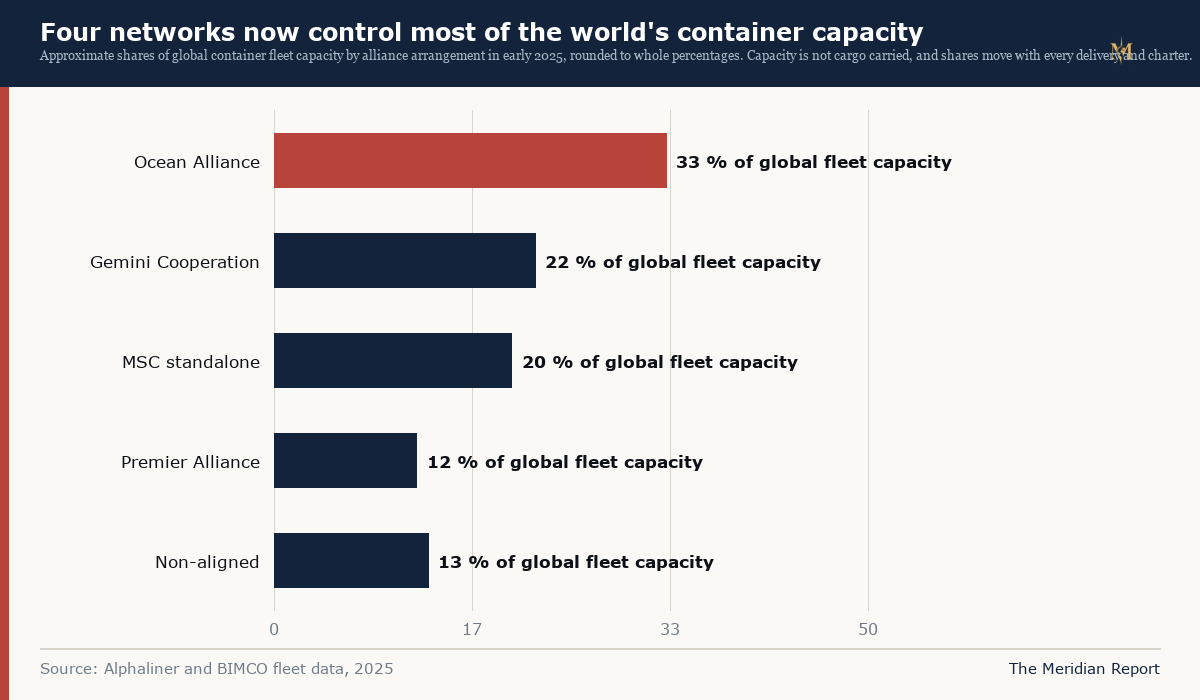
The container shipping industry reorganised itself on 1 February 2025, and almost nobody outside it noticed. Maersk and Hapag-Lloyd began operating a joint network called Gemini Cooperation. MSC, which had shared capacity with Maersk since 2015 in an arrangement called 2M, began operating on its own. The Ocean Alliance of CMA CGM, COSCO, Evergreen and OOCL carried on and extended its agreement to 2032. ONE, HMM and Yang Ming replaced THE Alliance with a new grouping. Four networks replaced three, and one of the largest carriers stopped cooperating altogether.
The change was reported as a service announcement, which is what carriers call a change to port rotations and sailing schedules. It was more than that. A liner network is a set of decisions about which ports a ship calls at, how often, and with whose cargo. Those decisions determine how long a container sits in a terminal, how much inland transport it needs, which ports grow and which decline, and how quickly a supply chain recovers when something goes wrong. Redrawing the networks redistributed those costs and benefits across ports, shippers and regions, and the redistribution is still working through.
What makes the reshuffle worth examining is not that it happened. Alliances have formed and broken since the first vessel sharing agreements in the 1990s. What makes it worth examining is that it happened at the same time as two larger forces: the Red Sea diversions that began in December 2023 and the delivery of a very large order book. Those forces dominate the numbers. The alliance structure determines who is best placed to absorb them.
What an alliance actually is
A container alliance is not a merger and it is not a cartel in the ordinary sense, though regulators have argued about the difference for thirty years. It is a set of vessel sharing agreements. Carrier A provides a ship on a route, carriers B and C buy space on it, and in exchange A buys space on their ships on other routes. Each carrier sells to its own customers at its own price. The agreement covers capacity, not price.
The purpose is frequency. A shipper wants a sailing every week, and a single carrier may not have enough cargo on a route to fill a weekly ship. By pooling, three carriers can each offer a weekly service with a third of the capacity risk. The ships get bigger, the port calls get fewer, and the network becomes more efficient in the way that container shipping has become efficient since the 1960s.
The cost is dependence. A carrier in an alliance cannot easily change its network without the agreement of its partners, and it cannot serve a port that the alliance has decided to drop. It also inherits its partners' operational problems: a delay at one carrier's terminal becomes a delay for everyone sharing the vessel. That is why the decision by Maersk to leave 2M and build a network it controls was significant. It traded frequency risk for control.
The regulatory position changed at almost the same moment. The European Union's Consortia Block Exemption Regulation gave liner consortia a safe harbour from competition rules if their combined market share stayed below a threshold. It expired on 25 April 2024, and the Commission decided not to replace it. Consortia must now self-assess against the prohibition on anti-competitive agreements, which means the parties have to justify their arrangement rather than rely on a presumption. The legal risk is not theoretical: a consortium that cannot show consumer benefit is exposed to investigation.
Four networks and three strategies
The new structure is easier to understand as three strategies than as four networks.
The first is scale without cooperation. MSC became the largest carrier in the world by capacity and chose to operate alone. A standalone network gives a carrier complete control over its schedule and its terminals, and it works if the carrier has enough ships to fill a weekly service on every route it wants to serve. MSC's order book made that possible. The risk is that a standalone carrier has no partner to share a bad season with.
The second is control with a partner. Gemini is a joint network between two carriers of similar size, designed around a smaller number of hub ports and a promise of higher schedule reliability. Maersk and Hapag-Lloyd set a target of 90 per cent reliability, which is far above the industry norm of the previous decade. The design concentrates cargo at hubs so that the large ships spend less time in port, and it relies on shuttle services to move containers between hubs and smaller ports.
The third is continuity. The Ocean Alliance kept its membership and extended its agreement, which is a statement that its members believe the existing network works. The alliance includes the largest Asian carriers and CMA CGM, and it has the advantage of scale on the Asia-Europe and transpacific routes. Extending to 2032 gives its members a planning horizon that the other networks do not have.
The Premier Alliance is the fourth arrangement and the smallest, grouping ONE, HMM and Yang Ming. It replaces THE Alliance, whose members had already begun to drift apart. A smaller alliance has less capacity to offer a weekly service on every route, so it tends to concentrate on the routes where its members are strongest.
The Red Sea made the reshuffle harder to read
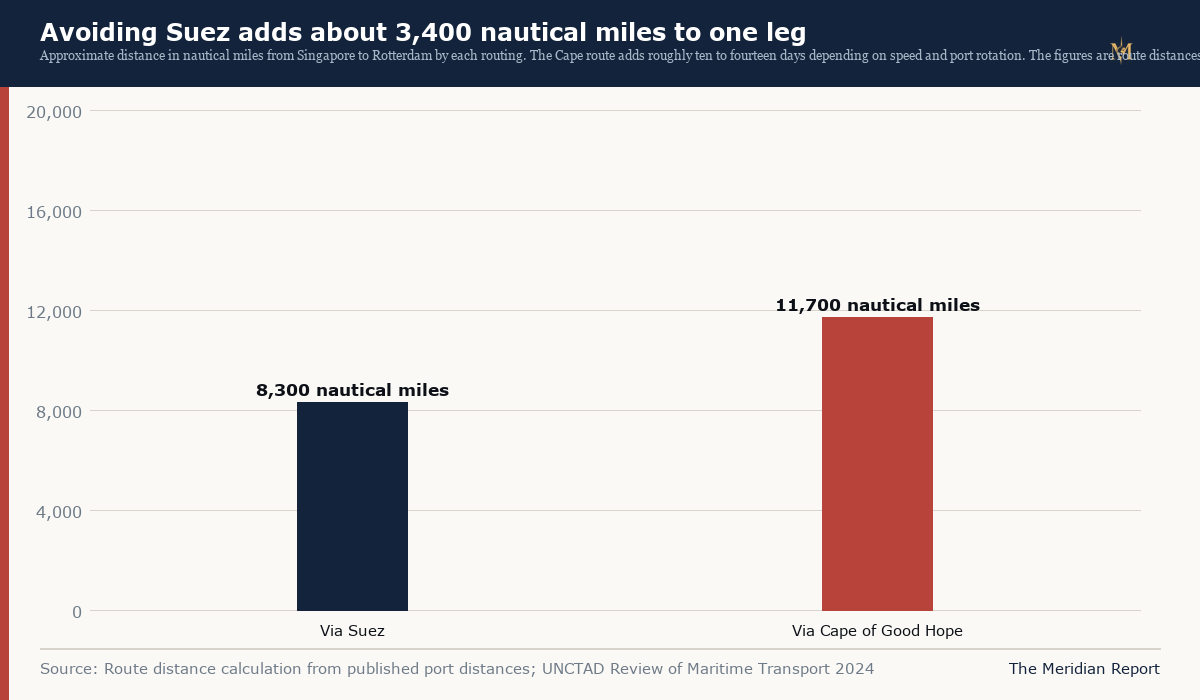
The new networks launched into a market distorted by diversion. Since December 2023, most container ships travelling between Asia and Europe have avoided the Suez Canal and sailed around the Cape of Good Hope, adding roughly ten to fourteen days to a one way voyage. The diversion absorbs capacity: a ship that takes longer to complete a round trip carries fewer containers per year, so the same fleet moves less cargo. UNCTAD estimated in 2024 that the diversion had absorbed a significant share of global container capacity, and the effect on rates was larger than any alliance decision.
For the alliance reshuffle, the diversion was both a shield and a distraction. It was a shield because the capacity absorbed by longer routes kept the market tight enough that the new networks did not have to compete on price in their first year. It was a distraction because it made the performance of the new networks hard to assess. A schedule that looks unreliable may be unreliable because the network is badly designed, or because a ship was diverted around Africa and missed a berth window. Separating the two requires data that carriers do not publish.
The diversion also changed the value of a hub. A network designed around Suez assumes that a container from Singapore to Rotterdam passes through the Mediterranean and can be transhipped at a port along the way. A network designed around the Cape assumes a much longer leg and a different set of intermediate options. Carriers that had built their networks around Mediterranean transhipment had to rethink, and carriers with strong West African and South African connections found new relevance. The alliance reshuffle and the diversion were not coordinated, but they pushed in the same direction: toward fewer, larger, better equipped hub ports.
Hubs are a bet on port performance
The logic of hub and spoke is straightforward. A large ship is expensive per day, and every hour it spends at a berth is an hour it is not earning. If a carrier can concentrate cargo at a few ports where cranes are fast and berths are available, the ship spends less time in port and more time at sea. Smaller ships then distribute the cargo to the final destinations.
The logic fails if the hub cannot handle the concentration. A port that receives twice as many containers as before needs twice the yard space, twice the gate capacity and twice the rail connections, and those are not quick to build. The congestion episodes of 2021 and 2024 showed what happens when a hub receives more cargo than it can move: containers stack in the yard, trucks queue, rail backs up, and the delay propagates through the network. A hub and spoke network is more efficient in normal conditions and more fragile in a shock, because the shock has fewer places to go.
Ports also compete for the role. A carrier choosing a hub is making a multi-year commitment that affects the port's investment plans, its labour agreements and its relationships with inland logistics providers. The competition is not only about price. It is about berth productivity, customs clearance, rail frequency, free time and the reliability of the labour force. The reshuffle moved some of that competition from the national level to the port level, and the winners are the ports that can demonstrate they can turn a ship around.
What shippers actually received
For a shipper, an alliance is invisible until something goes wrong. The bill of lading names the carrier, the container is booked with the carrier, and the service is marketed by the carrier. What changes is the schedule, the port of call and the ease of resolving a problem.
The first effect is service churn. A network redesign changes which ports are called directly and which are served by feeder. A shipper whose cargo used to move direct from a regional port now finds it moves through a hub, with an extra transhipment and an extra few days. That is a real cost, and it is usually discovered when the first shipment arrives late rather than when the schedule is published.
The second effect is contract structure. Large shippers negotiate annual contracts with minimum quantity commitments and fixed rates, and they choose carriers partly on the basis of the network. A network that offers a direct call at the shipper's nearest port is worth more than one that requires a feeder, and the difference shows up in the rate the shipper is willing to pay. The reshuffle changed the relative value of carriers for particular origins and destinations, which is why some contracts moved.
The third effect is reliability. The carriers that promised higher reliability are asking shippers to pay for it, either through a higher rate or through a service commitment. Whether the promise is met is measured by independent analysts, and the measurement matters because a shipper that plans inventory around a reliable schedule carries less safety stock. The value of reliability is real and it is large, which is why the promise is credible as a commercial strategy even before the results are in.
There is a fourth effect that is harder to see and matters over time: the bargaining position of a mid-sized shipper. A shipper that moves a few hundred containers a year has no leverage over a global network. It buys through a forwarder, which buys space from the carrier, which allocates it according to its own priorities. When the networks consolidate, the forwarder has fewer carriers to choose from, and the allocation decision becomes less contestable. The effect is not a price change at the top of the market. It is a widening gap between what the largest shippers pay and what everyone else pays.
The counter-evidence: structure is not price
It would be easy to overstate the effect of the reshuffle on freight rates, and the evidence does not support it. Container rates are set by the interaction of capacity and demand, and both moved for reasons unrelated to alliances.
In 2024, rates rose sharply because the Red Sea diversion absorbed capacity and because demand from North America and Europe was stronger than expected. In 2025, rates fell as new ships delivered and the diversion's capacity absorption was offset by the order book. Those movements happened across all alliances and all routes, and a shipper negotiating a contract would have seen the same direction of travel regardless of which network its carrier belonged to.
The alliance structure affects the distribution of rates between routes and the stability of service, not the level of the market. That is a modest claim, and it is the one the evidence supports. The larger claims, that the reshuffle would restore pricing discipline or that it would collapse rates, were predictions about conduct that the data cannot yet confirm.
The order book will test the structure
The container fleet order book is large relative to the existing fleet, and deliveries through 2027 will add capacity faster than demand is expected to grow. That is the classic condition for a rate war, blank sailings and pressure on the weakest members of any cooperative arrangement.
Alliances have historically broken up in downturns. The 2016 wave of consolidation, in which several carriers merged or failed, followed a period of overcapacity and low rates. Cooperation is easiest when everyone has cargo; it becomes difficult when members disagree about which routes to cut and which ships to idle. A network that has just been redesigned has less slack to absorb that disagreement, because the members have already made commitments to hubs and terminals.
The counter-argument is that the new networks are more disciplined by design. Gemini's hub structure and reliability target give its members a shared metric, and the Ocean Alliance's extension to 2032 gives its members a longer horizon. MSC's standalone position gives it the freedom to compete aggressively if it chooses, which is a threat to the others. The next two years will show whether the redesigned networks are more resilient than the ones they replaced, or merely differently arranged.
The terminal is where the network is paid for
A network design is only as good as the terminals it uses, and the carriers have been buying them. Maersk owns APM Terminals, one of the largest port operators in the world. CMA CGM has invested in terminals from Los Angeles to Singapore. MSC controls Terminal Investment Limited, which is now among the biggest port operators globally. Hapag-Lloyd has taken minority stakes in terminals in Europe and Latin America.
The logic is vertical. A carrier that owns a berth can prioritise its own ships, control the crane productivity it depends on and capture the terminal margin that would otherwise go to a third party. It can also design a network around a terminal it controls, which is what a hub and spoke network requires. The risk is that ownership reduces the port's incentive to serve other carriers well, and that a terminal built for one network becomes a stranded asset when the network changes.
The reshuffle accelerated this. Gemini's hub structure only works if the hubs can turn ships quickly, and the carriers involved have an interest in making that happen. That interest is expressed through investment, through long term agreements with terminal operators and through pressure on port authorities to improve productivity. Ports that cannot demonstrate fast turnarounds are being quietly removed from rotations, which is a slower and more consequential way of losing business than a public decision.
The ports that benefit are those with deep water, large yards, good rail and a labour agreement that allows them to operate at the productivity the carriers demand. The ports that lose are those that are close to a hub but not large enough to be one, because a hub and spoke network does not need every port on the coast. It needs a few good ones and a feeder service for the rest.
The Panama Canal is the other constraint
The Suez diversion gets the attention because it is a security story. The Panama Canal is the other chokepoint, and it has been constrained by something less dramatic: rainfall.
The canal is a lock system fed by freshwater, and it loses water to the sea every time a ship passes through. In a drought it has to reduce the number of daily transits and the maximum draught, which reduces the cargo each ship can carry and forces carriers to choose between waiting, diverting and splitting cargo. The restrictions imposed during the 2023 to 2024 drought cut daily transits by about a third at the tightest point and forced container and bulk carriers to reconsider routes that had been designed around the canal.
The economics are unusual. A container ship on the Asia to US East Coast route can use the canal or the Suez route, and the choice depends on the relative cost of time, fuel and canal fees. When the canal is restricted, the effective capacity on that route falls, and carriers adjust by using larger ships on the remaining slots or by routing via Suez. Both responses take time, and both interact with the alliance networks that were designed around the canal's reliability.
The longer term question is climate. The canal's water supply depends on a reservoir system that is sensitive to El Nino and to land use in the watershed. A canal that is unreliable in drought years is a canal that carriers cannot plan around, and a carrier that cannot plan around it will build networks that avoid it. That shift is slow, because the alternative routes are longer and the canal is still the fastest way between the Atlantic and the Pacific, but it is the kind of shift that determines where ports are busy in ten years.
The blank sailing is the pressure valve
When capacity exceeds demand, carriers do not usually cut prices until the loss is unavoidable. They cancel sailings. A blank sailing removes a ship from a rotation, which reduces the capacity offered and supports the rate. To the shipper, a blank sailing looks like a missing service and a delayed container. To the carrier, it is the main tool for managing a market it cannot control.
The tool becomes more important as the order book delivers. A carrier with new ships has to deploy them or pay for them idle, and the choice between a loss making voyage and a blank sailing is a choice between two losses. Alliances make the coordination easier, because members can agree to blank a joint service rather than each cancelling separately, but they also make it harder to allocate the pain. The member whose cargo is bumped has a legitimate complaint.
The pattern to watch is the ratio of blanked capacity to total capacity on the main routes. A high ratio with stable rates indicates disciplined capacity management. A high ratio with falling rates indicates that the discipline is not holding. Neither ratio is published consistently, which is why the market relies on analyst estimates and on the carriers' own announcements.
What the regulators are watching
The reshuffle did not escape regulatory attention. The European Commission lost its block exemption in April 2024, which means it now reviews consortia under the general competition rules, and it has the power to open investigations on its own initiative or on a complaint. The Federal Maritime Commission in the United States monitors alliances and has been more active since the Ocean Shipping Reform Act of 2022 gave it a broader mandate over detention, demurrage and service complaints.
The regulators are not primarily concerned with the level of rates. They are concerned with the conditions of service: whether a shipper can obtain space, whether a carrier can refuse cargo without justification, whether terminal charges are transparent and whether the alliance members coordinate on things they should compete on. Those questions are harder to answer than a price comparison, and they require data that the carriers hold.
The practical consequence for shippers is that a complaint has a route. A shipper that believes it has been treated unfairly can complain to the commission, and the commission can investigate. That route is slow and it does not produce a rate, but it does create a record. The record is the raw material for the next round of regulation, and the next round will be shaped by what the current networks do in the next downturn.
The berth is also a labour negotiation
A container terminal is one of the few places where a network decision meets a collective agreement. Crane productivity, gate hours and the willingness to work through a surge depend on a workforce that has organised for decades and that watches automation closely.
The United States provided the clearest example in October 2024, when the International Longshoremen's Association struck at ports along the East and Gulf coasts for three days. The dispute was about pay and about automation, and it ended with a tentative agreement on wages reported at a 62 per cent increase over six years, with the automation question deferred. Members ratified a contract in early 2025. The strike was short, but it demonstrated that a network designed around a handful of large ports is exposed to a labour dispute at any one of them.
The connection to the alliance reshuffle is direct. A hub and spoke network concentrates cargo, which concentrates labour, which concentrates the effect of a dispute. A carrier that routes a third of its transatlantic cargo through one port has a third of its transatlantic service dependent on that port's labour relations. The alternative, spreading cargo across more ports, reduces the concentration and reduces the efficiency that made the hub attractive in the first place.
Automation is the longer argument. A fully automated terminal can move more containers per hectare and per hour, but it costs capital and it reduces the number of jobs per box. Port authorities and carriers want the productivity. Unions want the jobs and the training that goes with them. The compromise in most ports has been partial automation, with new equipment introduced alongside existing labour, and the compromise has held because the alternative is a dispute that damages both sides.
For shippers, the practical implication is that port choice is not only a matter of distance and rate. A port with a stable labour relationship and predictable gate hours is worth more than a port with a lower headline charge and a history of disruption. That calculation has become more important as the networks have concentrated, because the cost of a disruption at a hub is now shared by more cargo.
What the numbers do not establish
The capacity shares are estimates compiled by commercial analysts from fleet data. They change with every delivery and every charter, and they measure capacity, not cargo carried or revenue earned. A carrier with 20 per cent of capacity may have a very different share of a particular trade.
The reliability figures are reported by carriers and measured by analysts using different definitions. A schedule that is reliable by one measure may be unreliable by another, and the measurement window matters: a vessel that arrives within one day is on time under one definition and late under another.
The diversion distance is a calculation from route geometry, not a measurement of any particular voyage. Actual distances depend on the routing, the weather and the port rotation, and the time penalty depends on the speed the ship steams. The figure is useful for showing the scale of the penalty, not for predicting a delivery date.
And the claim that the reshuffle caused a particular change in service is often untestable, because the counterfactual, the network that would have existed without the reshuffle, was never operated. What can be said is that the networks changed, the ports they call at changed, and the costs and benefits moved with them.
Sources
- Maersk, Gemini Cooperation network announcement, 2024.
- Hapag-Lloyd, Gemini Cooperation launch and network details, 2024 to 2025.
- European Commission, Consortia Block Exemption Regulation, expiry 25 April 2024.
- Ocean Alliance, extension of the agreement to 2032, February 2025.
- UNCTAD, Review of Maritime Transport 2024.
- Federal Maritime Commission, alliance monitoring and Ocean Shipping Reform Act implementation.
- Sea-Intelligence, global schedule reliability reports, 2024 to 2025.
- BIMCO and Alphaliner, fleet capacity and order book data, 2025.
- Drewry, World Container Index and capacity analysis, 2024 to 2025.