
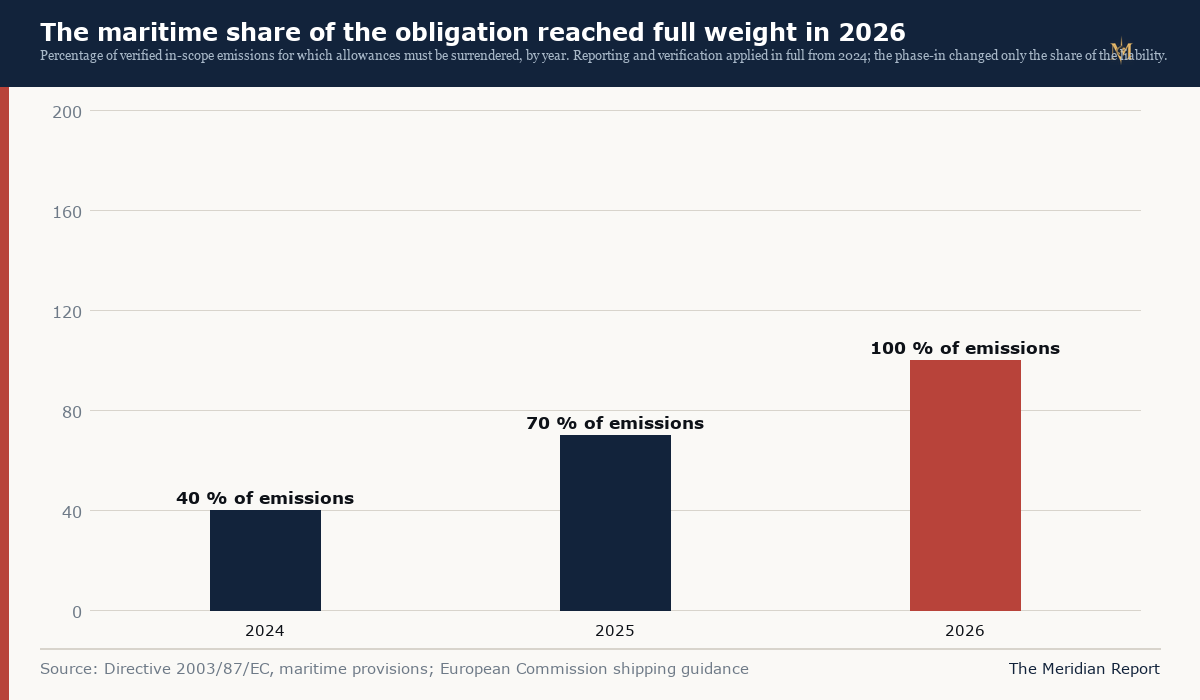
A ship that burns fuel oil on a voyage from Singapore to Rotterdam has always carried a cost that the market could see: the fuel bill. From this year it carries a second cost that the market is still learning to price. The European Union's emissions trading system now covers 100 percent of the maritime emissions within its scope, after a phase-in that charged 40 percent in 2024 and 70 percent in 2025. The allowance obligation is no longer a pilot programme with a partial liability. It is a full carbon cost on a voyage that touches a European port, and it sits alongside a separate fuel-intensity standard that can penalise the same ship for a different reason.
The shipping industry's response has been less dramatic than the headlines predicted and more consequential than the exemption debates suggested. Freight rates have not doubled. Ports have not emptied. But contracts have changed, data systems have been rebuilt, and a set of questions that were theoretical in 2023 are now being settled in charter parties and in court: who owns the allowance obligation when the ship is owned by one company and operated by another, what happens when a voyage is diverted, and how much of the cost can be passed to a cargo owner who did not choose the vessel.
The scope is a legal geography, not a distance
The emissions trading system does not cover a ship because it is engaged in European trade. It covers a ship because of where it sails. Emissions at berth in an EU or EEA port are covered in full. Emissions from a voyage between two EU ports are covered in full. Emissions from a voyage between an EU port and a port outside the union are covered at 50 percent, and the same applies to the return leg. A ship that never enters EU waters has no obligation, even if the cargo it carries is destined for Europe and is transshipped outside the union.
That geography creates the first commercial complexity. A container line that calls at Rotterdam, Hamburg and Antwerp on a single loop has a different obligation from a line that calls at one EU port and feeds the rest by road. A bulk carrier that discharges in Rotterdam and loads in Brazil has a different obligation from one that discharges in Rotterdam and loads in Norway, which is inside the EEA for these purposes. The voyage definition, not the cargo destination, determines the charge.
The 50 percent rule for extra-EU voyages was a compromise. It recognises that the carbon from a voyage to Asia is not solely attributable to Europe, while ensuring that the European leg is not free. The compromise also creates an incentive to concentrate discharges at a single EU hub and redistribute by feeder, which may or may not reduce total emissions depending on the feeder's efficiency. The Commission monitors the pattern but has not attempted to redesign the geography.
The phase-in ended, and the cash obligation began
The 2024 and 2025 phase-in was widely described as a soft start. It was soft only in the share of allowances that had to be surrendered. The monitoring and reporting obligations applied in full from the first year, and the verification requirement applied to the reported emissions. A company that under-reported in 2024 did not avoid the obligation; it created a liability that would be corrected in a later verification.
From 2026 the full share applies. A company must surrender allowances equal to the verified emissions within scope, and it must do so by the annual deadline for the previous year's emissions. The allowances are EU emissions allowances, bought in the same market as those used by power plants and factories, and their price is set by that market rather than by a maritime-specific mechanism. The cost is therefore exposed to the same volatility as the rest of the EU carbon market, which is a new risk for an industry that is used to fuel-price volatility but not to carbon-price volatility.
The cash flow matters as much as the unit cost. A company operating a fleet of large vessels can face an allowance bill in the tens of millions of euros, payable months after the voyages that generated it. The working capital has to be financed, and the financing cost is a function of the company's credit and the volatility of the allowance price. Some operators have begun to buy allowances in advance, which ties up cash but fixes the cost; others have left the exposure open, which is a bet on the carbon price that few shipping companies are equipped to make.
Methane and nitrous oxide change the ranking of fuels
The inclusion of methane and nitrous oxide in the reporting framework from 2026 changes the measured footprint of ships that burn gas. A dual-fuel LNG vessel emits less carbon dioxide per unit of energy than a conventional fuel-oil vessel, which is why LNG was marketed as a transition fuel. It also slips unburned methane from the engine, and methane has a much higher global warming potential than carbon dioxide over a twenty-year horizon. When the slip is counted, the climate advantage of LNG narrows or disappears, depending on the engine type and the operating profile.
The regulatory consequence is that a ship's compliance position can change without any change in its physical operation. A vessel that looked compliant under a carbon-dioxide-only metric can look non-compliant when methane is included, and the owner has to decide whether to retrofit the engine, change the fuel, or absorb the cost. The same logic applies to nitrous oxide from certain engine types, which is a smaller but non-trivial part of the footprint.
The inclusion also affects the credibility of the fuel transition. A shipping company that committed to LNG as a bridge to ammonia or methanol now has a fleet whose measured emissions are worse than the brochure suggested, and a customer base that is beginning to ask for the actual numbers rather than the design specification. The companies that measured methane slip early are at an advantage; the ones that relied on default factors are discovering a gap between the model and the measurement.
FuelEU is a different instrument with a different failure mode
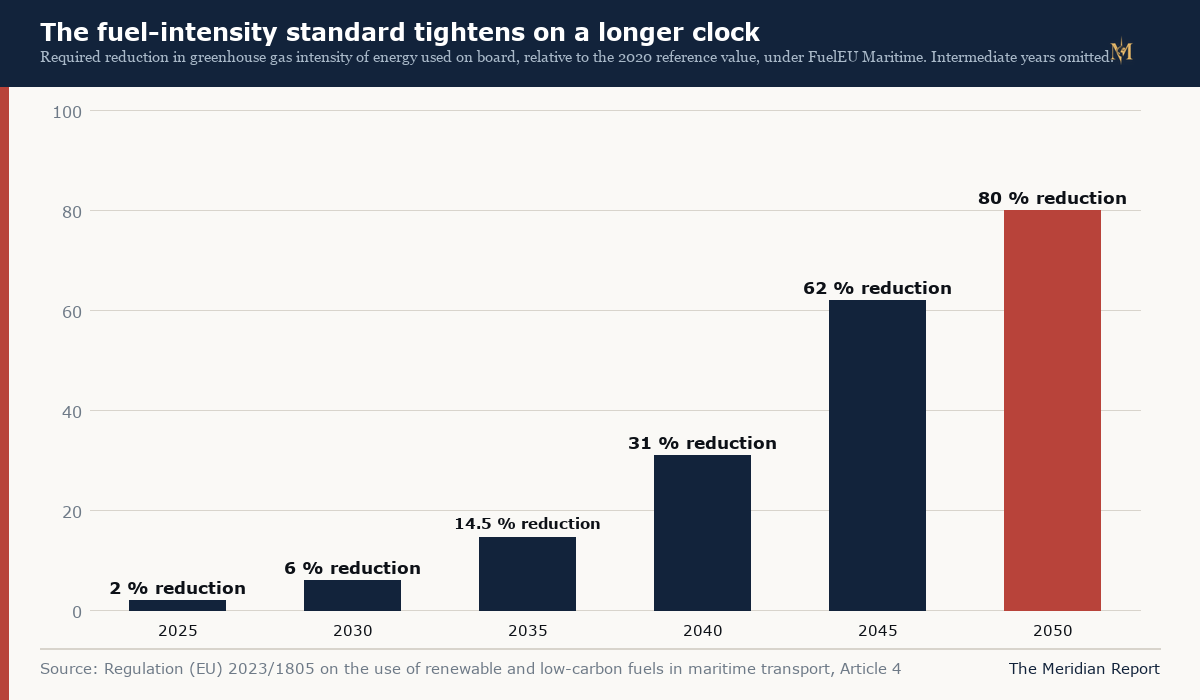
FuelEU Maritime sets a greenhouse gas intensity limit for the energy used on board, measured on a well-to-wake basis. The limit tightens over time, starting with a 2 percent reduction in 2025 relative to the 2020 baseline and reaching 80 percent by 2050. A ship that exceeds the limit must pay a penalty based on the energy that exceeds it, and the penalty is set at a level intended to make compliance cheaper than paying.
The two instruments can pull in different directions. The emissions trading system charges for the carbon in the fuel actually burned, which rewards a switch to a lower-carbon fuel. FuelEU sets a limit on the intensity of the energy used, which rewards a switch to a lower-intensity fuel or to electricity at berth. A ship that uses a biofuel blend can reduce its ETS liability without changing its FuelEU intensity, depending on the feedstock and the certification. A ship that plugs into shore power can reduce its at-berth emissions without changing its voyage fuel.
The compliance strategies therefore interact in ways that are not obvious from either rule alone. A company can optimise for the ETS and fail FuelEU, or optimise for FuelEU and overpay the ETS. The operators that have built an integrated compliance model, with the same fuel data feeding both obligations, are finding that the marginal cost of compliance is lower than the sum of the two separate calculations. The ones that have treated the rules as separate projects are paying twice for the same data.
Who owns the obligation when the ship is chartered
The legislation places the obligation on the shipping company, defined as the entity responsible for the operation of the ship. In a bareboat charter, that may be the charterer. In a time charter, it is usually the owner or the technical manager. In a voyage charter, the cargo owner may have effective control over the route and the speed, but not over the ship's operation. The contractual chain is more complex than the legal definition, and the allocation of the cost is negotiated separately from the allocation of the obligation.
The result is a set of clauses that did not exist five years ago. A time charter may include a carbon clause that requires the charterer to reimburse the owner for allowances attributable to the voyage, with a formula for the speed and route assumptions. A voyage charter may include a bunker adjustment factor that covers both fuel and carbon. A container line may include an emissions surcharge in the freight rate, calculated per container and reviewed quarterly.
The clauses are not standardised, and the disputes are beginning to appear. A charterer that ordered a speed that increased fuel consumption may argue that the resulting allowance cost is the owner's risk. An owner that routed the ship through a longer voyage to avoid congestion may argue that the extra emissions are the charterer's cost. The contract decides, and the contract is often silent on the point because the parties did not anticipate it when the fixture was negotiated.
Port evasion is a real route, and a limited one
The anti-evasion provisions exist because the geography creates an obvious arbitrage. A ship that would call at Rotterdam can, in principle, discharge at a non-EU port and move the cargo by road or feeder, reducing the EU voyage distance and the allowance obligation. The extra logistics cost may be lower than the allowance cost for some routes, particularly for short-sea traffic near the union's borders.
The Commission monitors port calls at neighbouring non-EU ports and has the power to investigate patterns that suggest diversion. The monitoring is not a prohibition, and the legal test is whether the diversion is commercially motivated or carbon motivated, which is difficult to establish. The practical constraint is capacity: a non-EU port that can handle the diverted volume needs the berths, the cranes and the hinterland connections, and most of the candidates do not have them at the scale required.
The evasion route that matters more is the one that does not involve a port at all. A ship can reduce its reported emissions by improving its operational efficiency, which is legitimate, or by changing the fuel, which is the intended response, or by reclassifying voyages, which is not. The verification regime is the defence against the last, and it depends on the accuracy of the ship's fuel records and the independence of the verifier.
The cost lands on the cargo, eventually
The economic incidence of the maritime carbon cost is the subject of a long literature on freight pass-through. In a competitive market with excess capacity, the carrier absorbs the cost. In a tight market, the carrier passes it to the shipper. The shipping cycle of the past few years has moved between the two, and the carbon cost is small relative to the freight rate in most trades, which makes it hard to isolate in the data.
The cost is larger relative to the value of low-value bulk cargo, which is where the incidence matters most. A tonne of iron ore or a container of recycled paper has a low value per tonne, and a carbon cost of a few euros per tonne of cargo can be a meaningful share of the delivered price. A tonne of electronics has a high value per tonne, and the same cost is a rounding error. The burden therefore falls disproportionately on the trades that can least afford it, which is one of the equity arguments that developing countries have made in the international negotiations.
The pass-through also depends on the contract. A long-term contract with a fixed freight rate may leave the carrier exposed until the next review. A spot contract reprices immediately. A contract with a bunker adjustment factor may or may not include a carbon adjustment, depending on the clause. The industry is gradually standardising the adjustment, and the standardisation is being driven by the largest shippers, who want a transparent line item rather than an embedded cost.
What the international negotiations mean for a regional scheme
The EU scheme is regional, and the shipping industry is global. A ship that trades between Asia and Europe pays the EU price on half of its voyage emissions, while a ship that trades between Asia and the United States pays nothing. That asymmetry is the reason the EU has argued for a global measure at the International Maritime Organization, and the reason the IMO's negotiations have been so difficult.
The IMO's 2023 strategy set a goal of net zero emissions from international shipping by or around 2050, with indicative checkpoints for 2030 and 2040. The measures to deliver it have been contested, and the adoption of a carbon price at the IMO has been delayed by disputes over the level, the revenue use and the treatment of developing countries. The EU has said it would consider how a global measure interacts with its regional scheme, but it has not committed to repealing the regional scheme if a global one is adopted.
For a shipowner, the practical question is not which forum prevails but which cost applies on which voyage. A global measure would reduce the arbitrage between routes, and it would also reduce the administrative burden of complying with different regional schemes. Until it exists, the regional schemes are the operating reality, and the operators that have built the systems to comply with the strictest one are the ones best placed to adapt to a global regime.
The data pipeline is the part nobody sees
A carbon market runs on a number, and the number has to be produced before it can be traded. For shipping, the number comes from the monitoring, reporting and verification system, which requires each ship to record its fuel consumption by type, its distance travelled, its time at berth and its cargo carried, and to have the resulting emissions report verified by an accredited body.
The data pipeline is more fragile than the policy assumes. Fuel consumption is measured by flow meters, tank soundings or bunker delivery notes, and each method has an error band. A ship that takes on fuel in a port where the delivery note is unreliable, or that burns a blend whose density varies between deliveries, produces a number that is accurate to a few percent at best. For a single voyage the error is small. For a fleet of hundreds of vessels and a year of voyages, the errors accumulate into a material uncertainty in the allowance obligation.
The verification regime is designed to catch systematic error rather than every measurement. A verifier checks the ship's procedures, samples the records and tests the calculations, and issues an opinion on whether the report is materially correct. The opinion is not a guarantee, and the liability for the number stays with the company. A company that has built its own data system, with automated feeds from the vessel and a reconciliation to the bunker invoices, is in a stronger position than one that assembles the report from spreadsheets in the last month of the cycle.
The data also feeds the commercial contract. A charterer that is paying for the carbon needs to see the voyage data, and the owner that is reporting it needs the charterer to accept the methodology. The two sides are negotiating over a number that neither can verify independently, which is why the standardisation of voyage data has become a commercial priority as well as a regulatory one.
Shore power is a berth investment, not a ship investment
At-berth emissions are covered in full by the emissions trading system, and FuelEU adds a separate requirement to use shore-side electricity or an equivalent zero-emission technology where it is available. The combination creates a strong incentive for a ship to plug in, and a strong incentive for a port to provide the connection.
The investment is not symmetric. A ship needs a connection point, a cable management system and a compatible voltage, which is a retrofit cost per vessel. A port needs a substation, cables, plugs and the capacity to supply several ships at once, which is an infrastructure cost per berth. The port investment is lumpy and long-lived, and it is recovered through a tariff that has to compete with the cost of burning fuel at berth.
The economics work best where the berth is used by a small number of large ships on a predictable schedule, which is the case for container terminals and cruise berths. They work least well at general cargo berths used by a rotating fleet of small ships with different connection standards. The result is a patchwork of electrified berths, and a ship that is equipped to plug in may find that the berth it is assigned does not have a connection.
The emissions trading system does not solve that coordination problem. It prices the emissions, and the price is borne by the ship, but the port's decision to invest depends on its own tariff and on the certainty that ships will use the connection. The regulation of the port side has moved more slowly than the regulation of the ship side, which is a familiar pattern in transport decarbonisation.
Alternative fuels are available, affordable and not yet scalable
Green methanol and ammonia are the two fuels that the industry most often names as the long-term replacements for fuel oil. Both can be burned in engines that are commercially available, both have a lower carbon intensity than fossil fuel when produced from renewable electricity, and both require infrastructure that does not yet exist at the scale of the global bunkering network.
The cost gap is the binding constraint. A green methanol molecule costs several times a fossil methanol molecule to produce today, and the gap is a function of the cost of renewable electricity, the efficiency of the electrolyser and the availability of biogenic carbon. Ammonia has a similar profile, with the added complication that it is toxic and requires different handling, training and port procedures.
The orderbook reflects the uncertainty. Shipowners have ordered vessels that are capable of burning alternative fuels, but many of those vessels will run on fossil fuel until the green supply is available and the price gap narrows. A dual-fuel engine is an option on a future fuel, and the option is worth buying when the alternative is a ship that cannot be retrofitted. The option is not a commitment to burn the fuel, and the emissions trading system does not distinguish between a ship that is capable of using green fuel and one that actually does.
That gap between capability and use is the reason the carbon price alone is unlikely to deliver the transition on the timetable the strategy assumes. A carbon price changes the relative cost of fuels at the margin, but it does not build the electrolyser, the bunkering vessel or the port terminal. Those require capital that is committed before the demand exists, which is the classic chicken-and-egg problem of infrastructure, and it is being addressed through subsidy, offtake and consortium arrangements rather than through the market alone.
The small operator and the island economy
The emissions trading system applies to ships of 5,000 gross tonnage and above, which covers most of the world's tonnage but excludes a large number of smaller vessels. A small operator below the threshold has no direct obligation, and a small operator above it has the same obligation as a large one, with less capacity to absorb the fixed cost of compliance.
That asymmetry matters for the routes that serve small markets. A feeder service to an island economy may use a vessel just above the threshold, with a thin margin and a captive customer base. The carbon cost is small in absolute terms, but it is large relative to the freight revenue, and the operator cannot pass it to a customer who is also struggling with input costs. The result can be a service reduction or a route change, which is a social cost that the carbon price does not capture.
The EU has recognised the issue in the design of the Innovation Fund and in the support for alternative fuel projects, but the support is project-based rather than route-based. A small operator that needs a retrofit or a fuel switch may not have the scale to win a grant, and it may not have the balance sheet to borrow. The just transition argument that applies to coal regions applies to maritime routes as well, and it has received less attention because the emissions are invisible to the consumer at the end of the supply chain.
What the first full year will show
Three things will be visible after the first full compliance year. The first is the size of the allowance bill relative to freight revenue, which will show whether the cost is material for the industry as a whole or only for the least efficient ships. The second is the pattern of port calls, which will show whether the anti-evasion provisions are working or whether the diversion is happening at a scale the monitoring did not anticipate. The third is the contract terms, which will show how the cost has been allocated between owners, charterers and cargo owners.
The freight market's repricing has been quieter than the policy debate. A carbon surcharge of a few euros per tonne of cargo is small against a container rate that can move by hundreds of dollars in a week, and it is easily absorbed in a rising market. In a falling market, the surcharge becomes visible because it is the one line item that does not fall, and shippers have begun to challenge it. The challenge is not usually about the arithmetic. It is about whether the surcharge reflects the actual allowance cost or a margin opportunity, and the carrier's answer depends on data that the shipper cannot see.
That information asymmetry is the commercial legacy of the first full year. The carriers that publish a transparent methodology, with the voyage distance, the fuel consumption and the allowance price stated separately, are finding that the surcharge is accepted. The carriers that bundle it into an all-in rate are finding that it is treated as a price increase, with the usual negotiation. The difference is not the size of the cost. It is the credibility of the calculation.
The evidence so far suggests that the cost is manageable for the large operators and difficult for the small ones. A company with a modern fleet, a good data system and access to capital can buy allowances, hedge the price and pass the cost through. A company with an older fleet, a thin balance sheet and a spot-market customer base has less room to manoeuvre, and the carbon cost accelerates the fleet renewal that the market was already forcing. That is not a failure of the policy. It is the policy working through the fleet, slowly and unevenly, which is how capital-intensive industries change.
The unresolved question is whether the regional scheme can survive the arbitrage while a global measure is negotiated. A carrier that pays the European price on half of a voyage and nothing on the rest has an incentive to route the cargo through the cheapest jurisdiction, and the incentive grows as the European price rises. The anti-evasion provisions address the port call, not the routing decision, and the routing decision is where the long-run adjustment will happen. Until a global price exists, the European scheme is an experiment in applying a territorial carbon cost to a mobile industry, and the experiment is being watched by every jurisdiction that is considering the same instrument.