
A lithium mine and a lithium refinery are not the same kind of asset. The mine is a hole in the ground with a grade, a strip ratio and a permitting process. The refinery is a chemical plant with a reagent balance, an energy contract, a waste stream and a customer specification that the plant must meet within a narrow tolerance. The mine can be financed against a resource statement. The refinery has to be financed against a customer, because a plant that produces battery-grade material without a qualified buyer is a plant that produces inventory.
That distinction explains why the policy debate about critical minerals has been aimed at the wrong end of the chain. Governments count reserves, announce mining projects and celebrate resource nationalism, while the step that converts ore into a usable material remains concentrated in a small number of countries and, above all, in China. The concentration is not a market failure in the ordinary sense. It is the result of deliberate industrial policy, integrated clusters and a cost structure that new entrants cannot match without a subsidy, a price floor or a guaranteed buyer.
Where the concentration actually sits
The International Energy Agency's critical minerals work has consistently shown a gap between mining concentration and refining concentration. For lithium, Australia and Chile are the largest sources of raw material, while China processes the majority of the world's refined product. For cobalt, the Democratic Republic of the Congo supplies most of the ore and China refines most of it. For rare earths, a handful of mines supply concentrate and China separates almost all of it. For graphite, the mining is more diversified than the processing, and the processing that matters for battery anodes, the spheroidising and coating step, is overwhelmingly Chinese.
The pattern repeats because refining is where the technical barriers, the environmental permits and the capital intensity combine. A rare earth separation plant is not a generic factory. It uses solvent extraction in a long sequence of mixer-settlers, with each stage tuned to a particular element and a particular impurity profile. The chemistry is well understood, but the operating knowledge is accumulated rather than purchased, and the equipment is specialised. A new plant can be designed from published flowsheets, but the ramp-up from design to battery-grade output is where projects lose years.
Graphite illustrates the point more sharply than any other material. Natural graphite is mined in several countries, including China, Mozambique, Madagascar and Brazil. The step that turns flake into spherical, coated anode material is a combination of milling, shaping, purification and thermal treatment, and it is capital intensive and energy intensive. A mine can produce concentrate and sell it, but the concentrate is not an anode. The processing capacity is the gate, and the gate is narrow.
The integrated park is the real advantage
China's midstream advantage is not only a set of individual plants. It is the co-location of refining, cathode and anode production, cell manufacturing and the equipment suppliers that serve them. A cathode plant next to a refiner can take material in slurry form, avoid drying and shipping costs, and iterate on specifications with the refiner in days rather than months. A magnet plant next to a separation plant can recycle its own scrap back into the feed. The cluster lowers logistics costs, shortens qualification cycles and creates a labour pool that a standalone plant cannot replicate.
That integration is why the cost gap is larger than a simple comparison of labour and energy prices would suggest. A new refinery in Europe or North America has to ship concentrate in, ship product out, build its own waste handling and train its own workforce. It may also have to pay for a higher environmental standard, which is a legitimate public good but a commercial disadvantage when the competing plant does not. The gap is the reason governments have concluded that the midstream will not relocate on price alone.
The integrated model also shapes the response to export controls. When China restricted gallium, germanium, graphite, antimony and later several rare earth elements, the immediate effect was on the customers who depended on Chinese processing, not on the mines that supplied the ore. A mine in another country could not fill the gap because the material still had to be processed. The controls demonstrated that the midstream is the point of leverage, and that a diversified mining portfolio is not a substitute for diversified processing.
The policies are buying capacity, not yet output
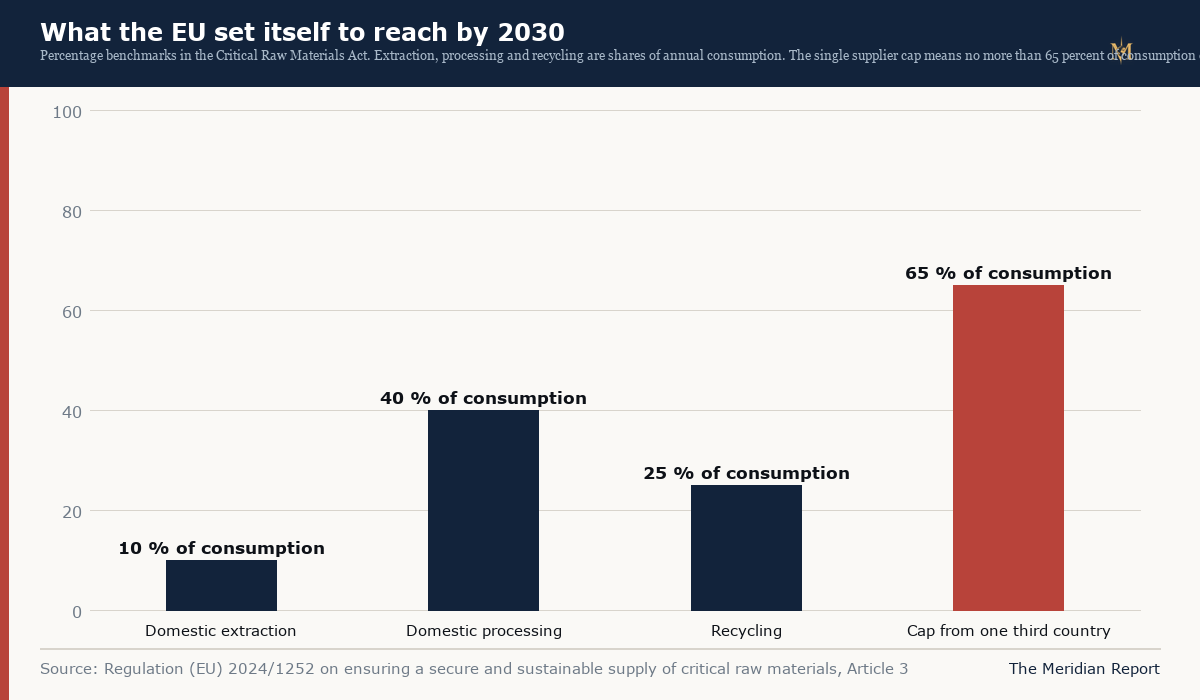
The European Union's Critical Raw Materials Act sets four benchmarks for 2030: at least 10 percent of consumption from domestic extraction, 40 percent from domestic processing, 25 percent from recycling, and no more than 65 percent of consumption of any strategic raw material from a single third country. The benchmarks are indicators of intent rather than quotas, and the Commission reports on progress. The Act also introduces strategic projects with faster permitting and a framework for joint purchasing and stockpiling.
The United States has used a different mix. The Inflation Reduction Act's clean vehicle credit attaches domestic content and foreign entity of concern conditions to battery components and critical minerals, which gives automakers an incentive to qualify their supply chains. The Defense Production Act has been used to fund processing projects, and the Department of Energy's loan and grant programmes have supported refineries and cathode plants. The approach is demand pull plus direct finance, with the tax credit doing the work that a carbon price does in other sectors.
Both approaches face the same timing problem. A refinery takes three to five years to build and another two to three years to qualify its product with a customer. A mine takes longer. The demand for battery materials is growing on a shorter cycle than the supply can be added, and the policies that support the supply are being written while the demand is already contracted. The result is a period in which the subsidy is doing the work that scarcity would do anyway, and in which the projects that receive support are not necessarily the ones that will be competitive when the shortage ends.
Prices tell a different story from policy
The lithium market is the clearest example of how quickly the narrative can change. Prices for lithium carbonate and hydroxide rose to extraordinary levels in 2022, when demand from electric vehicles outran supply and inventories were thin. They then fell sharply as new supply came online, as demand growth in some markets slowed and as buyers destocked. A price that once justified any project became a price at which only the lowest-cost producers could earn a return.
That cycle matters for the midstream because refinery economics are sensitive to the spread between concentrate and refined product, not only to the absolute price. A refiner that has contracted concentrate at a formula linked to the refined price can survive a fall in the absolute price. A refiner that bought concentrate at a fixed price and sells at a floating price can be wiped out. The projects that fail in a downturn are often the ones with the least integrated supply, which is another advantage for the incumbents.
Cobalt has a similar dynamic, with the added complication that most cobalt is a by-product of copper or nickel mining. A cobalt refinery cannot simply increase output when prices rise, because its feed is determined by the economics of another metal. That by-product structure makes cobalt supply inelastic in the short run and makes the midstream concentration harder to dilute, since a new refinery needs a secure feed that the existing mines have already committed.
The qualification bottleneck is invisible in the statistics
A refinery can be built and still not sell its output, because battery materials have to be qualified by the customer. Qualification involves sampling, cell testing, cycle-life testing and a production audit, and it can take a year or more for a new plant. The customer will not switch a qualified supplier for an unqualified one on price alone, because a failure in the field is a recall, a warranty claim and a reputational event.
That qualification barrier is one of the reasons the midstream is sticky. An automaker that has qualified a Chinese refiner has an incentive to keep using it, even if a new plant offers a lower price, because the cost of re-qualifying is high and the risk of a defect is concentrated. The barrier also explains why offtake agreements are so important: a new refinery needs a customer who is willing to bear the qualification cost, and that customer usually wants a price concession or a equity stake in return.
Governments have begun to address qualification directly, through demonstration facilities, shared testing centres and standards work. The United States and the European Union have both funded battery material testing and qualification infrastructure, on the theory that the private cost of qualification is a public good when the goal is supply chain diversification. The investment is small relative to a refinery, and it may be the highest-return spending in the entire policy package, because it lowers the barrier that keeps new capacity out of the market.
Recycling is a supplement with its own midstream
Recycling is often presented as the answer to primary supply concentration. It is part of the answer, but it does not avoid the midstream. A recycled battery is shredded, the black mass is separated, and the metals are recovered through hydrometallurgical or pyrometallurgical processes that are refineries in their own right. The output still has to be qualified, and the economics depend on the volume and chemistry of the feedstock.
The feedstock is the constraint. Batteries last a decade or more in vehicles, and the first large cohort of electric vehicle batteries is only now reaching end of life. The volume of recyclable material will grow, but it will grow more slowly than demand in a market where the fleet is still expanding. The EU's 25 percent recycling benchmark for 2030 is a real target, and it will be met by a combination of domestic recycling and imported black mass, which raises the same question about where the processing happens.
Recycling also has a collection problem. Batteries are heavy, hazardous and dispersed, and the reverse logistics network is expensive. A recycler needs a steady supply within a reasonable radius, or the transport cost consumes the value of the recovered metals. The countries that build collection infrastructure early will have an advantage in the recycled supply, and the countries that do not will export the feedstock to whoever does.
What the export controls changed
The controls that China imposed on gallium and germanium in 2023, on graphite in 2023 and on antimony in 2024, followed by the rare earth measures in 2025, changed the political economy of the midstream. Before those controls, diversification was a cost. After them, it became an insurance policy, and the willingness to pay for insurance rose sharply.
The controls also revealed a weakness in the retaliation toolbox. A restriction on processing affects the customers of the processing country, including its own downstream manufacturers, and it accelerates the search for substitutes. The measures were calibrated rather than comprehensive, with licensing rather than a blanket ban, which suggests that the objective was leverage rather than rupture. But the signal was enough to move capital: governments that had been debating diversification for years began funding it.
The long-run effect may be to reduce the concentration that gave the controls their power. That is the paradox of using a chokepoint: every use of it teaches the other side how much it depends on the chokepoint and how much it is willing to pay to escape. The question is whether the escape is fast enough to matter before the next restriction.
The arithmetic of a subsidy that has to end
A subsidy for a refinery can be justified as a temporary measure to overcome the qualification barrier and the incumbency advantage. It becomes a permanent cost if the plant cannot compete once the subsidy ends. The policy design question is therefore not whether to subsidise, but what the subsidy is buying and when it stops.
Three tests are useful. The first is whether the plant has a secured feed, because a refinery without a mine or a long-term concentrate contract is exposed to the spot market. The second is whether it has a qualified customer, because a plant without one is a stranded asset. The third is whether its cost curve improves with scale and learning, because a plant that needs the same subsidy at twice the output is not on a path to competitiveness.
Most of the announced projects pass the first test and struggle with the second. The ones that pass all three tend to be integrated with a mine, a customer or both, which is why the largest announcements have come from consortia rather than from standalone refiners. That pattern is likely to continue, and it suggests that the midstream will consolidate around a smaller number of well-capitalised players rather than spreading across many small plants.
Indonesia shows how fast a midstream can be built
The nickel chain is the counter-example to the idea that refining capacity cannot be relocated quickly. Indonesia banned the export of raw nickel ore in 2020 and required smelting and processing to happen domestically. Investment followed, much of it from Chinese companies, and the country became the largest source of nickel in a supply chain that had previously been dominated by other producers. The growth was fast enough to change the global market and to depress prices for some classes of nickel.
The model worked because three conditions were present at once: a large resource, a government willing to restrict exports to force domestic processing, and investors with the capital and the technology to build the plants. The environmental cost was significant, including tailings management and emissions from coal-fired power, and the social cost included land acquisition and labour practices that have been criticised by local and international groups. The episode demonstrates that a midstream can be built quickly when the state is willing to use coercion and when the investors are not constrained by the same environmental standards as their competitors.
That model is not easily exported to democracies with slower permitting and stronger environmental review. It is, however, a warning about the cost of delay: the countries that move slowly will find that the capacity has been built somewhere else, with a different set of rules, and that the resulting supply is cheaper but not necessarily cleaner.
Copper is the test of whether diversification scales
Copper is the least concentrated of the battery and electrification metals, and the most instructive. Mining is spread across Chile, Peru, the Democratic Republic of the Congo, Indonesia and the United States, and refining is spread across China, Chile, Japan, India and Europe. The market is deep, the grade is standardised and the price is set on an exchange, which makes it easier for a new refiner to sell its output than in lithium or rare earths.
Even so, copper smelting has been under pressure. Treatment and refining charges, the fees a smelter charges a miner to process concentrate, have been low because smelting capacity has grown faster than mine supply in some periods, and because Chinese smelters have expanded to secure feed. Low charges squeeze smelter margins, and several older smelters in Europe and Japan have closed or curtailed. The pattern is a reminder that refining capacity is not automatically valuable: it is valuable when it has feed, a customer and a margin.
The copper case also shows how policy can distort the midstream. A country that wants a domestic smelter has to compete with a smelter that is integrated with a mine, or with one that receives state support, or with one that has lower environmental costs. A subsidy can bridge the gap, but it has to be permanent if the underlying cost difference is permanent, which is why smelter support programmes tend to outlast the circumstances that justified them.
The workforce and the permit are part of the supply chain
A refinery needs operators, chemists, metallurgists and maintenance crews who have worked with the process before. Those people are scarce, and they are concentrated where the plants are. A new project can recruit experienced staff from abroad, but immigration rules, language and family considerations limit how many will move, and the local workforce takes years to train.
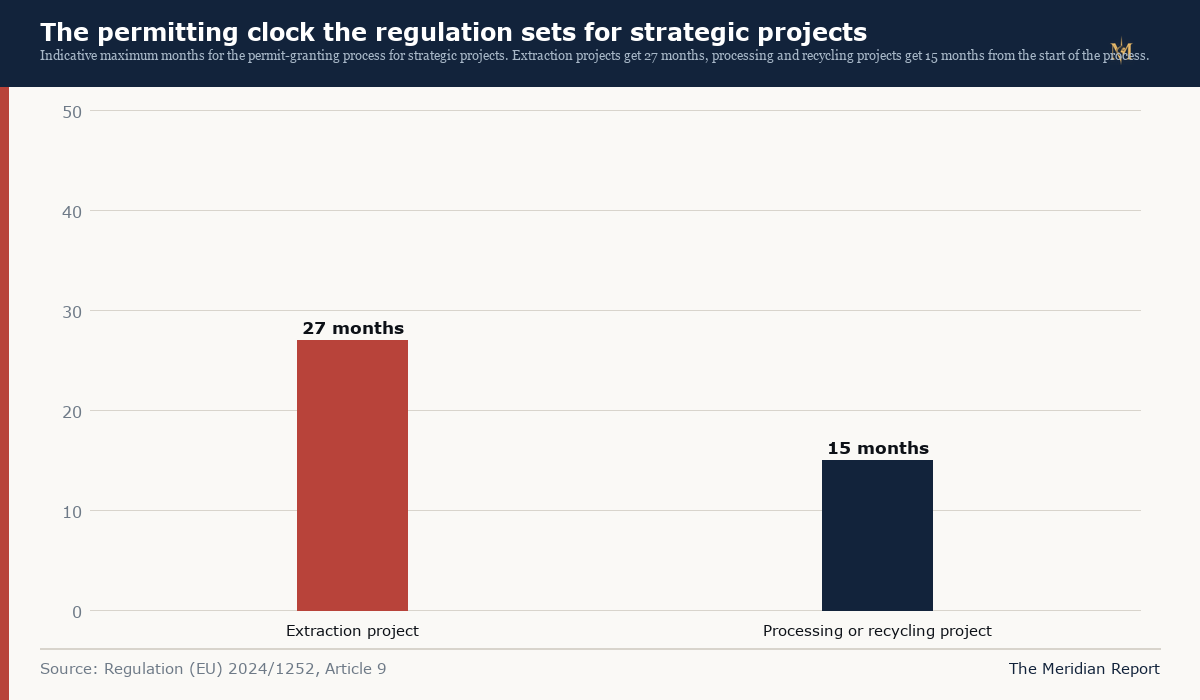
The permit is a similar constraint. The European Union's Critical Raw Materials Act designates strategic projects and sets indicative timelines for permitting, with shorter deadlines for processing and recycling projects than for extraction. The timelines are an improvement on the previous regime, and they still assume that a competent authority can complete an environmental assessment within the period, which depends on the quality of the application and the capacity of the regulator.
In the United States, the permitting of a new mine or refinery involves federal, state and local authorities, and the process can be contested at each stage. The result is that a project can spend more time in permitting than in construction, and the uncertainty is itself a cost because it raises the discount rate that investors apply. The policy response has been to create fast-track categories and to coordinate agencies, which helps at the margin without changing the underlying structure of environmental law.
Who pays for the redundancy
The cost of diversifying the midstream is borne by three groups: taxpayers who fund the subsidies, consumers who pay higher prices for batteries and vehicles, and shareholders who accept lower returns on projects that would not be financed on commercial terms. The distribution between them depends on the policy instrument, and the instrument determines how visible the cost is.
A direct grant makes the cost visible in a budget line and hides it from the product price. A tax credit makes the cost visible in a revenue estimate and hides it in the price of the vehicle. A price floor makes the cost visible in a contract and hides it in the battery. A tariff makes the cost visible at the border and hides it in the finished good. None of these is free, and the choice between them is a choice about who bears the cost and how easily it can be measured.
The case for paying the cost is insurance. A supply chain that depends on a single processor for a material that is essential to a strategic industry is exposed to a decision that the importing country cannot control. The cost of that exposure is difficult to quantify, which is why the debate tends to be about the cost of the insurance rather than the value of the risk it covers. The countries that have decided the risk is worth insuring are now paying, and the ones that have not are waiting to see whether the insurance is needed.
There is a further distributional question inside the importing country. The refinery is usually built in a region that has the port, the power and the workforce, and the environmental burden falls on the community around it. The benefit, a more secure supply chain, is national. That mismatch is familiar from every large industrial project, and it is the reason permitting is contested at the local level even when the national policy has broad support. A project that offers local employment and tax revenue can overcome the opposition; a project that offers only a strategic rationale usually cannot.
What the evidence does not establish
Three claims should be treated with caution. The first is that China's share of refining is a fixed fact. The share is a snapshot, and it is changing as new capacity is built outside China and as Chinese companies themselves invest abroad. A projection that assumes the current share persists is a scenario, not a forecast.
The second is that a friendly mine guarantees a friendly supply chain. The ore may still be processed in a country that is not friendly, and the refined product may still pass through a trading network that is difficult to trace. Supply chain due diligence is a separate problem from resource ownership, and it is not solved by a mine permit.
The third is that recycling will close the gap on the timetable that policy assumes. Recycling depends on feedstock that does not yet exist in the required volume, and it depends on collection infrastructure that is being built slowly. It will matter, but it will not replace primary refining within the horizon of the current policy cycle.
What the midstream teaches about industrial policy
The critical minerals midstream is a case study in the limits of a policy that targets the visible part of a supply chain. Mines are visible, they have addresses, they employ people and they can be counted. Refineries are less visible, they are chemical plants with permits and customers, and they are harder to photograph. The policy attention followed the visibility, and the vulnerability followed the chemistry.
The correction now under way is expensive and slow, and it is being paid for by consumers through higher battery prices and by taxpayers through subsidies. It is also, on the evidence, necessary. A supply chain that depends on a single country for the step that turns rock into a battery material is a supply chain that can be interrupted by a licensing decision, and the cost of that interruption is larger than the cost of the redundancy.
What would change the picture
Four developments would materially alter the analysis. The first is a sustained price for battery materials that justifies new refining without subsidy. A higher price would not solve the concentration problem, but it would make the economics of a new plant easier to finance, and it would reduce the fiscal cost of diversification.
The second is a technical substitution that reduces demand for the most concentrated materials. Sodium-ion batteries, iron-based cathodes and magnet designs that use less dysprosium or no heavy rare earths would change the composition of the problem. The substitutes are real and improving, and they are not yet at the scale or performance that would displace the incumbent chemistry across the vehicle fleet.
The third is a change in the exporting country's policy. If the licensing regime becomes more predictable, the urgency of diversification falls for the customers who can still buy. If it becomes more restrictive, the urgency rises and the willingness to pay for alternatives increases. The policy is a variable, not a constant, and the market's response depends on how it is expected to evolve.
The fourth is a breakthrough in recycling collection and processing that makes secondary supply a larger share of the total. That would reduce the demand for primary refining, particularly in Europe, where the stock of vehicles is large and the collection infrastructure is being built. It would not eliminate the midstream, but it would change its geography.
A short history of the same mistake
The belief that resource ownership is the same as supply security has a long record, and it has been wrong before. Oil-producing countries discovered in the 1970s that ownership of the resource did not give them control over the refining, shipping and marketing system, and consuming countries discovered that building refineries was easier than replacing the crude. The copper industry went through a similar reallocation when producing countries nationalised mines and then found that they lacked the capital and the technical staff to expand them.
The critical minerals chain is repeating the pattern with a different chemistry. The mine is the visible asset, the refinery is the difficult one, and the country that controls the refinery controls the material that enters the battery. The policy that treats a mine as the answer will produce concentrate and export it, and the policy that treats the refinery as the answer will produce a supply chain that can survive a licensing decision.
The lesson is not that every country should refine every mineral. It is that the location of processing is a strategic variable, not a detail to be left to the lowest bidder, and that the time to build the alternative is before the chokepoint is used. The projects now under construction are the first serious attempt to act on that lesson. Whether they arrive in time is a question the next five years will answer.