
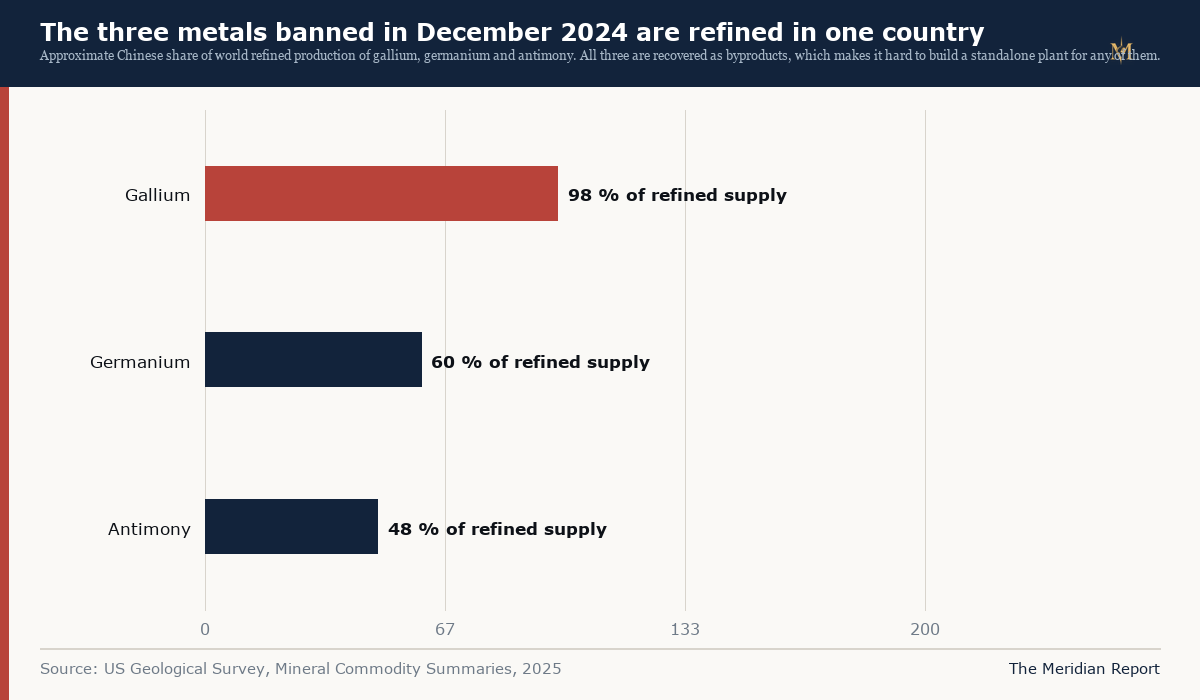
On 3 December 2024 China banned the export to the United States of gallium, germanium and antimony, and tightened its review of graphite. The announcement was a few paragraphs long and it reached purchasing departments faster than it reached the news. Gallium is used in compound semiconductors and in light emitting diodes. Germanium is used in infrared optics and in fibre optics. Antimony is used in flame retardants, in lead acid batteries and in ammunition. China refines most of the world's supply of all three.
The immediate consequence was a scramble for inventory. Prices for antimony, already rising, moved sharply. Buyers who had never thought about the difference between a metal and its oxide began asking suppliers where the material came from and whether it could be delivered at all. Governments announced reviews, then funds, then stockpiles. Within a few months the vocabulary of the response had settled into three words: stockpile, refine, friendshore.
Each of those words describes a different instrument, and the instruments fail in different ways. A stockpile is a buffer against a short interruption. A refinery is a capability that takes years to build and needs a customer when it is finished. Friendshoring is a trade policy that requires a friend with the right geology and the right permitting regime. Treating them as interchangeable is how a government ends up announcing a stockpile and discovering, two years later, that it has bought ore it cannot process.
What a stockpile is actually for
A strategic stockpile has three possible purposes, and they are often confused.
The first is military surge. A defence department holds materials it would need in the first months of a conflict, when normal trade is disrupted and domestic production cannot scale quickly. The American National Defense Stockpile was created in 1939 for exactly this reason, and its holdings have been shaped by wars ever since. The relevant quantity is the consumption rate in a war, not the consumption rate in a market.
The second is price stabilisation. A buffer stock buys when prices are low and releases when prices are high, smoothing the cycle. This requires the stock manager to trade against the market, which means taking positions that can lose money, and it requires a rule for when to buy and when to release. Most governments are bad at this because the political incentive is to release during a shortage and never to buy during a glut.
The third is insurance against a supply interruption. This is the purpose that matters for critical minerals. A stockpile of ninety days of consumption does not make a country self-sufficient. It gives it ninety days to find an alternative, to negotiate, to substitute or to accept a higher price. The value of the stockpile is the value of those ninety days, and it depends entirely on what the country does with them.
The distinction matters because a stockpile sized for the wrong purpose is a waste of money. A stockpile of sixty days of gallium is useful only if there is a plan for day sixty one. If the plan is to wait for a new refinery that has not been permitted, the stockpile has bought a delay in the shortage, not a solution.
The processing step is the bottleneck
The rare earth supply chain is not one industry. It is a sequence: mining, beneficiation, separation into individual oxides, reduction to metal, alloying, magnet production and assembly into a motor or a generator. Each step has different economics, different skills and different environmental problems, and China's dominance is concentrated in the middle of the chain.
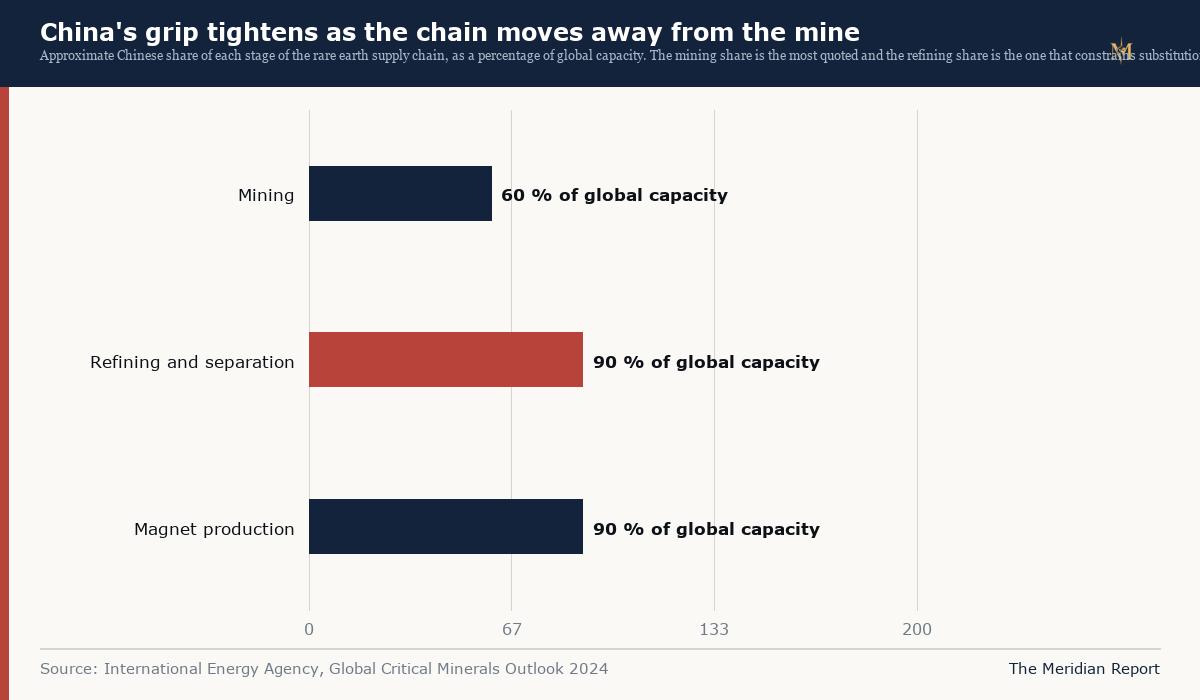
The International Energy Agency has estimated that China accounts for roughly 60 per cent of rare earth mining, around 90 per cent of refining and separation, and a similar share of magnet production. The mining figure is the one that gets quoted, because it is the easiest to understand. The refining figure is the one that matters, because a tonne of ore is not a tonne of neodymium oxide, and a separation plant is a chemical facility with a permitting timeline rather than a mine with a digger.
That is why stockpiling ore is close to useless in a supply crisis. Ore can be stockpiled cheaply, but it cannot be used until it is separated, and if the separation capacity is in the country that imposed the restriction, the stockpile is a pile of rock. Stockpiling oxide or metal is more useful, because it can go into a magnet factory, but it is more expensive to hold and the quantities are smaller.
The same logic applies to gallium and germanium. Gallium is not mined as gallium. It is recovered as a byproduct of bauxite processing and of zinc refining, which means a gallium supply chain is really an alumina supply chain with a recovery step attached. Germanium is recovered from zinc residues and from coal fly ash. Antimony comes from stibnite ore, and China's share of refining is roughly half. A country that wants a gallium stockpile has to decide whether it is stockpiling the metal, the oxide or the capacity to recover it, and only the last of those is a permanent asset.
The price floor was the more interesting instrument
In July 2025 the United States Department of Defense reached an agreement with MP Materials, the owner of the Mountain Pass mine in California and of a magnet plant in Texas. The department took an equity stake, agreed to buy the output of the magnet plant for ten years, and set a price floor of 110 dollars per kilogram for neodymium praseodymium oxide.
The floor is the part worth understanding. A price floor is a put option written by the government: if the market price falls below the floor, the government pays the difference, and if the market price rises above it, the company sells at the market. That transfers the downside risk from the investor to the taxpayer, which is exactly what makes a capital intensive plant financeable when the market price is below the cost of production.
The floor also creates an incentive that is easy to miss. A producer with a floor has no reason to sell below it, so the floor becomes a reference price for other contracts. If enough of the market is covered by floors, the floor becomes the market, and the government has effectively set a price without owning the mine. That can be good for investment and bad for consumers, depending on how the floor is set and who pays for it.
The problem with a floor is that it does not create demand. A government can guarantee a price for a material that nobody wants to buy at that price, and it will then hold the inventory. The MP agreement avoided that by combining the floor with a purchase commitment for magnets, which is a demand guarantee. That combination, price support plus offtake, is the closest thing to an industrial policy that has worked in this sector, and it is expensive.
Europe chose benchmarks
The European Union took a different route. The Critical Raw Materials Act, which entered into force in May 2024, sets benchmarks for 2030: at least 10 per cent of extraction, 40 per cent of processing and 25 per cent of recycling of strategic raw materials within the union, and no more than 65 per cent of consumption of any strategic raw material from a single third country.
The benchmarks are useful as a statement of intent and as a scorecard. They are not instruments. A benchmark does not permit a mine, finance a refinery or buy a stockpile. The regulation does ask member states to stockpile strategic raw materials and gives the Commission a coordinating role, but the quantities, the funding and the release rules are left to national decisions, which means the union's stockpile is the sum of twenty seven national decisions made for different reasons.
The 65 per cent cap is the more interesting commitment, because it is a target for diversification rather than a target for self-sufficiency. It accepts that Europe will import most of its critical minerals and asks only that no single supplier dominate. That is a realistic goal, and it is also a goal that cannot be met by stockpiling. It requires contracts with Australia, Canada, Brazil, Chile, South Africa and others, and those contracts require the exporting country to have a processing industry or to send its material somewhere that does.
Japan has run this play for forty years
Japan is the case study that other governments should read first, because it has been stockpiling rare metals since the 1980s and it has used the stockpile in a real crisis.
The Japan Oil, Gas and Metals National Corporation, known as JOGMEC, manages a stockpile of rare metals on behalf of the state and supports Japanese companies in securing supply. The stockpile is designed to cover a period of disruption, and the period is measured in months rather than years. In September 2010, after a collision between a Chinese fishing trawler and Japanese coastguard vessels, China restricted rare earth exports to Japan. Japanese companies found their shipments delayed, and the stockpile and their own inventories covered the gap.
What happened next is the instructive part. Japan did not become self-sufficient. It diversified: it invested in Lynas in Australia, it supported recycling, it substituted ferrite magnets for rare earth magnets in some applications and it reduced the rare earth content of others. The diversification took a decade, cost a great deal and left Japan still dependent on China for a large share of its heavy rare earths. The stockpile bought the time, and the time was used, but the result was risk reduction rather than independence.
The 2010 episode also produced a lesson about prices. Rare earth prices spiked, then collapsed as Chinese production expanded and buyers deferred purchases. The collapse destroyed the economics of several non-Chinese projects that had been launched during the spike. A stockpile that releases into a spike and buys in a glut would have smoothed that cycle. A stockpile that is filled once and never traded does not.
The 2010 precedent and the WTO case
The legal route was tried as well. In 2012 the United States, the European Union and Japan brought a complaint against China at the World Trade Organization over its export restrictions on rare earths, tungsten and molybdenum. The panel and the Appellate Body found in 2014 that the quotas and export duties were inconsistent with China's obligations. China complied, and the quotas were removed.
The case is often cited as proof that trade law works. It is also a lesson in what trade law cannot do. The dispute took two years, the restrictions had already been in place for years, and the remedy was the removal of a formal quota rather than the creation of an alternative supply chain. Prices fell after the case, which made non-Chinese projects less attractive, which meant the diversification that the dispute was supposed to encourage did not happen. The legal victory and the industrial outcome pointed in opposite directions.
That history explains why the response to the 2023 and 2024 controls has been different. Governments have not relied primarily on litigation. They have used subsidies, offtake agreements, price floors, stockpiles and export controls of their own. The instruments are more direct and more expensive, and they are aimed at capability rather than at rules.
Substitution is the cheapest stockpile
The least expensive way to reduce exposure to a constrained material is to use less of it, and the record here is better than the policy debate suggests.
In magnets, ferrite can replace rare earth magnets in applications where weight and strength are not critical: speakers, small motors, sensors and some household appliances. In traction motors, several manufacturers have developed electrically excited synchronous motors that use no permanent magnets at all, trading some efficiency for independence from the magnet supply chain. In batteries, sodium ion chemistries reduce the need for lithium, and lithium iron phosphate reduces the need for nickel and cobalt.
Each substitute has a cost. A ferrite magnet is larger and weaker than a neodymium magnet, so the motor that uses it is bigger. An electrically excited motor needs slip rings or a wireless excitation system and is more complex to control. A sodium ion battery has lower energy density, which matters for a car and less for a stationary storage system. The substitution is worth doing where the cost is acceptable, and the cost is easier to accept when the alternative is a supply interruption.
Recycling is the other substitute. It recovers rare earths from end of life magnets, catalysts and polishing powders, and it recovers gallium from scrap and from process residues. The volumes are limited by the amount of material in circulation and by the collection systems, and the economics depend on the price of the primary material. Recycling is a genuine contributor and it is not a substitute for a supply chain, because it cannot scale faster than the products that contain the material reach the end of their lives.
Defence demand is small and strategically decisive
The Department of Defense is not the largest buyer of rare earth magnets. It is the buyer that cannot accept a substitute. A guided munition needs a magnet that works at temperature and survives vibration. A fighter aircraft needs actuators and generators built to a specification that takes years to qualify. A submarine needs quiet motors and sensors. Those applications use relatively small quantities of material and they cannot be switched to a different supplier without requalification.
That combination, small volume and high criticality, is exactly the case for a stockpile. The defence department can hold several years of consumption of a material at a cost that is trivial relative to the platform it supports, and it can do so without distorting the commercial market. The same logic applies to medical isotopes, to certain alloys and to the chemicals used in propellants.
The difficulty is that defence demand alone cannot sustain a separation plant. A plant needs commercial volume to run at capacity, and commercial volume comes from magnets for cars, wind turbines and appliances. The defence department can underwrite the plant, as it did with MP Materials, but it cannot be the only customer. That is why the price floor and the offtake were paired with a commercial strategy, and why the plant's viability depends on whether carmakers and turbine manufacturers sign contracts at a price that covers the cost of non-Chinese production.
There is also a supply chain security argument that goes beyond the department's own consumption. A defence contractor that buys a motor from a supplier which buys magnets from a distributor which buys from China has a dependency it may not see. Mapping that chain is expensive and it is the first step in any serious stockpile policy, because a stockpile of the wrong item at the wrong tier of the chain provides no security at all.
The allies are all building the same plant
Outside China, the list of rare earth separation projects is long and the list of operating plants is short. Lynas operates the Mt Weld mine in Western Australia and a separation plant in Kuantan, Malaysia, and has been building a facility in Kalgoorlie. MP Materials operates Mountain Pass and is building magnet production in Texas. Iluka is developing a refinery at Eneabba in Western Australia with government support. Arafura is developing the Nolans project in the Northern Territory. Several smaller projects in the United States, Canada and Europe are at various stages of study, permitting and construction.
The projects compete for the same three things: ore, capital and offtake. Ore is the least scarce, because there are deposits in Australia, Canada, Brazil, Vietnam, Tanzania, Malawi and the United States. Capital is available when governments underwrite it. Offtake is the binding constraint, because a refinery needs a customer who will pay a price that covers the cost of production outside China, and that customer is usually a carmaker or a turbine manufacturer who has spent a decade optimising for the Chinese price.
That is why the policy conversation has moved from mining to contracts. A government can fund a refinery, but it cannot make a carmaker buy from it at a premium unless it imposes a tariff, a content rule or a subsidy that closes the gap. The European Union's approach has been to set benchmarks and to allow state aid, the American approach has been to use defence procurement and tariffs, and the Australian approach has been to fund projects directly. All three are attempts to create a customer, and all three are expensive per tonne of capacity.
The duplication is not necessarily wasteful. A separation plant is a chemical facility with a long permitting tail, and a country that has only one is a country with a single point of failure. But duplication without feedstock is a way to build plants that run below capacity, and plants that run below capacity have higher unit costs, which makes them less competitive, which increases the subsidy required. The arithmetic of a strategic industry is unforgiving: the first plant is a capability, the second is insurance, and the fifth is a white elephant.
What a stockpile costs to hold
The cost of a stockpile is not the purchase price. It is the purchase price plus the cost of carrying the material for as long as it is held, minus whatever it is worth when it is released.
Take a stockpile of a thousand tonnes of neodymium praseodymium oxide at the 110 dollar floor. The material costs 110 million dollars. Storage, insurance and handling might add one to two per cent a year. The cost of capital, at a government borrowing rate of four per cent, adds 4.4 million dollars a year. If the material is held for five years and released at the same real price, the carrying cost is roughly a fifth of the purchase price, before any loss from degradation or obsolescence.
That arithmetic explains why governments prefer to hold ore rather than oxide, and why holding ore is often the wrong choice. Ore is cheaper to store and it does not degrade in the same way, but it cannot be used without a separation plant. A stockpile strategy that optimises for carrying cost will hold the wrong thing.
The release rule matters as much as the purchase. A stockpile that is released at the first sign of a shortage becomes a subsidy to whoever buys at the release price. A stockpile that is never released is a monument. The useful rule is to release against a defined trigger, such as a supply interruption of a stated duration or a price above a stated level, and to replenish when the trigger is not met. Very few governments have written such a rule, and the ones that have written it have not always followed it.
Recycling has a feedstock problem
Recycling is the only source of critical minerals that does not require a mine, and its limits are physical rather than technological.
The feedstock is locked in products. A wind turbine magnet lasts twenty years. A hard disk drive lasts five to ten. A car motor lasts fifteen. The rare earths in those products were mined years ago, and they become available for recycling only when the product is retired, collected and dismantled. The collection rate for small electronics is low, the dismantling is labour intensive, and the magnet is often glued, coated or embedded in a way that makes separation difficult.
The technology is improving. Hydrogen decrepitation, in which hydrogen is used to break a magnet into powder, allows magnet-to-magnet recycling with much less energy than primary production. Several companies in Europe and North America are building plants that will take end of life magnets and produce new ones. The volumes are small relative to demand, and they are growing from a low base.
Recycling's strategic value is that it is domestic and it is dispersed. A country with a recycling industry has a source of supply that no export control can interrupt, and it has a reason to keep the material in circulation. Its limitation is that it cannot respond to a sudden restriction, because the feedstock is in products that have not yet reached the end of their lives. Recycling is a long term hedge, not a short term stockpile.
The premium is the policy
A non-Chinese separation plant costs more to build and more to run than a Chinese one. The reasons are scale, learning, environmental compliance, labour and the cost of capital, and they are not going to disappear because a government has announced a target. The premium has to be paid by someone, and the policy choice is who.
The first option is the taxpayer, through grants, equity, price floors and offtake. That is the American approach, and it is visible in the MP Materials agreement. The second is the consumer, through a tariff or a content rule that makes the imported material more expensive. The third is the manufacturer, through a contract that accepts a higher input price in exchange for supply security. Most real policies combine all three, and the combination is what determines whether the plant is built.
The size of the premium can be illustrated with the floor. If the floor is 110 dollars per kilogram and the market price is 60, the floor is 83 per cent above the market. A carmaker that pays 83 per cent more for its neodymium is paying a few dollars per vehicle, because the quantity per vehicle is small. A wind turbine manufacturer is paying more, because the quantity per turbine is larger. The incidence of the premium therefore falls unevenly, and the industries with the largest material intensity are the ones that lobby hardest against the policy that creates it.
That is the political economy of the whole agenda. The benefits of a domestic supply chain are diffuse and long term. The costs are concentrated on a few manufacturers who can name their competitors and their margins. A policy that does not address the cost will be announced and then quietly undermined, which is what happened to several earlier attempts at rare earth independence. The difference this time is that the export controls have made the cost of dependence visible, and visible costs are easier to legislate against than hypothetical ones.
What the numbers do not establish
The production shares are estimates. The IEA's figures for Chinese refining are the best available and they are still approximations built from company data, trade statistics and industry estimates. A share of 90 per cent is a description of a market, not a measurement of a single plant's output.
The price floor is a contract term, not a market price. It tells you what the government is willing to pay, not what the material is worth. The market price may be above or below it, and the difference is the subsidy.
The stockpile figures are quantities, not capabilities. A country that holds sixty days of a material has sixty days of the material, not sixty days of production, and the value of the holding depends on what happens on day sixty one.
And the claim that stockpiling, refining and friendshoring together will deliver security is a policy hypothesis. Each instrument addresses a different part of the problem, and none of them addresses the part that takes longest: the permitting, financing and construction of a separation plant, which is measured in years and which is the step that determines whether a stockpile of ore is worth anything at all.
Sources
- International Energy Agency, Global Critical Minerals Outlook 2024.
- US Geological Survey, Mineral Commodity Summaries, gallium, germanium, antimony and rare earths, 2024 and 2025.
- Ministry of Commerce of the People's Republic of China, export control announcements, December 2024.
- US Department of Defense, agreement with MP Materials, July 2025.
- Regulation (EU) 2024/1252 on critical raw materials.
- Japan Oil, Gas and Metals National Corporation, rare metal stockpile programme.
- World Trade Organization, China, Measures Related to the Exportation of Rare Earths, Tungsten and Molybdenum, 2014.
- European Commission, Critical Raw Materials Act implementation.