
A cocoa plot in the Western Region of Ghana is about two hectares. It has a few dozen trees, a boundary that is known to the family and to the neighbouring farmers, and no registered title. The farmer sells to a cooperative, the cooperative sells to a licensed buying company, the buying company sells to a trader, and the trader sells to a processor or an exporter. At no point in that chain has anyone recorded the coordinates of the plot, and until recently nobody needed to.
Under the European Union's deforestation regulation, that chain now has to produce a polygon. The operator that places the chocolate on the European market has to submit a due diligence statement that identifies the plots where the cocoa was grown, confirms that they were not deforested after 31 December 2020, and asserts that the production complied with the law of Ghana. The statement is checked against satellite data, stored in a European information system, and referenced on the customs declaration. If the coordinates are wrong, the shipment can be refused.
The regulation is the most ambitious attempt any major market has made to regulate land use in other countries through trade. It is also an administrative machine of extraordinary precision, and the precision is the point: a general assurance that a supply chain is sustainable can be faked, while a polygon that matches a satellite image of the plot cannot easily be. The difficulty is that the machine requires data that a large share of the world's farmers have never been asked to produce, and the cost of producing it is not evenly distributed.
What the regulation actually requires
The regulation entered into force in June 2023 and applies to seven commodities: cattle, cocoa, coffee, oil palm, rubber, soya and wood. It covers a long list of derived products, from chocolate and leather to tyres, furniture and paper. A product that contains a covered commodity has to comply even if the commodity is a small input, which is why the regulation reaches into food manufacturing, cosmetics and printing.
The core obligation is a prohibition. An operator may not place a covered product on the European market, or export it from the European Union, unless the product is deforestation free, produced in accordance with the relevant legislation of the country of production, and covered by a due diligence statement. The prohibition is enforced at the border and in the market, and the penalties are set by member states within a floor of four per cent of the operator's European turnover.
Deforestation free has a specific meaning. The land must not have been forest on 31 December 2020 and must not have been converted to agricultural use after that date, whether the conversion was legal under local law or not. The regulation also covers forest degradation, which is a narrower concept and harder to measure, and it requires that the production complied with laws on land use, labour, tax, environment and human rights.
The due diligence has three parts. The operator has to collect information, including the geolocation of the plots, the quantity, the supplier, the country of production and the date of production. It has to assess the risk that the product is not compliant, using the criteria in the regulation and any additional evidence it has. It has to mitigate the risk, which can mean asking for more information, auditing the supplier, or declining to buy. The statement is the record of that process, and it is submitted to the information system before the goods are placed on the market.
The obligation falls on the operator, which is the company that places the goods on the market, and on the trader, which is the company that makes them available. A retailer that imports chocolate is an operator. A trader that buys and resells within the European Union is a trader, with a lighter obligation to keep the statement reference. The farmer is not an operator, but the farmer is the source of the data, and the data has to be transmitted up the chain.
The geolocation point is the unit of compliance
The geolocation requirement is what makes the regulation enforceable and what makes it difficult. For a plot larger than four hectares, the operator has to provide a polygon: a set of coordinates that traces the boundary of the land. For a plot smaller than four hectares, a single point is enough. The coordinates are checked against the European Commission's global forest cover map and against satellite imagery, and a mismatch is a red flag that the competent authority can investigate.
The choice of four hectares reflects a trade-off. A polygon for every smallholder plot would be an impossible data collection task, and a point is enough to locate the plot on a map. But a point does not describe the boundary, so a plot that has expanded into a forest since 2020 may still be located by a point that sits in the original field. The regulation relies on the operator's assessment and on the authority's sampling rather than on a complete verification of every plot.
The cut-off date of 31 December 2020 is fixed, which means the satellite record is the evidence. Landsat and Sentinel imagery are available at resolutions that can detect the conversion of forest to farmland, and the European Commission's map provides a baseline. A plot that was forest in 2019 and is a field in 2022 will show up in the imagery, and the operator's statement that it was not deforested will be contradicted by the record.
The imagery is not a perfect oracle. Cloud cover in the tropics reduces the number of usable images, small clearings can be missed at the resolution of the sensors, and the definition of forest, which requires trees of five metres and a canopy cover of ten per cent, is not always easy to apply to a landscape of mixed trees and crops. The regulation acknowledges the limits and relies on a risk based approach rather than on an automated pass or fail.
The legal documentation is the second half of the requirement. The operator has to show that the production complied with the laws of the country, which can include land tenure, environmental permits, labour law and the right to use the land. For a smallholder without a title, the proof may be a customary right, a cooperative record or a certificate from a local authority. The regulation does not require a formal title, but it does require evidence, and the evidence has to be credible to a European authority that has never seen the local system.
Why the regulation reached for trade rather than aid
The European Union could have tried to reduce deforestation by funding forest protection, by paying for sustainable production or by supporting land use planning in producer countries. It chose a trade measure because the other approaches had been tried and had not reversed the trend.
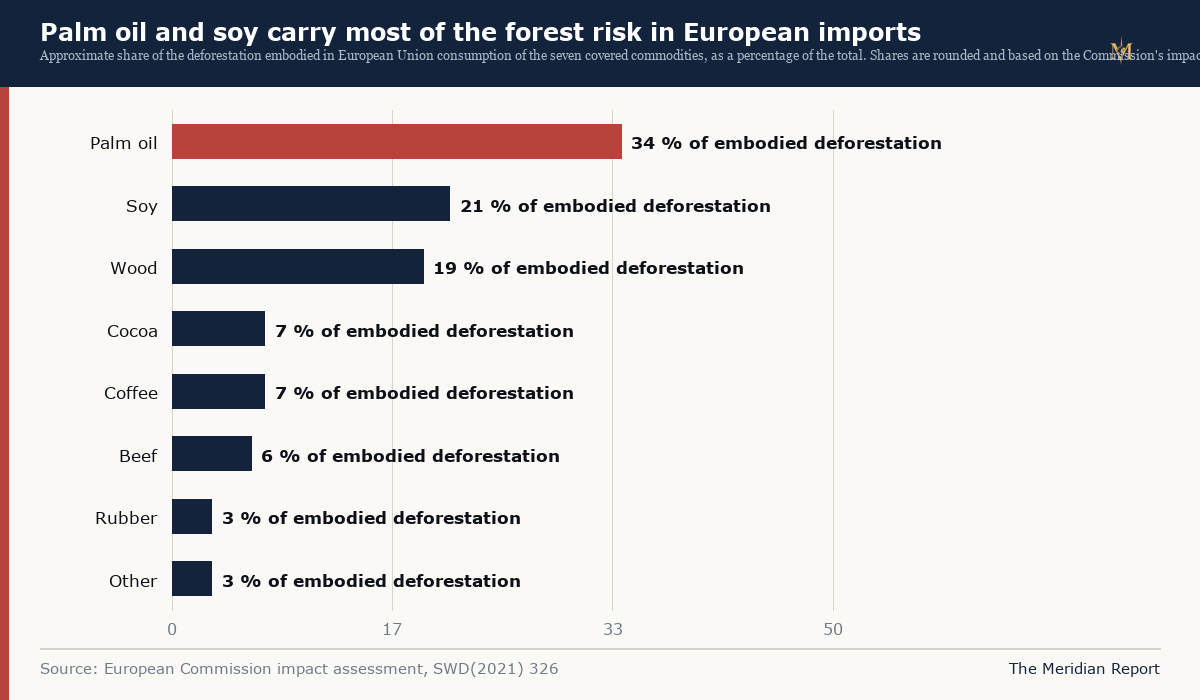
The impact assessment estimated that the European Union's consumption of the seven commodities was associated with a significant share of global deforestation, with palm oil and soy the largest contributors and cocoa, coffee and wood following. The estimate was uncertain, and the regulation's supporters used it to argue that Europe was importing the problem. The measure is therefore a demand side intervention: if the European market will not buy deforested products, the producers will have an incentive to keep the forest.
The logic is coherent and it has a flaw. The European market is not the whole market. If a producer can sell deforested cocoa to Asia or to Africa, the incentive to keep the forest is weaker than the regulation assumes. The regulation's answer is that the European market is large enough and pays enough of a premium to make compliance worthwhile, and that other markets will follow with their own rules. The first part is plausible for cocoa and coffee, where Europe is a major buyer, and less plausible for soy and palm oil, where the European share of global trade is smaller.
The benchmarking decision that shapes the burden
The regulation requires the Commission to classify countries as low, standard or high risk, and the classification determines how much due diligence is required. A low risk country's products can be subject to simplified due diligence, with less information and less verification. A high risk country's products face more scrutiny.
The classification is a diplomatic instrument as well as a technical one. A country that is classified as high risk will complain that the classification is a trade barrier, and a country that is classified as low risk will use the classification as a marketing advantage. The Commission has been cautious, and the first classifications have been delayed while the methodology is developed.
The criteria in the regulation include the rate of deforestation, the expansion of agricultural land, the production trends for the covered commodities and the quality of the country's governance. Those criteria are broad enough that the classification can be defended on technical grounds and contested on political ones. A country with a high deforestation rate but a strong forest governance programme may be classified as standard, while a country with a lower rate and weaker governance may be classified as high risk, and both will argue about which factor should dominate.
For an operator, the classification determines the cost of compliance. A shipment from a high risk country requires more documentation, more verification and more time, and the cost is reflected in the price. A shipment from a low risk country requires less, and the advantage is captured by the exporter. The classification therefore redistributes trade, and the redistribution is the reason the negotiations over the methodology are so intense.
Cocoa is the hardest commodity in the regulation
Cocoa is the test case because it combines every difficulty the regulation faces: small plots, unclear tenure, a long chain of intermediaries, a crop that is grown in countries with weak land records, and a market in which the European Union is the largest buyer.
World cocoa production is around five million tonnes a year, and about two thirds of it comes from two countries. Cote d'Ivoire produces roughly 2.2 million tonnes and Ghana around 700,000 to 800,000 tonnes. The farms are small, the average holding is between two and four hectares, and there are millions of them. The trees are grown under shade in some systems and in full sun in others, the yields are low, and the farmers are among the poorest in the agricultural economy.
The European Union imports more cocoa than any other region, and the processing industry in the Netherlands, Germany, Belgium and France turns it into chocolate, cocoa butter and cocoa powder. The chocolate that a European consumer buys is the end of a chain that begins with a plot that has probably never been mapped.
The chain has been formalised in the last decade. Ghana has built a cocoa management system that registers farmers and plots, and Cote d'Ivoire has a traceability system run by the Conseil du Cafe-Cacao. Both countries have introduced farmer cards, barcodes and cooperative level records, partly because the chocolate industry demanded traceability and partly because the governments wanted control over the marketing chain. The systems are more advanced than most outsiders assume, and they are not yet complete.
The gap is at the plot. A farmer may be registered with a name, a village and a cooperative, and the plot may be described as two hectares behind the village, without coordinates. The regulation requires the coordinates, and the coordinates have to be accurate enough to match a satellite image. Building that record for millions of plots is a mapping exercise that has to be done in the field, with a device, by someone who knows the farmer and the land.
Several organisations have been doing that work. The cocoa boards, the cooperatives, the certification bodies and the chocolate companies have funded mapping programmes, and the European Union has funded projects through its development budget. The progress is uneven, and it is fastest where a buyer is paying for it and slowest where the farmer is selling into the local market.
The price shock of 2024 changed the politics. Cocoa prices rose to record levels as West African production fell short of demand, and the high price gave the farmers more bargaining power than they had ever had. It also raised the cost of the traceability programmes, because every input became more expensive, and it made the compliance question more urgent for the chocolate companies, because the value at stake in each shipment increased.
The regulation's defenders argue that the mapping is a one-off investment that will improve the farmers' access to finance, to insurance and to better prices. The critics argue that the cost falls on the farmer and the benefit accrues to the importer, and that the farmer who cannot provide the coordinates will be excluded from the European market and will sell to a local trader at a lower price. Both arguments are consistent with the evidence, because the outcome depends on who pays for the mapping and how the cost is shared.
The child labour question the regulation does not settle
The regulation requires that the production complied with the law of the country of production, and the law includes labour standards. In cocoa, the most documented labour problem is child labour, and the evidence is that it is widespread.
Survey work funded by the American government found that about 1.5 million children were doing hazardous work in cocoa production in Cote d'Ivoire and Ghana. The chocolate industry has committed to eliminating the practice for two decades, and the practice persists. The regulation's requirement that production comply with local law is a lever, because child labour is illegal in both countries, and a due diligence statement that ignores it is a statement that the operator did not do its job.
The enforcement is the problem. A European authority cannot inspect a farm in Ghana, and the operator relies on the cooperative, the certification body or its own monitoring system. The regulation allows the operator to use third party schemes and audits, and the schemes have their own limits. The result is that the labour requirement is likely to be enforced through the same traceability infrastructure as the deforestation requirement, and the quality of that infrastructure determines the outcome.
That is not a criticism of the regulation's intent. It is a description of the gap between a legal requirement and a verifiable fact in a supply chain that begins with a farmer who may not have a birth certificate, let alone a labour contract. The regulation can require the operator to look. It cannot guarantee that the operator sees.
Coffee is a different problem with the same shape
Coffee is the second test case, and the difficulties are different. The European Union is the largest coffee market in the world, and it imports green coffee from Brazil, Vietnam, Colombia, Ethiopia, Uganda, Indonesia and dozens of other countries. The farms are small, the chain is long, and the deforestation risk is concentrated in a few expansion frontiers.
In Vietnam, the world's largest robusta producer, coffee area expanded rapidly in the Central Highlands, and some of that expansion came at the expense of forest. In Ethiopia and Uganda, coffee is grown in forest margins and in shade systems that are hard to classify as forest or agriculture. In Brazil, coffee is grown on large farms in states where the forest code requires a legal reserve, and the question is whether the farm complied with the code rather than whether it cleared primary forest.
The regulation applies the same rule to all of them: no deforestation after 2020, and compliance with local law. The rule is simple and the application is not, because the definition of forest and the boundary between a shade coffee system and a forest are contested. A coffee garden under a canopy of native trees can be a forest in ecological terms and a farm in legal terms, and the regulation's definition, which turns on tree height and canopy cover, may classify it as forest.
The European coffee industry has been preparing for the regulation for several years. The large traders have mapped farms, the certification schemes have added deforestation criteria and the importers have built due diligence systems. The smaller roasters, which buy through intermediaries, have less visibility, and the regulation's requirement that they submit a statement has forced them to ask questions they had never asked.
The cost is passed through the chain. A roaster that has to pay for the mapping of a farm in Ethiopia will pay a higher price for the coffee, and the farmer will receive some of it and not all of it. The regulation does not set a price, and the market determines how the cost is shared. In a market with strong demand and short supply, the farmer has more bargaining power. In a market with surplus, the farmer absorbs the cost.
Palm oil, soy and the scale problem
Palm oil and soy are the commodities with the largest share of the deforestation attributed to European consumption, and they are the commodities where the regulation's trade lever is weakest.
Palm oil is produced mostly in Indonesia and Malaysia, and the European Union is a significant but declining buyer. The European market has been reducing its palm oil imports for years, partly because of the renewable energy directive's treatment of palm based biodiesel and partly because of consumer pressure. Indonesia and Malaysia have their own sustainability schemes, and a large share of their production is certified, though the certification does not guarantee that a particular shipment is deforestation free.
The scale is the difficulty. A palm oil mill receives fruit from hundreds of smallholders and from its own estates, and the fruit is crushed within a day of harvest. Tracing a tonne of crude palm oil to the plots that grew the fruit is possible only if the mill records every delivery, and the smallholders who supply the mill may not have mapped plots. The regulation requires the traceability, and the industry has been building it, and the coverage is uneven.
Soy is the opposite. The farms are large, the supply chain is short, and the deforestation risk is concentrated in the Cerrado and the Amazon. Brazil has a forest code that requires a legal reserve, and the soy moratorium, a private agreement that dates from 2006, has kept soy out of recently cleared Amazon land. The regulation goes further than the moratorium, because it covers all deforestation and not only the Amazon, and because it requires compliance with the law as well as the absence of clearing.
The European Union's soy imports are mostly for animal feed, and the feed is bought by the poultry, pig and dairy industries. Those industries are price sensitive, and the cost of compliance is a cost on the feed. The regulation's defenders argue that the cost is small relative to the value of the meat, and the critics argue that it is large relative to the margin of a feed mill. Both are right, and the outcome depends on how the cost is passed through a chain that is more concentrated than cocoa and less transparent than coffee.
Cattle, wood and rubber are the smaller categories with the same issues
Cattle is a small category for the European Union in volume and a large one in reputation, because the association between beef and Amazon deforestation is strong. The European Union imports a limited quantity of Brazilian beef under a tariff quota, and the larger exposure is leather, which is a byproduct of the beef industry and is used in shoes, bags and car interiors.
Wood is the category with the longest regulatory history. The European Union's timber regulation, which has been in force since 2013, already required operators to exercise due diligence on illegally harvested timber. The deforestation regulation replaces it and adds the deforestation criterion, and the existing supply chains, the certification schemes and the enforcement systems are being adapted rather than created.
Rubber is the smallest category and the one with the least data. Thailand, Indonesia and Vietnam produce most of the world's natural rubber, and the farms are small. The European Union imports a significant share of its rubber for tyres, and the tyre industry has been mapping plantations for years, partly because of the traceability requirements in its own sustainability commitments. The mapping is less complete than the industry's public statements suggest, and the regulation will test it.
The common thread is that the regulation requires the same evidence from every commodity, and the commodities differ in their ability to supply it. Cocoa has the most developed traceability and the most fragmented production. Soy has the least fragmented production and the most contested land use. Wood has the longest regulatory history and the most established certification. The regulation treats them equally, and the cost of equality is that the weakest chain bears the heaviest burden.
The compliance industry that appeared within two years
A regulation creates a market, and the deforestation regulation has created one. The market has four layers: satellite monitoring, traceability software, certification and auditing, and legal advisory work.
The satellite layer is the most technical. Companies that had been selling imagery to governments and to the agricultural commodity trade found a new customer in the compliance department. The service they sell is not the image. It is the assessment: a plot boundary overlaid on a time series of forest cover, a risk score, and a report that can be attached to a due diligence statement. The assessment is only as good as the baseline map, and the baseline map is the European Commission's, which means the whole market depends on a single public dataset.
The software layer is the least glamorous and the most important. A due diligence statement has to be linked to a supply chain, and the supply chain has dozens of actors who record their transactions in different formats. The software companies sell systems that collect the data, reconcile the quantities, generate the statements and keep the audit trail. The large operators have built their own; the mid-sized ones buy; the small ones use a spreadsheet and hope.
The certification layer is the oldest and the most contested. Schemes such as the Forest Stewardship Council, the Roundtable on Sustainable Palm Oil, Rainforest Alliance and Fairtrade already audit producers against standards that include environmental and social criteria. The regulation allows operators to use certification as evidence, and it does not treat certification as proof. A certified supplier still has to provide the geolocation and the statement, and the scheme has to be able to show that its audit covered the deforestation criterion.
The legal layer is where the risk sits. An operator that submits a false statement is liable for a penalty, and the penalty can reach four per cent of turnover. The operator's lawyers therefore review the statement, the contracts with suppliers include warranties and indemnities, and the supplier's lawyers review the warranties. The cost of that legal work is a fixed cost per supply chain and a variable cost per shipment, and it falls hardest on the smaller operators.
The market has grown fast and it has grown unevenly. The large chocolate companies, coffee traders and timber importers have built sophisticated systems. The small roasters, the independent furniture makers and the specialist food importers have less capacity, and they are more likely to rely on a supplier's assurance than on their own verification. The regulation treats them all the same, and the difference in capacity is one reason the enforcement is likely to be concentrated on the operators that can be audited.
Satellite monitoring has limits that the regulation acknowledges
The technology that makes the regulation possible is the open satellite record. The Landsat programme has been imaging the earth since the 1970s, and the European Sentinel satellites provide free imagery at ten metre resolution with a revisit time of about five days. The combination allows an analyst to see a forest disappear and a field appear, and to date the change to within a few weeks.
The limits are real. Clouds obscure the tropics for part of the year, and a plot that is cleared and planted during a cloudy season may not be imaged until the next dry season. The sensors measure reflectance, not land use, and a mature shade coffee system can look like forest. A small clearing of less than a tenth of a hectare may be below the detection threshold at ten metre resolution. The Commission's global map is a baseline, and the baseline has its own errors.
The regulation's answer is a risk based approach. The operator does not have to prove that no deforestation occurred on every square metre. It has to assess the risk, taking account of the country classification, the commodity, the supplier and the satellite evidence, and it has to mitigate the risk in proportion. An authority that finds a plot with a suspicious clearance can ask for more information, and the operator that cannot provide it loses the shipment.
The risk based approach is defensible and it creates an incentive that the regulation's drafters may not have intended. An operator that wants to avoid scrutiny will choose suppliers in low risk countries, which is the point, and it will also choose suppliers that can produce a clean satellite record, which may exclude the smallholders whose plots are hardest to image. The exclusion is not a formal rule. It is a procurement decision, and it is invisible in the statistics.
What compliance costs, and who pays
The cost of compliance has three parts: the one-off cost of mapping and registering the plots, the recurring cost of monitoring and updating the records, and the transaction cost of the statements, audits and legal work.
The one-off cost is the most studied. Mapping a smallholder plot with a handheld device and a field visit costs a few dollars per plot in labour and equipment, and the cost rises where the plot is remote, the farmer is not registered or the boundary is disputed. For a cocoa sector with millions of plots, the total is in the tens of millions of dollars, which is small relative to the value of the crop and large relative to the budgets of the cooperatives that have to do the work.
The recurring cost is less visible and probably larger. A plot boundary changes when a farmer expands the field, and the record has to be updated. A supply chain changes when a cooperative buys from a new farmer, and the statement has to reflect it. The monitoring is a permanent function, and the operators that have built it describe it as a data management business rather than a compliance exercise.
The transaction cost is the part that falls on the shipment. A due diligence statement, an audit and a legal review add a fixed cost per consignment, and the cost is proportionally larger for a small shipment. A container of cocoa beans is worth a few hundred thousand dollars; a pallet of chocolate is worth a few thousand. The fixed cost is negligible for the first and material for the second, which is why the regulation is harder for the small importer than for the large one.
The incidence of the cost is the political question. The regulation does not say who pays, and the market decides. In a tight market the producer can pass the cost forward. In a surplus market the importer passes it backward. The evidence from other compliance regimes, such as the timber regulation, is that the cost is usually shared, with the producer bearing the cost of the data and the importer bearing the cost of the documentation. The farmer who bears the cost of the mapping receives no direct payment for it, and the benefit is the continued access to the European market.
The trade diversion problem
The regulation's central assumption is that access to the European market is valuable enough to change land use. The assumption is strong for cocoa and coffee, where Europe is a major buyer, and weaker for soy and palm oil, where the European share of global trade is smaller.
If the assumption holds, producers will invest in traceability and the forest will be protected. If it does not, the compliant supply will go to Europe and the non-compliant supply will go elsewhere, and the total deforestation will be unchanged or higher. That is the leakage problem, and it is the main economic criticism of the regulation.
The evidence on leakage is limited because the regulation is new. The analogous evidence from the timber regulation is mixed: the European Union's imports of illegal timber fell, and the share of illegal timber in the global trade did not fall by the same amount. The lesson is that a demand side measure works best when the demand is large and when the other markets adopt similar rules.
The other markets are moving slowly. The United Kingdom has a deforestation provision in the Environment Act 2021, and the secondary legislation has been delayed. The United States has the Lacey Act for illegal wood and a proposed Forest Act that has not passed. China, India and the Gulf states have no equivalent. The European Union is therefore acting alone for the foreseeable future, and the leakage is a structural feature of the policy rather than a temporary problem.
The producing countries have noticed. Indonesia and Malaysia have argued that the regulation is a trade barrier dressed as an environmental measure, and they have raised the issue in the World Trade Organization's technical barriers committee. Brazil has argued that its forest code is stricter than the regulation acknowledges, and that the country classification should reflect the legal reserve requirement. The complaints are not a rejection of the objective. They are a negotiation over the cost and the criteria, and the negotiation will continue for years.
The smallholder exclusion risk
The most serious social criticism of the regulation is that it will exclude the producers who can least afford to comply. The mechanism is simple: an operator that cannot verify a plot will not buy from it, and the farmer who sells to that operator loses a market.
The evidence from certification schemes is instructive. When a scheme requires an audit that costs more than the price premium it delivers, smallholders drop out, and the supply consolidates into larger farms and estates. The deforestation regulation's cost is not an audit fee but a data requirement, and the data requirement has the same structure: a fixed cost that is proportionally larger for a small producer.
The regulation's defenders point to the support programmes. The European Union has funded traceability projects, the cocoa boards have mapped plots, and the chocolate companies have invested in cooperatives. The support is real and it is uneven, and it is concentrated in the supply chains that a large buyer cares about. A farmer who sells to a local trader, or to a processor in a neighbouring country, is outside those programmes and outside the European market, and the regulation does not reach them.
The long run effect may be consolidation. A sector that was made up of millions of small plots becomes a sector of larger, registered, traceable farms, because the traceable farms can sell to Europe and the untraceable ones cannot. Consolidation may raise productivity and it may reduce poverty, and it may also transfer land from the farmers who cannot afford the compliance to the ones who can. The regulation does not have a policy on that outcome, and the outcome will be determined by the market.
What the customs union does with a due diligence statement
The regulation's enforcement is built into the customs process. An operator submits the due diligence statement to the information system and receives a reference number. The number is quoted on the customs declaration, and the customs authority checks that the number exists and that it covers the product. If the number is missing, the goods are not released.
The check is administrative rather than substantive. The customs authority does not verify the geolocation or the satellite evidence. It verifies that the statement exists, and the substantive verification is done by the competent authority in the member state where the operator is established, through audits and sampling.
That division of labour is efficient and it creates a gap. A false statement with a valid reference number will clear customs, and the fraud will be discovered only if the competent authority audits the operator. The audit capacity is limited, the number of operators is large, and the incentives to submit a statement that is technically compliant and substantively wrong are considerable.
The regulation provides for cooperation between authorities and for the exchange of information, and it requires the Commission to coordinate. The coordination is new, and the member states have different levels of resources and different enforcement cultures. A shipment that enters through a member state with a small authority may face less scrutiny than one that enters through a member state with a large one, which is a familiar problem in the customs union.
The data protection question nobody asked
There is a smaller issue that has received little attention. The geolocation of a plot is personal data when the plot belongs to an identifiable farmer, and the regulation requires that data to be transmitted through a supply chain and stored in a European system. The farmer has to consent, and the consent has to be informed, and the data has to be protected.
The regulation does not set out a data protection regime for the farmer's coordinates. It relies on the general data protection rules and on the producer country's law, and the two do not always fit. A cooperative that collects coordinates on behalf of a buyer is processing personal data, and the farmer may not understand what he is consenting to or who will see the data.
The issue is not hypothetical. A plot boundary can reveal a farmer's land holding, his income and his family's location, and the data can be used by a buyer to negotiate a lower price or by a government to tax the land. The regulation's transparency is a public good and it is also a surveillance risk, and the balance has not been struck.
The Commission has published guidance and the operators have adopted privacy notices, and the practice is uneven. The farmer who signs a consent form in a language he does not read is not consenting in any meaningful sense, and the regulation's legitimacy depends on the consent being real.
The delay, and what it revealed
The regulation was adopted with an application date of 30 December 2024 for large operators and 30 June 2025 for micro and small enterprises. In December 2024, weeks before the deadline, the European Union postponed the application by twelve months. The large operators became subject on 30 December 2025, and the small ones on 30 June 2026.
The postponement was requested by member states, by industry and by several producing countries, and it was justified by the state of readiness. The information system was not fully operational, the country benchmarking had not been completed, and the guidance for operators was still being drafted. A regulation that cannot be complied with is not enforced; it is ignored, and the Commission preferred a delay to a collapse.
The delay revealed three things about the policy. The first is that the administrative capacity of the European Union was thinner than the ambition of the regulation. The information system, the benchmarking, the guidance and the training of national authorities were all behind schedule, and the delay was a recognition that a trade measure requires an administrative machine.
The second is that the producing countries have leverage. The postponement was supported by countries that had been arguing that the regulation was unfair, and the Commission needed their cooperation to make the system work. The cooperation is not free, and the price is likely to be technical assistance, longer transition periods and a more generous classification.
The third is that the regulation is now a permanent negotiation. The 2025 simplification package proposed to reduce the burden on small operators, to simplify the statement and to delay the application further. Each of those changes is a concession to a constituency, and each of them weakens the mechanism. The Commission's challenge is to simplify without creating a loophole, and the history of environmental regulation suggests that the loophole is easier to create than to close.
The delay has a cost that is not in the impact assessment. A company that has invested in traceability, mapped its suppliers and trained its staff has paid for a system that is now subject to a moving deadline. The companies that waited have saved the cost and face the same deadline. The regulation rewards delay, and the reward is a lesson for the next regulation.
The enforcement capacity is the unknown
The regulation's effectiveness depends on enforcement, and enforcement depends on the resources of the member states. The competent authorities are national, the budgets are national, and the priorities are national.
The Netherlands, Germany, France and Belgium have large customs and food safety authorities, and they have been building the capacity to audit operators. Smaller member states have fewer resources, and the operators that import through them may face less scrutiny. The regulation provides for mutual assistance and for the Commission to coordinate, and it does not provide for a European enforcement body.
The audit model is a sample. An authority audits a proportion of the operators, checks a proportion of the statements and investigates the cases that look suspicious. The sample is the deterrent, and the deterrent works only if the probability of detection is high enough to outweigh the cost of compliance. The probability depends on the number of auditors, and the number of auditors depends on the budget, and the budget depends on the political priority.
The customs data gives the authorities a map of the trade. The regulation requires the information system to record the statements, and the system can be cross checked against the customs declarations. A shipment with a statement that does not match the product, the quantity or the origin is a candidate for investigation. The technology exists, and the question is whether the political will to use it survives the first trade dispute.
The counter-evidence: deforestation is falling, and the regulation may not be the reason
The regulation's premise is that European demand is a significant driver of deforestation. The premise is plausible and it is difficult to prove, and the evidence on deforestation is more encouraging than the regulation's supporters sometimes acknowledge.
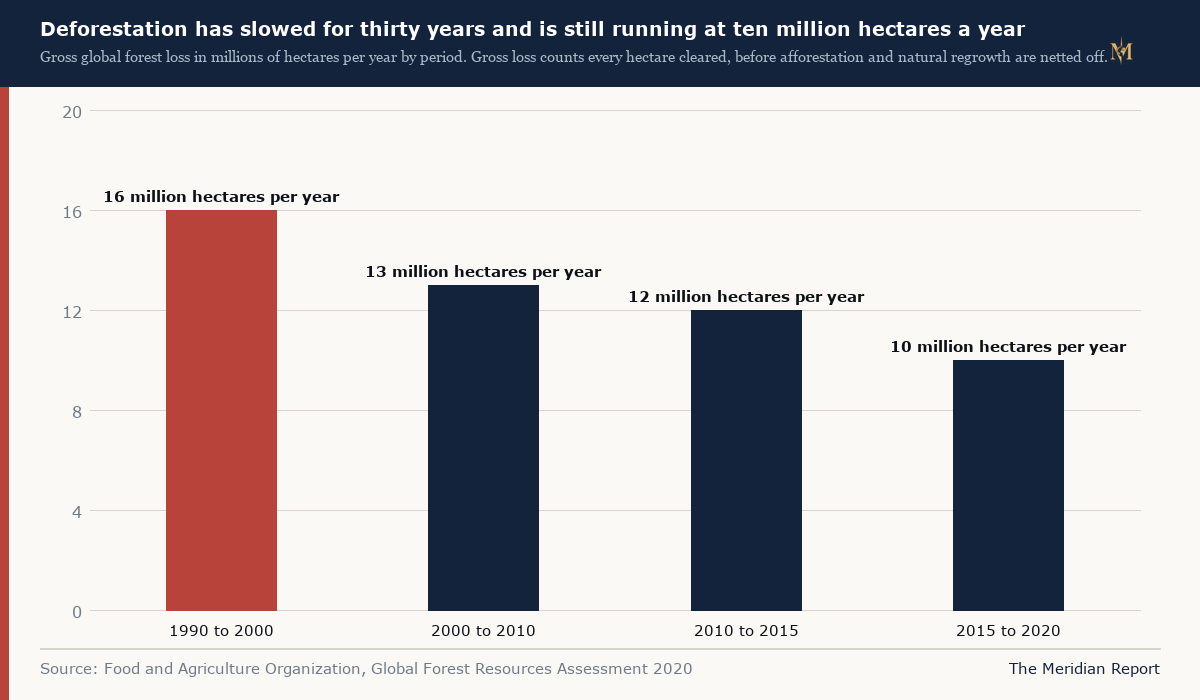
The Food and Agriculture Organization's assessment of global forest resources found that the rate of net forest loss fell from about 7.8 million hectares a year in the 1990s to about 4.7 million hectares a year in the 2015 to 2020 period. Gross deforestation, which is the measure the regulation cares about, fell from about 16 million hectares a year in the 1990s to about 10 million hectares a year in the most recent period. The decline is real, and it happened before the regulation existed.
The decline has several causes: stronger forest law in Brazil, the soy moratorium, the expansion of protected areas, the intensification of agriculture, the shift of palm oil expansion to already cleared land and the collapse of beef demand in some markets. The regulation may accelerate the decline, and it may also take credit for a trend that was already underway.
The more serious counter-argument is that the regulation could increase deforestation in the short run. A producer that expects the rules to tighten has an incentive to clear land before the cut-off, and a producer that expects to be excluded has no incentive to preserve the forest. The regulation's cut-off date is fixed, which removes the first incentive for land cleared after 2020, and the exclusion risk remains.
The evidence from the timber regulation suggests that the effect is modest and positive. The imports of illegal timber fell, the share of certified timber rose, and the total trade in timber did not collapse. The deforestation regulation is broader and more ambitious, and the timber precedent is the best available guide.
What the regulation borrows from the timber regulation
The European Union's timber regulation, which has been in force since 2013, is the model for the deforestation regulation. It prohibits the placing of illegally harvested timber on the market, requires due diligence and establishes a chain of custody. It has been in force for more than a decade, and its results are mixed.
The timber regulation's strength is that it built on an existing certification industry and an existing customs system. Its weakness is that it relies on the producer country's definition of legality, which varies widely, and on the operator's assessment of risk, which is difficult to challenge. The deforestation regulation corrects the first weakness by defining deforestation in European law, and it keeps the second.
The comparison matters because the timber regulation did not transform the global timber trade. It changed the European market, it raised the cost of illegal timber in Europe, and it left the trade in other markets largely untouched. The deforestation regulation will probably have the same effect: a cleaner European market and a global trade that adjusts around it.
What the numbers do not establish
The share of deforestation attributed to European consumption is an estimate from a economic model that allocates global land use change to final demand. The model is a reasonable tool and it is not a measurement. A different model, a different base year or a different allocation method would produce a different share, and the regulation's impact assessment acknowledges the uncertainty.
The cost of compliance figures are estimates from pilot projects and from the operators' own disclosures. They vary by country, by commodity and by the size of the operator, and the sample is biased toward the supply chains that a large buyer has an interest in documenting. The cost for a marginal farmer is not known, and the marginal farmer is the one the policy is most likely to exclude.
The forest loss data is a global aggregate. It does not tell you whether a particular plot was cleared, and it does not distinguish between a forest that was cleared for agriculture and a forest that was degraded by logging or fire. The regulation's satellite evidence is plot level, and the global statistics are context rather than proof.
The claim that the regulation will reduce deforestation is a prediction. The evidence from the timber regulation and from similar schemes suggests that a demand side measure can change the European market, and it does not establish that it changes the global rate. The outcome depends on the enforcement, on the leakage and on the response of the producing countries, and none of those is settled.
The scenarios that matter
Three scenarios describe the range of plausible outcomes, and they are distinguished by enforcement and by leakage.
In the first, enforcement is credible and the other markets follow. The European market becomes deforestation free, the compliance cost is absorbed by the supply chain, the producing countries adopt traceability as a condition of access, and the global rate of deforestation falls. This is the scenario the regulation was designed for, and it requires a level of administrative capacity and international cooperation that has not yet been demonstrated.
In the second, enforcement is credible in Europe and the other markets do not follow. The European market becomes cleaner, the non-compliant supply is diverted to Asia and the Gulf, the global rate is unchanged, and the producers who cannot comply are excluded from Europe. The cost falls on the smallholders and the benefit is a cleaner European supply chain. This is the most likely scenario on the current evidence.
In the third, enforcement is weak and the compliance is formal. The statements are submitted, the customs authorities check the reference numbers, the audits are rare, and the system becomes a documentation exercise. The European market looks compliant, the deforestation continues, and the regulation's credibility is damaged. This is the scenario that the delay and the simplification package make more likely.
The difference between the scenarios is not the design of the regulation. It is the resources devoted to enforcement and the diplomacy devoted to the producing countries. A regulation is a legal instrument, and its effect is determined by the administration that applies it.
Brazil and the legal reserve
Brazil is the producer country where the regulation's interaction with national law is most contested, because Brazil already has one of the strictest forest codes in the world and it argues that the European rule does not recognise it.
The Brazilian forest code requires rural landowners to maintain a legal reserve of native vegetation on their property. The share is 80 per cent in the Amazon, 35 per cent in the Cerrado and 20 per cent in the other regions. The code also protects riparian areas and steep slopes, and it requires registration of the property in a rural environmental registry, which is a public database of boundaries and compliance.
The European regulation's cut-off date is 2020, and it prohibits deforestation after that date regardless of whether the clearing was legal under Brazilian law. A Brazilian farmer who complied with the forest code by clearing 20 per cent of his Cerrado property in 2022 would be legal in Brazil and non-compliant in Europe. That difference is the core of the Brazilian objection, and it is not a technicality.
The Commission's position is that the regulation sets the European market's standard, and that a producer who wants access to that market has to meet it. The position is legally coherent and it is politically difficult, because it treats a country with strong forest governance as a source of risk and a country with weak governance as a potential supplier if its remaining forest is intact.
The benchmarking process is where the tension will be resolved. A classification of Brazil as standard risk would allow the trade to continue with due diligence. A classification as high risk would raise the cost and reduce the flow. The Brazilian government has been lobbying for a classification that recognises the forest code, and the Commission has been careful not to promise one.
Indonesia and the certification model
Indonesia is the largest palm oil producer and the country with the most experience of European sustainability rules. It has its own certification scheme, the Indonesian Sustainable Palm Oil standard, and it has argued for years that the European rules discriminate against its product.
The palm oil supply chain is shorter than cocoa and more concentrated than coffee. A mill receives fruit from its own estates and from smallholders, and the mills are often owned by the same groups that own the refineries and the plantations. Tracing the fruit to a plot is technically feasible and it is expensive, because the smallholders deliver in small quantities and the mill has to weigh and record every delivery.
The Indonesian response has been a combination of compliance and diversification. The large producers have mapped their estates, the government has strengthened its certification, and the industry has looked for new markets in Asia and the Middle East. The European Union's palm oil imports have fallen, partly because of the renewable energy directive and partly because of the deforestation regulation, and the fall has been absorbed by other buyers.
The Indonesian argument that the regulation is a trade barrier has a legal basis in the World Trade Organization's rules. A measure that restricts trade for an environmental purpose can be justified under the general exceptions if it is necessary, proportionate and non-discriminatory. The regulation's defenders argue that it is non-discriminatory because it applies to all sources, and the critics argue that it discriminates in effect because it imposes a standard that only some producers can meet.
Ghana, Cote d'Ivoire and the price of traceability
The two West African cocoa producers have the most to gain and the most to lose from the regulation. They supply the European market, they have built traceability systems, and they have argued that the regulation should recognise their efforts and pay for the data.
Ghana's cocoa management system registers farmers and plots, and the cocoa board has been mapping farms with the support of the industry and of development partners. Cote d'Ivoire's system is run by the Conseil du Cafe-Cacao and is linked to the export process. Both countries have introduced a living income differential, a premium on the farmgate price that is intended to raise farmer incomes, and both have argued that the compliance cost should be added to the price rather than deducted from the farmer's share.
The European buyers have been reluctant to accept a direct link between the regulation and the price. The regulation does not require a premium, and the market determines the price. The producing countries argue that the market will not pay for a public good, and that the compliance cost will be pushed down to the farmer unless the buyers commit to a higher price.
The outcome will depend on the balance of power in the cocoa market. The 2024 price spike gave the producers more leverage than they had had for decades, and the regulation arrived at a moment when the buyers were worried about supply. A producer country that can credibly threaten to divert its cocoa to Asia has more bargaining power than one that cannot, and the West African producers have been exploring Asian markets for years.
The legal question the World Trade Organization will decide
The regulation's legality under international trade law has not been tested. The producing countries have raised concerns in the World Trade Organization's technical barriers committee, and none has filed a formal dispute.
The legal analysis turns on three questions. The first is whether the regulation is a technical regulation within the meaning of the technical barriers agreement, and whether it is based on an international standard. There is no international standard for deforestation free supply chains, so the regulation is a unilateral standard, and the agreement requires that a unilateral standard be notified and explained.
The second is whether the regulation is necessary and proportionate. The European Union will argue that it is the least trade restrictive measure that achieves the objective, and the complainants will argue that a labelling scheme or a partnership approach would be less restrictive. The outcome of that argument depends on the evidence and on the panel's assessment of the alternatives.
The third is whether the regulation discriminates between countries. It applies to all imports, so it is formally non-discriminatory. The complainants will argue that the country benchmarking, the cut-off date and the smallholder requirements have a disproportionate effect on developing countries, and the European Union will argue that a measure can have different effects without being discriminatory.
A dispute would take years, and the appellate body of the World Trade Organization is not functioning, which means a panel report could be appealed into a void. The legal uncertainty is therefore likely to persist, and the regulation's effect will be determined by the market before it is determined by a panel.
The comparison with the carbon border adjustment
The deforestation regulation and the carbon border adjustment mechanism are the two most ambitious trade measures the European Union has adopted, and they share a structure: a European standard applied to imported goods, with a documentation requirement and a penalty for non-compliance.
They differ in what they regulate. The carbon mechanism prices the emissions embedded in a product, and it requires measurement at the installation level. The deforestation regulation prohibits a land use change, and it requires a geolocation at the plot level. The carbon mechanism is a price instrument and the deforestation regulation is a prohibition, and the administrative burden is different in kind.
The comparison is useful because it shows where the deforestation regulation is weaker. The carbon mechanism has a market price that reveals the cost of compliance and allows a firm to decide whether to pay it or to reduce its emissions. The deforestation regulation has no price, and a firm that cannot document its supply has no option except to stop buying. The absence of a price makes the regulation less efficient and more exclusionary.
The comparison also shows where it is stronger. A prohibition is harder to evade than a price, because a false statement is a fraud rather than a tax planning decision. The deforestation regulation's reliance on satellite evidence gives it a verification tool that the carbon mechanism lacks, and the tool is public and cheap.
What the record establishes
The deforestation regulation is a serious attempt to use the European market to change land use in producer countries, and it has already changed the behaviour of the companies that supply that market.
The compliance infrastructure exists and it is being built at scale. The cocoa and coffee sectors have mapped millions of plots, the satellite monitoring is operational, and the due diligence statements are being submitted. The cost is real and it is unevenly distributed, and the smallholders who cannot document their plots are the most exposed.
The regulation's effect on deforestation is not yet established. The global rate was falling before the regulation, the leakage to other markets is a structural feature of a unilateral measure, and the enforcement capacity of the member states is the variable that will determine whether the regulation is a prohibition or a paperwork exercise.
The political economy is the part that will decide the outcome. The regulation was delayed once, it is being simplified, and it is the subject of a negotiation with the producing countries that will continue for years. A regulation that is amended every year is a regulation that firms cannot plan around, and the planning is what makes the compliance investment worthwhile.
What the record does establish is narrower and more useful. The European Union has built a system that can trace a chocolate bar to a plot of land, and it has done so in less than three years. The system is imperfect, the data is incomplete, and the enforcement is untested. It is also the first time a major market has tried to regulate deforestation at the level of the individual field, and the attempt has changed the terms of the trade even before it has changed the forest.
Sources
- Regulation (EU) 2023/1115 on deforestation-free products.
- European Commission, Regulation on Deforestation-free products, implementation pages.
- European Commission Joint Research Centre, Global Forest Cover map.
- Food and Agriculture Organization, Global Forest Resources Assessment 2020.
- European Commission, impact assessment for the deforestation regulation, SWD(2021) 326.
- Cocoa Board of Ghana and Conseil du Cafe-Cacao, production and traceability data.
- International Cocoa Organization, quarterly bulletin of cocoa statistics.
- UK Department for Environment, Food and Rural Affairs, Environment Act 2021, Schedule 17.
- World Trade Organization, Committee on Technical Barriers to Trade, concerns raised on the EU deforestation regulation.
The forest definition is doing more work than anyone admits
The regulation defines forest as land of more than half a hectare with trees taller than five metres and a canopy cover of more than ten per cent, or trees that can reach those thresholds. The definition is technical, it is borrowed from the Food and Agriculture Organization, and it determines which land is protected.
The definition is generous in some landscapes and strict in others. A savannah with scattered trees that meets the canopy threshold is a forest under the regulation, even if it has been managed as a woodlot for generations. A cocoa farm under remnant shade trees may meet the threshold, which means the farmer who thins the canopy to increase yield could be judged to have deforested his own farm. A eucalyptus plantation established on grassland is not deforestation, even if it replaces a biodiverse ecosystem that is not a forest.
The choice of definition has distributional consequences. A country with a lot of land that meets the threshold has more land at risk of being classified as deforested, and a country with a definition that differs from the European one will have to reconcile the two. The regulation allows the use of national definitions in the risk assessment and it applies the European definition to the prohibition, which is a compromise that satisfies nobody.
The degradation clause adds a second layer. Forest degradation is a reduction in the capacity of a forest to provide goods and services, and it is harder to measure than deforestation. A selective logging operation that removes a few trees may degrade a forest without converting it, and the satellite record may not show it. The regulation requires that the product is not associated with degradation, and the evidence for degradation is thinner than the evidence for conversion.
The practical effect is that the regulation is precise about the thing it can measure and vague about the thing it cannot. A plot that was cleared is detectable. A forest that was thinned is not, and a supply chain that depends on thinning can be certified as deforestation free while the forest loses the qualities that made it worth protecting.
That is not a reason to abandon the regulation. It is a reason to be honest about what it does. The regulation is a deforestation regulation, not a forest protection regulation, and the difference matters in the landscapes where the threat is degradation rather than clearance.
What would make the regulation work
The first requirement is a stable timetable. A regulation that is postponed and simplified every year cannot be planned around, and the firms that have invested in compliance are the ones that are penalised by the delay. The Commission should set a date and keep it, and if the system is not ready, it should say what is missing rather than move the deadline.
The second is money for the producers who cannot afford the data. The cost of mapping a smallholder plot is small in absolute terms and large relative to the income of the farmer, and a facility that pays for the mapping would remove the exclusion risk at a fraction of the cost of the regulation. The European Union has development instruments that could be used, and it has not used them at the scale the problem requires.
The third is enforcement that is visible. A few well publicised penalties, applied to a large operator and to a small one, would do more to change behaviour than a thousand guidance documents. The authorities have the data and the powers, and the question is whether they will use them against the companies that have the lawyers.
The fourth is a conversation with the producing countries that treats them as partners rather than as risks. The regulation's country benchmarking is a unilateral judgment, and a judgment that is made without the producer's input will be contested. A process that recognises national systems, pays for the data and accepts a transition period would be slower and more durable.
The counter-argument that the regulation is a solution to the wrong problem
The strongest criticism of the regulation is not that it is too strict. It is that it addresses the wrong variable.
Deforestation is driven by the demand for agricultural land, which is driven by the demand for food, feed, fuel and fibre, which is driven by population, income and policy. A regulation that restricts the European market changes the destination of the supply, not the total demand, unless it reduces the demand for the commodity or raises the cost of clearing land everywhere.
The European market is a large buyer of cocoa and coffee, and a smaller buyer of soy and palm oil. The regulation can change the practices of the suppliers who sell to Europe, and it cannot change the demand of the consumers who buy the products. A policy that reduced food waste, changed diets or paid for forest conservation directly would address the demand, and it would be harder to design and less visible to voters.
That is the trade-off the regulation embodies. It is a visible, enforceable measure that uses the market's leverage, and it is not a solution to the underlying demand. Its defenders argue that a visible measure is worth more than a perfect one that cannot be enforced, and its critics argue that a measure that shifts the trade without reducing the demand is a cost without a benefit. The evidence is not yet available to settle the argument, and the regulation's own review clause will require the Commission to report on it.
What the record establishes
The deforestation regulation has built a compliance system that can trace a product to a field, and it has done so faster than most of its critics predicted. The system is imperfect, the data is incomplete, and the enforcement is untested, and it has already changed the way the cocoa, coffee and timber trades document their supply.
Its effect on deforestation is not established. The global rate was falling before the regulation, the leakage to other markets is a structural feature of a unilateral measure, and the enforcement capacity of the member states will determine whether the regulation is a prohibition or a paperwork exercise.
The distributional question is the one that will decide its legitimacy. A regulation that excludes the smallholders it was meant to protect, and that transfers the cost of compliance to the producers with the least ability to pay, will be contested in the producing countries, in the World Trade Organization and in the European Parliament. A regulation that pays for the data, recognises national systems and enforces visibly would be slower and more durable.
The timetable is the immediate test. The regulation has been postponed once, and a further postponement would signal that the European Union is not serious about the deadline. The firms that have invested are watching, and so are the producing countries.