
The insurance industry is often described as leaving. The description is vivid and imprecise. Private insurers are still writing policies in the places that are described as abandoned. What has changed is the price, the terms and the appetite, and the result is that a growing share of the risk has moved from a company that prices it to a public or quasi-public entity that spreads it. The move is not a disappearance of insurance. It is a change in who holds the tail, and in who is asked to pay for it when the tail moves.
That change matters because the entity that holds the tail does not have the same capital, the same pricing discipline or the same ability to say no. A state-backed pool can insure a property that the private market will not, and it can do so at a price that is below the actuarial cost because the state can assess the cost onto someone else later. The "later" is the part that policyholders and taxpayers discover after the disaster.
What retreat actually looks like
An insurer has four ways to reduce its exposure. It can raise the premium. It can raise the deductible, exclude a peril or require a mitigation. It can decline to renew. Or it can withdraw from a line or a state entirely. Most of the retreat has taken the first three forms, and the fourth is rarer and more visible.
The repricing is the first signal. A premium that rises by a large percentage in a year is a signal that the insurer's model of the risk has changed. The increase may reflect a reassessment of the hazard, the cost of reinsurance, the cost of capital or the regulator's approval of a rate filing. The policyholder sees one number and the insurer sees four.
The terms are the second signal. A deductible that rises from a fixed amount to a percentage of the insured value shifts a larger share of a small loss to the policyholder. An exclusion for wind, flood or wildfire removes a peril that the policyholder thought was covered. A requirement for a new roof or a fire-resistant exterior is a condition that the policyholder must meet to keep the cover.
The withdrawal is the third signal, and it is the one that makes the news. An insurer that stops writing new policies in a state, or stops renewing a book, creates a gap that the residual market fills. The gap is real for the policyholder and it is not a proof that the state has become uninsurable. It is a proof that the private market's price for the risk is above what the regulator will allow or what the policyholder will pay.
The residual market is a public insurer with a private name
A residual market is a pool created by statute to provide cover that the private market will not. It goes by different names: a FAIR plan, a wind pool, a beach plan, a citizens corporation, a catastrophe fund. The names differ and the structure is similar. The pool writes policies, collects premiums, buys reinsurance and pays claims, and it is backed by an assessment mechanism that can reach beyond its own policyholders.
The assessment is the key. A pool that runs a deficit can recover it by charging its policyholders, by charging the private insurers that operate in the state, or by issuing bonds that are repaid from a surcharge on policies. The charge is usually levied after the event, which means the cost is not in the premium that the policyholder sees at the time of purchase. It appears later, on a renewal or a separate line.
That structure has three consequences. It makes the cover look cheaper than it is. It transfers risk from the pool's policyholders to the wider market. And it creates an incentive for the private market to withdraw, because a private insurer that stays is exposed to assessments from a pool that is growing. The residual market can therefore crowd out the market it was created to supplement.
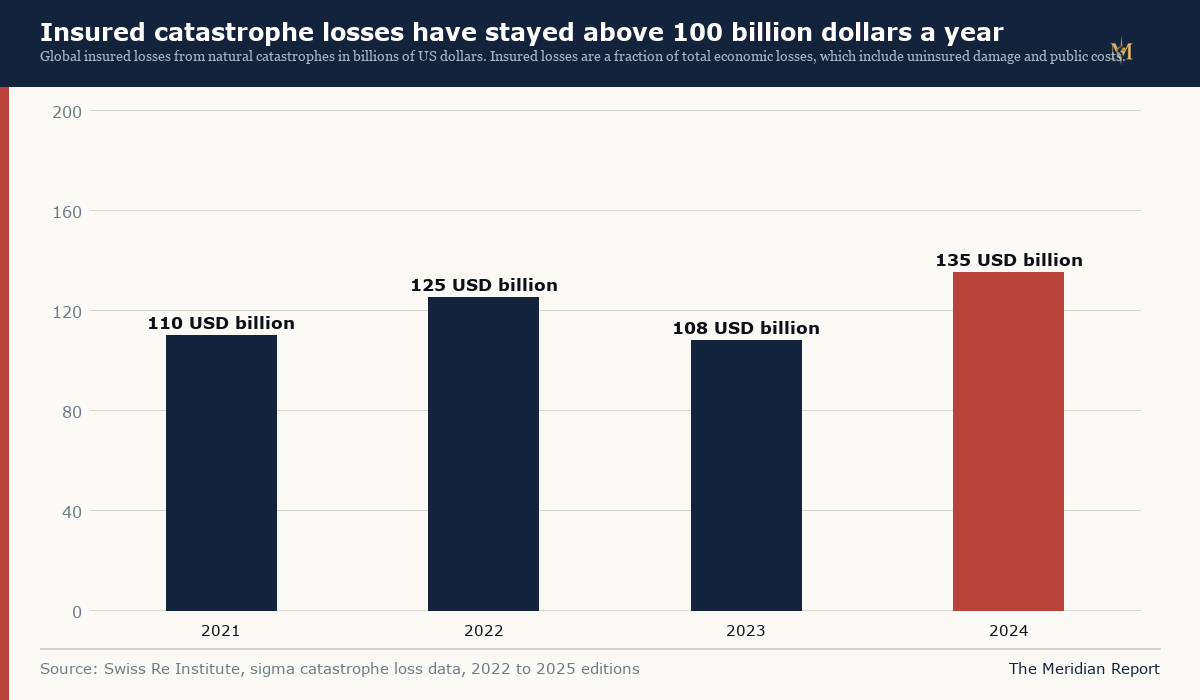
Why reinsurance sets the price of the whole system
A primary insurer does not keep all the risk it writes. It buys reinsurance, which is insurance for insurers, to cap its losses from a single event or a series of events. The price of that cover is set by global capital, by the models that estimate catastrophe risk and by the capacity that the reinsurance market is willing to deploy.
When reinsurance is cheap and abundant, a primary insurer can write more risk at a lower price. When it is expensive or scarce, the insurer retains more risk, raises prices or withdraws. The reinsurance cycle is therefore a transmission mechanism between global capital and a local premium. A homeowner in a wildfire zone is exposed to the price of capital in Bermuda and London, whether or not the connection is visible.
The reinsurance market has also changed its structure. Catastrophe bonds transfer a defined layer of risk to capital-market investors, who receive a yield and lose principal if a trigger is met. The bonds broaden the capacity and they also introduce a new set of investors who are sensitive to the modelled loss and to the trigger design. A bond that is triggered by an industry loss estimate behaves differently from a bond that is triggered by a parametric measurement, and the difference matters to the insurer that buys the cover.
The models are the argument
A catastrophe model is a probabilistic estimate of loss. It combines a hazard model, an exposure database and a vulnerability function, and it produces a distribution of losses. The model is the basis for the premium, the reinsurance price and the regulator's view of solvency capital.
The models are also the subject of the dispute. A wildfire model that was calibrated on a period of moderate fire activity will underestimate a season of extreme fire weather. A flood model that relies on a national elevation dataset will misjudge a local drainage pattern. A hurricane model that assumes a stationary climate will miss a trend in sea surface temperature. The insurer updates the model, the premium rises, and the policyholder experiences the update as a withdrawal.
The modelling problem is not a reason to ignore the models. It is a reason to treat the output as an estimate with a range, and to require the model to be transparent about its assumptions. A regulator that approves a rate filing without understanding the model is approving a number, not a risk. A policyholder who receives a premium increase without an explanation is receiving a number, not a reason.
California shows the mechanism at work
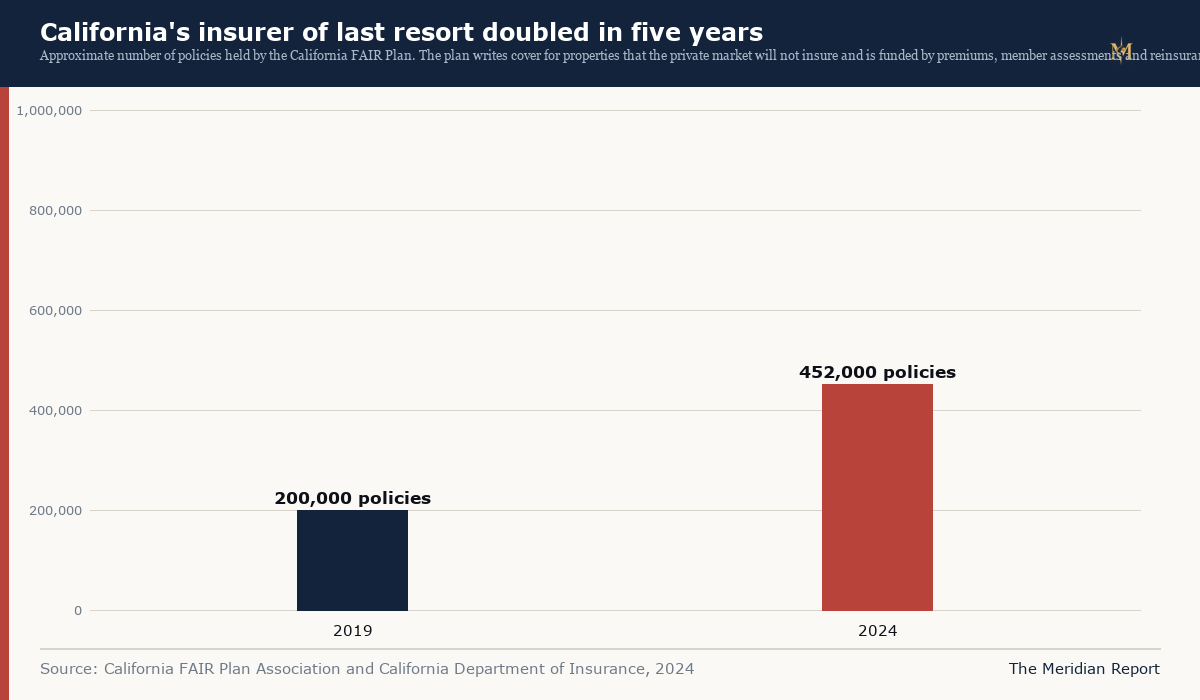
California's FAIR Plan is the state's insurer of last resort for property that the private market will not cover. It has grown rapidly as insurers have reduced their appetite in wildfire-exposed areas, and its exposure is concentrated in the same areas that the wildfire models identify as high risk. The plan is funded by premiums and by assessments on its members, and it buys reinsurance.
The growth of the plan is a measure of the private market's retreat and a measure of the public exposure. A plan that insures a large share of the high-value homes in a fire-prone region is a plan that would face a very large claim in a severe season. The assessment mechanism determines who pays for that claim, and the mechanism is a political choice as much as an actuarial one.
The state has also required insurers to write in high-risk areas in exchange for approval of other rate changes. That approach is a cross-subsidy, and it has the effect of keeping some risk in the private market. The debate is about how much cross-subsidy is acceptable and how much should be borne by the state, and there is no technical answer that settles it.
Florida and the cost of a public catastrophe fund
Florida has a residual insurer, Citizens, and a state catastrophe fund that provides reinsurance to insurers. Both are backed by assessment mechanisms, and both have grown as the private market has repriced hurricane risk. The state has also invested in mitigation and in a reinsurance programme, and the combination has kept the market functioning at a cost.
The Florida structure shows the trade-off clearly. A state catastrophe fund can lower the cost of reinsurance for private insurers, and it concentrates the risk of a very large event in a single public entity. If the event is smaller than the fund's capacity, the structure works. If the event exceeds it, the assessment falls on policyholders and insurers, and the state's credit is tested.
The structure also creates a political economy of its own. A fund with a large capacity is a reason to keep building in exposed areas, because the cost of the risk is not fully in the premium. A fund with a small capacity is a reason to raise the premium, which is politically difficult. The choice between the two is a choice about how much risk to socialise.
The public balance sheet is the insurer of last resort
When a private insurer fails, a guaranty fund pays the claims, and the fund recovers the cost from the surviving insurers. When a public pool runs a deficit, the state may issue bonds, levy an assessment or appropriate funds. The ultimate backstop is the taxpayer's ability to pay, and that ability is not unlimited.
The public balance sheet is therefore part of the insurance system, whether or not it appears in the accounts. A state that guarantees a pool has taken a contingent liability, and a state that requires insurers to write in high-risk areas has taken a regulatory liability. The liabilities are not always disclosed in the budget, and they are not always priced in the premium.
The disclosure matters for the same reason that a bank's capital matters. A contingent liability that is large relative to the state's revenue is a risk to the state's credit and to its ability to respond to the next disaster. A state that discovers the liability after the event has fewer options than one that planned for it.
Parametric cover is a useful tool with a specific limit
Parametric insurance pays when a measured trigger is met, such as a wind speed, a rainfall total or an earthquake magnitude. It is faster than an indemnity claim because it does not require an adjuster to assess the damage, and it can be structured to cover a specific risk that the traditional market will not.
The limit is basis risk. A parametric policy can pay when there is no damage, or fail to pay when there is. The trigger design determines the basis risk, and a policyholder who does not understand the trigger can be disappointed. The product is most useful for a public entity, a utility or a business that can model its exposure and match the trigger to its loss.
Parametric cover is also a signal of the market's adaptation. It is a way to transfer a risk that the indemnity market cannot price, and it is a way to bring capital into a region that the traditional market has left. It is not a substitute for a functioning insurance market, and it is a useful complement.
What the retreat teaches about adaptation
The insurance market is an adaptation signal. A premium that rises is a message that the risk has increased. A withdrawal is a message that the risk is above the price that the market can charge. A residual market is a message that the state has decided to absorb the risk rather than to price it.
The signal is imperfect. A premium can rise because of the cost of capital, the cost of reinsurance or a regulatory decision rather than because of the hazard. A withdrawal can reflect a company's strategy rather than the risk. A residual market can be a deliberate policy choice rather than a failure. The signal has to be read with the institutional context, and the context is different in every state.
The adaptation response is also imperfect. A homeowner can harden the roof, clear the vegetation and elevate the property, and the insurer may or may not recognise the mitigation in the premium. A community can improve the drainage and the building code, and the benefit may take years to appear in the model. The market rewards the mitigation only when the model and the rate filing reflect it.
The mortgage is the transmission belt
Most homeowners do not buy insurance because they want to. They buy it because the lender requires it. A mortgage contract obliges the borrower to maintain cover, and the lender has the right to force-place a policy if the borrower does not. That requirement is the reason the insurance market reaches the housing market, and it is the reason a withdrawal can affect a sale.
When a private insurer declines a property, the borrower can often move to the residual market, and the mortgage survives. When the residual market is expensive or the cover is limited, the borrower's monthly cost rises, and the affordability of the home changes. When the residual market is unavailable, the lender may decline the loan, and the property becomes difficult to sell to anyone who needs a mortgage.
That chain is why insurance is a financial stability issue rather than a consumer issue. A market that reprices quickly can reduce the value of the collateral that backs the mortgage book, and a reduction in collateral value can affect the lender's capital. The effect is slow and it is cumulative, and it is the reason regulators pay attention to the insurance market even when they do not regulate it directly.
The chain also explains the political pressure. A state that allows the premium to rise to the actuarial level is accused of making housing unaffordable. A state that suppresses the premium is accused of building a liability. The residual market is the compromise, and the compromise is a transfer from the future to the present.
The municipal credit channel
A city or a county that depends on property tax revenue is exposed to the insurance market through its tax base. A neighbourhood that becomes difficult to insure becomes difficult to sell, and a decline in sales reduces the assessed value and the revenue. The effect is not immediate, and it compounds over several years.
The municipal exposure is also direct. A city owns buildings, vehicles and infrastructure that it insures, and its premium rises with the market. A city that cannot afford the cover may self-insure, which means it holds a liability that its budget does not show. A city that buys less cover is accepting a larger deductible, and a single event can exceed its reserves.
The credit rating agencies have begun to ask about climate exposure, and the questions are not limited to the physical damage. They cover the insurance cost, the tax base, the contingent liabilities and the adaptation plan. A city that cannot answer those questions is a city that may pay more to borrow, and the cost of borrowing is a cost that the residents bear.
The reinsurance cycle is not the same as the risk
Reinsurance prices move in a cycle that is driven by losses, capital and demand. A large catastrophe reduces the capital of the reinsurance market, and the price rises. A period without large losses rebuilds the capital, and the price falls. The cycle can move the premium by a large amount without any change in the underlying hazard.
That cyclicality is a problem for a policyholder who is trying to adapt. A premium that rises because of the cycle is a signal that the market is tight, not a signal that the property is more exposed. A policyholder who responds by investing in mitigation may see the benefit eroded by the next cycle. The signal is noisy, and the noise is expensive.
The cycle is also a problem for the state. A residual market that buys reinsurance at the top of the cycle pays more than one that buys at the bottom, and the difference is borne by the policyholders. A pool that self-insures through the cycle avoids the price but holds the risk. The choice between the two is a choice about the state's appetite for volatility.
The secondary effects: value, migration and the tax base
A rising insurance cost affects a property in three ways. It raises the cost of ownership, it reduces the price that a buyer is willing to pay, and it changes the decision to stay or to move. The three effects reinforce each other, and they are visible in the places that have experienced the largest repricing.
The value effect is the simplest. A buyer who finances a home compares the total monthly cost, including the insurance, with the rent or the alternative. A higher insurance cost reduces the affordable price, and the reduction is larger when the cost is uncertain. The uncertainty is itself a discount, because a buyer cannot price a cost that may rise again.
The migration effect is slower. A household that can move to a less exposed area may do so, and the move reduces the demand in the exposed area and increases it elsewhere. The migration is selective: households with the resources to move are the ones who move, and the households that remain are the ones with fewer options. The result is a change in the composition of the community, not only in its size.
The tax base effect follows. A decline in value reduces the property tax revenue, and a change in the composition of the community changes the demand for services. A city that loses high-value properties and gains households with lower incomes faces a budget squeeze that is not of its making. The squeeze is the fiscal version of the insurance retreat, and it is the part that local officials see first.
What would change the picture
Four developments would alter the trajectory. The first is a run of benign years that rebuilds the capital of the reinsurance market and lowers the price of cover. That would ease the pressure without changing the underlying risk, and it would be a temporary relief rather than a solution.
The second is a step change in mitigation that the models recognise. A community that retrofits its roofs, clears its fuel and improves its drainage can lower its modelled loss, and the lower loss can be reflected in the premium. The effect is real and it is slow, and it requires the insurer to trust the mitigation.
The third is a public policy that prices the risk honestly. A residual market that charges an actuarially sound premium, discloses its assessment mechanism and buys adequate reinsurance is a residual market that can survive a severe event. A pool that suppresses the price is a pool that accumulates a liability.
The fourth is a change in the climate itself. A stabilisation of the hazard would eventually feed into the models, and the premium would follow. That is a long-term condition, and it is not a plan for the next renewal.
How a pool sets a premium
A residual market is required to be actuarially sound in most statutes, and the requirement is easier to state than to meet. The pool has to estimate the loss cost, add the expenses and the cost of reinsurance, and set a rate that covers them. The estimate depends on a model, and the model is uncertain.
The pool also has a mandate that the private market does not. It must accept the risks that the market declines, which means its book is adversely selected. The properties in the pool are the ones that the private insurers have judged to be the most exposed, and the pool's loss cost is therefore higher than the market average. A rate that is set at the market average will run a deficit.
The political pressure pushes in the opposite direction. A pool that sets an actuarially sound rate is accused of pricing people out of their homes. A pool that suppresses the rate is accumulating a liability that will be assessed later. The statutes often include a cap on the annual increase, which is a compromise that shifts the deficit to the future.
The reinsurance is the other variable. A pool that buys reinsurance transfers a layer of the risk and pays for it in the premium. A pool that does not buy reinsurance keeps the premium lower and holds the risk. The choice is a choice about the state's balance sheet, and it is often made in a boardroom rather than in a legislature.
The international comparison
The insurance retreat is not unique to the United States. Australia has faced a similar repricing in its flood and bushfire zones, and the government has debated a reinsurance pool for cyclone risk. The United Kingdom has a flood reinsurance scheme, Flood Re, that pools the risk and caps the premium for eligible homes. France has a natural catastrophe scheme that is funded by a surcharge on property policies.
The schemes differ in their design and they share a common logic. The private market prices the risk, the state decides that some of the risk should be shared, and the sharing is funded by a levy, a surcharge or a guarantee. The design determines who pays and how visible the cost is.
The British scheme is instructive because it is explicit about the cross-subsidy. The levy is collected from the insurers and the pool reinsures the flood risk, and the householder pays a capped premium. The cost is visible in the levy and it is spread across the market. The scheme has a sunset date, which is a commitment to review rather than a permanent subsidy.
The French scheme is instructive for a different reason. It is a public-private partnership with a broad mandate, and it covers a wide range of perils. The breadth is a strength and it is also a cost, because the scheme is exposed to every event rather than to a single peril. The design reflects a political choice to share the risk widely, and the choice is reflected in the price.
The question that the premium does not answer
The insurance debate is usually framed as a question about affordability. Can a homeowner afford the premium? Can a business afford the cover? Can a state afford the pool? The framing is understandable and it misses the underlying question: who should bear the cost of living in a place that is exposed to a hazard?
The market's answer is the policyholder. The state's answer is the taxpayer or the wider pool of policyholders. The two answers are both legitimate and they produce different distributions. A market price that reflects the risk is efficient and it can be unaffordable. A subsidised price is affordable and it can increase the exposure.
The insurance system does not resolve that question. It reveals it. A premium that rises is a signal that the risk has become more expensive, and a residual market that grows is a signal that the state has decided to absorb the difference. The decision is political, and the accounts should show it.
A state that discloses the contingent liability, prices the pool at an actuarially sound level and funds the mitigation is a state that is choosing the risk with its eyes open. A state that suppresses the price, hides the assessment and delays the mitigation is a state that is choosing the same risk and sending the bill to a future legislature. The difference between the two is not the climate. It is the accounting, and the accounting is a choice that every legislature makes whether or not it says so.