
Crude recovered and diesel did not, and that single divergence is the most important fact about the oil market in the seventh month of this war.
Brent, the benchmark for crude, has spent the past fortnight trading between roughly $97 and $104 a barrel, which is high by the standards of the last decade and unremarkable by the standards of this one. On 2 October it fell below $100 on the news of an emergency release and was back around $102 by the evening. Before the United States and Israel attacked Iran in February it was trading near $73.
Diesel has done none of that. British pump prices passed two pounds a litre for the first time. American diesel reached about seven dollars a gallon. Europe spent a week deciding whether to open its reserve tanks, and then did so under pressure.
The pressure is the part worth understanding. The instrument Washington raised was not a subsidy or a sanction. It was the possibility that America, which supplies more than half of the EU's diesel imports, would simply stop selling. That threat did what seven months of war had not: it produced a decision in Europe within forty-eight hours.
The first fortnight, in prices
The scale of what has been consumed is easier to grasp from the price record of the opening days, which is unusually well documented.
The International Energy Agency's Oil Market Report of 12 March recorded that benchmark crude prices had risen by $20 a barrel to $92 since hostilities began on 28 February, and noted even bigger increases across some products.
By the end of March, Brent had risen about 65 percent, or $46 a barrel, according to the World Bank, in the highest monthly increase on record. CNBC reported the same month as the biggest monthly gain in the price since the series began in 1988.
The peak came later. Brent rose as high as $126.41 a barrel on 30 April, the highest since 9 March 2022, before retreating on the day by $4.02, or 3.41 percent, as Reuters reported. April as a whole averaged roughly $117 a barrel.
Set that sequence against the 2 October price and the shape of the whole crisis becomes visible. Brent went from about $73 before the war to $92 within a fortnight, then to $126 at the April peak, and now sits around $102. The oil system has given back the panic premium and retained the war premium.
Diesel never had a panic premium to give back, because it never stopped being scarce.
Crude is not the same market as diesel
The reason crude recovered and diesel did not is that they are not the same commodity, and the public argument about them has mostly been conducted as though they were.
Crude oil is close to fungible. A cargo of Arabian Light can be moved, stored, sold to a different buyer, or refined in a different country. When a shipping route closes, the oil does not vanish. It finds another route, and the cost of finding it is a freight rate and a few days. This is why the oil system adapted to the closure of the Strait of Hormuz at all, and why flows through it recovered to the point where Middle East exports rebounded in recent weeks.
A refinery is not fungible. It is a fixed industrial asset, built for one location, producing one specification of product from one feedstock. When Ukrainian strikes damaged refining units across Russia and the war with Iran removed Iranian capacity, the barrels those plants would have produced could not be conjured by moving crude somewhere else. They simply did not exist.
The International Energy Agency said in August that global observed oil stocks had fallen by about 410 million barrels since 28 February, and that tight diesel and jet fuel supplies had pushed refining margins to record levels. A record margin is a refining system telling you it is constrained, in the same way that a record price tells you a crude market is constrained.
Diesel's specific uses make the shortage harder to solve than the headline suggests. It is harder to refine into than petrol, it is burned in heavy goods vehicles where electrification has barely begun, and it underpins agriculture, where seasonal demand cannot be deferred. The BBC reported the view plainly: because of its use in haulage and agriculture, it is very difficult to reduce demand.
A market in which demand cannot move and supply has lost fixed capacity is a market in which price is the only remaining variable. That is the mechanism by which a crisis in one refinery in Russia becomes a record margin in Dubai and a petrol price on a forecourt in Berkshire.
The refinery is the asset that was destroyed
Two separate conflicts have been removing refining capacity this year, and they have been removed for different reasons with the same result.
Ukraine's campaign against Russian oil refineries has been running for months. Ukrainian estimates put its effect at more than 45 percent of Russian refining capacity knocked out, which has produced fuel rationing in some regions and queues at filling stations. Volodymyr Zelenskyy continued striking on the morning of 1 October, hitting a facility in the Samara region, and Vladimir Putin conceded at the Valdai forum that the campaign had cost Russia roughly 1 percent of its gross domestic product. Russia has responded by extending its own ban on diesel exports to the end of October.
Russia is, traditionally, the world's second-largest diesel exporter. The largest available source of replacement barrels is therefore a country that has stopped selling them.
The war with Iran removed the other tranche. Iranian refining capacity was struck from the first day of hostilities, and Iran has also lost the export earnings that would otherwise have funded both domestic fuel subsidies and the imports that keep a domestic system supplied. US naval blockade has compounded the effect by restricting the tankers that would have moved Iranian product out.
The combination is what produced the margin. It is not that the world has run out of oil molecules. It is that the world has run out of the ability to turn a subset of them into the specific liquid that heavy trucks and tractors need.
The barrels drawn down exceed the barrels released
There is a way to see the scale of what has been consumed, and it does not require estimating anything.
The International Energy Agency reported in August that global observed oil stocks had fallen by about 410 million barrels since the war began on 28 February.
The largest emergency release in the agency's history was agreed on 11 March: 400 million barrels.
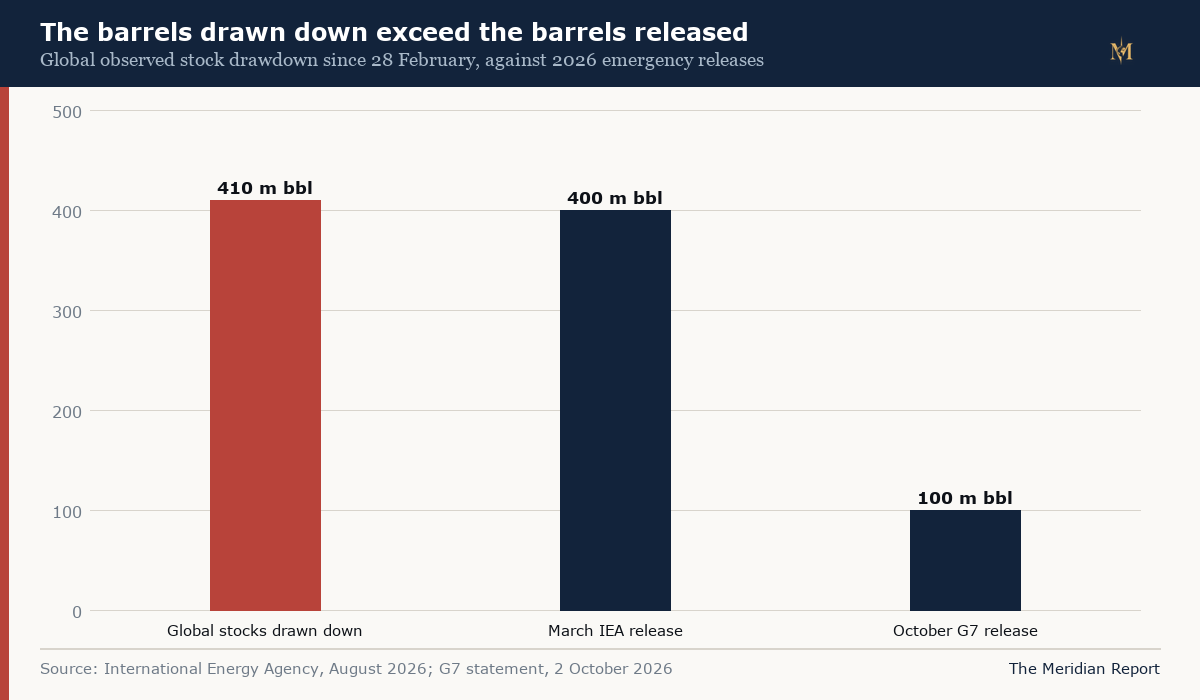
The drawdown has already exceeded the March authorisation, and a further 100 million barrels was authorised by the G7 on 2 October, taking total authorised releases in 2026 to 500 million barrels.
That comparison is not an argument about who caused what. Stock drawdown is the net of production, consumption and releases, and stocks are drawn down for reasons that have nothing to do with war at all. What it does establish is the order of magnitude: the buffer that exists to absorb a disruption has been consumed at least once over in seven months, and the response has been to release from it twice.
That is the structural problem with emergency stocks, and it is worth stating plainly. They are not a resource. They are a buffer, and a buffer that is spent during the first shock is not available for the second one.
What the March release actually delivered
The 400 million barrels agreed in March have not all arrived, and the shortfall has its own arithmetic.
By 21 July, members of the International Energy Agency had released 290 million barrels since March. That leaves roughly 110 million barrels authorised but not delivered, a gap that European officials and the agency itself were still working through in late September.
Several features explain the lag, and they are not all about reluctance. Release requires physical stock, transport, and a decision by each government about which refineries need crude and which products they prioritise. The Middle East war placed enormous demands on the same tanker fleet that moves reserve oil. European countries contributed roughly 20 percent of the March total, and a significant portion of their allocation had yet to reach markets as of the week before the G7 agreement.
The agency's own response was to press for the unused barrels rather than to authorise more. Fatih Birol urged European countries to use the remaining March allocations at an informal meeting of energy ministers in Dublin on 29 September. Two days before that, the European Union's energy commissioner, Dan Jorgensen, told Euronews that member states were discussing timing with all members of the agency, not only the United States, and said of the release decision: this is a decision of each member state.
The G7's new statement refers to discussions around additional diesel releases as necessary. That language implies the 100 million is a first instalment rather than a settlement, which is a materially different position from the one the agency was defending in September, when its chief executive was still trying to get the earlier barrels used.
Who actually holds Europe's diesel
European emergency stocks are governed by a rule that is simple to state and awkward to interpret.
EU member states must hold emergency stocks equivalent to at least 90 days of net imports, or 61 days of inland consumption, whichever is higher. Reuters reporting on the eve of the G7 agreement noted that the European Union's emergency diesel stocks are concentrated in Germany and France.
The two-part rule produces very different requirements across the bloc, and a reader who quotes the ninety-day figure without the alternative is overstating the obligation for net exporters and understating it for the continent's largest importers. For an importer, ninety days of net imports is the binding number. For a country that produces more than it consumes, the inland-consumption test governs instead.
The scale of what Washington asked for is easier to grasp against the total. The release European countries were pressed to make was 120 million barrels of diesel over six months, which POLITICO reported would account for well over a third of the EU's total reserves of the fuel.
Releasing more than a third of a strategic reserve in order to satisfy a trading partner who had threatened to cut off the supply is not a market decision. It is a political settlement, and it was made under a deadline that the supplier set.
That distinction matters for what happens next. A buffer drawn down by choice, under pressure, in the middle of an unresolved conflict, is a buffer that has been reduced for reasons unrelated to the condition of the underlying market. The next time prices rise, it will rise from a lower floor.
The leverage, and why it worked
The arithmetic of American diesel supply is the reason the threat carried weight rather than being dismissed.
American refineries turn out roughly four to five million barrels of diesel a day. Americans consume about 3.6 million. Refiners export the balance, somewhere between 1.2 and 1.5 million barrels a day.
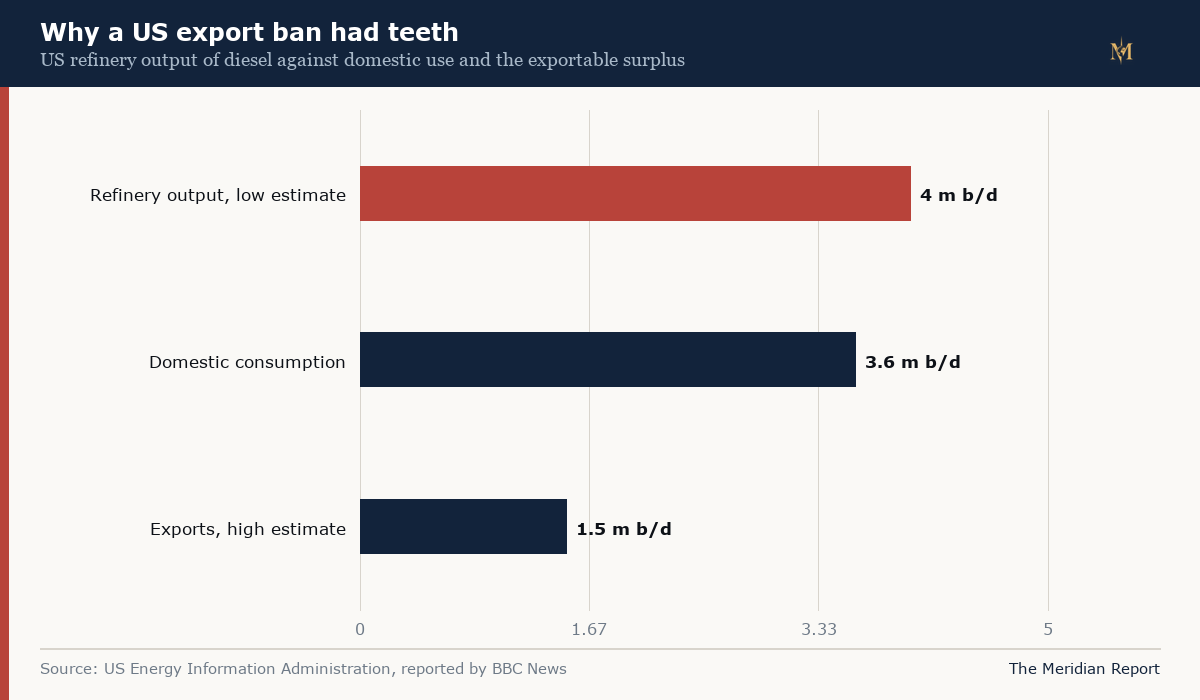
That export slice is the entire margin. A country that consumes most of what it makes has no buffer to give away in a crisis, and a country exporting the difference can influence a price it does not set simply by changing how much it sells abroad.
Europe is on the other side of that trade. The United States supplies more than half of the EU's diesel imports. Over half of the UK's diesel is imported, with 31 percent of those imports coming from the United States, and the United Kingdom relies on imported diesel heavily enough that pump prices crossed two pounds a litre this week.
The export restriction was therefore a real instrument, and its real effect would have fallen on European buyers rather than on the physical supply of fuel to America. Restricting exports raises the domestic price by removing the export outlet; it does not create a barrel.
Policy documents on the sequence make the strategy explicit. POLITICO reported that US Energy Secretary Chris Wright was asking for oil releases as an alternative to imposing an export ban on which the EU is heavily dependent, and that five European countries, together with the European Commission, met on 1 October to decide a common response. They agreed to three things, according to three European officials: to react to the pressure with a coordinated voice, to ensure that every decision about releasing stocks should be elevated to the International Energy Agency level, and to decrease the tension when speaking to the United States.
One of the officials described the intent to an American outlet with the phrase: to be sort of assertive but positive in the communication. When you're dealing with the hungry lion, you do not necessarily play dirty games with him.
What 100 million barrels is, measured in days
The G7 decision is frequently described by its headline number, which invites a scale error. A hundred million barrels sounds enormous against a crisis that has moved a global benchmark by forty dollars.
Expressed as a rate it is modest. One hundred million barrels across four months is approximately 0.83 million barrels a day.
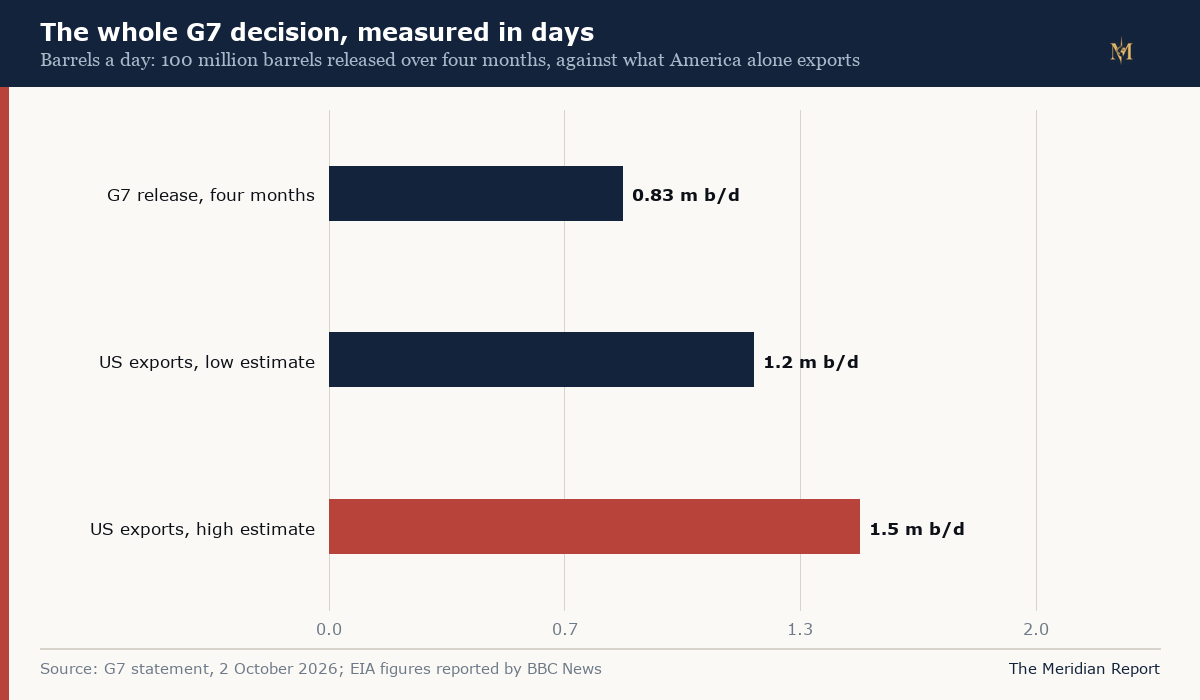
Set that against the 1.2 to 1.5 million barrels a day the United States exports and the whole G7 commitment is worth rather less than a single day of American exports, delivered by seven countries over sixteen weeks.
The frontloading changes the early profile. The statement commits members to a substantial diesel release within the first twenty days, which implies a meaningfully higher rate in the first three weeks than the flat average, after which the rate falls to sustain the four-month window. A frontloaded release is the right design for a market where expectations move faster than barrels do, because it signals the direction of travel to traders who price on expectation.
It is also the reason the price response on 2 October was brief. Brent fell below $100 and returned to around $102 within the same session. Matt Smith, who directs commodities research at Kpler, attributed the reversal not to the release but to reports from Yemen. Oil was selling off strongly on the announcement of strategic stock releases in Europe, he said, but prices reversed on rumours that Saudi Arabia was planning an offensive into Yemen in order to re-establish a safe path through Bab al-Mandeb.
A release of historic size produced a price move that lasted a few hours and was reversed by a second waterway. That is the clearest evidence available that this crisis is not primarily a shortage of barrels, and therefore cannot be solved principally by barrels.
The second chokepoint in the same afternoon
It deserves separate treatment because it explains why the emergency measures arrived late and why they will be withdrawn early.
The oil system responded to the closure of Hormuz by building a workaround. Crude that would have moved by tanker through the Gulf moved instead through pipelines to Saudi Arabia's Red Sea terminals, then through Bab al-Mandeb into the Gulf of Aden and onward to Asia. Reported throughput on that route rose substantially during the war. The workaround has one fatal property, which is that its exit is the 29 kilometre strait on the Yemeni coast that Houthi forces have taken.
So the market that was managing one chokepoint now has to manage two, and the second one is not a pipeline failure that can be repaired with a bypass. It is a stretch of water contested by an armed group that has demonstrated the capacity to close it.
This is the background against which the G7 met, and it is why the United States Energy Secretary's first reported instinct was to ask for releases rather than to escalate. The arithmetic of a two-chokepoint problem is worse than the arithmetic of a one-chokepoint problem in a way that additional barrels do not address, because the second chokepoint removes the rerouting option that made the first one survivable.
It also explains the 2 October price round trip without needing to invent anything. A release calms one market. A rumour that a second corridor is closing tightens another. On an afternoon when both were in the news, the second won.
The politics of the threat
The sequence is worth reconstructing because it is unusual, and because its shape will recur.
Washington did not begin by announcing a restriction. It began by asking. Chris Wright's request for releases as an alternative to an export ban was reported before the ban itself was threatened, and the European response to the request was divided: European countries had pushed back against the US threats, in a context of the US-led war in the Middle East and reduced supplies from Russia and China.
What changed the outcome was the alternative being placed on the table. By Thursday, Trump was saying he was thinking about an export ban, adding that he spoke to Wright and Interior Secretary Doug Burgum about it often, and that they sort of thought it would help diesel, but it might raise the price of other things. Treasury Secretary Bessent had framed the stakes domestically, arguing that American farmers, truckers and businesses should not be left carrying the burden.
Within a day, a decision existed. On Friday Trump said on social media that Europe had just agreed to release a massive amount of their heavily stocked diesel oil, and that the process would begin immediately. Later, at the White House, he said a ban was never really on the table, that what Europe did was a great thing, that Europe had a lot of diesel and was going to be making a major world contribution, and so would the United States, and that the United States was not going to be doing the export ban but what it was supposed to be doing.
Both accounts are true and they are not about the same thing. The American account describes a decision taken and a threat withdrawn. The European account describes a decision extracted. The evidence supports both: the concession came after the alternative was named, and the withdrawal came with public credit to the United States.
The lasting consequence is about credibility rather than about barrels. European officials agreed among themselves to elevate every future release decision to the International Energy Agency level, which is an institution where decisions are coordinated among equals rather than extracted by a supplier. That is a structural response to a lesson about where policy leverage now sits in this trade.
The statement, clause by clause
The G7 statement is short, and its structure is more informative than its length suggests.
The operative sentence commits members to implement their commitments with a coordinated release through the International Energy Agency of 100 million barrels, to begin immediately over four months, including a frontloaded substantial diesel release within the first 20 days by G7 members and partners.
Three design choices are visible in that sentence. The volume is expressed in barrels rather than in days, which is the conventional unit and also the flattering one, since the same volume expressed as a rate is 0.83 million barrels a day. The release is frontloaded, which is the correct response to a market that moves on expectation. And the commitment is made through the agency, which places it under a coordination framework rather than under national command.
The most important clause is the shortest. There will not be any export restrictions on energy and energy products between G7 members.
That is a genuine and unusual commitment. Export restrictions are a standard response to a domestic energy shortage, and several members have the domestic problem that would justify one. Agreeing not to use the instrument, at the moment it was being threatened, removes a recurring risk from the outlook, and it is the only clause in the document that leaves the market better placed in four months than it is now without consuming a barrel.
The final clauses are the ones that address the actual constraint. Members will coordinate maintenance schedules to avoid multiple refineries being shut down at the same time, while encouraging countries with the capacity to do so to ramp up refining of diesel in particular.
That sentence is doing more work than the rest. Coordinating maintenance is a real and immediately implementable measure that protects existing product supply, and it is the only item announced that adds barrels to the market from outside the reserve. The encouragement to ramp up refining is weaker, because a refinery cannot be turned up indefinitely, but it points at the right target.
Two things the statement does not do are as informative as the things it does. It contains no reference to restoring refining capacity in Iran or Russia, which is where the missing millions of barrels a day actually are. And it contains no commitment to publish the outage figures, which would allow anyone outside the seven governments to know whether the measures are proportionate.
Both omissions are explicable. Neither is reassuring.
What a release does and does not fix
Emergency releases have a specific and limited set of effects, and it is worth being exact about them.
A release adds barrels to a market this month. That is real, and because diesel is a liquid with a finite storage capacity, it reaches the market quickly. This is the mechanism by which the March release brought prices down from their peak and by which the G7 decision had an immediate effect on Friday, however brief.
A release does not add refining capacity. The G7 crisis is a refining constraint, and every barrel released into a market that cannot process it raises the value of the products it could have made while leaving the constraint untouched. This is why the statement's least discussed clauses may prove the most useful: members committed to coordinate refinery maintenance schedules so that several plants do not shut down simultaneously, and to encourage countries with the capacity to run diesel refining harder. Coordination of shutdowns is unglamorous and it is one of the few genuine remedies available.
A release depletes a buffer that was held for the next disruption. The March authorisation has not fully arrived, and 100 million more barrels have been committed on top of it. When these are spent, European stocks are lower than they were before the war.
A release also has a signalling effect that can work in either direction. The G7 commitment to no export restrictions on energy and energy products between members removes a recurring risk, and the language about additional diesel releases as necessary provides a floor under expectations. Neither of those is a barrel, and both are worth something.
A history of buying your way out
Emergency oil stocks are not an invention of this crisis. They exist because every advanced economy has concluded that oil markets clear through price, and that price is an unacceptable mechanism for a supply shock.
The International Energy Agency coordinates a system in which member countries hold reserves against a shared obligation of ninety days of net imports, and can decide jointly to release stocks during a severe disruption. The first such collective action was in 2011, after the Libyan civil war removed a large share of global supply, and the mechanism has been used repeatedly since.
Two features of that history are relevant now.
The first is that releases work. They are designed to work, they have worked, and the 2011 precedent is the reason governments reach for them under pressure. Treating the 2 October decision as futile would mean arguing with a mechanism that demonstrably functions.
The second is that they are finite and rarely sufficient, and that the 2011 release of about 60 million barrels was a fraction of what was lost. Releases smooth a price path. They do not restore capacity. In 2011 the missing barrels arrived through Libyan production recovering; in 2026 they will have to arrive through Russian and Iranian refining being repaired, or through new capacity that does not yet exist.
Drawing down a reserve twice inside a single year, as the world has now done, is not a precedent with a good record. The second drawdown starts from a lower floor than the first, and the third would start lower still.
The United States is selling from its own reserve while asking Europe to sell from hers
The most consequential fact about the 2 October decision is that the United States, which pressed Europe to release stocks, is itself releasing stocks. It has been doing so since March, on a larger scale, and it has now gone below a level at which routine drawdowns are permitted.
The administration announced a release of 172 million barrels from the Strategic Petroleum Reserve during the closure of the Strait of Hormuz, according to the Bipartisan Policy Centre, which describes it as the second release in the series. That figure represented roughly 43 percent of the 400 million barrel total agreed by the International Energy Agency in March.
On 29 September, with prices still climbing, the government offered up to 40 million more barrels from the reserve. Reuters reported at the time that routine drawdowns are restricted once inventory falls below 252.4 million barrels, while emergency releases remain allowed.
That threshold matters, because the reserve had already crossed several of the lines that mark its condition. Quartz reported that the SPR dropped below 300 million barrels for the first time in more than four decades earlier in the year. CNBC, writing in August, reported that the reserve was releasing 172 million barrels in response to the war and raised questions about the integrity of the salt caverns in which the oil is stored. Oil and Gas Journal reported that more than a quarter of the inventory was unavailable for drawdown at one point because of construction and cavern outages.
That last detail deserves more weight than it received. A reserve in which a quarter of the nominal inventory cannot be withdrawn is not the reserve its headline capacity implies, and an emergency that requires physical movement out of caverns is not served by barrels that are still in the ground.
So the sequence on 2 October is not simply America pressuring Europe. It is America, with its own reserve near a floor and its own cavern integrity in question, asking European governments to release more than a third of their diesel reserves in order to avoid a restriction that would have lowered prices for American voters.
Diesel and jet fuel come out of the same barrel
The International Energy Agency's August observation was not only that diesel supplies were tight. It was that diesel and jet fuel supplies were both tight, and that the combination had pushed refining margins to record levels.
Those two products are not independent. Both are middle distillates, the fraction of crude that comes out of a refinery between the light ends and the heavy residue, and a refinery configured to produce them produces both. A barrel of crude cannot be redirected from diesel to aviation, or from aviation to trucking, without changing what the plant is for.
The consequence is that the demand shock is larger than the diesel story alone suggests. The same war that has driven up the cost of moving goods by road has simultaneously raised the cost of moving people and freight by air, and the industry that supplies both is running at the limit of what it can produce from the crude available.
This is the second-order effect that most commentary on a shipping chokepoint misses. Closing a strait removes molecules. Damaging refineries removes the ability to turn molecules into a specific product. And when two large product markets compete for one constrained fraction of one barrel, the price of each rises for reasons that have nothing to do with demand for that specific fuel.
It also explains why the emergency response is frontloaded toward diesel rather than spread evenly. Diesel is the product with the least substitutable demand in the short run, because haulage and agriculture cannot switch fuels for weeks or months.
Why a refinery cannot simply be made to make something else
It is worth spelling out why refining capacity is so much harder to replace than crude supply, because the intuition that a shortage of one product should be solvable by making more of another product is the most common error in public discussion of this crisis.
A refinery is built around an assay. Crude is not a uniform substance; different fields produce crude with different densities and sulphur contents, and the design of a refinery is matched to the crude it was built to process. A plant is a physical machine with distillation columns sized for particular cut points, conversion units sized for particular sulphur removal, and often a hydrocracker for converting heavy residue into lighter products.
Changing what such a plant produces is not a matter of adjusting a setting. It is a matter of rebuilding or replacing units, obtaining permits, qualifying suppliers, and commissioning, and the whole sequence runs in years rather than months.
This is why a damaged refinery is a strategic asset and not just a facility. Damage to a processing unit does not merely reduce output of one product at one site. It reduces output of a defined fraction of crude at a defined location, and the industry cannot route around that the way it routes around a closed strait, because the alternative routes require the same missing plants.
It is also why the G7's least discussed commitment may be the most useful one. Coordinating refinery maintenance schedules so that several plants do not shut down simultaneously is not a glamorous measure, but it protects the existing base from exactly the kind of clustered outage that turns a manageable problem into a shortage. And encouraging countries with spare capacity to run diesel refining harder is the only clause in the statement that addresses the actual constraint, because it seeks to extract more from a plant rather than to compensate for a missing one.
The distributional question the price creates
A global commodity price is an abstraction until somebody has to pay it, and the people paying this one are identifiable.
Diesel burns in goods vehicles and in agricultural machinery. Those two uses set the character of the pain, because both are inputs to prices rather than prices themselves. A family paying more at a forecourt notices the receipt. A haulier paying more per litre pays it again on every delivery, and passes it into the cost of everything moved. A farm paying more for diesel pays it in the cost of moving feed, in harvesting, and in the fuel burned by machinery that cannot be idled.
This is why the BBC's observation that diesel demand is very difficult to reduce is not a technical footnote. It means the price signal is slow to work, because the capital stock that consumes it turns over on a multi-year cycle. Trucks last a decade or more. Tractors last longer. A driver who pays more for diesel this October is driving the same vehicle that was bought before the war.
The distributional effect therefore falls hardest on people who cannot substitute and cannot wait, which is to say on the businesses that move other people's goods and on the households that buy what they move. The United Kingdom passing two pounds a litre is the visible edge of a mechanism that runs through every consumer price in an economy that imports more than half its diesel.
For a government, that arithmetic has a second implication. Fuel costs feed directly into headline inflation, and inflation is what decides elections. The G7 statement was agreed six weeks before American midterms and a few weeks before European attention turns to its own. Both the United States and the European members have an interest in the price falling quickly, and that shared interest is what produced agreement faster than seven months of war had.
It is also why the agreement is likely to be temporary in one direction. Prices are politically urgent in October. They are not politically urgent in February, by which point the reserve barrels have been sold and the refining constraint will have either been repaired or will not have been.
What Europe is buying when it buys diesel
One further distinction is worth making, because a barrel of diesel is not a fungible good either.
Fuel is sold against specifications, and a barrel that meets one specification is not automatically acceptable in a market designed around another. Winter grades differ from summer grades. Sulphur limits differ by jurisdiction. Enthalpy requirements, density bands and cold-flow properties all restrict which product can be delivered into which market, and blending and reprocessing exist for exactly this reason.
The practical consequence is that a release of generic oil is not the same as a release of usable diesel. Part of the difficulty the International Energy Agency had in delivering the March barrels was matching product to the market that needed it, and part of the frontloading language in the October statement is specifically about diesel rather than oil because a crude release into a refining market that is already capacity constrained does not arrive as a usable fuel.
It also helps explain why the agency's August assessment mentioned jet fuel in the same breath as diesel. These are markets organised around specification, and when the constraint binds, the specification decides who gets the product.
None of this is visible in the headline figures. A release of 100 million barrels sounds like a single quantity. In practice it is a set of grades in a set of locations, matched to refineries that may or may not be operating, delivered into terminals that may or may not have room, and it arrives over sixteen weeks into a market that will have moved.
The rerouting machine, and why it was not enough
The reason crude recovered is that the oil system contains a large amount of built redundancy, and most of it is not tankers.
When the Gulf route was interrupted, the response was to move crude by pipe. The Saudi east-west system can carry several million barrels a day westward to terminals on the Red Sea, from where tankers reach Asia without passing through the Strait of Hormuz at all. Our own reporting on the second chokepoint put the rerouted volume at roughly five million barrels a day, and noted that throughput through the Bab al-Mandeb strait it feeds rose from about 5.4 million barrels a day in late 2025 to about 8.1 million in the second quarter of 2026 as traffic moved away from Hormuz.
That is a remarkable piece of adaptation. Within months, a war that removed one of the world's great shipping lanes was substantially worked around by pipelines that were built for other reasons decades earlier.
It is also exactly why the workaround is fragile. Pipelines move crude. They do not refine it, and the receiving terminals on the Red Sea require tankers to complete the journey to Asia. The rerouted barrels rejoin the shipping system at a different point, and the system they rejoin is the one whose exit, Bab al-Mandeb, now sits beside Houthi forces that have taken the Yemeni coastline.
So the redundancy that saved crude has moved the vulnerability rather than removed it. A system with one chokepoint became a system with two, connected in series rather than in parallel, which is the least resilient arrangement available. Losing either one removes the route.
This is also the reason a crude supply response and a diesel supply response are not the same intervention. Rerouting more crude through the Red Sea eases the price of the molecule and does nothing for the missing middle distillate, because the problem is downstream of the pipe.
The United Kingdom as the acute case
Britain is the clearest illustration of what happens when a country has low refining capacity, high diesel dependence on imports, and a supplier with market power over it.
Over half of the UK's diesel is imported. Thirty-one percent of those imports come from the United States. Pump prices passed two pounds a litre for the first time on Friday, the day of the G7 decision. The Foreign Secretary, Ed Miliband, represented Britain at the meeting where the agreement was made, and said afterwards that the measures would stabilise energy supplies, build resilience in supply chains and shield households and businesses from price shocks.
None of those three things is what the release does. A release adds barrels for four months. It does not build resilience, and it does not shield anything beyond the end of that window. Those phrases describe the argument for emergency coordination, which is a different argument from the one the release actually settles.
Britain's position also illustrates why the American threat landed. A country importing more than half its diesel, with a third of those imports from one supplier, has very little room to refuse a request, and no domestic refining capacity to substitute with on any timescale that matters to a forecourt.
That is not a criticism of British energy policy so much as a description of a structural position shared across much of Europe. The continent has comparatively little refining capacity relative to its consumption, which means its diesel market is a net importer and therefore permanently exposed to whoever supplies it.
The strategic conclusion is uncomfortable and unglamorous. European energy security in diesel is, to a substantial degree, American energy policy, and the G7 agreement of 2 October demonstrated that by showing how quickly a threat from Washington translated into a decision in European capitals.
The measurement problem nobody has solved
There is one number that would sharpen every estimate in this report, and it has not been published.
Nobody publishes a global refining outage figure.
The International Energy Agency publishes refinery utilisation rates and product balances, which allow a careful analyst to infer where capacity has been lost. Analysts and consultancies publish estimates of damaged capacity in specific countries. But no agency or government has produced an authoritative statement of how much global diesel production capacity is currently unavailable as a result of the war and of the strikes on Russian refineries.
The consequences of that absence run through this entire analysis. The gap between a record refining margin, which means the system is constrained, and a physical shortage, which means consumers cannot obtain fuel, is a quantity measured in barrels per day of lost capacity, and that quantity is unknown.
It is worth being clear about what can be said without it. The margin observation establishes that the constraint is real and current. The stock drawdown establishes that inventories have been consumed. The Iraqi and Russian strike records establish that specific plants have been damaged. None of these establishes the magnitude, and the magnitude is what would determine whether the crisis ends through repair, through demand destruction, or through rationing.
Anyone presenting a precise global figure should be asked where it came from. In a field where the primary statistics are utilisation rates and the outage estimates are proprietary, a confident number is usually a model rather than a measurement.
What a ceasefire would fix, and what it would not
It is worth being careful here, because the conditional claims in this area are easy to overstate.
A durable end to the campaign against shipping in the Strait of Hormuz would restore the reliability of the Gulf route, which would reduce freight and insurance costs, ease the pressure on Middle East exports, and remove the daily risk premium that presently sits in every cargo routed through the waterway. That is a substantial benefit and it is available at a price only the parties to the conflict can set.
It would not restore refining capacity. The plants damaged in Iran remain damaged. The units destroyed at Russian refineries remain destroyed, and Ukraine's campaign has continued regardless of the state of maritime diplomacy in the Gulf. A ceasefire in Hormuz would therefore relieve a chokepoint while leaving a processing constraint intact, which is to say it would largely restore the crude price and leave the diesel price where it is.
It would also not refill the buffers. The March and October authorisations would still have to be delivered, the reserve levels would still be lower than they were in February, and the next disruption would find a thinner margin.
The most likely path, on the evidence available, is therefore not a single resolution but a sequence: a shipping normalisation that stabilises crude, continued repair of refining capacity that stabilises products with a lag measured in months, and a reserve system that has to be rebuilt from wherever it ends up. That sequence is slower and less satisfying than a deal, and it does not depend on any single decision.
The 2 October agreement fits neatly into it. It buys four months of relief at the cost of a thinner buffer, in exchange for a threat withdrawn. Whether that is a good trade depends on what happens in the four months, and nobody has said what that is supposed to be.
The layer between the barrel and the pump
The price of Brent is not the price of the diesel in the tank, and the difference is where much of this crisis actually lives.
A delivered barrel of fuel carries at least four costs beyond the crude: refining, freight, insurance, and tax. The refining margin has been discussed above and is at record levels. The insurance component is less discussed and has moved further.
Before the fighting, war risk insurance for a vessel transiting the Strait of Hormuz cost about 0.125 percent of the hull and machinery value per transit, according to a 2025 assessment by the marine insurer Howden Re's specialist arm, Pole Star. Al Jazeera reported on 3 March that the rate could rise to 0.5 percent of a vessel's value, a doubling, or to 1 percent, a quadrupling.
It went considerably further than that. The Economic Intelligence Unit reported on 13 March, citing the US broker Marsh, that premiums which had previously averaged 0.2 to 0.25 percent of vessel value had climbed to between 1 and 1.5 percent. Reuters reported on 6 March that most tankers are valued between $200 million and $300 million and that a 3 percent war risk rate would imply a hull war risk premium of about $7.5 million. Howden Re's own March report put the worst case at around 5 percent of vessel value.
The figures differ because they measure different things on different dates and for different classes of ship. A hull war risk premium and an additional premium charged on top of standard cover are not the same number, and rates rose unevenly over six weeks. The range is wide for real reasons.
What the range establishes is the order of magnitude. On a single transit, a war risk premium that moves from a fraction of one percent of hull value to several percent is a cost running into millions of dollars per voyage. For a tanker, that is a larger single logistics expense than the crew, the fuel or the voyage itself, and it is charged whether or not anything hits the ship.
This is why an insurance market can be more disruptive than a battlefield. A blocked strait is visible, reported and eventually negotiated. A withdrawal of cover is invisible until a ship declines to sail, and it does not require anyone to fire anything. By March, protection and indemnity cover for the Gulf had been withdrawn, which made the strait legally open and commercially unusable at the same time.
The layer also explains a feature of the current price that is otherwise puzzling. If the crude price recovered while diesel did not, part of the reason is that the crude price fell back while the insurance and freight premium did not. A cargo that costs the same crude as it did in August can cost more to deliver, because the cost of arriving has gone up.
What a release costs, and who pays to refill it
Emergency releases are treated in public discussion as free, because the government that releases oil is paid for it. The revenue is real and it is also misleading.
When a government sells reserve crude, it receives money. That receipt does not represent the cost of the reserve, because the oil had to be bought once and will have to be bought again. The correct accounting treats a reserve drawdown as a deferral of a purchase obligation, not as income, and the deferral carries a price.
The United States case is unusually clear because the numbers are unusually large. The administration released 172 million barrels from the Strategic Petroleum Reserve during the closure of the Strait, and on 29 September offered up to 40 million more. Routine drawdowns are restricted once inventory falls below 252.4 million barrels, though emergency releases remain allowed, which means that at least part of what has been released was authorised under a provision designed for genuine emergencies and has been used for a price problem.
Refilling a reserve is neither cheap nor quick. Oil must be bought, and the buying happens into whatever market exists at the time. A government that sells at $100 and must buy back at $130 has not avoided a cost, it has deferred one and enlarged it, and the bill arrives with the interest.
There is a second, less visible cost: the option value of the buffer. A reserve exists so that a country can act without deciding, quickly, in a crisis. A reserve that has been drawn down to manage a price has spent some of that option, and the next crisis will find the decision slower.
Neither point is an argument against the releases, which prevented a worse outcome and were made by governments facing real pressure on real prices. Both are arguments against treating a release as a solution rather than as a purchase on instalment.
How the market got here
The sequence matters, because the crisis is not one event but a series of them, each of which changed what the next one could do.
| Date | What happened | What it did to the diesel problem |
|---|---|---|
| 28 February | United States and Israel begin airstrikes on Iran | Brent around $73; diesel unremarkable |
| 4 March | Iran declares the Strait of Hormuz closed | Tanker traffic collapses; war risk cover withdrawn |
| 8 March | Brent passes $100 a barrel for the first time in four years | Panic phase begins |
| 11 March | IEA agrees a record 400 million barrel release | First drawdown on global buffers |
| 12 March | IEA reports crude up $20 a barrel to $92 in a fortnight | Rerouting begins in earnest |
| End March | Brent up about 65 percent for the month | Largest monthly rise on record |
| 30 April | Brent peaks at $126.41, highest since 9 March 2022 | Refining capacity starts coming out |
| June to July | Ceasefire attempts, then renewed closure | Pipelines fill the gap for crude, not for products |
| August | IEA reports global stocks down 410 million barrels since February | Record refining margins reported |
| September | Ukraine's refinery campaign intensifies; Russia bans diesel exports | The second-largest export source closes |
| 29 September | United States offers up to 40 million barrels from its reserve | American buffer nears its floor |
| 2 October | G7 agrees a 100 million barrel release over four months | Diesel frontloaded within 20 days |
Two features of this sequence are easy to miss.
The first is that the crude panic and the diesel shortage did not peak together. Crude peaked in April and has been falling since. The refining constraint became binding later, as damaged plants closed and could not reopen, and it has tightened steadily since. A reader watching Brent alone would have concluded that the crisis was easing, which is precisely what the market did.
The second is that the response arrived in stages rather than at once. The March release was the response to the closure. The October release is the response to the refining loss, eight months later, and it is smaller than the first.
Who pays and who does not
The distribution of this crisis runs along refining capacity, and the map is not symmetrical.
Countries with spare refining capacity are, in a rough sense, holding an option on this crisis. Running a refinery harder is available to them, which is why the G7 statement's encouragement to increase diesel refining has a practical meaning for some members and is meaningless for others.
Net importers of diesel are exposed twice, once through price and once through supply security. The United Kingdom, which imports more than half its diesel and takes nearly a third of those imports from the United States, is exposed in both dimensions and has no domestic lever to pull.
The United States occupies an unusual position that is easy to misread. It is the world's largest producer, a net exporter of the product, the supplier of more than half of EU imports, and simultaneously the country drawing down its own strategic reserve faster than at any point in four decades. It is the buyer in this market and it is also the one calling for others to sell.
Russia's position is the mirror image. It is traditionally the world's second-largest diesel exporter and it has chosen to stop exporting, which protects its own consumers from the international price and costs it the revenue. Whether that is a supply decision or a political one is not something the available evidence settles, and it should not be written as either.
Iran is short of both crude markets and domestic fuel, having lost export earnings, refinery capacity and the ability to move what remains.
Households bear the cost in every case, through fuel that is an input to the goods they buy rather than a discretionary purchase. That is why a fuel price of £2 a litre is a household prices story and not an energy story, and why the governments involved have all treated it as one.
The strongest case against this reading
An account that only accumulates the alarming evidence is not analysis. The case against the crisis framing deserves to be put properly.
Crude has recovered. Middle East exports have rebounded. The strait is carrying traffic, and a substantial volume of crude has found its way around the closure through pipelines and rerouting. A market that has adapted that successfully in seven months is not a market that has permanently failed to adapt.
Emergency releases genuinely work in the short run, and the March decision prevented a far worse outcome than the one that materialised. Prices peaked and then came down, and the August stock drawdown figure, while large, was measured over a period that included the worst of the shock rather than the current state.
The EIA figures underpinning the leverage argument are point-in-time estimates of output, consumption and exports, and they move. US refinery runs rise and fall with maintenance seasons, and a fall in European demand, which has not yet happened, would relieve the pressure faster than any release.
Russian refining capacity is damaged but not destroyed, and Russia has oil to sell if it chooses to. The export ban is a policy that can be lifted, and Ukraine's campaign degrades over time as air defences adapt.
The G7's commitments on refinery maintenance coordination and on encouraging additional diesel refining are substantive, and if implemented they would add product supply without depleting anything.
And the deepest objection is that this is a price event, not a physical shortage. Nothing in the evidence establishes that a diesel consumer anywhere in Europe will be unable to obtain fuel. They will pay more for it. That is what a market does, and treating a price as a crisis invites the kind of intervention that makes the next one worse.
The fair reading is narrower than either the alarm or the dismissal. Diesel is physically scarce at the margin, because fixed refining capacity has been destroyed by two wars and crude cannot substitute for it at short notice. The response so far has been to release buffers that were designed for one emergency and are now being used for a second, under pressure from the supplier. Prices are high rather than absent. None of that is a catastrophe, and all of it is reversible only if the underlying constraint, which is refining capacity, is repaired.
What the evidence settles
Five things are established by the documents and the market data.
Crude and diesel have diverged, and the reason is structural rather than speculative. Crude recovered because it can be moved; diesel did not because refineries cannot. The International Energy Agency recorded record refining margins in August, which is the market's own statement that the constraint is in processing rather than in crude supply.
The buffer has been spent more than once. Global observed stocks fell by about 410 million barrels since 28 February, against an initial emergency authorisation of 400 million in March and a further 100 million authorised on 2 October. Releases in 2026 total 500 million barrels authorised, of which 290 million had been delivered by 21 July.
The leverage was American and it was deliberate. United States refiners export 1.2 to 1.5 million barrels of diesel a day out of 4 to 5 million barrels of output, and supply more than half of the EU's diesel imports. A threatened export restriction is a real instrument aimed at foreign buyers, and European officials responded to it within days.
The largest available replacement source is unavailable. Russia, traditionally the world's second-largest diesel exporter, has extended its own export ban to the end of October following Ukrainian strikes on its refineries, which Ukrainian estimates put at more than 45 percent of national refining capacity.
And the October price response shows that barrels alone are not the variable. Brent fell below $100 on the G7 decision and returned to about $102 the same evening, with Kpler attributing the reversal to reports of a Saudi offensive into Yemen and the safety of the Bab al-Mandeb route.
What is not established is how much refining capacity has actually been lost, in barrels per day, worldwide. Neither the International Energy Agency nor any government publishes a global refining outage figure, and without one the gap between a record margin and a physical shortage cannot be quantified. That single missing number would sharpen every other estimate in this report.
Five developments would change the picture. Restoration of Russian refining capacity, which is a Ukrainian military question before it is a market one. Publication of a global refining outage figure, which would replace inference with measurement. Implementation of the G7 commitment on maintenance coordination, which is the one measure announced that adds product supply rather than consuming a buffer. A firm end to the Hormuz campaign, which would let the rerouting system normalise. And a change in European diesel demand, which nothing announced so far addresses and which is the only one of the five that would not require anyone else to act first.
It is worth being explicit about what changed in the week this report covers, because the change is not the one the headline describes.
The crude market did not change. Brent traded in a band through the week and ended roughly where it began, having fallen below $100 on the reserve announcement and returned to about $102 on news from the Red Sea. Anyone tracking the world's most quoted oil price would conclude that nothing happened.
What changed is the institutional arrangement. On 1 October, before any decision existed, five European countries plus the European Commission had agreed among themselves to a coordinated voice and to route future release decisions through the International Energy Agency. That agreement was reached under pressure, in private, between governments that had spent a week being told what to do by a supplier.
By 2 October a commitment existed: 100 million barrels over four months, diesel frontloaded within twenty days, no export restrictions between members, refinery maintenance schedules coordinated, and spare refining capacity urged to work harder.
That is a real package and it contains one genuinely useful measure. Almost everything else in it either consumes a buffer or restrains an action.
The significance of the week is therefore less about barrels than about where authority in this trade now sits. The country with the largest domestic refining base, a large exportable surplus and the ability to name an alternative for European buyers obtained a concession from five European governments inside forty-eight hours. Those governments had, the previous week, been coordinating a response to a request.
Whether that is a durable shift or a single instance depends on something nobody can observe yet, which is whether the next time a reserve decision is needed, the decision is taken at the International Energy Agency or extracted in Washington. The commitment to elevate those decisions to the agency is the clause to watch. It is the only part of the agreement that changes who decides.
What remains uncertain is almost everything about scale. Nobody publishes a global refining outage figure. Nobody publishes the split of the 410 million barrel stock drawdown between war consumption and ordinary demand variation. Nobody publishes which refineries in Russia and Iran are destroyed, though both governments and multiple analysts have claimed the other side's figures are inflated. Each of those gaps is fillable, and until they are filled the honest description of this crisis is that the world is short of the ability to make one specific product, by an amount that can be bounded at neither end.
The final thing worth saying is about the argument that has run alongside the crisis, that this is a price event rather than a shortage, and that markets should be left to clear. Nothing in the evidence contradicts that, and the G7's own decision to act rather than to wait for prices to do the work concedes something. But a price event that requires a hundred million barrels of strategic reserve, a supplier's export policy, and the coordinated maintenance schedules of seven governments is not being left to clear. It is being administered, by the same governments that describe it as a market outcome.
That tension is not peculiar to this crisis. It is the permanent condition of a fuel market in which a small number of countries hold most of the refining capacity, most of the exportable surplus, and most of the strategic reserve, and the largest number of countries hold none of the three.