
Oil has spent four sessions doing something it did not do once in the first month of this war: falling on quiet days. Brent crude traded near 101.73 dollars a barrel on Monday, down about 2.1 percent, after Thursday and Friday both closed lower and Monday extended the slide. No ceasefire has been signed. The strait through which roughly a fifth of the world's oil passes remains, in the language the market has used since spring, functionally closed. The last attack wave was ten days old.
The fall is the story. It marks the point at which the largest repricing of oil in a generation has stopped responding to what is happening and started responding only to what changes.
The year in one line
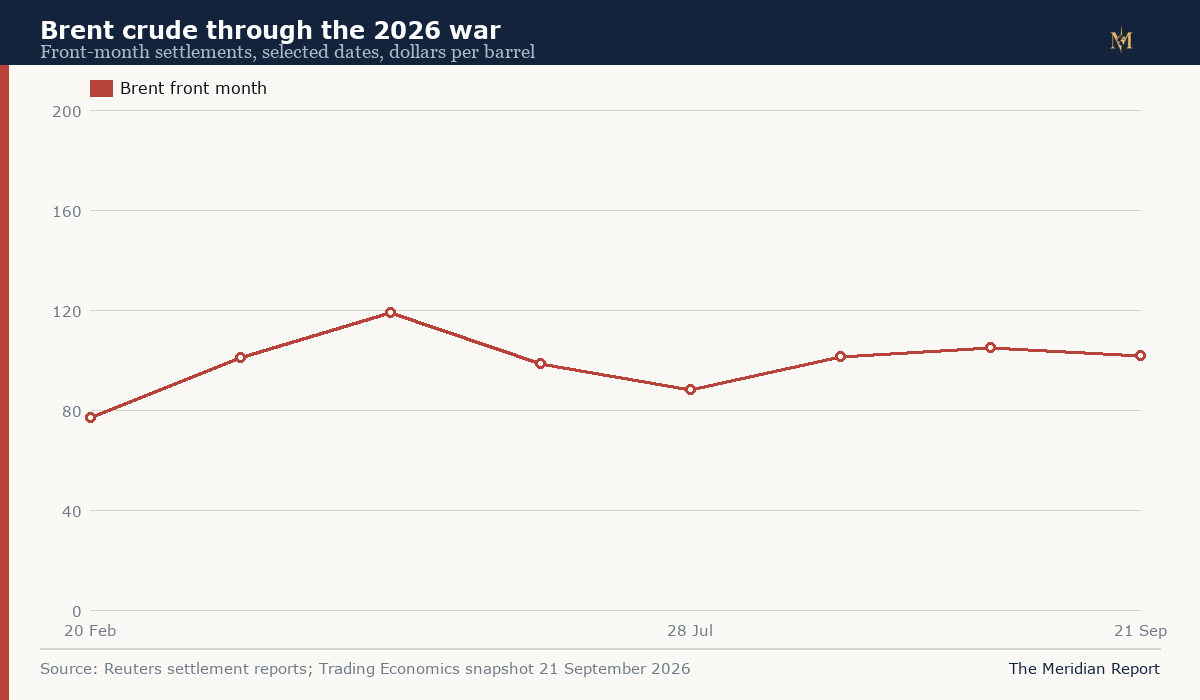
The path since February explains why four down days can carry meaning. Brent opened the year's crisis near 77 dollars. The strikes of 28 February and Iran's response pushed it past 100 within days. The de facto closure of the Strait of Hormuz in March drove it to nearly 120 dollars, its peak, in what the International Energy Agency has described as the largest supply disruption in the history of the oil market. The US Energy Information Administration documented the same shock in its first-quarter review: prices rose sharply after the 28 February military action and the closure that followed.
Then the market did what markets do with boundaries. Every subsequent escalation, and every subsequent hint of talks, was priced against the worst case that was already embedded. When attacks came in September, including the strike wave of 9 September, Brent's weekly gain was 8 percent, not a doubling. When a report of messages between Washington and Tehran surfaced in mid-September, prices had already been falling for days.
What a war premium actually is
A war premium is the difference between today's price and the price the same barrels would command without the war. It is not a fee anyone collects. It is the market's standing estimate of the scenarios that have not been ruled out.
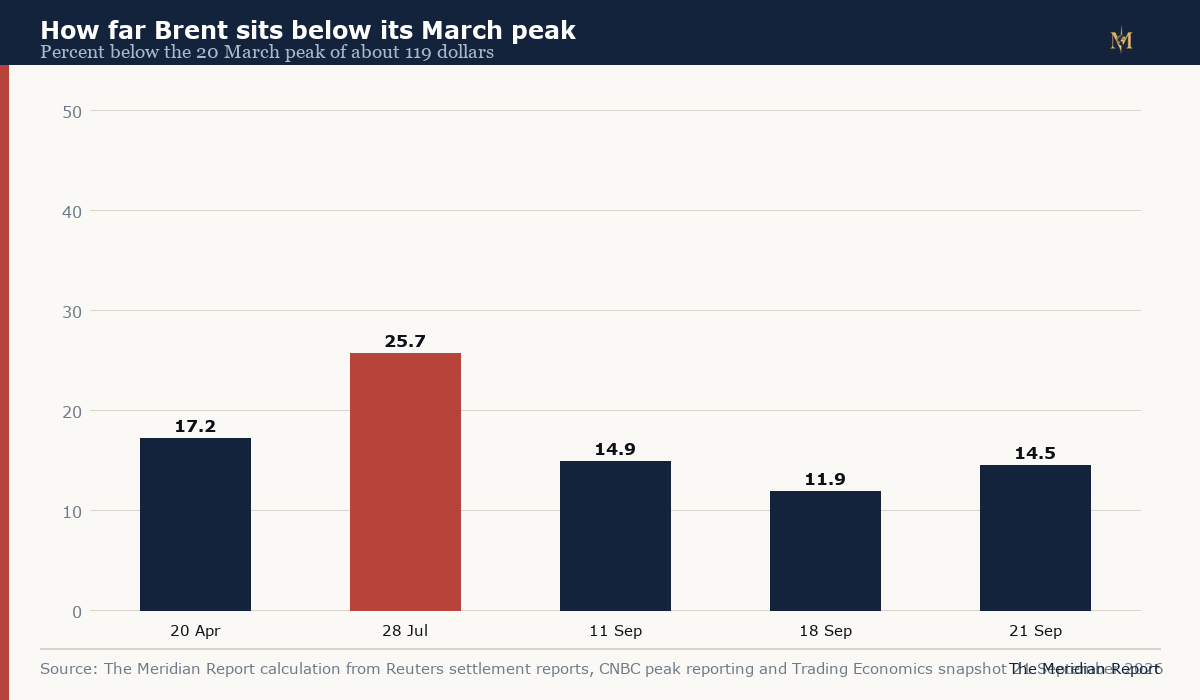
The premium this war built was extraordinary. Roughly a third of Brent's current price sits above the February reference point, a markup the market has maintained for seven months through refinery fires, tanker losses, record diesel prices and the shuttering of the world's most important oil chokepoint. That much is unchanged on Monday.
What changed is the premium's direction. From March through September the premium expanded on escalation and paused on diplomacy, but it never surrendered ground for long. The four sessions now ending are different in kind: prices are falling not because good news arrived but because no bad news did, and the market has begun treating the absence of escalation as information. Traders quoted in recent sessions cite hopes of limited supply disruption and exchanges of messages between Washington and Tehran. Neither hope has produced an agreement. Both have produced selling, because both were already priced in the other direction.
The mechanics of a quiet decline
Three forces are doing the work in this week's decline, and none of them requires peace to continue.
The first is the boundary effect. A market priced for closure, escalation and shortage gives back value whenever a day passes in which none of those things intensifies. The premium does not need peace to shrink. It needs only monotony.
The second is physical adaptation. Crude has found routes around the closure at a cost: longer voyages, older fleets, rerouted flows through pipelines east and west of the Gulf. Our reporting on the Hormuz round trip documents the mechanics in detail, and our investigation of the base-oil crisis shows the same pattern in products, where the plants that cannot move determine prices. Adaptation does not restore the pre-war market. It lowers the marginal price of surviving it, which is what the futures curve now reflects.
The third is position fatigue. Seven months into the war, the capital that wanted exposure to a supply catastrophe has largely deployed. Each new headline finds fewer buyers left to move the price upward, which is why a strike wave that once would have repriced the year instead produced an 8 percent week.
The settlements that built the chart
| Date | Brent settlement or snapshot | What the market was pricing |
|---|---|---|
| 20 February 2026 | About 77 dollars | Pre-war baseline |
| 2 March 2026 | About 101 dollars | First days of closure |
| 20 March 2026 | Nearly 120 dollars | Hormuz shut, peak fear |
| 20 April 2026 | 98.48 dollars | First lasting retreat |
| 28 July 2026 | 88.36 dollars | Summer low, talks reported |
| 11 September 2026 | 101.21 dollars | Post-escalation week, 8 percent gain |
| 18 September 2026 | 104.87 dollars | Record diesel, tight product supply |
| 21 September 2026 | About 101.73 dollars | Fourth straight decline |
Every row is a Reuters settlement report or a same-day market snapshot, and the shape they trace is the anatomy of a war premium: vertical in the month of maximum uncertainty, grinding lower as adaptation proceeds, and now easing on stillness rather than on resolution.
What this price cannot tell you
The honesty the market is owed runs in both directions. Four quiet sessions do not establish a trend any more than one strike wave did. The same boundary that produces today's decline produces tomorrow's spike, on a torpedo, a collapsed talks schedule or a fire at a loading terminal. Analysts spent the spring warning that closure scenarios pointed to 150 dollars or beyond; the market never priced those tails out, it merely stopped paying for them daily.
The consumer channel also runs ahead of crude. Our reporting this weekend documented what product markets do when the plants that make their feedstock are the ones that cannot move: motor oil rationed at a national retailer, base oil at a record multiple of its pre-war price, diesel at records crude has not matched. Crude easing below 102 dollars does not, by itself, put a bottle of oil back on the shelf.
What Monday's price does establish is narrower and more interesting than a ceasefire bet. The market has finished paying for scenarios it has already lived through, and it now charges only for the next one. Seven months in, the war has a standing price and no longer a rising one. The way to read the next headline is not how frightening it is, but whether it describes something the market has not yet survived.