
Volodymyr Zelenskyy opened Thursday's strikes with a shopping list. An oil facility in Russia's Samara region, hit overnight. A launch and storage site for attack drones in Oryol. A vessel in the Black Sea. Alongside the statement he released footage of a ballistic missile launch, the FP-7, a 200 kilometre weapon built by the Ukrainian company FirePoint and used for the first time, without saying where or when it had fired.
The strikes continued a campaign that has run for months and that Washington has spent much of the summer trying to stop. President Trump told reporters on Wednesday that diesel was being hurt by what was happening in Russia rather than in the Middle East, because refineries there were being knocked out at an alarming rate. Energy analysts have disagreed, pointing to the war with Iran and the disruption to shipping as the dominant cause.
Both can be true of different molecules, and that distinction matters more than the argument between them.
One percent of GDP
The most interesting number of the week came from the other side. At the Valdai discussion club on Thursday, Vladimir Putin said the Ukrainian strikes on Russian oil refineries had cost the country roughly one percent of its gross domestic product.
That is an admission of scale from a man whose government has spent months insisting the campaign is a rounding error. It is also, on its own, not a measure of the strategic effect. A refinery lost to a drone is worth less than a refinery lost to sanctions, and the damage compounds through queues and rationing rather than through the damaged capacity itself.
Ukrainian estimates put more than 45 percent of Russian refining capacity out of action. Russian official figures put the number far lower, and the gap has never been narrower because neither government discloses which processing units are down.
Why diesel and not Brent
Crude has held together better. Brent December futures traded at $99.83 a barrel at 1233 GMT on Friday, 4.3 percent below the previous Friday's close of $104.32, as flows through the Strait of Hormuz recovered and traders priced the possibility of a European stock release. Over the preceding month Brent had traded between $97 and $102, some $25 to $30 above pre-war levels.
Diesel has not enjoyed that recovery, and the reason is structural rather than political. Crude is fungible: move it, store it, refine it elsewhere. A refinery is not. When processing capacity is destroyed, the barrels it would have made cannot be conjured by rerouting a cargo, which is why refining margins have gone to record levels while the price of the raw material has been comparatively calm.
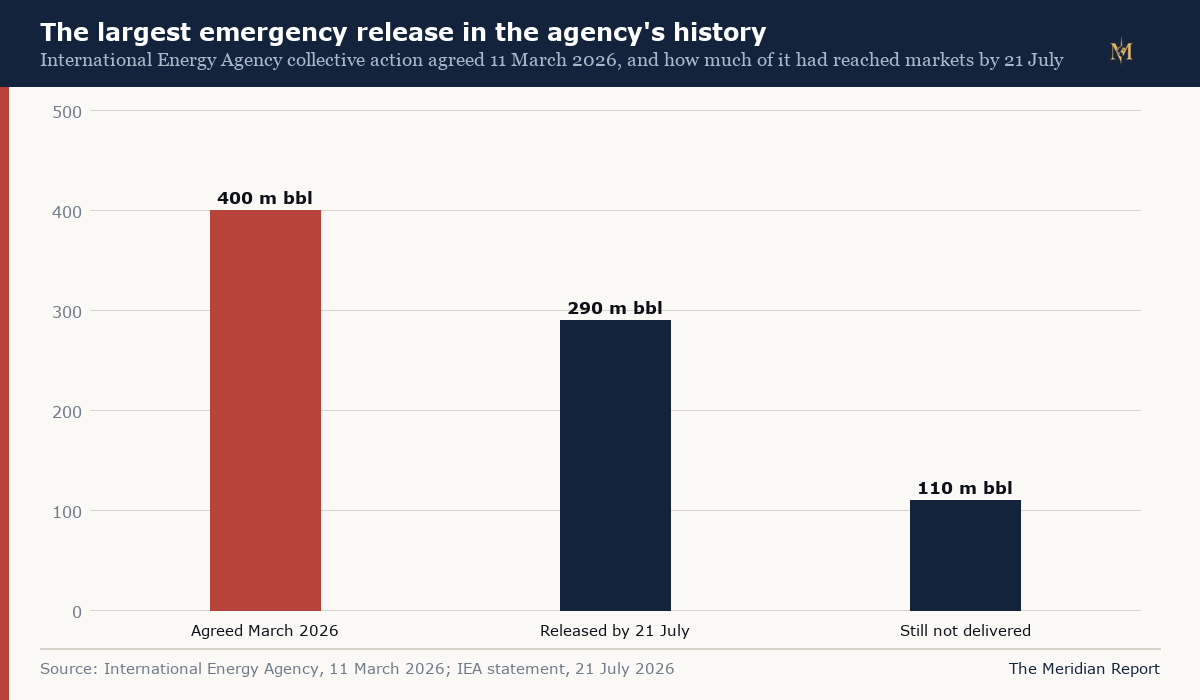
Europe's answer has been to open its tanks, and to discover that it has partly spent them. The International Energy Agency agreed a record 400 million barrel release on 11 March. By 21 July members had released 290 million. A significant portion of the March allocation had still not reached markets in late September, and the agency's chief executive, Fatih Birol, pressed European countries to use the remainder at a meeting in Dublin on 29 September.
On Thursday the European Union's energy commissioner, Dan Jorgensen, said member states were discussing going again. He was careful about what that meant. "We coordinate via the EU and our positions in the IEA. But this is a decision of each member state," he said. The Commission held a call on Thursday with several countries, including the United Kingdom.
Emergency stocks are the one lever that works quickly and the one that cannot be pulled twice in the same direction. Every barrel released to relieve a price this month has to be bought back at some future price, and the buffer that absorbs today's squeeze is the buffer that is missing when the next shock arrives.