
The most consequential meeting at this year's General Assembly will not happen in the hall. On Wednesday, a senior Russian diplomat told TASS, Sergei Lavrov and Marco Rubio sit down in New York, the second known meeting this year between the two men who now carry the Ukraine file for their presidents, and at least the third since the track began in Kuala Lumpur in July 2025. Lavrov announced the session himself a week ago, telling reporters he had a meeting scheduled on the margins of the assembly. The State Department has not published an agenda. The subject list, however, is not mysterious: an energy ceasefire proposal Washington promised Kyiv it would deliver to Moscow, a sanctions law passed by the House on 16 September that puts 100 percent tariffs on the table, and the shape of any trilateral meeting that might follow at the G20 in Miami in December.
Each side arrives with a different definition of success, and neither definition includes the same word.
What Washington needs: an answer it can carry to the election
Rubio's position is the more constrained of the two, because his president has put a date on everything. Donald Trump told the General Assembly on Tuesday that he faces a big decision on Iran and predicted an Iran deal right after the midterm elections of 3 November, while warning that new tariff authorities against buyers of Russian oil will be deployed if necessary. The diesel record that has reshaped his Ukraine policy, the all time high of 6.285 dollars a gallon set by the Energy Information Administration for the week ending 14 September, gives the White House a domestic reason to want the refinery war stopped on any terms that hold. Zelensky, after meeting Trump on Tuesday, said Ukraine is ready for an energy ceasefire in any format, provided Russia accepts the same terms, and confirmed the American side will carry the proposal to Moscow.
That makes Wednesday's meeting the delivery point. Rubio needs from Lavrov one of three things: acceptance, a counterproposal, or a clear refusal. Any of the three is workable before an election, because each can be framed. What the White House cannot use is what Moscow has specialised in through two years of stop start diplomacy: a process signal, a promise to study the text, a technical follow up. If the meeting produces only a next meeting, the administration enters the final weeks of the campaign with two wars and no new facts, and the diesel price keeps voting daily.
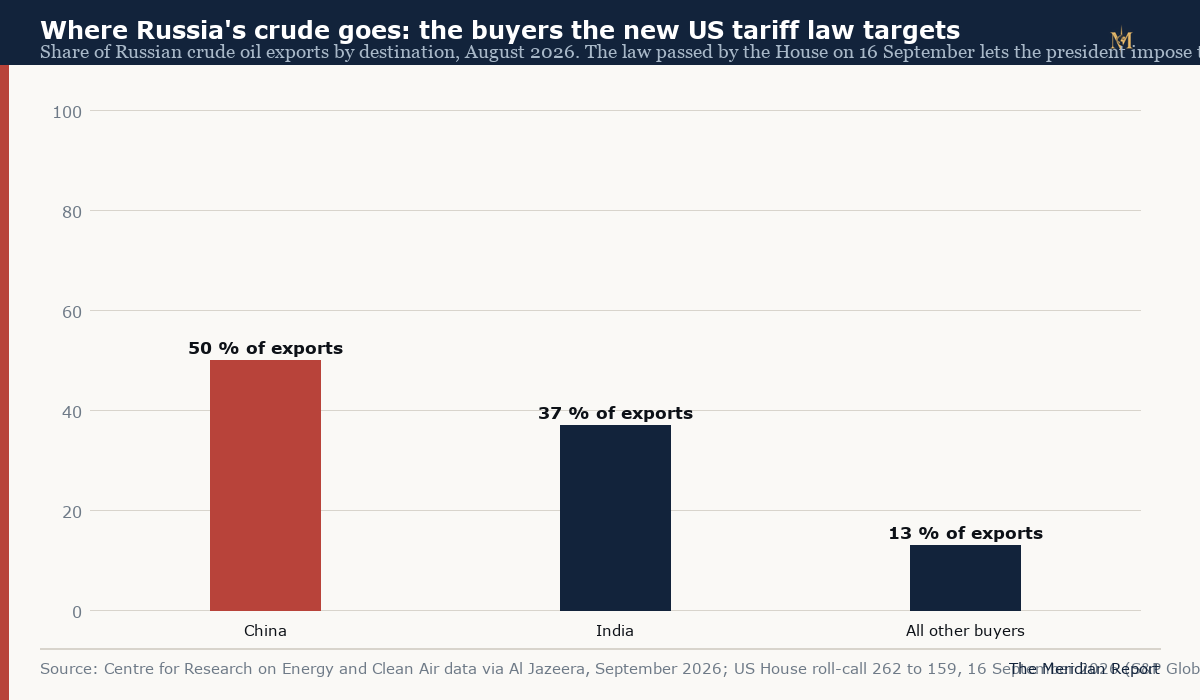
The second thing Washington needs is cheaper and quieter. The tariff law passed last week works only if someone believes it. The House vote was 262 to 159, comfortably bipartisan, and the law lets the president impose tariffs of up to 100 percent on the five largest buyers of Russian oil: China and India first among them. China takes roughly half of Russia's crude exports and India about 37 percent, which means the lever points at the two economies the administration is simultaneously trying to stabilise. Imposing it is costly; credibly threatening it is not. Rubio's task is to make Lavrov believe the threat without firing it, because a threat that Moscow publicly calls a bluff stops being a threat.
What Moscow needs: the meeting itself, and what follows it
Lavrov's requirements are different in kind. Russia has spent 2026 collecting evidence that time runs in its direction on the battlefield and that Western unity is weakening; the diplomatic record shows a consistent pattern in which every engagement with Washington is used to test how far American policy has drifted from European policy. In Manila on 23 July, Lavrov told Rubio that arming Ukraine is unacceptable and claimed Russia is ready for talks, a formulation that leaves Russia's territorial demands untouched. RFERL's account of that session recorded no breakthroughs and little optimism.
From Wednesday's session Moscow can bank three outcomes without conceding anything. The first is continuity: a sitting American secretary of state meeting the Russian foreign minister during a wartime General Assembly is itself the photographs and the precedent Moscow wants, evidence for domestic and Chinese audiences that isolation is not working. The second is information: Lavrov will calibrate, from Rubio's language on the tariff law and the energy ceasefire, how much domestic pressure the White House is actually carrying, and whether the midterms make Washington more or less flexible in November. The third is delay on favourable terms. An energy ceasefire that halts Ukrainian strikes on refineries while Russian attacks on the grid continue, or that freezes the refinery campaign just as it bites, would be worth more to Moscow than to Kyiv; Russian officials have spent the week signalling interest in exactly such an asymmetry.
The Kremlin's stated position on the ceasefire text is that it has not formally received it. Whether that changes on Wednesday, and what Moscow says afterwards, is the meeting's first measurable output.
The clock under the table
Two dates structure everything both ministers say. The first is 3 November, the American midterms, after which Trump has predicted deals with Iran and, by extension, a changed diplomatic environment around Ukraine. Trump said on Tuesday he gives no credence to the election when it comes to Iran; the sequence he described, in which Tehran waits on the result, suggests otherwise, and Moscow is watching the same clock. The second is 14 and 15 December, the G20 summit at Trump National Doral in Miami, the venue Zelensky named as the right place for a possible trilateral meeting with Putin. Putin has refused every invitation to meet Zelensky in a neutral country, countering with invitations to Moscow, so the Miami idea depends on Putin choosing to travel to American soil, something he has not done in a decade.
The realistic outcomes of Wednesday therefore sit on a spectrum from process to position. At the thin end: agreement to keep talking, technical teams instructed, the energy ceasefire text under study, nothing public. At the thick end: Russia accepts the energy ceasefire in principle, symmetric and verifiable, and a trilateral is sketched for December. The record of this diplomacy, from Kuala Lumpur through Manila to New York, leans toward the thin end. But the conditions around the table have moved: Ukraine has accepted a truce format, the tariff law has passed, the diesel price has broken its record, and both presidents now have a date they want a headline before. Wednesday's meeting will show which side thinks that pressure works in its favour.
Our coverage of the Trump UN address and the Zelensky energy truce meeting tracks the American and Ukrainian positions in detail. This page will be updated with the readout once the session ends.