
United Nations addresses by American presidents usually advertise a doctrine. Donald Trump's roughly 37 minute appearance before the 81st General Assembly on Tuesday advertised a date. Whether the subject was Iran, Ukraine, Venezuela or Cuba, the resolution he described kept arriving at the same point on the calendar: the midterm elections of 3 November, and whatever his political position looks like on 4 November.
On Iran, the linkage was explicit. The president told the hall he faces a big decision between striking a deal with Tehran and, in his words, driving the country into hell with no chance of survival. He then explained the timing himself. They are waiting to see how I do in the midterm election, he said, before adding that he personally gives no credence to the election when it comes to Iran and that his only fixed point is that Iran will never have a nuclear weapon. The distinction matters: he presented the other side's timing as electoral while denying that his own is. What the address did not contain was any explanation of what a deal would look like, or what happens to the choice if the midterms produce a Congress that constrains his freedom of action.
The second war on the agenda arrived with a price tag attached. Ukraine came up in the speech chiefly as a matter of economic pressure, with Trump vowing to deploy his new tariff authorities against buyers of Russian oil if necessary. The more concrete diplomacy happened away from the podium. Meeting Volodymyr Zelensky the same day, their first session since July, Trump was pressed on the subject that has visibly reshaped his administration's approach: the price of diesel.
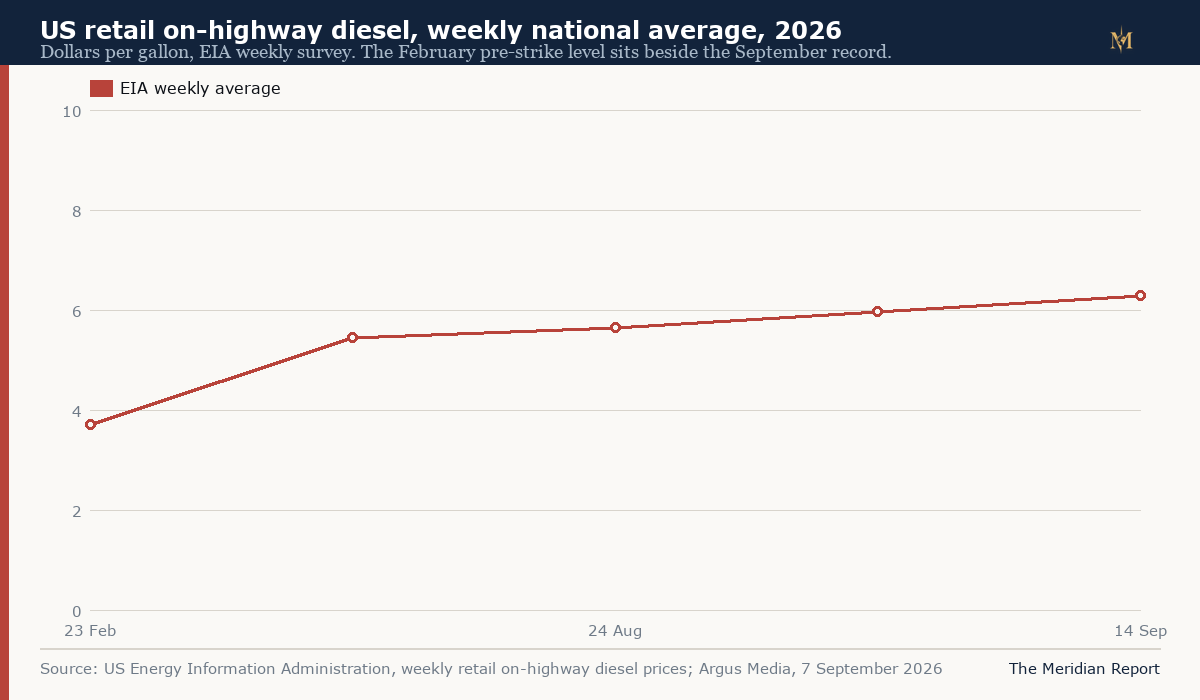
Here the verified record is striking. The weekly national average for on-highway diesel published by the US Energy Information Administration reached 6.285 dollars a gallon for the week ending 14 September, the highest level in the series' history, breaking records set the previous two weeks. Argus Media traces the climb to 5.967 dollars in the week ending 7 September, up 2.26 dollars from late February, before Ukraine's campaign against Russian refineries intensified and before the Iran war tightened the global middle distillate market. Trump told reporters in New York that Ukraine's strikes are a serious hit against the Russians, and a serious hit on the price of diesel, and his administration is studying a short term ban on diesel exports. A president who spent the summer asking Kyiv to stop hitting refineries is now negotiating with a pump price that will not wait for the election.
The energy ceasefire that emerged from the Trump Zelensky meeting has a symmetric shape Ukraine can live with. Zelensky said his country is ready for any kind of format of energy ceasefire, including refineries, but only if Russia accepts the same terms, and he confirmed that Washington will carry the proposal to Moscow, whose position is unknown. Ukraine received no one sided order to stop, which was the fear in Kyiv after weeks of American pressure over the refinery campaign. The test now runs through Moscow, and through the winter: Zelensky noted that if the war continues into the cold months, air defence ammunition, not diplomacy, is Ukraine's most urgent need.
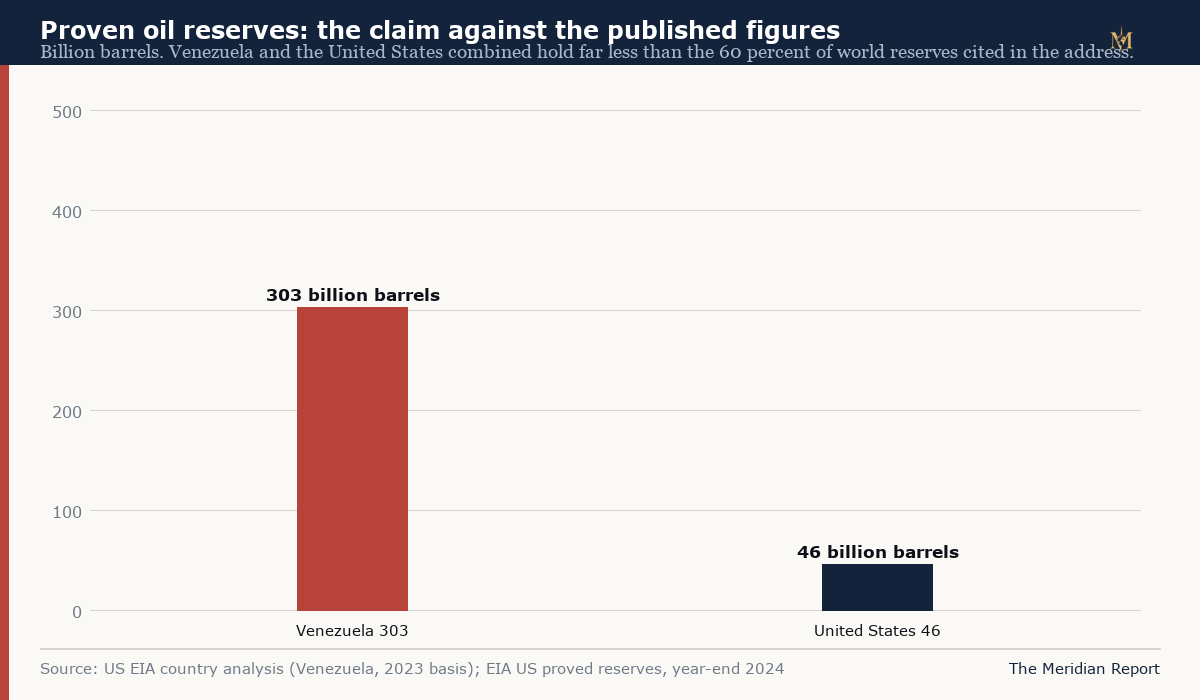
Venezuela produced the speech's boldest number, and its least verifiable. Trump described the intervention this year as a war that produced perhaps the biggest deal ever made, telling the assembly that to the victor belong the spoils, and that the two countries control 60 percent of the world's reserves. The published figures do not support that share. The Energy Information Administration's country analysis puts Venezuela's proven reserves at roughly 303 billion barrels, the largest national endowment on earth, while US proved reserves stood near 46 billion barrels at the end of 2024. Combined, about 349 billion barrels, that is closer to a sixth of world reserves than to three fifths. The claim appears to rest on a looser definition, or on no definition at all. What is verifiable is the direction of the policy: American companies now operate Venezuelan crude under terms the administration has not published, and the speech offered no detail on revenue, ownership or duration.
Cuba drew the day's most theatrical moment. Trump called it an absolutely failed state that will fall, accused it of coordinating with left wing radicals and Communist networks inside the United States, and said freedom will be coming to Cuba under negotiations led by Secretary of State Marco Rubio. The Cuban delegation walked out as he spoke. No mechanism, timeline or evidence accompanied the prediction, and the walkout underlined how little of the address was directed at the governments in the room rather than at domestic audiences watching the broadcast.
The same morning produced the week's one signed agreement. Trump praised the Greenland security deal with Denmark, signed at a trilateral ceremony hours before his speech, as giving the United States the complete ability to do what is necessary to defend the American continent. The signature ended a two year confrontation, and our earlier analysis tracks what the text settles and what it defers: sovereignty untouched, ratification pending in two parliaments, and the full text still unpublished. That analysis is here.
Artificial intelligence closed the speech on a note that will interest industrial policy more than diplomacy. Trump rebranded the technology as super intelligence, compared those warning about its risks with people he dismisses on climate, and committed the government to encouraging rather than restraining the sector. We're going to encourage it, not rein it in, he said, while allowing that Washington would step in if needed. The position aligns his administration with the fastest possible buildout of data centres and chips, the same buildout our investigation measured at 733 billion dollars of hyperscaler capital spending this year in the $733 billion year.
By evening the president had held the bilateral with Zelensky, hosted a Shield of the Americas coalition event where he told Latin American leaders, you let us know, and we take them out, and met Britain's new prime minister Andy Burnham, telling him global energy prices would come way down once the wars end. The pattern across the day was consistency of a particular kind. Every open question in American foreign policy, Iranian escalation, Russian refining capacity, Cuban communism, diesel prices, is now scheduled for resolution immediately after an election whose outcome the president insists has no bearing on any of them. The assembly has heard promises of transformation from American presidents before. It has rarely heard one put the whole agenda on a single polling date.
What the speech establishes, and what it leaves open
The address itself settles little, but the week's verified events around it mark the positions precisely. Ukraine has accepted an energy ceasefire in principle and symmetrically. Russia's answer is pending. Iran faces a stated deadline that its own leadership has not confirmed. The diesel market, the one actor in this sequence that votes every day, set its record the week before the speeches and has eased only marginally since. Anyone assessing the probability of a truce in either war is therefore watching the same indicators: whether Moscow accepts the energy ceasefire format, whether the White House imposes the tariff authorities on Russian oil buyers, and whether the diesel price gives the president the domestic room he needs to keep both pressures on.