
President Trump sits down with President Zelenskiy in New York on Tuesday afternoon carrying a request that would have been unthinkable a year ago: stop winning.
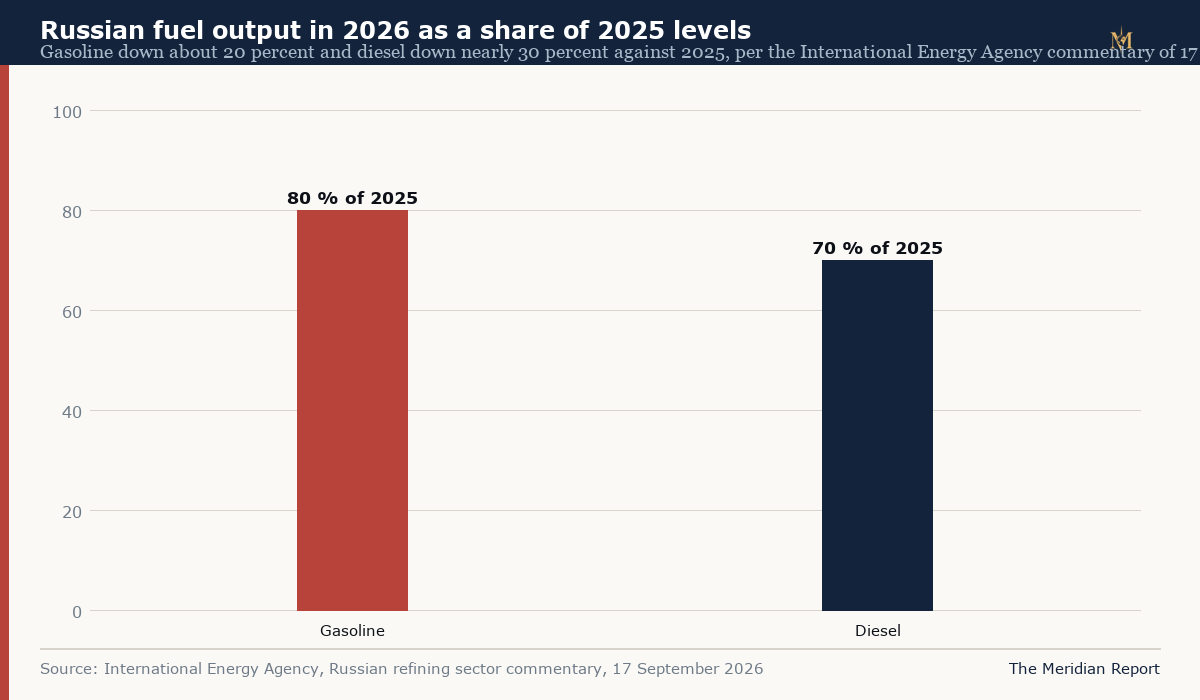
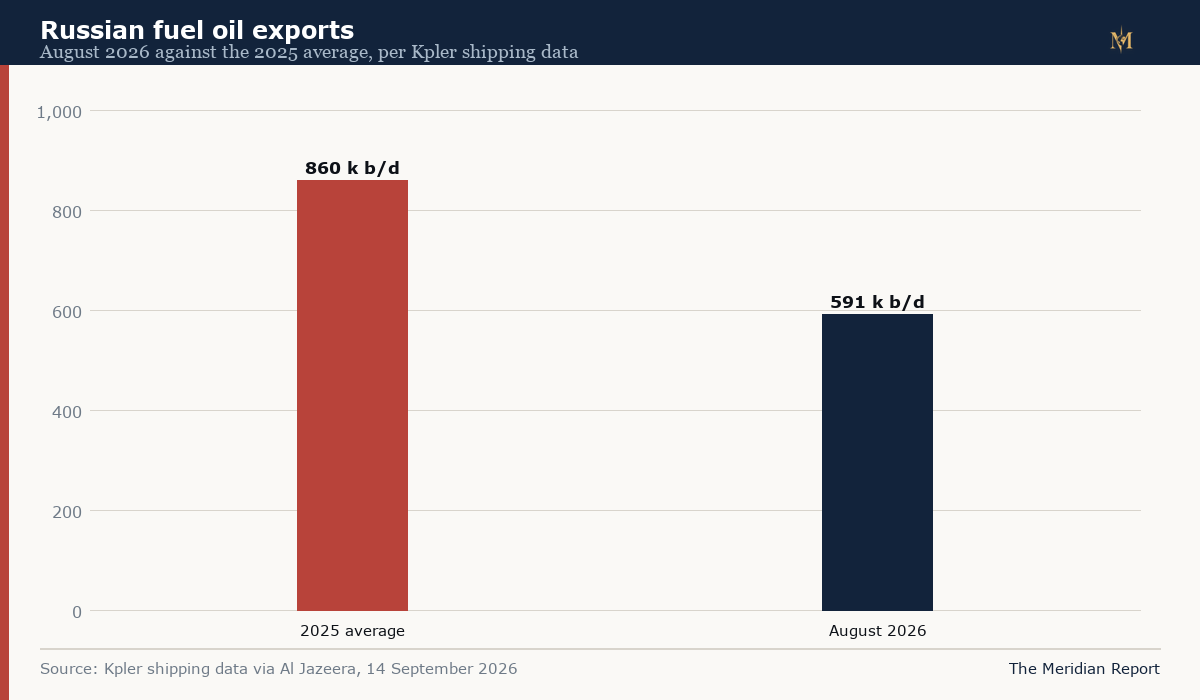
The request concerns the campaign of drone and missile strikes that has methodically disabled Russian oil refining since the summer. Half of Russia's six top diesel-producing refineries were forced to significantly cut back or completely halt output in September, according to Reuters reporting, and the International Energy Agency's assessment, published last Wednesday, puts reported gasoline output down about 20 percent against 2025 levels and diesel production down nearly 30 percent. Russian fuel oil exports fell to 591,000 barrels a day in August from an 860,000 barrel average across 2025, on Kpler shipping data.
For Kyiv, those numbers are the strategy. Zelenskiy's government sees the damage it is inflicting on Russia's fuel industry as its most effective instrument for forcing Moscow toward any negotiation at all. The strikes are the reason the Kremlin's war economy is rationing fuel across regions covering roughly a third of its own population, and the reason Russian officials are defending the reliability of an economy they spent three years insisting was immune.
For Washington, the same numbers have become a price tag on the other side of the Atlantic. Diesel is the fuel of tractors, trucks and harvesters, and its price has become a domestic political emergency in the American Midwest six weeks before midterm elections. Iowa's Republican senators and representatives are publicly demanding export bans and relief programmes, in a state where Republican candidates now trail in polls that were recently comfortable. Trump wrote on Monday that Russia has lost control of its diesel oil industry and that the whole world suffers, language that indicts a campaign he is simultaneously asking Kyiv to pause.
The truce that dissolved in a day
The meeting's ostensible subject already failed once. Trump announced last week that Ukraine and Russia had agreed not to strike energy targets. Neither government had, in fact, agreed to anything: both Moscow and Kyiv made clear within a day that no such understanding existed, according to contemporaneous reporting from New York and Moscow. Russia hit petrol stations in Kyiv the following day. Ukraine bombed a Russian oil refinery.
The pattern matters more than the episode. Ukraine has offered a reciprocal arrangement in exactly the terms the American side wants to hear. Zelenskiy wrote on Monday that Ukraine's energy sector, critical infrastructure and food exports must stop being targets for Russia, and that matching de-escalation steps would follow on Ukraine's part. That is a standing offer, public and unconditional in form. What it requires is a Russian counterpart who stops, and Russia, which holds the missile advantage in the air war, has given no sign of pausing. In July it fired the largest number of ballistic missiles at Ukraine in a single month since the war began.
What each man brings to the room
Zelenskiy arrives with a request of his own, and it is not the refinery pause. His government wants Patriot air defence missiles for the winter, because the ballistic threat that only Patriot-class systems intercept reliably is growing while inventories across the alliance are not. If the energy truce fails, air defence is the winter plan, and the meeting determines how much of it exists. Ukrainian officials fear a renewed Russian campaign against heating and power facilities as temperatures fall, the same playbook as 2022 and 2024, against a grid already battered by three years of strikes.
Trump arrives with a coalition problem he built and a fuel price he does not control. His administration's war with Iran has global energy markets priced for disruption, with the strait through which a fifth of the world's oil transited now effectively closed for seven months, and the Russian refining campaign has removed the margin the diesel market had left. Neither problem is soluble by Kyiv. Both are attributable to it in the political messaging of the moment.
The two leaders have met in circumstances good and bad. Their February 2025 Oval Office meeting collapsed into a shouting match. Their meeting at the United Nations a year ago produced the opposite: an abrupt rhetorical shift in Zelenskiy's favour, with Trump saying Ukraine could expel Russia from all its territory. The relationship has moved between those poles since, and the meeting's outcome depends less on chemistry than on whether Moscow gives either man anything to work with. Russia's Foreign Minister arrives in New York on Wednesday to meet the American Secretary of State, which makes Tuesday's conversation also a message-drafting exercise for that one.
The arithmetic that will decide the winter
A genuine reciprocal truce would leave Russia's fuel industry recovering at a moment when it can least afford the repair time, and Ukraine's grid breathing before the heating season. That is the version the American side wants to announce. The other outcomes are weaker and more likely: a unilateral Ukrainian pause, which Kyiv's own leadership resists because it surrenders the only lever that has produced visible damage inside Russia; a formal announcement that dissolves within days, as the last one did; or no agreement at all, with the air war escalating into the winter and the American diesel price becoming the political story of the midterm campaign.
Each of those outcomes is observable within weeks, which is more than can be said for most summit stakes. The refining numbers will show within a fortnight whether strikes have stopped. The Patriot question will show in any weapons announcement. And the fuel price itself, the number that dragged the American president into Ukraine's war economy in the first place, updates every business day.