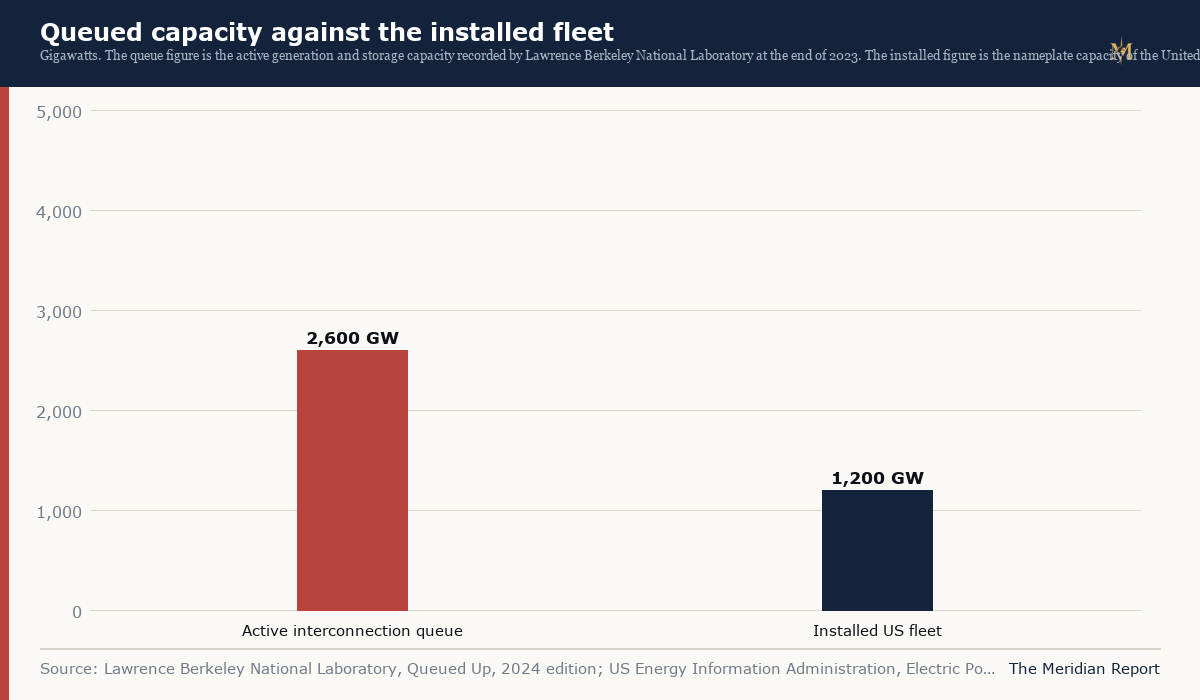
The constraint on the next wave of computing is not the supply of accelerators. It is a study queue. A developer can order servers, lease land, secure cooling and break ground on a data centre hall in eighteen months. The same developer can wait four to seven years for a network upgrade that allows the site to draw the power it needs, and the queue that decides the order of that wait contains several times more generation capacity than the country will ever build.
That mismatch is the subject of this article. It is not a story about a shortage of electricity in the abstract. The United States has ample generation and, in most hours, ample energy. The shortage is locational, temporal and administrative: the right capacity cannot reach the right point on the network at the time the load arrives, and the process for allocating the right to connect has become a speculative asset in its own right.
The queue is a study process wearing the clothes of a market
An interconnection queue is a list of projects that have asked a transmission provider for permission to connect. Entry is inexpensive relative to construction. A developer pays a study deposit and submits a request, and the utility studies the impact of the project on the network, then estimates the cost of the upgrades required to accommodate it. The project holds a position in the queue while that work proceeds.
The process was designed when requests were few and most projects were utility-owned. It became a bottleneck when wind, solar, storage and now data-centre load arrived in volumes that the serial study model could not absorb. Each request was studied against the network as it would look after every earlier request had been built, which meant that a single withdrawal could invalidate the studies of everything behind it. Projects waited years for a result that a later withdrawal would render obsolete.
Lawrence Berkeley National Laboratory has documented the consequence. Its queue database has recorded more than 2,000 gigawatts of generation and storage in active queues in recent years, against an installed US fleet of roughly 1,200 gigawatts. The vast majority of that queued capacity will never be built. For projects that entered the queue between 2000 and 2018, the historical completion rate is about 14 percent. The queue is therefore not a pipeline in any ordinary sense. It is a list of options, most of which expire.
That completion rate is the single most important number in the debate, because it changes what the queue means. A queue of 2,000 gigawatts does not imply that 2,000 gigawatts are coming. It implies that developers are paying a small option premium to hold a position while they search for a customer, a permit and a network cost they can afford. The network planner, meanwhile, has to study each option as though it were real, because the process cannot know which ones will proceed until the studies are done.
What FERC tried to fix, and what it left alone
The Federal Energy Regulatory Commission addressed the process in Order No. 2023, issued in July 2023. The order replaced serial studies with cluster studies, in which requests in the same window are studied together. It moved the process to a first-ready-first-served principle, with deposits and withdrawal penalties intended to deter speculative requests. It required transmission providers to use standardised models and to consider advanced transmission technologies. It imposed deadlines and reporting requirements.
Those changes address the queue's internal inefficiency. They do not address the reason the queue is long: the network does not have enough capacity at the locations where new generation and load want to connect, and building more capacity takes longer than studying it. A cluster study can process requests faster, but it cannot create a corridor, a substation or a line. If the answer to a cluster study is that the network needs a 500 kilovolt line that has not been permitted, the project is still waiting, and the wait has simply become better organised.
The order also shifted risk. Withdrawal penalties make a speculative request expensive, which should reduce the number of projects that enter without a customer. But the penalty is incurred at the point of withdrawal, and a developer that withdraws after a cluster study has assigned it a large upgrade cost may decide that paying the penalty is cheaper than building. The reform therefore improves the signal without removing the option value that created the queue in the first place.
There is a deeper problem that the order could not solve. Interconnection is Planned by transmission providers under state and federal jurisdiction that does not align with the geography of demand. A data-centre campus in a rural county may be served by a utility whose transmission planning process is designed for reliability within its own footprint, while the generation that could serve it sits in another region with surplus capacity. The network that would connect the two is planned on a different cycle, with a different cost-allocation formula, and often without a statutory mandate to build for economic load growth rather than reliability.
Why a data centre is a different kind of customer
A new factory adds load gradually and can often be served by reinforcing the local distribution network. A data centre adds load in blocks of tens or hundreds of megawatts at a single point, and it needs firm capacity, not just energy. The servers run continuously, the cooling runs continuously, and the backup systems must be sized for the full load. A 300 megawatt campus is a transmission-level event, not a distribution upgrade.
The load is also concentrated. Data-centre development has clustered in northern Virginia, central Ohio, the Dallas area, the Phoenix valley and a small number of other counties where land, fibre and power were historically cheap. Those counties now face a queue of their own, not for generation but for load. The utility must study whether the network can deliver the requested capacity under contingency conditions, and the answer is often that it cannot without a new substation, a new line or a rebuild of an existing corridor.
The timing is the crux. A data-centre shell can be built in a year or two. A new 230 kilovolt substation can take three to five years, and a new transmission line can take a decade if it crosses jurisdictions and requires environmental review. The developer therefore faces a choice: wait for the network, build its own generation behind the meter, or move to a location where the network already has headroom. Each choice has a different cost and a different regulatory consequence, and the choice is being made project by project rather than through a national plan.
The capacity auction as a price signal
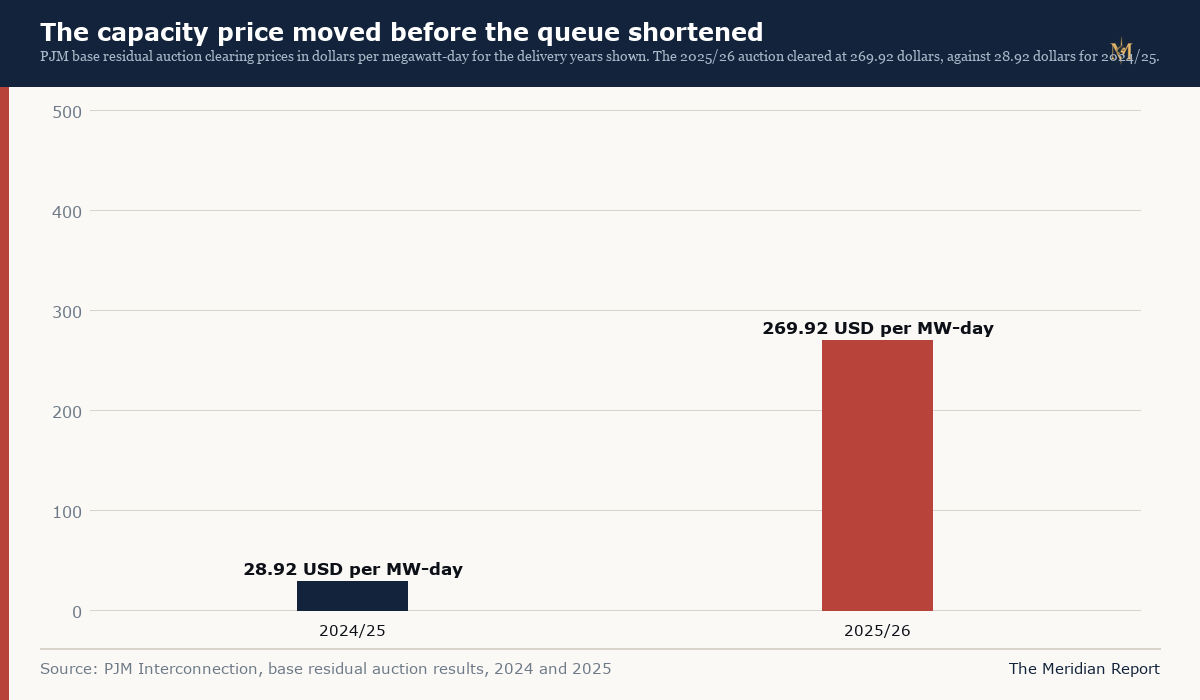
PJM Interconnection operates a capacity market that pays generators to be available during periods of system stress. The auction for the 2025/26 delivery year cleared at 269.92 dollars per megawatt-day, a sharp increase from the previous year's clearing price. The increase reflected tighter supply, higher load forecasts and the retirement of older plants, and it was large enough to become a political event in the states that pay the bill.
The auction price is not a measure of the interconnection queue, and it should not be read as one. It is the price of capacity in a specific market for a specific delivery year, and it clears against a load forecast that includes expected demand growth. But the two are connected. A queue that cannot deliver new generation on schedule tightens the supply curve, and a tighter supply curve raises the auction price. The capacity price is therefore one of the places where the queue's delay becomes visible to consumers.
The auction also reveals a distributional conflict that the queue debate tends to obscure. Capacity costs are allocated to load-serving entities, which pass them to customers. A large new load that arrives with its own generation may pay less into the capacity market than its presence would justify, particularly if it is allowed to net its behind-the-meter supply against its obligation. The other customers in the territory then pay for the reliability the data centre still needs when its own generation is unavailable. That is the co-location argument in its simplest form, and it is being litigated in several proceedings rather than resolved by a single rule.
Behind the meter is not outside the system
The most common short-term answer is to build generation on the customer's side of the meter. A gas plant, a fuel cell array or a battery can be permitted and built faster than a transmission line, and it can be sized to the campus rather than to the network. The data centre then draws less from the grid, or draws nothing at all in normal operation, and the interconnection request shrinks or disappears.
The physics is straightforward. The regulatory and economic questions are not. A load that supplies itself still relies on the network for backup, for startup power and for the imbalance service that keeps frequency stable. If it takes that service, it should pay for it, and the price should reflect the capacity that the network must hold in reserve. If it does not pay, the cost shifts to other customers, and the shift is larger when the load is large.
There is also a fuel and emissions consequence. Behind-the-meter gas generation is usually outside the wholesale market and outside the emissions trading systems that apply to large generators in some jurisdictions. It may be subject to local air permits, but the carbon is not priced in the same way as the carbon from a grid-connected plant. A policy that pushes data centres to self-supply with gas can therefore reduce the measured emissions of the electricity sector while increasing total emissions, which is an accounting outcome rather than an environmental one.
The third question is dispatch. A behind-the-meter plant that runs continuously is invisible to the system operator, which cannot call on it during a system emergency and cannot count on it when forecasting reserve margins. As more load moves behind the meter, the operator's visibility of the demand side falls, and the reserve margin it publishes becomes a less reliable guide to the capacity that is actually available. Some markets are beginning to require telemetry and emergency response capability from large behind-the-meter resources, but the rules are not uniform.
The queue as an asset changes the politics
When a queue position is valuable, it becomes something to hold, trade or defend. Developers with a position that is expensive to replicate have an incentive to keep it alive even if the project is not yet financeable, because the position itself may be worth more than the project. That is rational behaviour under the rules, and it is one reason withdrawal penalties have to be calibrated carefully: too low and the queue fills with options, too high and genuine projects are deterred from entering.
The same logic applies to load. A utility that has allocated capacity to a data-centre campus has created an asset for the county and a liability for the other customers if the campus does not materialise. Some jurisdictions are now requiring large loads to post collateral, to sign minimum-demand commitments or to fund the network upgrades they trigger. Those requirements protect existing customers, and they also raise the cost of entry for the projects that would use the capacity most productively.
The politics follow the money. States that host data centres receive tax revenue and construction employment, and they have an interest in approving the load. The customers who pay for the network upgrades may live in another state or another utility territory, and they have no vote in the decision. Regional transmission organisations were designed to internalise some of that conflict through cost-allocation rules, but the rules were written for a world in which load growth was modest and predictable. They are being tested by a load that arrives in blocks and can move to another county if the answer is slow.
What a faster queue would not fix
Even a perfect queue process would leave three constraints. The first is transmission. The network's capacity is a physical fact, and the queue only allocates access to it. If the corridor does not exist, a faster study cannot create it. The second is the equipment supply chain. Transformers, switchgear and high-voltage cable have long lead times, and the demand from data centres, utilities and electrification projects is competing for the same factories. A project that wins its queue position may still wait for a transformer.
The third is skilled labour. Substation construction, line work and commissioning require trained crews, and the crews are finite. A national programme to build transmission faster would run into the same labour constraint that the projects face individually. The queue reform debate tends to treat time as an administrative variable, but a significant part of the delay is physical and cannot be compressed by rulemaking.
Those constraints do not make reform pointless. They change what reform can deliver. A cluster study that removes two years of administrative delay is worth having even if the line still takes five years, because the developer can plan, finance and sequence the project against a known date. A first-ready-first-served rule that removes speculative projects is worth having even if the network remains constrained, because it shortens the queue for the projects that are real.
The number that matters is the completion rate
The debate over interconnection reform has produced a large number of statistics, and most of them measure the wrong thing. The size of the queue is not a measure of demand. The number of requests is not a measure of capacity. The only number that connects the queue to the physical system is the completion rate: the share of queued projects that reach commercial operation, and the time they take to get there.
That rate is low, and it has been low for two decades. It was low before wind and solar dominated the queue, and it was low when most requests were for gas plants. The causes are not only administrative. A project that enters the queue without a customer, a site or a permit is a project that is likely to fail, and the queue's design allows it to enter anyway. The reform agenda has focused on the process, but the completion rate also depends on the quality of the projects that enter and on the strength of the signals that tell developers whether they have a realistic path.
For data centres, the relevant completion rate is different. The load is real, the capital is committed and the customer is a creditworthy hyperscaler or a colocation operator with signed leases. The bottleneck is not project quality but network capacity and the time required to reinforce it. That is why the data-centre debate has moved from the queue to the substation, the transformer and the line, and why the solutions being proposed are physical rather than procedural.
The equipment queue behind the interconnection queue
A project that survives the study process then enters a second queue, for equipment. Large power transformers, high-voltage circuit breakers, switchgear and underground cable are built to order, and the lead times for the largest units have stretched from under a year to several years as utilities, data centres and electrification programmes compete for the same manufacturing capacity. The constraint is not only factory slots but the grain-oriented electrical steel, copper and specialised labour that go into the units.
The transformer shortage has a particular geography. A significant share of global large-transformer manufacturing sits in a small number of countries, and the units are heavy, customised and difficult to ship. A utility that orders a 500 megavolt-ampere transformer for a new substation may be quoted a delivery date years away, and the date is not firm until the design is approved and the steel is allocated. A data-centre developer that has secured a queue position and a site can still find that the substation cannot be energised because the transformer has not arrived.
This is where the physical and the administrative interact. A faster interconnection study that assigns a project a network upgrade it cannot build on time is not a faster connection. The upgrade has a bill of materials, and the bill of materials has a lead time that the study does not model. Some transmission providers are now publishing equipment lead times alongside study results, which allows developers to see whether the constraint is the study, the line or the transformer. That transparency is more useful than a generic queue position, because it tells the developer which problem to solve.
The equipment queue also changes the calculus of location. A site that can be served by reinforcing an existing substation, or by reusing a transformer that is already on order, can be energised years before a greenfield site with a new corridor. That is why some of the largest new campuses are being built next to retiring plants, where the interconnection rights and the equipment already exist, and why the retirement of a coal plant has become a commercial opportunity for a developer as well as a reliability question for the operator.
Reserve margins are a planning convention under pressure
The North American Electric Reliability Corporation assesses the reliability of the bulk power system against planning reserve margins, which are the amount of generating capacity above forecast peak demand that the system is expected to hold. The margins are set by regional rules and are based on historical outage rates, load shapes and the ability to import power from neighbouring areas.
Data-centre load stresses the convention in three ways. It raises the forecast peak, it changes the shape of the load because servers draw power continuously rather than in the evening peak, and it concentrates the demand in locations where the import capability is limited. A system that meets its reserve margin on paper can still fail to serve a campus if the local transmission constraint binds before the regional capacity does. Reserve margins are a regional measure, and the problem is local.
The convention also treats load as a forecast rather than a contract. A utility that has signed an agreement to serve a 500 megawatt campus must plan for that load even if the campus is delayed, and it must hold capacity in case the campus arrives early. If several campuses in the same area are delayed in sequence, the utility can end up with more contracted capacity than it needs, and the cost is recovered from customers. The reverse case is worse: a campus that arrives before the network reinforcement can leave the utility short at the local level, which is a reliability event rather than a commercial one.
What a developer can actually control
A developer cannot shorten the transmission queue by argument, but it can change which queue it joins. The first lever is location. A site with existing interconnection rights, available transformer capacity and a utility with a planning process that has already identified the reinforcement is worth a premium over a cheaper site that requires a new corridor. The second lever is size. A campus that can be built in phases, with each phase sized to the capacity that the network can deliver, can begin operating years before a single large block would be allowed.
The third lever is supply. A power purchase agreement with an existing generator does not create new capacity, but it can transfer an existing capacity right to the load, and it gives the developer a counterparty with an interest in the interconnection. A physical hedge, such as a battery on site, can reduce the maximum draw at the point of connection and therefore the size of the network upgrade. The fourth lever is demand flexibility. A load that can curtail a defined number of megawatts within a defined time can be treated differently in the study, because the network does not have to be sized for its full peak.
Those levers are commercial rather than regulatory, and they are being used. The largest operators now employ power teams that negotiate interconnection agreements, purchase generation and manage regulatory proceedings in several states. That is a change in the industry's skill set: the companies that build data centres are becoming electricity market participants, and the ones that do not are dependent on a utility's timetable.
Why the queue reform debate keeps returning to cost allocation
The technical problem of studying requests faster has a technical solution, and the 2023 order largely implements it. The political problem is who pays for the network that the requests require. Transmission costs are recovered from customers through tariffs, and the allocation between generators, load-serving entities and specific beneficiaries is set by regional rules that were designed before large single loads existed.
A new line that connects a data-centre campus to a generation-rich area benefits the campus directly and the regional system indirectly. If the campus pays the full cost, it may build behind the meter instead, which removes the benefit to the system. If the system pays, existing customers subsidise a new load that may be owned by a company with a market capitalisation larger than the state's economy. The search for a formula that is both fair and buildable is the reason interconnection reform keeps returning to the same argument.
Some regions have begun to allocate costs by beneficiary, with a share assigned to the load that triggers the upgrade and a share to the system that benefits from the reinforcement. That approach is more economically coherent than spreading the cost across all customers, and it is harder to administer because it requires a forecast of who benefits and by how much. The first cases are being litigated, and the outcomes will determine whether large loads are welcomed or pushed to self-supply. A region that prices the benefit correctly can attract the load and recover the cost; a region that does neither will watch the campus move to a county that does.
What to conclude from the evidence
The evidence supports four conclusions. The interconnection queue is a real constraint on new generation and large load, and it is longer than the physical build time of the projects it contains. The reforms of 2023 improved the process without removing the transmission bottleneck. The capacity market is transmitting the scarcity into prices, and those prices are creating a distributional conflict between large new loads and existing customers. Behind-the-meter generation can shorten the timeline for a single campus, but it shifts cost and visibility problems onto the network rather than eliminating them.
What the evidence does not support is the claim that the grid cannot accommodate AI growth. The grid can, at a cost and on a timetable. The cost is measured in transmission, transformers, substations and the labour to build them, and the timetable is measured in years rather than quarters. A company that plans a campus without a power strategy is planning a building, not a data centre, and a policy that treats the queue as the only obstacle will spend its reforms on the wrong constraint.
The practical test is whether the project has a dated path to energisation that names the substation, the transformer, the line and the study milestones, rather than a queue position and an assumption. A path that names only the queue is a path that has not been planned past the application stage, and the difference shows up in the energisation date. The projects that energise on schedule are the ones whose developers treated the network as a design constraint from the first site visit, and whose utilities treated the load as a planning input rather than an inconvenience.