The Greenland agreement entered its parliamentary phase the moment its text was published, and both ends of the Kingdom's ratification machinery are now formally in play. Nothing has happened yet, which is itself the verified status: no Folketing consultation has been announced, no Inatsisartut motion has been tabled, and no government in Copenhagen or Nuuk has published a schedule. What can be established precisely is the path each process must follow, the arithmetic and factions that shape each vote, and the signals that will show movement before either parliament formally acts. This page is the tracker for all of it, and it will be updated as each step lands.
Where the Folketing process stands
The Danish parliament's role is structural, not ceremonial. Under Article XII of the published agreement, the instrument enters into force on the diplomatic note informing Washington that the necessary parliamentary procedures are complete in the Kingdom together with Greenland. Denmark's constitution requires Folketing involvement for agreements that bind the realm's territory, and the precedent is recent and exact: the December 2023 defence cooperation agreement went through consultation of the Folketing's Foreign Policy Committee before signature and parliamentary approval afterwards, a process the government described publicly at each step.
Three institutional facts frame what happens next.
The calendar comes first. The Folketing's new session year opens on 7 October, the traditional state opening, and the agreement has not appeared on any published agenda before that date. The earliest realistic window for the government to consult the Foreign Policy Committee is therefore early October, with any implementing legislation or approval motion following in the weeks after. The 2023 DCA took months from consultation to full approval, and a comparable cadence would put formal Danish approval in the late autumn or winter, consistent with the mid to late 2027 entry-into-force estimate our main analysis carries from the Swedish DCA benchmark.
Then the committee path. The government must consult the Foreign Policy Committee on foreign and security policy matters of this magnitude, and the committee's position shapes the plenary vote. The Greenland Committee, a standing Folketing committee specifically for the island's affairs, is also a likely stop, and any reservations it attaches would be politically significant even where they are not formally binding.
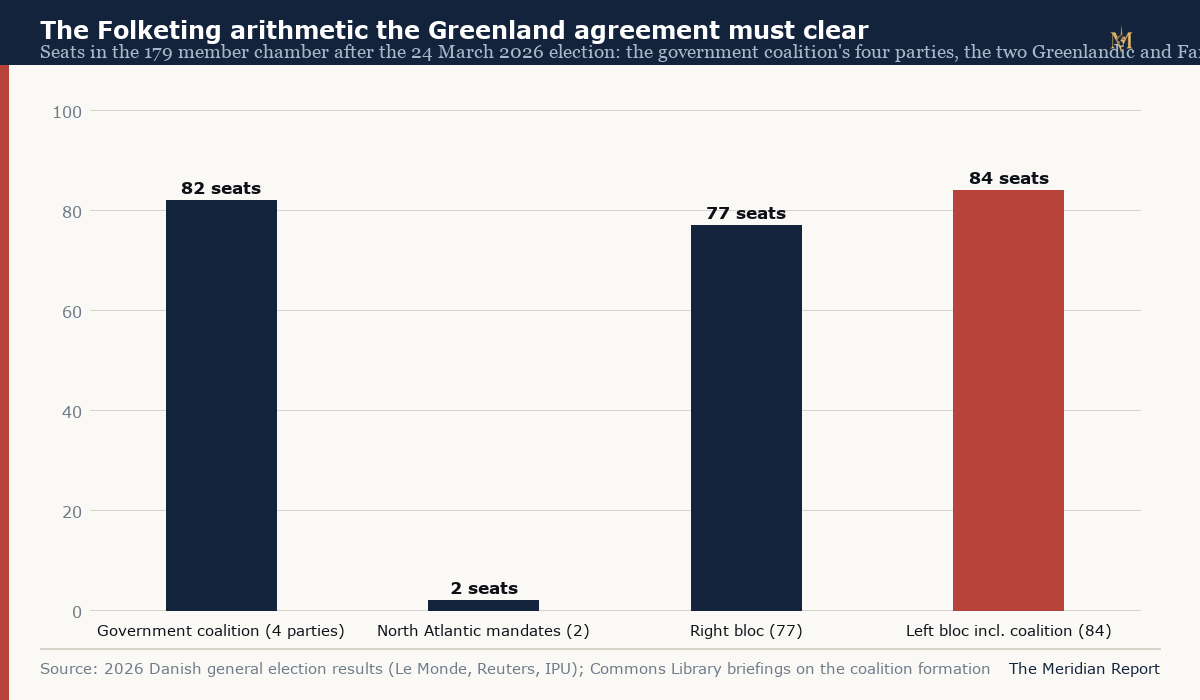
Third, the arithmetic. The March 2026 snap election left the Folketing fragmented: the government coalition's four parties hold 82 of 179 seats, the left bloc as a whole 84, the right 77, with the two North Atlantic mandates, one Greenlandic, one Faroese, sitting outside both blocs. The coalition is a minority government dependent on opposition support vote by vote. A ratification vote is therefore a genuine test, and the government will want either the centre-right parties or the North Atlantic mandates with it before scheduling one. The counterweight is that opposition parties supported the substance of the negotiations even while criticising the government's handling of the pressure campaign; the agreement's sovereignty-reaffirming preamble gives opponents of the process little textual ground to oppose the instrument itself.
Where the Inatsisartut process stands
Greenland's parliament opened its autumn session on 18 September, four days before the signing, so the island's legislature is already sitting. No consent motion has been tabled publicly, and no debate date has been announced. The Naalakkersuisut's public position, set out in its statements around the agreement, is that Greenland's consent was given for defence cooperation, that the island's constitutional future belongs to Greenlanders alone, and that the benefits provisions, Greenlandic contracts to the maximum extent possible under Article IV, are part of what Greenland agreed to.
Three things will constitute actual movement in Nuuk.
The first is a formal consent item on the Inatsisartut's agenda, which the session calendar or the Naalakkersuisut's communications would announce. The second is the modalities process: Article IV sends the technical details for Narsarsuaq and Mestersvig to mutual agreement through the Permanent Committee, and any proposal that reaches that committee will require Greenlandic positions agreed inside the coalition government. The third, and the one with the longest tail, is legislation: Article X's investment screening commitment is to be ensured by Greenland under its own laws, which means the Inatsisartut must eventually pass or amend screening legislation for the perimeter to function. That bill, when it comes, is where the agreement's economic perimeter meets Greenlandic domestic politics.
The factional landscape matters here. Nielsen's coalition governs on a platform of gradual independence and cooperation with Copenhagen, and the March 2025 election that produced it was fought substantially on the American question, with the slow-independence Demokraatit winning on exactly that platform. Naleraq, the fastest-independence party, is the coalition's most likely critic of Article XI, the clause obliging an independent Greenland to remain in NATO and assume Danish obligations under the agreement. How the Inatsisartut's debate handles that clause, as a guarantee of stability or as a constraint written into Greenland's constitutional future, is the political substance of the Nuuk process.
What each side needs from each vote
The two processes are not symmetric, and neither is the political exposure. Frederiksen needs a broad vote, because a narrow ratification that depends on reluctant opposition support would reopen the crisis narrative her government has spent two years trying to close, and because the agreement's domestic sell in Denmark is precisely that it constrains future unilateral American claims. Nielsen needs a unanimous or near-unanimous Inatsisartut, because the agreement's legitimacy in Greenland rests on the consultation promise, and a divided island parliament would hand the argument to every voice that said Nuuk was presented with a document rather than a negotiation. Neither leader controls the timing; both control the framing.
The three signals that will show movement first
Before any vote is scheduled, three observable signals will mark the path. The government's consultation of the Foreign Policy Committee, usually announced through the Foreign Ministry with a readout, the earliest formal Danish step. The appearance of the agreement, its modalities or its screening legislation on the Inatsisartut's published agenda, the earliest formal Greenlandic step. And any public position taken by the opposition parties in either parliament, Danish or Greenlandic, since ratified positions tend to harden before votes are called. Our daily monitoring logs news signals for exactly these steps, and this page records them as they land.
The agreement's own legal finish line is Article XII's diplomatic note, and every step above is upstream of it. Until both parliaments complete their procedures, the signed text is what it was on the day it was signed: an international commitment by three governments, awaiting the domestic law that makes it operate. The full analysis of the text itself is in our main report, Control without sovereignty, and the capability implications are in the radar explainer.