
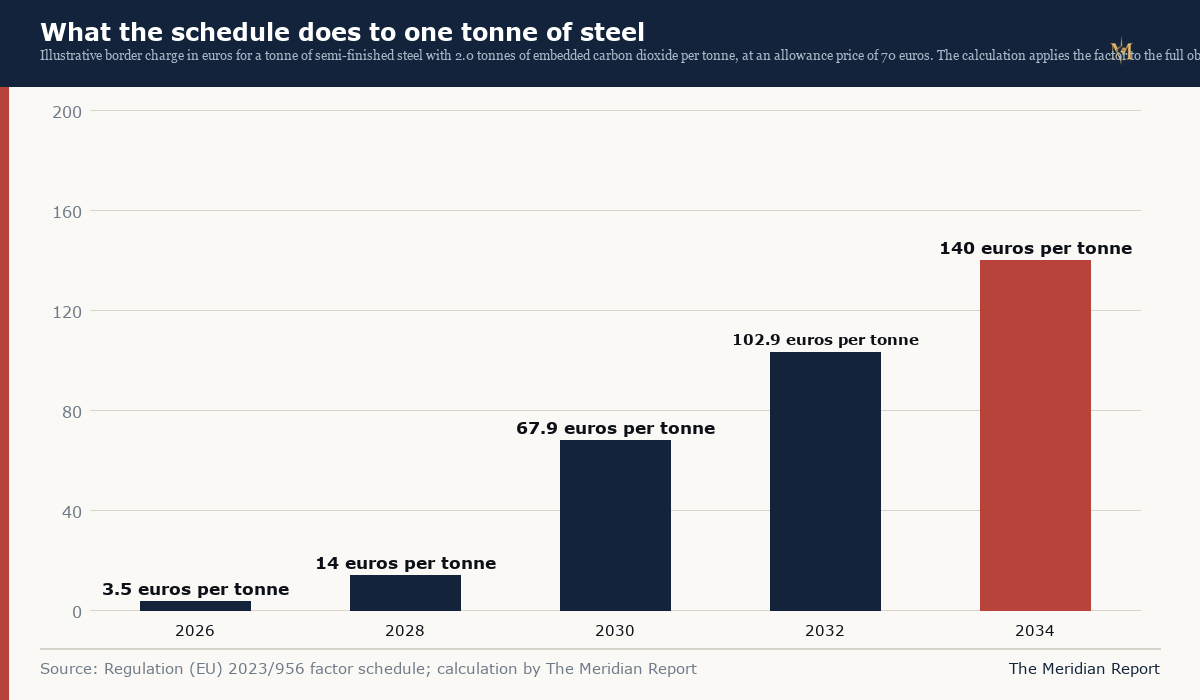
On 1 January 2026 the European Union began charging a border price on carbon embedded in imported steel, aluminium, cement, fertilisers, hydrogen and electricity. The first invoice is not due until 30 September 2027, and for imports made during 2026 the charge is set at 2.5 percent of the obligation that would apply if the goods had been produced under the full EU emissions trading system. A tonne of steel carrying two tonnes of carbon dioxide per tonne of product, priced against an allowance near 70 euros, attracts a border charge of about 3.50 euros. That is less than the cost of the paperwork required to establish the number.
The temptation is to treat 2026 as a soft launch. The regulation does not. It creates a legal person, the authorised declarant, without whom the goods cannot be released for free circulation. It creates a registry, a verification chain and an annual declaration that must reconcile customs records with installation-level emissions data. It creates a certificate market tied to the auctions of the EU emissions trading system. And it publishes a schedule that takes the charge from 2.5 percent of the obligation to 100 percent in nine annual steps. The first year is cheap because the factor is small, not because the system is optional.
The charge is small because the factor is small
The CBAM factor is the share of the emissions obligation that the border mechanism collects while the EU continues to hand free allowances to its own producers. In 2026 that share is 2.5 percent. It rises to 5 percent in 2027, 10 percent in 2028, 22.5 percent in 2029, 48.5 percent in 2030, 61 percent in 2031, 73.5 percent in 2032, 86 percent in 2033 and 100 percent in 2034. The design mirrors the phase-out of free allocation in the emissions trading system, so a European producer and an importer selling the same product at the same emissions intensity converge on the same carbon cost by the end of the period.
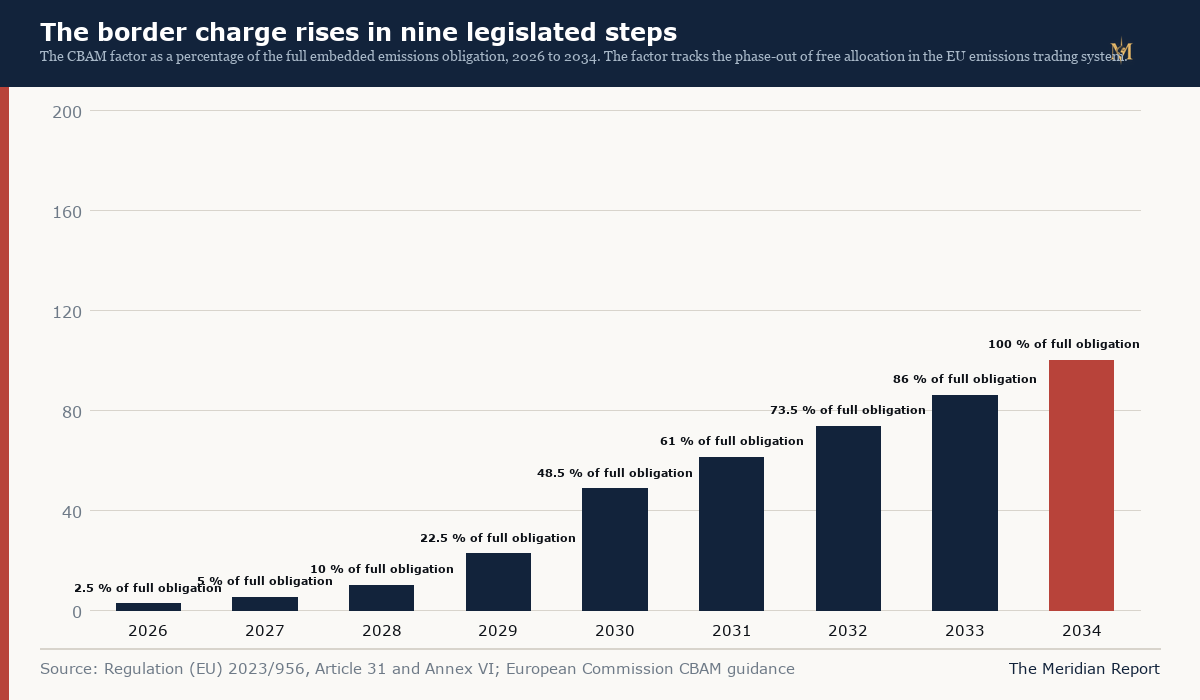
That convergence is the point, and it is also why the first-year arithmetic misleads. The relevant number for a purchasing decision is not the 2026 charge but the charge at the date when a contract signed in 2026 will still be running. A three-year supply agreement for steel signed this autumn spans factors of 2.5, 5 and 10 percent. A five-year agreement spans 2.5 to 48.5 percent. A capital investment in a European fabricator that depreciates over fifteen years spans the whole schedule and then the post-2034 regime, in which the border price and the domestic price are intended to be identical.
The regulation's own arithmetic makes the trajectory legible. Take a tonne of semi-finished steel with embedded emissions of 2.0 tonnes of carbon dioxide per tonne. At an allowance price of 70 euros, the full obligation is 140 euros. At the 2026 factor the charge is 3.50 euros. At the 2030 factor it is 67.90 euros. At the 2034 factor it is 140 euros. The same calculation for aluminium at 8 tonnes of carbon dioxide per tonne, a figure that varies widely by smelter and power source, moves from 14 euros in 2026 to 560 euros in 2034. Cement at 0.6 tonnes per tonne moves from 1.05 euros to 42 euros. These are illustrations built from stated assumptions, not forecasts of any particular producer's liability, but they show why procurement teams began rewriting contract clauses before the first certificate was ever sold.
A second arithmetic point matters more for cash flow than for unit cost. Certificates must be purchased and surrendered, which means the importer finances the obligation between the import and the annual declaration. The regulation allows certificates to be bought in advance and requires surrender by 30 September of the following year, so a company importing through 2026 carries a growing certificate balance through 2027. At a 2.5 percent factor the working capital is trivial. At a 48.5 percent factor it is not, particularly for a trader operating on thin margins and short credit terms.
What the declarant has to prove, and to whom
The customs declaration identifies the importer, the goods, the country of origin and the mass. The CBAM declaration has to connect that mass to the emissions of the installation that produced it. The connection runs through the supplier, because the installation-level data belongs to the producer, not to the importer. A declarant who cannot obtain that data has two options: use the default values published by the Commission, with the mark-up that the regulation attaches to them, or stop importing goods whose emissions it cannot document.
The default values are not a neutral fallback. They are set at a conservative level and carry an add-on precisely because they are not measured. The practical consequence is that a supplier who provides verified actual data gives its customer a lower liability than a supplier who does not. That reverses the usual information asymmetry in commodity trade. Historically the buyer demanded a certificate of analysis for the metal and left the process to the mill. Now the mill's electricity contract, its fuel mix and its measurement methodology are part of the commercial offer, because they determine what the buyer pays at the border.
Verification adds a second layer. The emissions report supporting actual values must be verified by an accredited verifier, and the verifier's scope includes the installation boundary, the production route, the embedded emissions calculation and the allocation of emissions to the exported product. For a integrated steel mill producing several products, that allocation is a substantive accounting exercise rather than a clerical one. For a remelter using scrap, the boundary question is whether the scrap's own embedded emissions are counted, and at what value. The regulation sets rules for these cases, but the rules have to be applied installation by installation, and the first verification cycle is where the disagreements will surface.
The registry is the third layer. Certificates are held in accounts, declarations are filed electronically, and the national competent authority reconciles the two. A declarant that imports through several member states still files one declaration in its state of establishment, which means the customs data from every entry point has to be consolidated. Groups that operated country by country under the transitional regime are discovering that the definitive regime requires a single emissions ledger across the union.
The coverage gap is the design's weak point
CBAM covers raw and semi-finished goods, not the products made from them. A tonne of steel slab is covered. A steel bracket stamped from that slab and imported as a finished component is not. The same is true for aluminium extrusions versus assembled window frames, and for cement versus precast concrete elements. The regulation acknowledged the gap and required a review of downstream coverage, but the first phase leaves an obvious route for a manufacturer to move the carbon-intensive step outside the union and import the finished article free of the border charge.
How large that route is depends on the cost of fabrication relative to the cost of the covered material. Where fabrication is labour-intensive and the material is a small share of the finished value, the incentive to relocate the final step is weak. Where the material dominates, as in some fabricated steel and aluminium products, the incentive is stronger. The Commission's review has to weigh that leakage risk against the administrative cost of extending the mechanism to thousands of product codes and millions of small importers, and the political economy of the answer is why the extension has been slower than the raw-materials phase.
A second gap is emissions scope. Direct emissions are covered for all goods. Indirect emissions, from the electricity consumed in production, are covered for cement and fertilisers, with a separate regime for imported electricity. Steel and aluminium are charged on direct emissions only in the first phase. That choice benefits producers in jurisdictions with carbon-intensive grids, and it disadvantages European producers who pay for decarbonised electricity through the emissions trading system and then compete with imports that carry no charge for the power used to make them. The review of indirect coverage is therefore not a technical detail. It determines whether the mechanism protects the European producer it was designed to protect.
A third gap is the treatment of electricity. Imported power is a flow rather than a product with a verifiable installation boundary, so the regulation uses default values and origin rules, with limited scope for actual data. The result is a regime that is administratively workable but coarse, and that is sensitive to the carbon intensity assumed for the exporting grid. Neighbouring markets with interconnected grids and shared dispatch present boundary problems that a national average cannot resolve.
The small importer bears a fixed cost that the charge does not reflect
The 150 euro consignment exemption removes the smallest shipments from the mechanism, but it does not remove the fixed cost from the small importer who exceeds it. Authorised declarant status requires an application, a compliance officer, a registry account and an annual declaration. Verification requires an accredited body and installation data from a supplier who may have no experience of the process. For a company importing a few hundred tonnes a year, the compliance cost per tonne can exceed the carbon charge by an order of magnitude in 2026, and it does not fall as the factor rises.
That asymmetry is not an accident of drafting. A border mechanism needs a declarant who can be held liable, and liability cannot be diluted across thousands of one-container importers without weakening enforcement. But it creates a market structure effect: compliance capacity becomes a barrier to entry, and the traders who survive are the ones large enough to amortise the fixed cost. The same effect appears in the customs brokerage market, where brokers are building CBAM data services because their clients cannot build them in house.
The regulation offers some relief through simplified reporting and the use of default values, and the Commission has consulted on further simplifications for small and medium importers. The direction of travel is toward a mass-based threshold that would exempt importers below a stated annual tonnage rather than a consignment value, which would address the fixed-cost problem more directly than the 150 euro rule. Until such a change is adopted and transposed, the consignment rule remains the legal baseline, and importers should not plan on relief that has not entered into force.
Why the certificate price is not a carbon tax
A carbon tax is set by a government and collected as revenue. A CBAM certificate is an instrument tied to the allowance price of the emissions trading system, and its price is the average of auction closing prices in the preceding week. The mechanism therefore imports the volatility of the European carbon market into the border. When allowances rise, the border charge rises with them, and when the market falls, the charge falls. A supplier quoting a fixed price for a year of deliveries is quoting against a floating cost that neither party controls.
That has three consequences. First, hedging becomes part of the importer's treasury function, not only its compliance function. Second, the price discovery for CBAM certificates depends on the liquidity and design of the auction market, which is a domestic instrument with domestic participants. Third, the revenue accrues to the EU budget rather than to a national treasury, which changes the politics of the mechanism: member states that bear the administrative cost do not receive the proceeds directly, and the revenue is earmarked for the union's own priorities.
The regulation also addresses the risk of double charging. Where a carbon price has already been paid in the country of origin, the declarant can claim a reduction, but only for a price that is effectively paid and can be documented, and only for the emissions that the price covered. The reduction is not automatic, and the evidentiary standard is high. Exporters in jurisdictions with explicit carbon taxes or emissions trading systems have a route to relief; exporters in jurisdictions where carbon is priced implicitly through fuel taxes or regulation do not, which is one of the fairness arguments that trading partners have pressed hardest.
What the first compliance cycle will reveal
The first declarations are due on 30 September 2027. Between now and then, three things will be tested. The first is data quality. The transitional period produced reporting, but much of it was based on default values and estimated intensities. The definitive regime requires verified installation data, and the gap between the two will show up as a variance between what importers reported and what they can prove.
The second is the capacity of the verification market. Accredited verifiers with metals, cement and fertiliser expertise are a scarce resource, and the first cycle will concentrate demand into a narrow window. Companies that wait until the second quarter of 2027 to commission verification will compete for a queue that did not exist in 2026.
The third is the legal interpretation of allocation. The regulation sets principles for allocating emissions to products, but integrated plants produce multiple outputs and the boundaries between them are contested. The first verified declarations will establish precedents, and the national competent authorities will not necessarily interpret them identically. A declarant operating in several member states should expect to defend its methodology more than once.
Fertilisers show where the mechanism bites first
Of the six covered sectors, fertilisers have the shortest path from the border charge to the farm gate. Nitrogen fertilisers are made from natural gas, and the emissions intensity of a tonne of ammonia depends heavily on the price and carbon content of the gas used to make it. A European producer paying for allowances under the emissions trading system competes with imports from producers who pay nothing for the carbon in their feedstock, and the gap is largest exactly when gas prices are high. CBAM is intended to close that gap, but the first phase closes only a fraction of it, and the administrative burden falls on importers who are often small blenders and distributors rather than the multinational producers.
The sector also illustrates the interaction between carbon policy and trade defence. Fertiliser imports into the European Union have been subject to anti-dumping measures and to safeguard-style monitoring at various points, and a border carbon charge sits on top of those instruments rather than replacing them. An importer therefore faces two calculations: the anti-dumping duty, which is based on the export price and the injury margin, and the CBAM charge, which is based on embedded emissions and the certificate price. The two are calculated on different bases, reviewed on different cycles and administered by different authorities, and a change in one does not automatically adjust the other.
For ammonia, the emissions boundary is relatively simple: the feedstock, the process and the fuel used to drive it. For blended fertilisers, the boundary is more complex because the nitrogen content comes from several inputs and the final product may contain fillers, coatings and inhibitors. The regulation allocates emissions by product and requires the declarant to know the recipe, which means the importer needs data from every input supplier, not only from the final blender. That chain of custody is the practical reason why default values remain common in fertilisers, and why the mark-up for using them is a real cost rather than a theoretical one.
The farm-level consequence is a slow repricing of nitrogen. A European farmer buying fertiliser does not see a CBAM line on the invoice, but the importer's certificate cost is embedded in the wholesale price, and the pass-through depends on the competitiveness of the local market. In a season with tight supply the cost passes through quickly; in a season with surplus it is absorbed by the importer. The mechanism therefore adds a new source of volatility to an input that already moves with gas prices, and the volatility is largest in the years when the factor is still small, because that is when the market is least able to price it.
What the transitional period did and did not produce
The transitional regime ran from October 2023 to December 2025. It required importers to report the quantity of goods, the embedded emissions and the carbon price paid in the country of origin, but it did not require them to buy certificates or to have the data verified. The reporting was deliberately lighter than the definitive obligation, and the design assumed that three years of reporting would build the data architecture that the definitive regime needs.
That assumption held only partly. The reports established that many importers did not know the emissions of the goods they bought, that suppliers often could not provide installation-level figures, and that default values would carry a large share of the first definitive declarations. They also revealed inconsistencies in how member states collected the data and how importers interpreted the product scope, particularly at the boundary between covered semi-finished goods and uncovered finished products.
The transitional period did produce one durable asset: a baseline. An importer that reported consistently for two years now has a series against which a verified declaration can be compared, and a supplier that engaged with the reporting has a record of its own performance. The companies that treated the transitional reports as a compliance exercise rather than a data project are the ones now paying for default values and discovering that their supplier cannot answer a verification questionnaire.
Contracts are where the cost actually lands
The regulation places the obligation on the importer, but the economic incidence depends on the contract. A supplier selling on a delivered duty paid term bears the customs and the CBAM cost until the goods are released, and will price that risk into the offer. A supplier selling on free on board terms leaves the importer to manage the declaration, the certificates and the verification, and the importer will discount the offer accordingly. The choice of Incoterm therefore determines not only who arranges freight but who owns a compliance process that did not exist five years ago.
Three clauses are appearing in contracts that were not there before. The first is an emissions warranty: the supplier warrants that the installation-level emissions data it provides is accurate and that it will cooperate with verification. The second is a price adjustment clause: the price moves with the certificate price or with the published CBAM factor, so that neither party carries a cost it cannot control. The third is a data clause: the supplier commits to provide the production route, the electricity source and the allocation methodology within a stated period after the order, with a remedy if it does not.
The clauses matter because the legal obligation and the commercial bargain are not the same thing. An importer that signs a fixed-price contract without an emissions warranty has accepted a cost that can rise with the carbon market and a data risk that can force it onto default values. A supplier that signs without a price adjustment has accepted a cost that is set by a market it does not trade in. The first year's small charge makes these clauses look like diligence for later; the 2030 factor makes them the difference between a predictable margin and an unpredictable one.
The customs interface is the enforcement point
CBAM is administered through the customs declaration, not alongside it. The declarant must be authorised before the goods are released, and the customs authority checks the authorisation as part of the release process. The CBAM data is then linked to the customs record, which is what allows the annual declaration to reconcile the mass imported with the emissions reported.
That linkage is the reason the regime is harder to evade than a self-assessed tax. A customs record exists for every shipment, and the declarant's registry account is the only place where the corresponding certificates can be surrendered. An importer that understates the mass or misclassifies the product creates an inconsistency that the reconciliation will surface, and the penalty regime is modelled on the emissions trading system's excess emissions penalty rather than on a fixed administrative fine.
The interface also creates a dependency on national systems. Member states have implemented the CBAM checks in different customs platforms, with different data fields and different levels of automation. A group importing through several entry points has to map those differences, and a broker that handles clearance in one member state may not be able to handle it in another. The regulation harmonises the obligation, not the plumbing, and the plumbing is where the first delays will appear.
The strategic question the schedule forces
For an importer, the sensible response to 2026 is not to minimise the 2026 charge. It is to decide what the business looks like at a 48.5 percent factor, which arrives in 2030, and at 100 percent, which arrives in 2034. That decision has three branches: secure low-carbon supply and the data to prove it, relocate the carbon-intensive step inside the union, or exit the covered product line.
The first branch is the one the regulation is designed to reward, and it is already changing contract terms. Suppliers with verified low-carbon routes can charge a premium because their product carries a lower border liability, and buyers are beginning to write emissions specifications into purchase agreements alongside chemical and dimensional specifications. The second branch is the leakage the mechanism is meant to prevent, and the downstream coverage review is the test of whether it succeeds. The third branch is already visible in the market for marginal importers, particularly in fertilisers and basic aluminium products, where the compliance cost per tonne is high relative to the margin.
None of this is settled by the 2026 charge. What 2026 settles is that the architecture exists, that it is enforceable, and that the schedule is legislated rather than aspirational. A company that treats the first year as a trial will spend the next eight years catching up with a cost curve it could have priced at the start.
What the numbers do not establish
Three claims should be resisted. The first is that CBAM will raise a specific amount of revenue in 2026. The revenue depends on import volumes, certificate prices, the mix of actual and default values, and the share of imports that fall below the de minimis threshold, and none of those is known with precision before the first declarations are filed. Any published figure for 2026 revenue is an estimate, and should be labelled as one.
The second is that the mechanism has stopped carbon leakage. It has changed the relative price of imported and domestic production for covered goods, but leakage can move to downstream products, to non-covered jurisdictions, or to production processes that fall outside the installation boundary. The review of downstream coverage exists because the first phase does not close those routes, and the evidence on relocation will not be visible for several years.
The third is that the schedule is immutable. The regulation sets the factor path, but it also contains review clauses, and the 2025 simplification debate showed that the implementation can be adjusted without reopening the principle. The factor path is the best available guide to the direction of travel, not a guarantee that every annual step will survive political pressure.
There is a fourth claim that should be resisted, and it is the one most often made by the mechanism's defenders: that the first year proves the system works. A charge of 2.5 percent, collected a year after the imports and tested against a declaration that has not yet been filed, proves that the legal architecture can be erected. It does not prove that the data is accurate, that the verification market can absorb the workload, that the coverage gap is closed or that the revenue is predictable. Those tests arrive with the first declarations, and the answers will be published in national statistics and in the Commission's review rather than in the regulation's preamble.
What the record does establish is narrower and more useful. The European Union has built a border mechanism that is legally operational, tied to its domestic carbon market, and scheduled to converge with it. The first year's charge is small enough to ignore and the first year's obligations are not. The companies that understand the difference will be the ones whose contracts still make sense in 2030.