
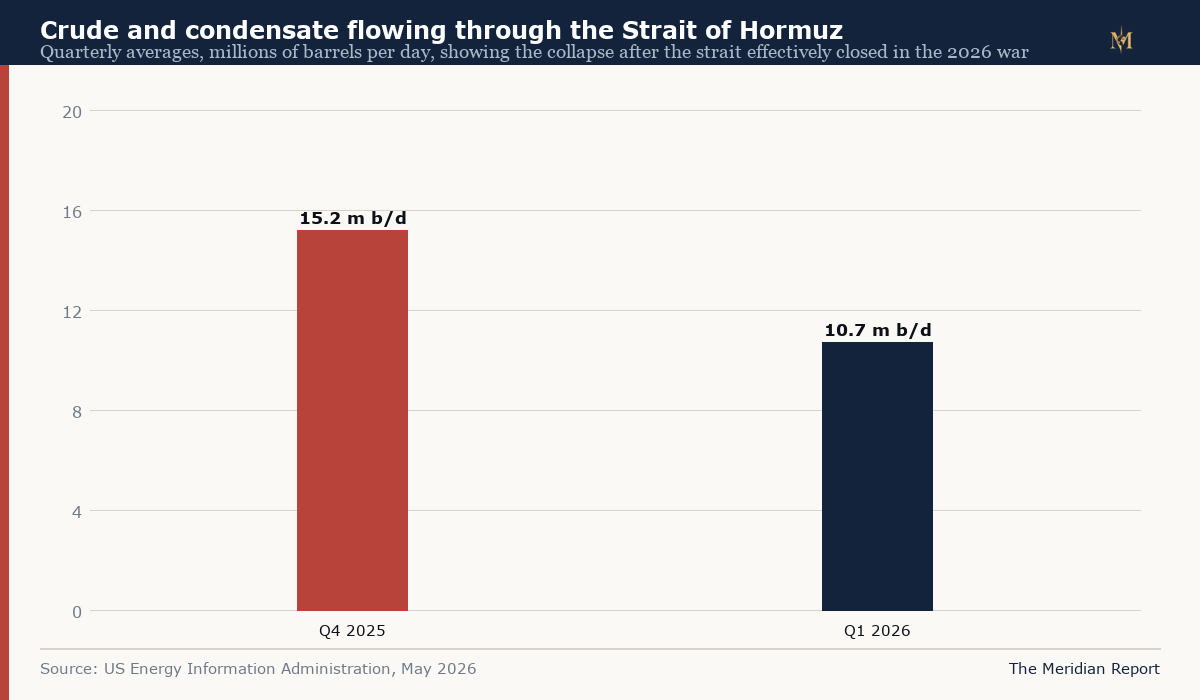
The Strait of Hormuz carried about a fifth of the world's oil until February. The war closed it, the price spiked, and the system adapted, in the way the system always adapts: by finding the pipes. Saudi Arabia has pumped westward through its East-West pipeline to the Red Sea, a line running from the Abqaiq field complex to the port of Yanbu with roughly five million barrels per day of nameplate capacity, most of it now committed. Abu Dhabi and others have used overland and alternative routes where they exist.
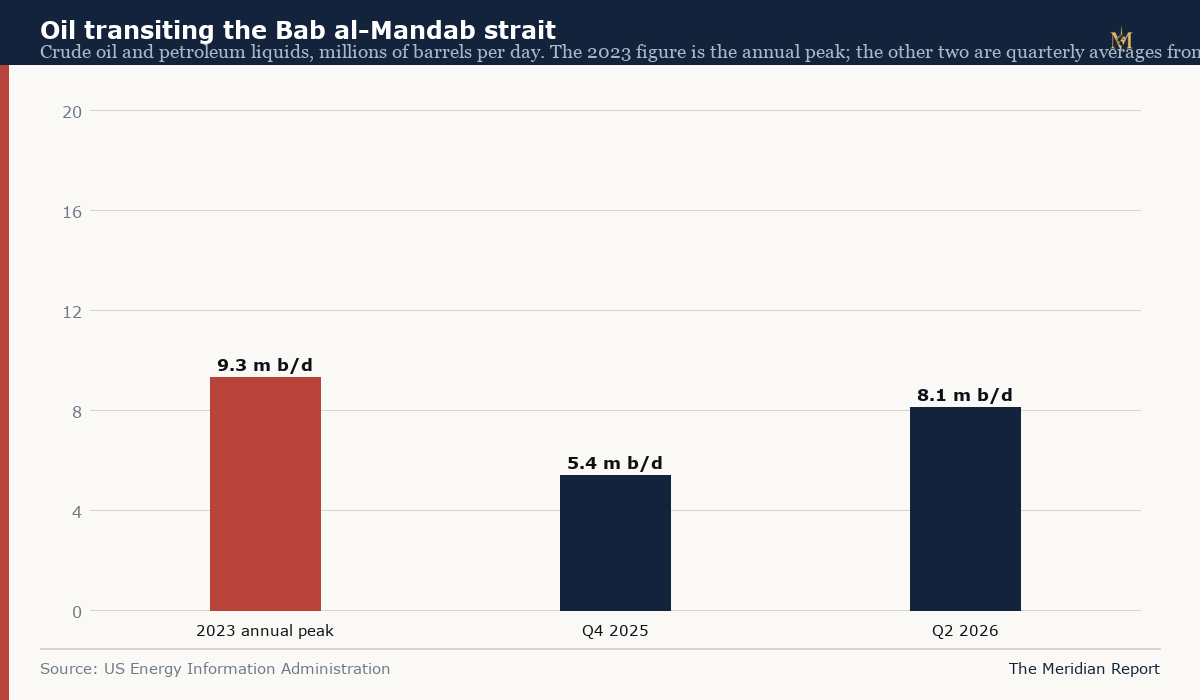
The adaptation worked. It also concentrated the problem. Every barrel the pipeline saves from Hormuz must exit through the Bab al-Mandab, the 29 kilometre passage between Yemen and the Horn of Africa, whose 2023 peak flow of 9.3 million barrels per day made it the fourth most important oil chokepoint on Earth. The Energy Information Administration's data shows what the war did to that strait: crude and liquids transiting it averaged 5.4 million barrels per day in the final quarter of 2025 and 8.1 million in the second quarter of 2026, a rise the agency attributes directly to Saudi rerouting.
The strait that absorbed the rerouted barrels has a shoreline controlled by a force at war with the country that owns the pipeline.
The offensive that moved the front to the water
In mid-September, Houthi forces charged down Yemen's western coast and seized territory from government-aligned forces, including the Yemeni side of the Bab al-Mandab strait and the island of Mayyun, which sits athwart the strait's shipping lane, according to reporting from the International Crisis Group, the Associated Press and regional outlets. The Iranian Revolutionary Guard Corps reportedly guided and armed the offensive, which opened what is effectively a second front in the seven-month-old war. Houthi forces are also ramping up attacks on Saudi territory and its energy facilities, pulling Riyadh more deeply into a war it had managed to keep at arm's length since February.
The strategic fact is geometric. The chokepoint that carries the war's rerouted oil is now held, on its Arabian shore, by the war's most capable non-state force, one that demonstrated between 2023 and 2025 that it could and would strike commercial shipping in those waters with missiles, drones and boats.
The second front on land
The offensive's target list extended beyond coastline. In the same weeks, Houthi forces stepped up attacks on Saudi territory and its energy facilities, according to American network reporting, pulling Riyadh more deeply into a war it had largely avoided fighting directly since February. Saudi Arabia is simultaneously the country whose rerouted exports flow through the strait and the country whose infrastructure is being struck by the force that holds the strait's shore. That dual exposure has no precedent in the shipping crises of 2023 to 2025, when the Red Sea route was disrupted while Gulf export infrastructure stayed physically safe.
The displacement on the ground is running alongside. The Houthis' advance through territory along Yemen's southern Red Sea coast has taken new ground and displaced more people, in the assessment of United States public radio reporting this week, adding a humanitarian dimension to a corridor already crowded with war risk.
What the system can and cannot absorb
The exposure is measurable. Roughly 8 million barrels per day now transit Bab al-Mandab, about two thirds above the level of a year ago. Saudi Arabia's East-West line has little remaining headroom: roughly 2 million barrels per day of its five million in capacity feeds Saudi refineries on the west coast, and the pipeline's operators were reported in July to be studying an expansion, which takes years, not weeks. The Suez route's cargo, LNG from Qatar and Egypt's own transit revenue, add exposure beyond crude.
The offsets are real but partial. A share of Gulf production can still reach Asia on the long route around the Cape of Good Hope, at higher cost and longer sailing time. American strategic and commercial inventories are fuller than in previous shocks. And the United States Navy has kept a substantial presence in the Red Sea since 2023, though the Houthi ground advance has now given that force a land problem to accompany the sea one: interdiction from ashore is a harder mission than interdiction from a coastline.
What the system cannot do is substitute for the strait itself. There is no pipeline across the Horn of Africa, no canal alternative, no overland route from Yanbu that reaches Asian markets without passing a Houthi-held coast or clearing the Gulf of Aden. The 2023 to 2025 shipping crisis in these waters was resolved by deterrence that never had to close the strait. This offensive has changed the map that deterrence was built on.
Why the market is not panicking, yet
Brent crude has fallen for four consecutive sessions, closing Monday around 101.73 dollars, roughly 15 percent below its March peak. The market's pricing reflects what it can see: no strait closure, no attack wave in the strait itself since the offensive, talks continuing. The Houthi advance is a fact on land, not yet a fact in the water.
That is the correct reading of present evidence, and it is also the fragile one. The strait's traffic includes the very barrels the market's own adaptation routed there. A closure would not remove supply from the system so much as strand the workaround: the pipeline that saved Hormuz's volume from one chokepoint delivers it to another. The war's first energy shock came from a strait the world had mapped. The second one is 29 kilometres wide, it changed hands this month, and the people who hold it have spent three years proving what they can do to ships.