
The A7 Network describes itself as infrastructure. On Thursday the United States government described it as a criminal organisation and acted on the difference.
Three separate instruments went out from Washington on the same afternoon. The Financial Crimes Enforcement Network proposed a rule that would prohibit banks from transmitting funds involving the network's sub-agents, a step that requires banks to freeze rather than merely report. FinCEN issued an alert listing red flags that institutions should look for. And the Office of Foreign Assets Control sanctioned the A7 Network itself as a significant transnational criminal organisation, which blocks its property and interests in property, and sweeps in any entity owned 50 percent or more in aggregate by blocked persons.
The network was created and backed by already-sanctioned individuals. Treasury identifies Ilan Mironovich Shor, a sanctioned and convicted criminal fraudster, as its leader. Individual A7 entities were first designated in August 2025, including A7 LLC and Old Vector LLC. What changed on Thursday is that the architecture between them is now itself a target, and the United Kingdom's National Crime Agency had already published an alert on the same network on 31 August.
The number the network gives about itself
Treasury's release contains two figures that measure different things, and it reports both without measuring the distance between them.
The first is the network's own. According to Treasury, the A7 Network claimed as of January 2026 to process more than 2,000 transactions a day, with a total volume above 7.5 trillion rubles, which the department put at a dollar equivalent of $91.5 billion, or roughly 13 percent of the Russian Federation's foreign trade transactions in 2025.
The second is what investigators could prove. FinCEN's investigation identified that the sub-agents processed more than $17 billion between January 2025 and June 2026, aggregated globally.
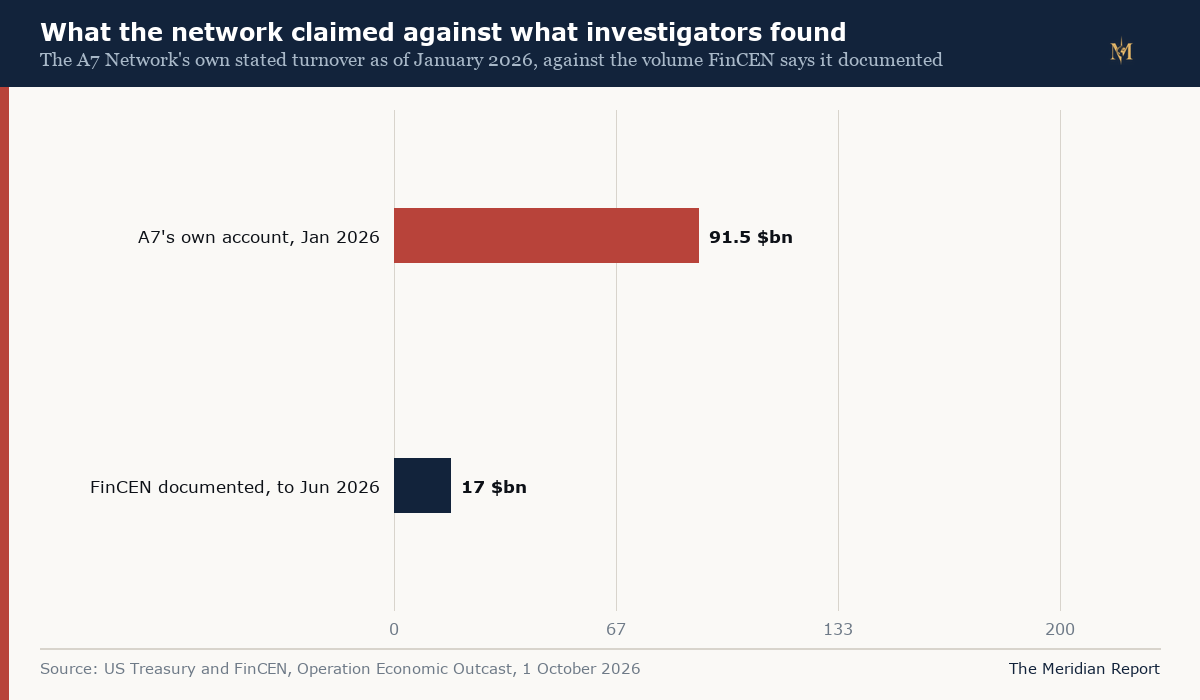
Nothing in the announcement suggests the $17 billion figure is a fraction of the real activity. A laundering network's business is precisely the part that does not appear on any ledger FinCEN can seize. But the two numbers cannot be added, compared or averaged, because they are not the same kind of claim. One is a marketing figure, produced by the subject of the investigation and measured over a single month. The other is an enforcement finding, measured across eighteen months and limited to what could be documented.
Why the network matters more to Tehran than to Moscow
Treasury's account of the Iranian dimension is specific rather than rhetorical. It says the same sub-agents that enable Russian illicit finance created pathways for the Central Bank of Iran, the Revolutionary Guard Corps and Iran-backed terrorist organisations to move money through the international financial system.
The named flows are small. One sub-agent transacted directly with entities involved in Iran's shadow fleet, and that sub-agent and its sister company received nearly $140 million from entities involved in Iranian sanctions evasion. A separate sub-agent moved about $1.6 million to a company linked to Iranian sanctions evasion and weapons procurement. Those are the amounts investigators could trace to a named counterparty, not the value of what the network carries.
The architecture is described in operational terms rather than financial ones. The sub-agents are companies incorporated in third-country jurisdictions whose websites and bank accounts are controlled by network staff, who reach the accounts through custom-built virtual private networks that mask their true location. Payments can therefore be executed quickly, and the counterparty on paper does not resemble the party receiving the money.
The network has also issued its own instrument. The A7A5 is a blocked, ruble backed token issued by Old Vector, created so that members could transact internationally and generate revenue for the sanctioned infrastructure providers that keep it running. Treasury also links the network to Nobitex, Iran's largest digital asset exchange, which OFAC designated on 2 June 2026.
The industrial designations alongside it
In a separate release the same day, Treasury sanctioned Iran's automotive and rail industries, describing them as among the last significant elements of Iranian industrial infrastructure deeply intertwined with the Revolutionary Guard.
The rail designation rests on an unusual rationale. Treasury argues that Tehran has come to rely on the sector amid the ongoing US naval blockade in the Gulf of Oman, which is a sanction rationale built on wartime substitution rather than on double use.
The automotive designations reach well outside Iran. Treasury named companies in Indonesia, the United Arab Emirates, Turkey and Hong Kong that supply parts, and two China based steel companies, Shanghai Ruimi Import and Export Trade Co. and M and R Steel Co., over their alleged work on behalf of Ramin Kashvardoust, a Hong Kong based businessman whom Treasury describes as Iranian and Dominican. Two companies is a small number, and Treasury's own framing of the strategy is that the rest of the global economy will do the enforcement the United States cannot.
Treasury's own account is that the blockade has squeezed Iranian oil revenue enough that Washington can now move to other sources of income. Whether designating two domestic car producers that between them make more than 90 percent of Iran's cars changes the arithmetic is the question nobody in Washington has yet answered with a number.