
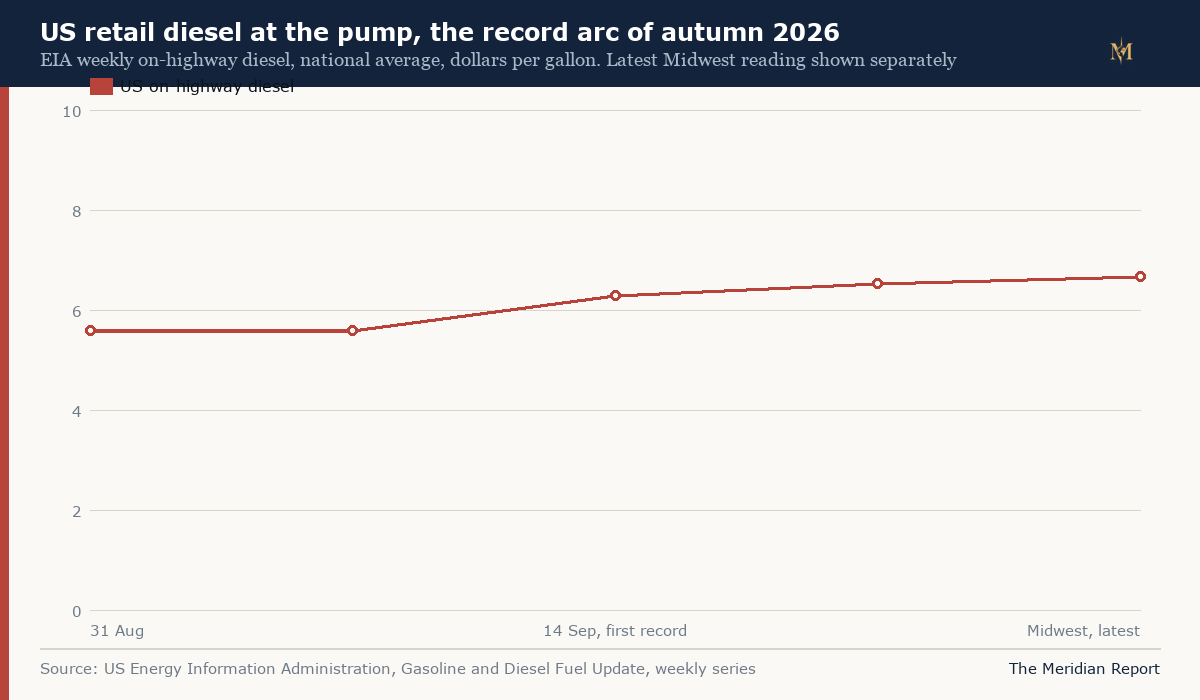
The federal government's weekly fuel survey has spent September doing something it has never done before. The Energy Information Administration's on-highway diesel series, the number the American trucking and freight economy prices against, printed $6.285 a gallon on 14 September, its first record of the month, up from $5.599 two weeks earlier. It printed $6.529 a week later. The Midwest, the region through which the country's grain, livestock and freight corridors run, stood at $6.68 in the latest reading, 80 percent above its level a year ago. A war that began in the Persian Gulf, and a drone campaign fought over Russian refinery complexes, now has a mailing address at every truck stop in the United States.
What the record actually measures
The weekly series is a survey of pump prices, not a commodity quote, which matters for reading it honestly. It lags the wholesale market by days, it is a national average rather than any driver's price, and its records arrive in print three days after the market conditions that caused them. What it measures with unmatched authority is what the economy actually pays at the pump, and by that measure the autumn of 2026 now holds every weekly record the series has. The 2026 year-to-date average through early September, about $4.90 a gallon, was already the highest on record before this month's surge lifted the entire curve.
The arithmetic of the surge has two engines, and the report's coverage has documented both. The first is the Gulf: the closure and partial reopening of the Strait of Hormuz put a war premium into every barrel of crude on Earth, and Brent's move from $71 in January to above $100 through September passes into the pump price with refiners' margins attached. The second is specific to diesel: Ukraine's campaign against Russian refining, which has cut or halted half of Russia's six top diesel-exporting refineries this month by Reuters' count, removed a major swing supplier from the international distillate market just as the northern hemisphere entered harvest and heating season. Diesel is the one petroleum product whose trade is genuinely global and whose substitute supply is thin. The result is the divergence every motorist can see: gasoline at a national average around $4.48, painful but short of records, diesel above $6.50 and rewriting them weekly.
The transmission chain, in order
A diesel record becomes an economic event through a sequence with well-studied lags, and the sequence is now running. Fuel surcharges in freight contracts reset first, within days to weeks. Long-haul rates follow, because diesel is roughly a fifth to a quarter of a carrier's operating cost at current prices. Food distribution prices adjust next, along with construction materials and rail cargo, each with margins attached. Agricultural costs are the politically sensitive link: harvest demand is the seasonal peak of farm fuel consumption, and the Midwest's $6.68 arrives precisely as combines roll, with fertiliser, drying and transport all diesel-denominated.
The inflation timing is the part Washington is watching. Consumer price indices capture fuel directly, but the larger effect travels through the goods whose transport just got more expensive, arriving with a one-to-two quarter lag. That arithmetic places the September diesel records in the winter inflation prints, weeks after the midterm elections whose campaigns are already being fought over grocery prices. Political science and freight economics rarely meet this neatly.
What turns the arc
Three things would bend the curve, and each is observable. The reopening of the Strait of Hormuz, the event the government's own forecaster assumes when it projects Brent averaging $90 in the second half of 2026, would remove the war premium from the crude feedstock within weeks, as the April-to-June round trip demonstrated when Brent fell from $118 to its pre-war level on the June memorandum's signature alone. The second is Russian refining recovery, which the strike data shows resuming more slowly than damaged: every week the diesel refineries stay down tightens the distillate market further. The third is demand destruction, the quiet mechanism by which high prices eventually ration themselves, visible in freight volumes and airline schedules with the same lag as inflation.
None of the three is currently running. The strait is partially closed, the strikes continue, and demand has not yet blinked. The weekly survey will print again on Tuesday, as it always does, and the honest reading of this month's records is that they describe a market waiting for one of two calendars to expire: the war's, or the year's heating season. Until one does, six-dollar diesel is not a spike. It is the new benchmark the entire American cost structure is quietly repricing itself against.