
Every few years, the same scene repeats in the Gloucestershire countryside. Residents report their houses shaking. Heavy bombers appear over the Cotswolds, and a field that most of the year runs skeleton operations becomes, within days, a node in an American air campaign. In March 2026 the bombers were flying against Iran, which is why five men were arrested on a dark lane near the base in September, and why an understanding of what Fairford actually is became suddenly relevant.
The short version: Fairford is the United States Air Force's only European airfield for heavy bombers. The longer version, which explains why that single sentence is true, runs back to 1943 and forward through the entire Cold War.
Built to drop an army, not bombs
Construction began in 1943, part of a programme to open fourteen airfields across southern England for British and American troop carrier transports and gliders ahead of the invasion of France. The station opened on 18 January 1944, and by late March its Stirling bombers were towing Horsa assault gliders. On D-Day, Fairford's aircraft carried British paratroopers into Operation Tonga, the airborne landings on the eastern flank of the Normandy beachhead, and later in the year the same crews lifted troops for Operation Market Garden.
That origin is worth holding onto. Fairford's founding purpose was to deliver the maximum possible mass of aircraft and cargo onto a single runway as quickly as physics allowed. The airfield was never designed as a fighter station or a defensive outpost. It was designed for weight.
The 1950 transfer and the logic of distance
In the early Cold War, the British and American governments agreed that elements of the USAF's Strategic Air Command would be based in the UK. The existing American bases in East Anglia, Mildenhall and Lakenheath, sat inside the likely footprint of a Soviet bomber attack, close enough to the threat axis that planners wanted alternatives further back, behind the RAF's fighter defences. Four airfields were selected for SAC units: Brize Norton, Fairford, Greenham Common and Upper Heyford.
In 1950 the airfield transferred to the United States Air Force for strategic bomber operations, and the change that made everything since possible followed: a 10,000 foot runway, completed in 1953. Fairford became a forward base for Convair B-36 Peacemakers from Carswell Air Force Base in Texas, then B-47s held at heightened alert through the worst years of the decade.
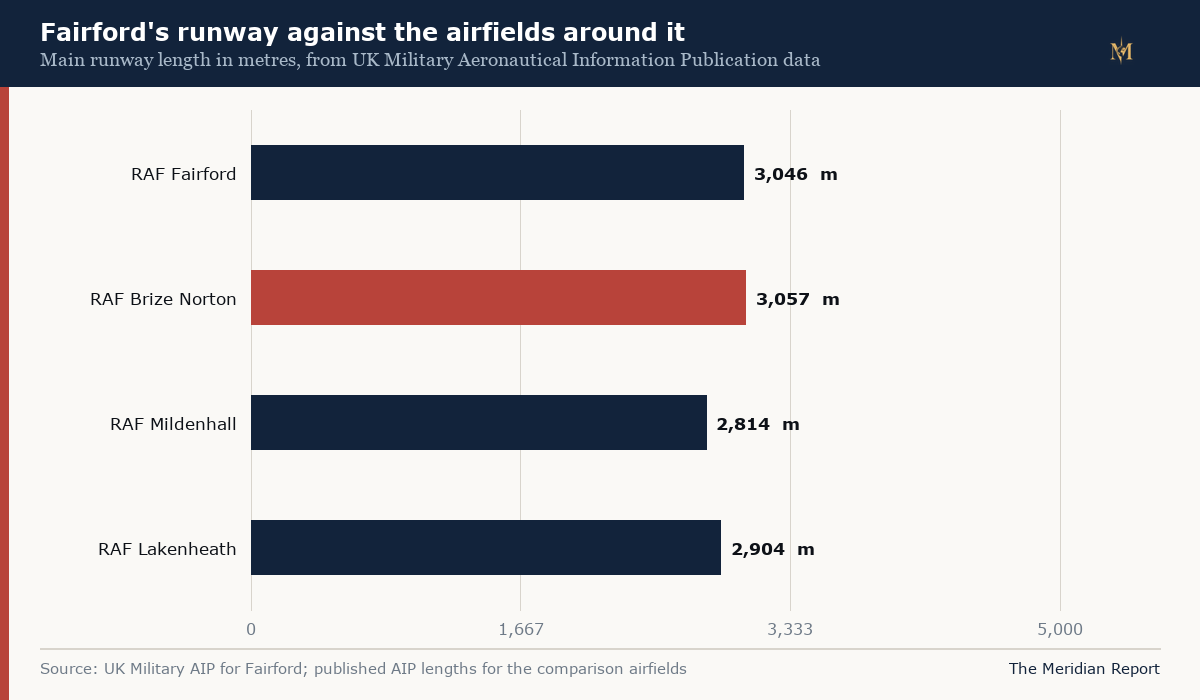
The runway remains the base's defining asset. At 3,046 metres it is among the longest in Europe, and it carries an unrestricted load bearing rating, meaning any aircraft the Americans operate can use it at any weight. That combination is rare enough that it produced a second career entirely separate from war: from 1969 to 1977 Fairford was the British test centre for Concorde, and from 1983 until the shuttle programme's end it was the UK's designated transoceanic abort landing site for NASA's Space Shuttle, with NASA trained fire and medical crews stationed on the field. A runway rated to land a bomber from Texas at maximum gross weight could also, in principle, land a shuttle in distress.
What actually happens here: the Desert Storm pattern
Fairford's combat record is not continuous but episodic, and the episodes follow a template worth examining. When the United States goes to war in the eastern hemisphere, Fairford reactivates, a provisional bomber wing forms, and the base spends months as a launch point before going quiet again.
The 1991 Gulf War set the pattern. Fairford's B-52s, formally the 806th Bomb Wing (Provisional), formed around a cadre from the 97th Bomb Wing at Eaker Air Force Base in Arkansas, with aircraft and crews drawn from no fewer than six bomb wings across the United States. The first aircraft arrived on 5 February. The wing became operational on 8 February and flew its first mission, callsign Luxor, the next day.
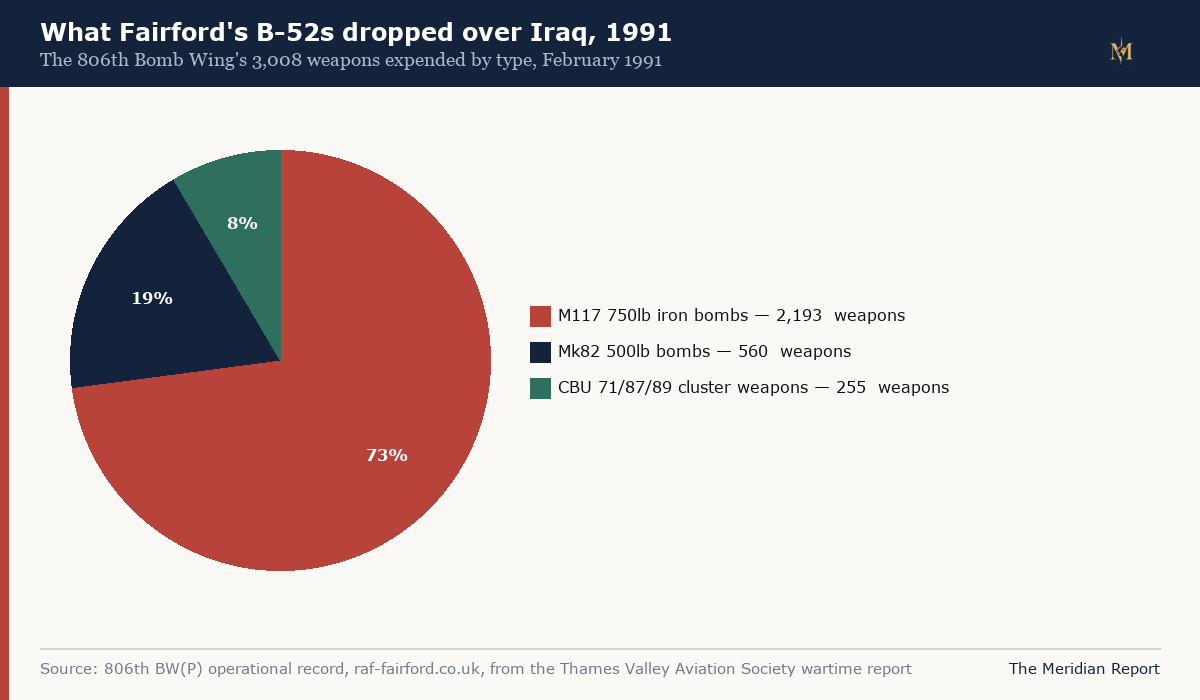
The numbers from that deployment survive in the unit's operational record. Ten B-52Gs rotated through the field. Around 2,000 tons of munitions arrived from 6 February, of which 1,158 tons were eventually expended. The wing dropped 3,008 weapons: 2,193 M117 iron bombs, 560 Mk82s and 255 of the CBU family of cluster weapons, across 62 sorties and roughly 927 combat flying hours. Sortie times averaged 16.3 hours, and the ground crews, who had turned aircraft around in about five and a half hours in peacetime, cut that to 90 minutes.
One number in that ledger explains the whole staging question. The B-52s stationed furthest from their targets consumed a disproportionate share of the USAF's tanker force, drawing refuelling aircraft from Mont de Marsan in France and Athens in Greece for every mission. Distance from the target is not free: it is paid in tankers, and tankers are a finite fleet. A base like Fairford does not bring the bombers closer to Baghdad than a US based wing, but it materially shortens the leg and spares the tanker fleet for the mission itself.
The same template repeated for the NATO bombing of Yugoslavia in 1999, when B-52s from Barksdale and B-1Bs from Ellsworth operated from the field, for the 2003 Iraq War, when Minot based B-52s flew from Fairford again, and for the 2026 Iran war, where the March deployment of B-1s and B-52s came under the British permission for defensive operations against Iranian missile sites.
The hollow-out, and what standby actually means
Between campaigns, Fairford empties. In 2010 the USAF withdrew all its uniformed staff, leaving a civilian operating unit to maintain the base in care and maintenance status. The designation that matters is standby airfield for heavy bomber operations, capable of reactivation within 24 to 48 hours.
The infrastructure was rebuilt for exactly that role. Between May 2000 and May 2002 the runway and fuel systems underwent a $100 million upgrade, the largest NATO funded airfield construction project inside a NATO country since the Cold War's end, and two climate controlled hangars, built at a cost of £12.2 million and completed in December 2004, exist to maintain the B-2 stealth bomber's low observable coating. A field that keeps its uniformed population small between wars but can host the most sensitive aircraft in the American fleet is not a neglected base. It is a deliberately configured reserve.
The peacetime rhythm keeps the option alive. Since 2014 heavy bomber exercises have returned regularly, six B-52Hs arrived in March 2019 in the largest deployment since 2003, and six more flew from Fairford in August 2020 on an exercise that overflew all thirty NATO countries in a single day. Since 2019 the base has also hosted a detachment of U-2 reconnaissance aircraft from the 99th Expeditionary Reconnaissance Squadron, and each July it becomes the world's largest military airshow, the Royal International Air Tattoo, for three days that have nothing to do with any of this.
The legal line the plot tested
The arrangement that puts American bombers on British soil has a legal shape, and the September arrests made it visible. The station is owned by the UK Ministry of Defence and remains an RAF station operated by the USAF under the visiting forces framework. Combat use requires British consent, which is why the March 2026 authorisation for defensive American action against Iranian missile sites was a Starmer government decision, and why protests have followed the bombers in the months since.
That structure is also why an attack on Fairford would not have been simply an attack on an American base. The people who live around it are British, the police who responded are British, and the village that spent Sunday night at a leisure centre in Cirencester is inside a jurisdiction whose government chose, in March, to make the field's mission possible. The war the bombers fly to is fought in the eastern hemisphere. The risk attached to flying them from Gloucestershire stayed at home, which is the bargain the 1950 transfer struck and the one the base's neighbours have lived beside for seventy six years.