
Every radar in the missile-warning story has one limitation in common: it can only see as far as the horizon, and the horizon is close. A conventional radar watching a cruise missile flying at rooftop altitude sees it when it is about 40 kilometres away. Even a tall radar tower watching an airliner at cruising altitude sees it from roughly 400 kilometres. The Earth's curvature, not the radar's power, sets the limit. Over-the-horizon radar is the one family of sensors that refuses the premise. It throws its signal upward, lets the ionosphere bend it back down past the horizon, and reads the echoes that come back from targets a thousand to three thousand kilometres away. The physics is easy to state and so hard to operate that only a handful of nations have made it work; the one that made it work best is Australia, and its technology is now being bought by Canada to watch the Arctic approaches that the Greenland agreement and the NORAD rebuild are organised around.
The problem the horizon sets
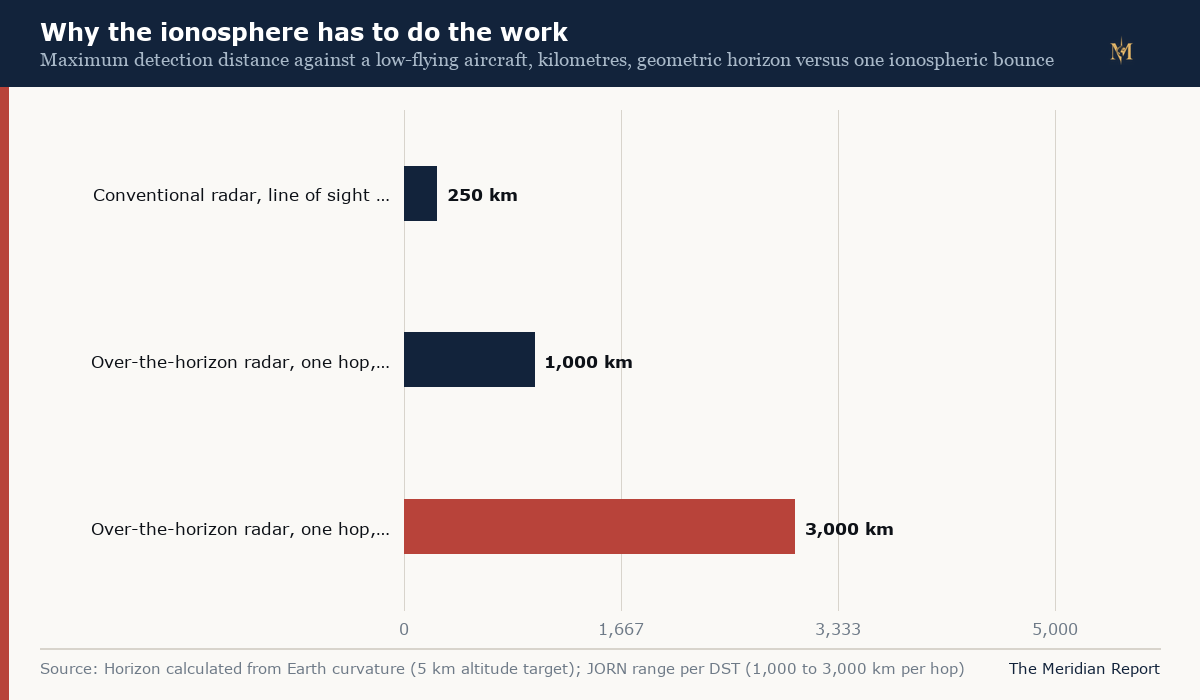
A radar is a flashlight for radio waves, and radio waves travel in straight lines unless something bends them. The Earth curves away beneath the beam, and the distance at which the beam leaves the surface depends on the target's height. Against a low-flying cruise missile, the geometric horizon sits near 40 kilometres. Against an aircraft at 5 kilometres altitude, near 250 kilometres. Every line-of-sight radar in the world, from an airfield approach radar to the 3,000-mile phased arrays at Pituffik, fights the same curvature, and those big missile-warning radars only reach their enormous ranges because their targets are ballistic missiles climbing high above the Earth, where the beam has millions of square kilometres of sky to work with.
The gap this leaves is the low-altitude gap. Anything that flies below the horizon line, cruise missiles skimming the waves, aircraft weaving through terrain, drones crossing the ice, is invisible to microwave radar until it is close. The North Warning System's short-range radars cover the gaps in the Arctic north only by being numerous, and being numerous across Canada's three million square kilometres of northern territory was never affordable. The physics offered one alternative, and it had been sitting in the sky all along.
The mirror overhead
Between 60 and several hundred kilometres up, the upper atmosphere is bombarded by solar ultraviolet and X-ray radiation that strips electrons from gas molecules, producing layers of ionised gas: the D layer near 60 to 90 kilometres, the E layer near 100 to 120, and the F layers from 200 to 400 kilometres. These layers are transparent to visible light and opaque to some radio frequencies, in the same way a glass window is transparent to light and opaque to certain infrared. A high-frequency signal in the 3 to 30 megahertz band, the band shortwave listeners know as the crowded, static-prone home of international broadcasts, entering the ionosphere is gradually refracted, bent, as it travels through the charged gas, and if its frequency is low enough and the layer dense enough, the bending turns it around entirely and sends it back down toward the ground.
That is a skip. Amateur radio operators ride these skips every day to talk to continents. An over-the-horizon radar is a skip with a purpose: it transmits a shaped high-frequency beam a few degrees above the horizon, the signal refracts down from the ionosphere a thousand or more kilometres away and illuminates a patch of earth, sea or airspace, and any moving object in that patch scatters some of the energy back up to the ionosphere and down again to the radar's receiver, which sits at a separate site kilometres away from the transmitter to escape its own transmission. The journey is thousands of kilometres each way, and the radar measures three things about the echo: how long it took, which tells the range band; which direction it came from, which tells the bearing; and how its frequency shifted, which tells the target's radial speed. The last measurement, the Doppler shift, is the quiet miracle of the system: high-frequency waves are long, so a target's small motion shifts their frequency measurably, and the shift is precise enough to sort a jet from a propeller aircraft and to measure ocean waves from a storm a continent away.
Why the mirror moves
The ionosphere is not a polished mirror; it is weather. The F layers are stronger by day, when the sun's radiation generates ions faster than they recombine, and weaker at night, which is why shortwave broadcasts shift between frequencies at dawn and dusk. The D layer, which absorbs high-frequency signals rather than refracting them, is present by day and vanishes at night, changing which frequencies work and how far they carry. A working over-the-horizon radar therefore never sits still: it continuously sounds the ionosphere, chooses a operating frequency from the live conditions, and steers its beam by frequency and geometry to put its illumination patch where it needs one. Modern systems do this with phased arrays, long rows of antennas, Jindalee's Alice Springs transmitter array is 2.8 kilometres long, that steer and shape the beam electronically and broadcast across a band of frequencies at once.
Then there is the noise. The same long wavelengths that make the Doppler shift measurable make the radar deaf to precision: its resolution cell is kilometres wide, so a single echo is a blur of everything moving in a patch of sea or sky. Extracting a target is a statistical problem, done by long integration times, tens of seconds per dwell, and by processing that stacks measurements across frequency and time until moving things separate from the ocean and the terrain. And in the high latitudes the noise has teeth. The auroras that light Arctic skies are the visible sign of charged particles pouring down magnetic field lines into the upper atmosphere, and the same events that paint the sky disturb the ionosphere exactly where a polar radar's mirror has to be: signals get absorbed, layers scatter instead of reflect, and the moving plasma itself returns Doppler-shifted clutter that can bury every aircraft in the sector. Early studies of high-frequency radar operations identified these disturbances as the defining problem of polar operation. It is the reason the Arctic, precisely where the cruise-missile corridor is, was the last place the technology matured rather than the first.
Jindalee: the forty-year proof
Australia's path to over-the-horizon radar began not with a military requirement but with ionospheric research at the Weapons Research Establishment in the 1950s, work driven at first by the practical business of keeping high-frequency communications alive across vast distances. In 1970 the high-frequency over-the-horizon radar became a core research project, and in the mid 1970s the first experimental radar was built at Alice Springs in central Australia. The prototype, later called Jindalee Stage A, was modestly powered, stared through a narrow beam, and its antenna array was a quarter the length of what stands at the site today. It found aircraft at long range, later ships, and it taught Australian scientists the operational lessons that no simulation could: how the ionosphere behaved hour to hour, which frequencies survived the dawn, what the ocean returned.
From 1971 to 1987 the programme moved from concept demonstrator to proven capability. Two further radars, at Longreach in Queensland and Laverton in Western Australia, joined Alice Springs, and in 2003 the network was commissioned as JORN, the Jindalee Operational Radar Network, operated by the Royal Australian Air Force from the Battlespace Surveillance Centre at Edinburgh, near Adelaide. Each radar pairs its transmitter array with a receiving array tens of kilometres away, the separation keeping the sensitive receivers out of their own transmitters' way, and each illuminates a fan of territory to Australia's north. The published range figures run from 1,000 to 3,000 kilometres from the array, and the network's coverage spans the sea-air gap from the Indian Ocean to the Pacific, watching Australia's northern approaches the way the American early warning line watches the Arctic.
Two details of the record deserve notice. First, the capability is more than a detector: JORN's Doppler processing can pick ship wakes out of sea clutter and classify aircraft by their engine signatures, and the network has been integrated into Australia's air and maritime operations, border protection and search-and-rescue for two decades. Second, the industrial base behind it runs deep: BAE Systems Australia has supported and maintained the network since the 1980s and led its $1.2 billion Phase 6 upgrade with more than 110 Australian suppliers. JORN is not an experiment that worked once. It is the operating proof that skywave radar can be run as a durable, upgradeable national capability.
Canada buys the mirror for the Arctic
Canada's defence problem inverts Australia's geometry. The northern approaches to North America, the corridors a cruise missile would fly toward the continent's population centres, cross territory too vast for line-of-sight coverage and too disturbed for easy skywave work. Canada's June 2022 NORAD modernisation plan, a $38.6 billion package announced by the government, included a project to close exactly this gap, and the project's solution is to buy the most proven skywave radar on the market.
The route is unusual and telling. Rather than developing its own design, Canada signed a government-to-government acquisition arrangement with Australia, formalised in Canberra on 22 June 2026 by procurement secretary Stephen Fuhr and Deputy Prime Minister Richard Marles, under which Australia contracts BAE Systems Australia to deliver a JORN-derived system for Canada's Arctic Over-the-Horizon Radar programme. The agreements signed alongside it, an OTHR rights agreement covering technology and intellectual property and an industrial benefits agreement requiring Canadian industry participation to the maximum extent possible, buy Canada not just hardware but forty years of Australia's operating experience. Canada's own project documentation puts the funding range above $5 billion, sites the system in southern Canada, from where the skip geometry looks north over the polar approaches, and sets Stage 1 initial capability for December 2029, with the programme now formally in its delivery phase.
The reasoning traces straight back through the physics. A southern site bouncing signals off the auroral-zone ionosphere reaches the Arctic Ocean approaches without building a radar line across the tundra; the system needs no forward infrastructure to survive in; and its wide-area fan covers the corridor that short-range radars could only watch piecemeal. It is the same trade the NORAD modernisation makes everywhere: fewer exquisite sensors on the ice, more resilient reach from farther south, with the space-based and terrestrial layers filling in what the ionosphere's mirror cannot resolve.
What it can and cannot see
An over-the-horizon radar's honest specification is a triage, not a triumph. It sees big things that move across thousands of square kilometres: aircraft of every size, ships, and the wakes they leave. It measures their range coarsely, their bearing well and their speed precisely. It cannot see small things cleanly, cannot give a missile battery a firing solution from its own data, and cannot be relied on in the hours when the ionosphere is changing state or during the solar storms that hit high latitudes hardest. That is why the architecture it belongs to is layered: the skywave radar cues, the space-based infrared sensors detect the launch, the ground-based phased arrays at Pituffik and its sister sites track anything that climbs, and the interceptors and fighters finish whatever the fan handed them.
The technology's story is also a quiet lesson in how defence capabilities actually mature. The ionosphere's reflectivity was known to radio engineers in the 1920s; the military idea took shape in the 1950s and 1960s and consumed large budgets in the United States and the Soviet Union through the Cold War; but the nation that made it an everyday operational capability was the one that treated it as a forty-year scientific programme rather than a crash project, and the world is now queuing at its door. The mirror overhead is free. Making it work, every hour, in every season, at the top of the world, is what forty years buys.