
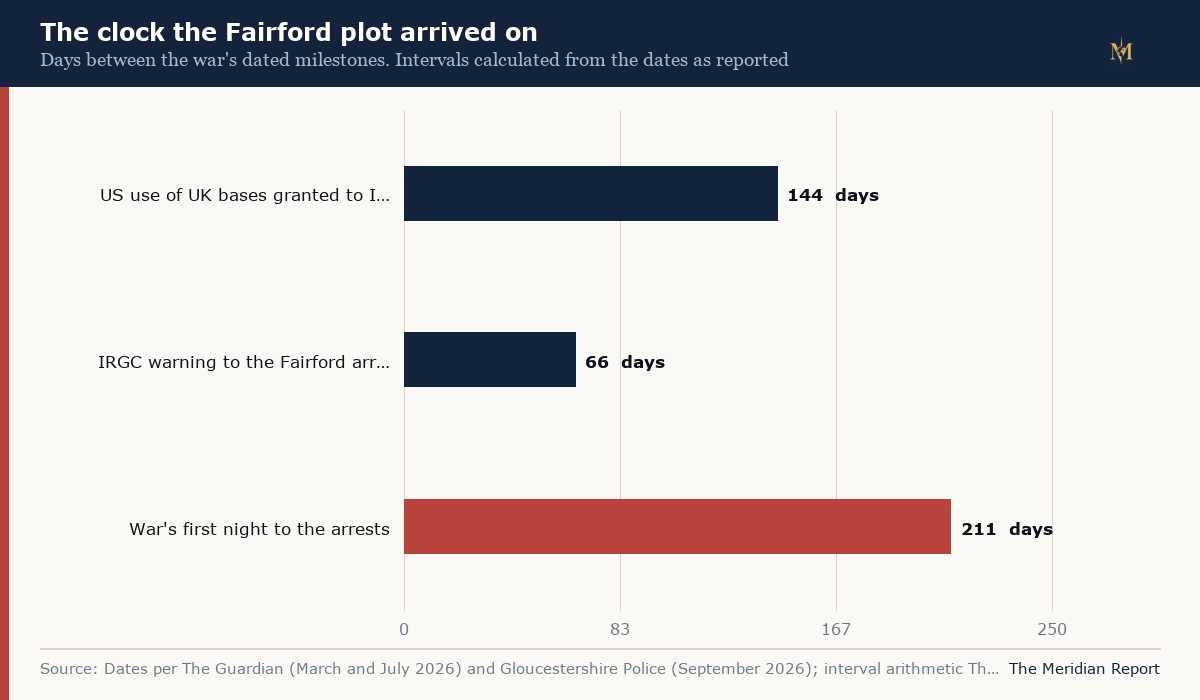
The warning was precise in a way that has made it evidence. On 23 July, after the twelfth consecutive night of American strikes on Iran, the Revolutionary Guard Corps published a statement on the Tasnim news agency declaring that any base used for aggression against Iranian territory constitutes a legitimate target for our forces, and noting that American bombing missions had launched from RAF Fairford in Gloucestershire two days earlier. The statement's grammar drew a line from an American act to a piece of British sovereign territory, and it held the line open.
Sixty six days later, five men were arrested in the lane beside that base, and bomb robots spent a Sunday examining materials whose initial assessment described them as consistent with improvised explosive devices. Counter terrorism police are investigating whether Iran had anything to do with it. The investigation is live, no origin has been established, and this explainer asserts nothing about the men in custody. What can be examined without them is the doctrine itself: what the Guard means when it declares a base legitimate, where Iran has enforced that doctrine in this war, and what the warning would legally imply if the investigation ever traced it to Tehran.
The doctrine, in the Guard's own practice
The legitimate target formulation is not new rhetoric. What makes it operational rather than rhetorical is the pattern of enforcement behind it, which in this war runs in two tiers.
The first tier is direct strikes on facilities that host American forces. On 1 March a drone struck RAF Akrotiri in Cyprus, hitting a hangar and prompting a partial evacuation. On 19 March Iran fired two ballistic missiles at the UK's Diego Garcia base in the Chagos Islands, one failing in flight and the other shot down. On 3 March a ballistic missile struck Al Udeid in Qatar, which hosts the largest American air base in the region, without casualties. In the war's earlier campaign in June 2025, Iran fired a salvo at Al Udeid that Qatar intercepted, telegraphed in advance through the region's usual warning channels, with no casualties, the signature of a strike calibrated to register rather than to destroy. The Gulf states that house American forces, Bahrain, the Emirates and Kuwait, have been struck repeatedly, and American service personnel have been killed in some of those attacks.
The second tier is the threat itself, issued against states whose forces have not fired a shot. That is what the July statement did to Britain: it named a base on British soil as legitimate because of what an allied power does from it.
The two-tier structure is the doctrine's substance. Direct attacks on US facilities rest on belligerent logic: America is a party, its bases are military objectives, and the Guard claims the ordinary right of a belligerent to strike them. The extension to host states rests on something else, a claim about Britain's legal position. The Guard's statement called the monarchy the primary cause of hardships in the region and warned the government against deepening its record, language aimed at a state it treats as a participant, not a bystander. That is a claim about the law of neutrality, and it is worth taking apart, because its legal foundation is weaker than its operational reach.
What the law of neutrality actually says
The classic rule comes from the Hague Convention V of 1907: a neutral state that tolerates on its territory the formation of troops for a belligerent, or the establishment of wireless stations or other means of communication for a belligerent's use, fails its neutrality. The rule's underlying logic is reciprocity, and the construction that has governed since the First World War is the one that matters here: the United States asserted in 1915, while selling munitions to the Allies, that neutrality does not require a state to stop lawful trade, and the belligerents eventually acquiesced. A neutral's duty is impartiality, not austerity. The neutral's duty is impartiality, not austerity.
Britain's position fits squarely into the older, pre-1915 reading that the Guard's statement implies. American heavy bombers have launched from Fairford since March, under a permission granted by the Starmer government for defensive operations against Iranian missile sites, extended under Burnham with a decision notified to the new prime minister. Those are national facilities placed at a belligerent's disposal, the textbook neutral failure under the Hague rules, and if Britain is a neutral that failed, Iran's argument runs, the base loses its protection and becomes what the Guard called it.
The argument has three problems, and each is dispositive on its own. First, Britain does not claim neutrality: London has described itself as acting in accordance with international law, permitting defensive operations, and its government has been open that the permission was granted, which is not toleration but authorisation. A state that authorises another's use of its territory for force against a third state is not a failed neutral; it is a state whose conduct must be measured by the law governing resort to force and the conduct of hostilities, not by a neutrality it has abandoned. Second, the United States claims a right of collective self defence against Iran, a claim Iran's own June 2025 strike on Al Udeid, and its attacks on American forces since February, have reinforced rather than undermined in Western eyes; a belligerent acting in self defence may lawfully accept assistance from a consenting state. Third, the doctrine's enforcement tier stops at the neutral's own weakness: even if Britain's conduct were a wrong, the lawful response to a neutral failure is not attack but the remedies the law of neutrality itself allows a belligerent, principally against the violating traffic, not against the neutral's sovereign territory. The Hague rules were written for exactly that reason: to prevent the great powers' wars from consuming every state between them.
None of this makes Fairford untouchable in fact. It makes the Guard's warning, as law, an argument rather than a conclusion, and a warning is the cheapest instrument a state can issue precisely because it binds nothing.
Warning, targeting, and the two laws that apply
Two bodies of law govern any attack on Fairford, and the IRGC's language sits oddly in both.
The law of resort to force, the jus ad bellum, asks whether Iran could lawfully use force against Britain at all. Its touchstone is Article 51 of the UN Charter: no state may use force against another except in self defence following an armed attack, or with Security Council authorisation. Iran's claim would be that Britain's authorisation of American operations makes Britain a party to an unlawful armed attack against it, and that striking the launch point is self defence. The equivalent claim has been made by other states about other bases, and the pattern of international response has been consistent: host state consent to a belligerent's operations is legally effective, and a belligerent attacked from a consenting state's territory may treat the host as a party, but the initial user of force bears the burden of proving the necessity and proportionality of its response against the host state, a burden no tribunal has ever found Iran to have discharged in this war. The lawful response to an unlawful launch from a consenting host, in the settled practice, is against the launching state, not a war against the consenters.
The law of war, the jus in bello, governs conduct once force is used. Its first rule, customary and codified, is distinction: attacks may be directed only at military objectives. Fairford is a military airfield, and its status as a military objective is not in serious dispute; the U-2 detachment, the munitions squadrons and the bomber operations since March are the facts that make it so. But a lawful target under distinction is not a licence. Proportionality would weigh any civilian harm against a concrete and direct military advantage, and precautions would require constant care and, where circumstances permit, effective advance warning of attacks that may affect the civilian population. The IRGC's habit of telegraphing strikes is sometimes read as compliance with that last duty, and the reading does not survive scrutiny: the duty to warn exists for the protection of civilians, and a public threat against a military base is not it. What the Guard's announcements do resemble is the practice of escalation management, calibrated strikes preceded by public notice to shape the target's response and to signal that the attack is bounded.
The Al Udeid precedent of 2025, a salvo against the largest American air base in the Gulf, telegraphed through regional channels, intercepted almost entirely and injuring no one, is the doctrine's operating image. It says the Guard's declaration of legitimacy is a step in a political sequence, not a legal threshold. Iran crossed it against a US facility where the ad bellum argument at least had a belligerent logic. At Fairford, where the target's owner has not fired, the same declaration rests on the weaker foundation examined above, which is perhaps why the July statement warned rather than struck, and why the strikes Iran has carried out against host state facilities in this war, at Akrotiri and Diego Garcia, came early in the campaign and have not been repeated against Britain since.
The arrests, and the other law that would apply
If the Fairford investigation ever traced the plot to Tehran, a different body of law would take over, and its precedents are European.
Iranian state direction of violence on European soil has been litigated. In Belgium, the diplomat Assadollah Assadi was convicted in 2021 and sentenced to 20 years for masterminding a plot to bomb an Iranian opposition rally outside Paris, a case in which the court rejected his immunity claim and the German prosecutors' evidence established his delivery of the device from the embassy in Vienna. Iranian agents have been convicted in the United States and Europe for surveillance and plotting against dissidents and, in the American case, for the kidnapping plot of Masih Alinejad. In 2022 Germany's Federal Court of Justice convicted an Iranian intelligence officer of crimes against humanity for the role of Iranian leadership in the 1992 Mykonos restaurant assassinations, and held that such convictions do not violate the immunity of state officials, because international crimes cannot be clothed in state immunity.
Those cases establish what a Fairford conviction could trigger. A finding that Iranian officials directed the plot would not make the attack an act of war by itself, but it would put Britain in the position Germany's Federal Court of Justice reached in 2022, when it convicted a former Iranian intelligence officer over the 1992 Mykonos restaurant assassinations and held that such convictions do not violate the immunity of state officials: international crimes cannot be clothed in state immunity. The proposition sits in the same family as the customary rule, long stated, that the peacetime law between states does not shield the instruments of a state's armed attacks. Iran's own conduct at its missions abroad has already produced the precedent of the Tehran Hostages case, where the International Court held that a state's failure to protect a diplomatic mission, and its endorsement of the seizure, engaged its international responsibility. The logic inverts: a state that uses its missions or agents to attack another state's territory engages its responsibility, and the flag of immunity does not cover it.
What the arrests could also settle is the question the July warning raised and the law left open: whether the Guard's declaration of a target's legitimacy is policy or operational direction. The statement named Fairford; the arrests happened at Fairford; the sixty six days between them are the interval an investigator would map. If evidence showed the plot followed the doctrine rather than coincided with it, the case would be the first in which a legitimate target declaration moved from rhetoric to a charging document.
What the warning does and does not change
The honest summary is narrower than either hawks or lawyers would prefer. The IRGC warning does not make an attack on Fairford lawful, because the doctrine rests on a neutrality claim Britain has rejected and no tribunal has validated, and because a declaration is not a licence. It does not make an attack impossible, because Iran has enforced the same formulation against allied facilities in this war, and the record at Akrotiri and Diego Garcia shows the enforcement tier is not rhetorical. It does not create a duty to warn in the legal sense, because the duty exists for civilians and the Guard's notices serve escalation management. What it does change is the calculus of every actor around the base: Britain's air and missile defence posture, which the government described in its July reply; the United States' assumption that European staging is free of the war's risks, which the arrests have already tested; and the legal position of any future attack, which would begin, unlike Akrotiri, from a documented warning naming the target.
A warning that binds nothing can still organise a war's next stage. The one that named Fairford is sixty six days old on the morning of the arrests, and what the investigation finds, or does not, will determine whether the doctrine it announced remains an argument in a statement, or becomes a pattern with a body of evidence behind it.