
Volodymyr Zelensky came to New York this week with a single argument and delivered it in the plainest language he has ever used at that podium. Trade with Russia is not neutral commerce; it is time purchased for the war. Every barrel, every tonne, every transaction that flows through the aggressor's economy flows into its army, which is why Ukraine has stopped asking the world to sanction Russia's revenues and started destroying them itself, with drones, at their source. Russia's revenues must remain a target, he told the General Assembly on Wednesday. When someone gives Russia more money through trade, they give this war more time.
The speech's most quoted line, the description of Putin as Patient Zero, the one from whom the idea of war keeps spreading, was the argument's rhetorical core, and its least interesting part. The interesting part was the accounting: a war now in its fifth year, funded by exports that the sanctions regime has redirected rather than reduced, against a Ukraine that has concluded the fastest route to peace runs through Russia's oil terminals, refineries and export logistics rather than through any communique issued at the United Nations.
The invitation that answered him
Twenty-four hours after Zelensky spoke, Washington's answer to a different question arrived. Secretary of State Marco Rubio announced that President Trump has invited Vladimir Putin to the G20 summit in Miami in December, an invitation designed, in Rubio's framing, to give the Russian leader the chance to engage not just with the American president but with other world leaders. The Kremlin's response landed on Thursday morning: Peskov said Moscow truly appreciates the kind invitation and will work on it before deciding. No European leader required translation. Poland's Donald Tusk said he feared Russia would read it as encouragement to continue its aggressive policies. The European Union's foreign policy chief, Kaja Kallas, called it very hard to understand, and warned that normalising the author of this war guarantees more wars like it.
The sequence, speech then invitation, looks like a contradiction and is not. Zelensky was arguing that pressure works, and asking for more of it. The invitation extends engagement, which Washington presents as a different channel toward the same settlement. Both can be sincere, and the decade's precedent says both will be tested: every previous Trump-Putin encounter has produced warmth, followed by a Russian escalation somewhere, followed by a recalibration. Miami in December would be the first Putin visit to the United States for the G20's purpose since the full-scale invasion, held on American soil, in an election season, with Ukraine's fate as the presumed agenda item and Europe watching from outside the room.
The tactical subtlety is who else is invited to the conversation. Rubio's phrasing, engagement with other world leaders, is the invitation's real product: a Putin appearance in Miami would normalise the Russian leader's presence across the summit's bilaterals, not only in an American one. That is precisely what Tusk and Kallas fear, and precisely why Moscow values it.
The campaign the speeches are about
Neither the Ukrainian speech nor the American invitation would carry the weight they do without the month's other news, which arrived from refinery country rather than diplomatic venues. Ukraine's drone campaign against Russian refining has reached the point where the numbers no longer need adjectives. Reuters counted half of Russia's six top diesel-producing refineries significantly cut back or completely halted in September after strikes. Ukrainian General Staff estimates during the July peak put as much as 43 percent of national refining capacity offline, a figure outside monitors treat as an upper bound but in the right range. The International Energy Agency, whose commentary this month framed the campaign against Russia's 32 major refineries and 6.5 million barrels per day of capacity, describes a sector struggling under intensifying attack.
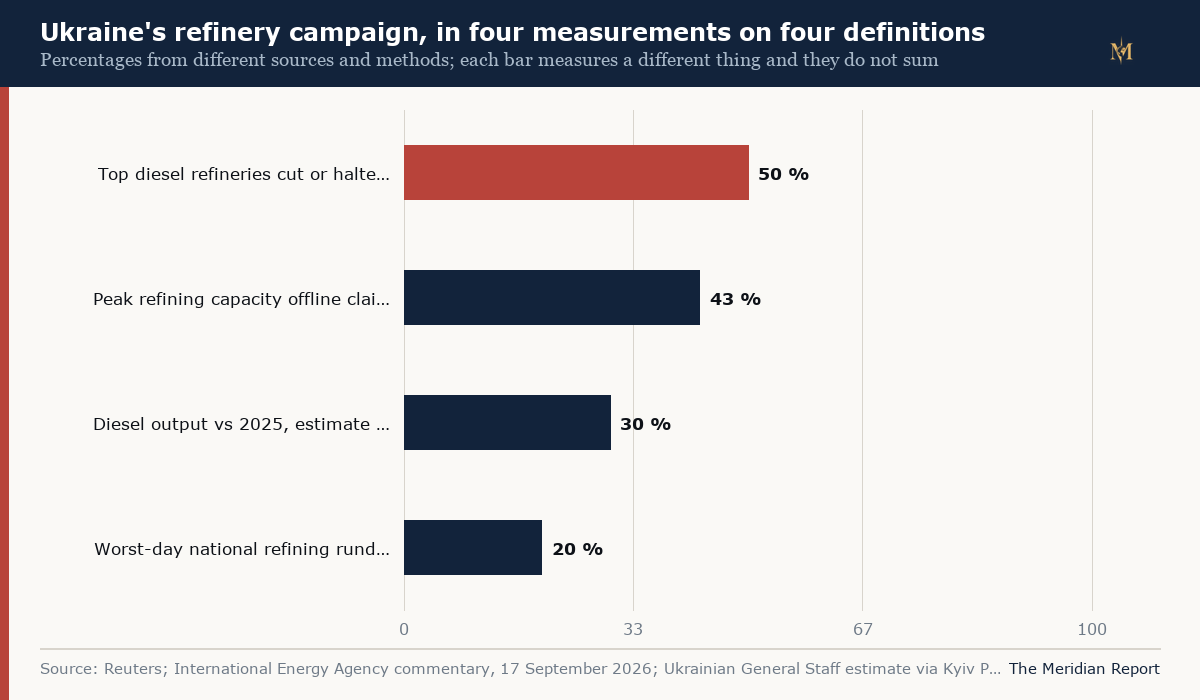
The four bars in that chart measure four different things by four different methods, and no attempt to average them would be honest, because their disagreement is the finding: the campaign has damaged enough of Russia's diesel complex, by any of the measurements, to register in global fuel markets and in American political debates about diesel prices, and the distinctions between its measures are the sort of distinction worth keeping visible rather than smoothing over. Diesel production is estimated to have dropped by nearly 30 percent against 2025 in trade estimates, and Russian authorities have resorted to export restrictions and rationing in the Far East to keep domestic markets supplied. What began as battlefield logistics denial has become a macroeconomic event with a constituency in the American Midwest.
That constituency is the silent third party to this week's diplomacy. Washington has asked Kyiv to pause the refinery campaign, an appeal our earlier reporting documented in the run-up to Tuesday's leaders' meeting, on the argument that global fuel prices are the war's most politically expensive export. Kyiv's answer, delivered in substance if not in words by a week of continued strikes, is that the campaign is the leverage no other actor possesses. Every conversation about an energy ceasefire runs through it.
What Lavrov's pause means
Sergei Lavrov gave the Russian reply at the Security Council on Wednesday, and its wording deserves the attention diplomats gave it. Russia is prepared to negotiate toward a lasting peace, he said, but will not simply pause the war: a ceasefire would only buy Ukraine and its backers time to rearm. The formulation is not new, but its timing is a message aimed at the American calendar. An administration seeking a pre-midterm foreign policy achievement wants a stopping of the guns it can announce. Moscow is offering a settlement it defines, on a schedule it controls, and calling the alternative a pause that profits its adversary. Between an American invitation to Miami and a Russian refusal to stop shooting first, December's summit now has its agenda written by both hosts.
Zelensky, for his part, spent the week offering what he can: an energy ceasefire, a trilateral with Trump and Putin, and continued pressure on the revenues his speech described as the war's oxygen. His position, that the war ends when the revenues end, is now the operating theory of both Kyiv's war-fighting and its diplomacy. The week confirmed it is not yet the operating theory of anyone else's.
Three indicators will tell the next chapter before the speeches do. The first is refinery output in the October data, where a Russian recovery would weaken Kyiv's hand exactly as the Miami agenda is set. The second is the Kremlin's answer on attendance, which converts the invitation from gesture to event. The third is whether Washington's request to pause the strikes survives another week of Ukrainian drones, because that answer determines whether the leverage Kyiv owns remains solely Kyiv's.