
The announcement on 1 October 2026 was not framed as a response to a crisis. It was framed as a decision.
The US Navy signed an agreement with Raytheon for SM-6 multipurpose interceptors, structured as five years with two additional option years, described by the Pentagon as a contract worth $24.4 billion and by the Navy's own description as up to $25 billion. Admiral Daryl Caudle, the Chief of Naval Operations, put the reasoning plainly: "Combat credibility depends on having enough weapons, produced at the speed and scale the Fleet requires." The award, he said, "gives industry the demand signal and stability to expand production, strengthen the munitions industrial base, and build the magazine depth our Fleet needs."
Two facts about that announcement deserve to sit in the same sentence.
The first is that Congress has not appropriated the money. Reporting on the agreement notes that the contract still has to be funded by Congress, and that a continuing resolution was expected to run through at least early December with no full fiscal 2027 defence budget in place. A production commitment has been made against funds that do not yet exist.
The second is that it followed, by sixteen days, the publication of something the Pentagon had never published before. The office of the Under Secretary for Acquisition and Sustainment, the organisation that buys everything the military fires, told investigators that munitions expenditure in Operation Epic Fury "has resulted in strategic inventory shortfalls and revealed industrial base bottlenecks for munitions resupply." On the same day the Congressional Budget Office estimated $38.1 billion in Department of Defense costs for combat operations against Iran through 1 August, and concluded that the United States has "probably used between one-half and two-thirds of its inventory" of Patriot, THAAD, SM-3 and SM-6 interceptors since June 2025.
An unfunded five year contract, signed in response to a documented inventory shortfall, is not a contradiction. It is an accurate description of the situation the department finds itself in. The commitments are real, the production is real, and the appropriation that would pay for it is not.
One word deserves examination before going further, because it appears in both the inspector general's report and the Navy's announcement, and it does different work in each.
In the inspector general's report, "shortfall" is a measured deficiency against a requirement. The document's finding is that expenditure produced shortfalls and revealed bottlenecks, which is a statement about quantity and about the capacity to replace quantity.
In the Navy's announcement, the purpose is described as building "magazine depth," which is a statement about a desired state rather than a deficiency. Magazine depth is the number of rounds aboard a ship before they must be reloaded at port. It is a legitimate and important concept, and it is also a different objective from restoring a national inventory that the Congressional Budget Office estimates has fallen by between a half and two thirds since June 2025.
Nothing in this suggests the Navy is pursuing the wrong goal. It suggests that a fleet magazine and a national stockpile are two different problems, that a five year contract against one of them leaves the other where it was, and that a reader encountering both phrases in the same week should notice which one is being funded.
There is a third word that appears in neither document and that describes the department's actual position better than either. The Navy is not rebuilding an inventory. It is trying to hold a rate of consumption below the rate of production, for the first time since February, by ordering enough missiles that the arithmetic eventually works. That is a harder and slower task than rebuilding, because it requires the war to be finite rather than merely survivable.
Two official numbers, measured with two different instruments
Both figures in circulation describe the same war, and they differ, and the difference is not an error.
The inspector general's report is a mandatory report to Congress covering Operation Epic Fury from 28 February to 30 June 2026. Its most recent cost estimate is $33.4 billion as of 29 June. That total decomposes into $7.4 billion in cumulative obligations, $22.3 billion in expended munitions, and $3.7 billion in equipment losses. It carries a personnel ledger alongside the financial one: 417 service members wounded and seven killed.
The Congressional Budget Office's analysis is an external estimate prepared at the request of Representative Brendan Boyle, ranking member of the House Budget Committee, covering Department of Defense costs through 1 August. It comes to $38.1 billion. Its composition answers a different question, because the budget office separated the bill for munitions expended from the bill for everything else:
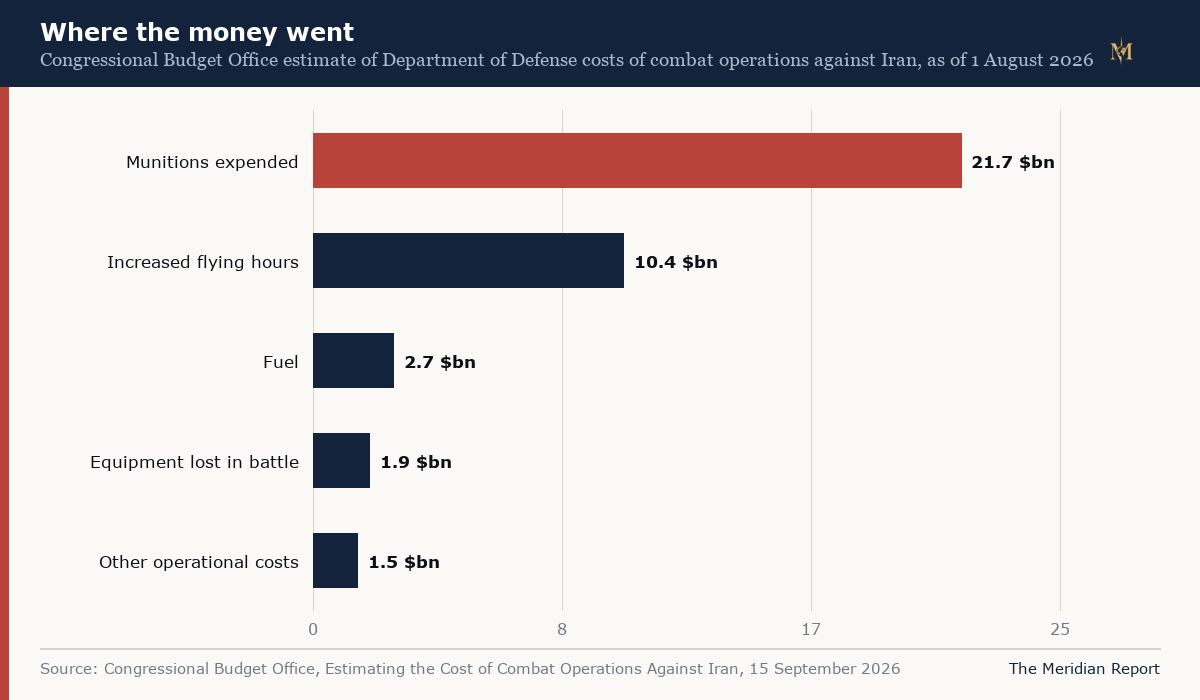
The methodological difference is the interesting part. The inspector general asks the department that spent the money. The budget office could not ask, and said so. The Defense Department declined to respond to the Congressional Budget Office's requests for information, a departure from the norm the agency noted, so its analysts worked from government databases and public reporting and warned that the estimate is "subject to considerable uncertainty."
That warning is the honest reading of both documents. An internal figure produced with full access to contract files is more reliable than an external reconstruction that could not interview anyone. But an internal figure that stops at 29 June cannot describe July, and an external figure that reaches into July cannot separate expended munitions from replacement cost with the same granularity.
Neither number includes the repair of damaged buildings, and that omission is the largest one in either document. The inspector general reported that Iranian strikes "damaged and destroyed hundreds of buildings and structures at U.S. bases in Kuwait, Bahrain, Qatar, UAE, Saudi Arabia, Iraq, Oman, and Jordan," and attached no cost. It is not yet clear, the report said, whether all the bases will be repaired or who would foot the bill. The only figures attached to the damage are repairs to US diplomatic facilities in Iraq, Kuwait, Saudi Arabia and the UAE at roughly $184 million, and $79.2 million of State Department contingency spending, largely evacuation.
The bill that cannot be paid back
Ordinary military expenditure ends. A tank destroyed is replaced, a building is rebuilt, the cost appears in one fiscal year and recedes. Munitions expenditure does not behave that way, because a Patriot or a Tomahawk is consumed the instant it leaves the rail, and the bill for it is not the cost of firing but the cost of replacing it.
That distinction makes the Congressional Budget Office's $21.7 billion figure the load-bearing number in its report. Of the $38.1 billion total, $21.7 billion is the estimated cost of replacing munitions expended through 1 August. It is more than half the bill, and it is the only part that cannot be switched off by ending the fighting.
Its composition is where the interceptor problem becomes concrete:
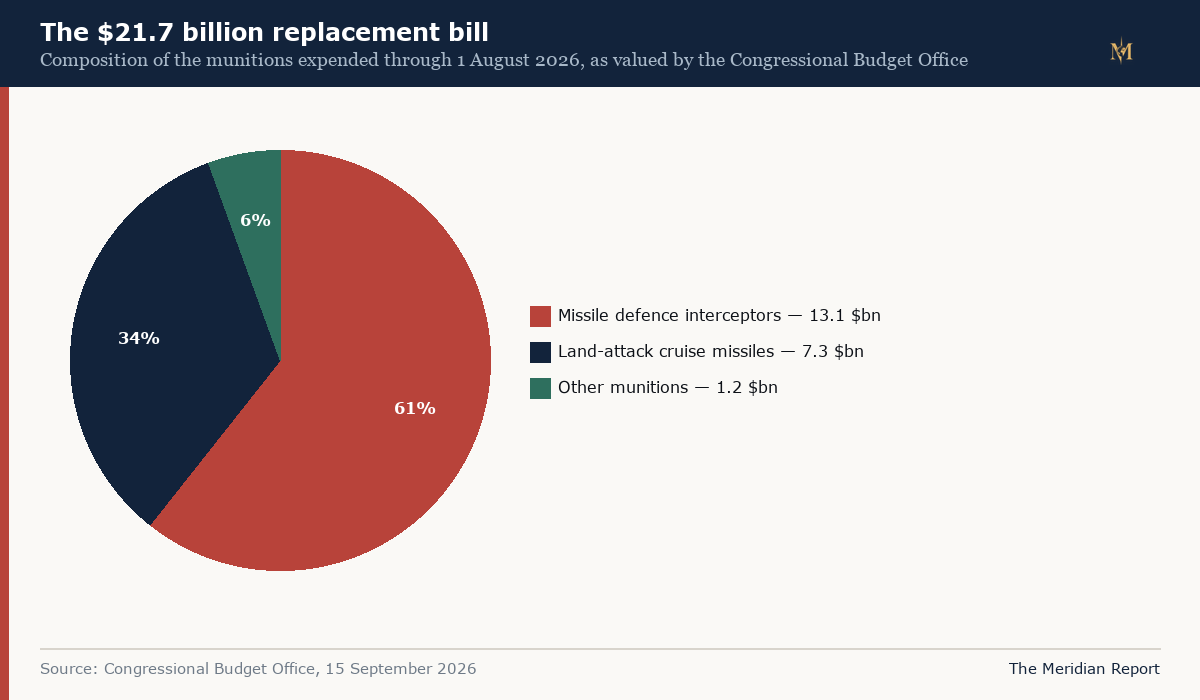
Missile defence interceptors account for $13.1 billion, roughly three fifths of the replacement bill. Land-attack cruise missiles account for $7.3 billion. Everything else, which is to say artillery, bombs and the unglamorous majority of what an air force actually drops, accounts for $1.2 billion.
That ratio is not what most readers expect, and it needs explaining. An air campaign expends ordnance by the thousand. A defensive campaign expends missiles one at a time, at millions of dollars each, and each shot is a direct hit. The United States spent most of its heavy combat airpower on offensive strikes against Iranian targets, which is where the Tomahawk and Joint Air-to-Surface Standoff Missile expenditure comes from. But the interceptors were consumed by arithmetic rather than by choice: every Iranian ballistic missile and every drone that arrived inside defended airspace required a missile to answer it, at roughly $4 million to $28 million a shot.
The inspector general put the physical ledger alongside the financial one. Four F-15s destroyed. One F-35 damaged. Seven KC-135 tanker aircraft damaged. Up to 30 MQ-9 Reaper drones destroyed. A THAAD radar destroyed by Iranian fire. The operational cost lines are itemised as well: airlift operations at $929.6 million, the Flying Hour Program at $691.1 million, mission and other ship operations at $647.7 million, base support at $405.0 million, and maneuver units at $385.3 million.
The opening phase of the operation involved about 250 tactical aircraft, the Congressional Budget Office estimated, including roughly 90 from two carrier strike groups and an amphibious readiness group, supported by bombers, airlifters, tankers, other naval vessels and Army air defence, aviation and artillery units.
How a budget office counted missiles it was not allowed to count
The most consequential passage in the Congressional Budget Office's report is a passage about method.
The budget office could not be told how many interceptors the Pentagon holds. The report says the Pentagon does not disclose it. So the analysts compared reported expenditure with the total number of missiles the Department of Defense has purchased, and inferred the share of the stockpile that the spending implies has been used.
This method deserves more scrutiny than it has received, in both directions.
Its strength is that it does not depend on the department's self-reporting about its own readiness, which in this case had been contradicted publicly by the President of the United States. Its weakness is that it rests on total purchases ever made, which is a ceiling on inventory rather than a measurement of it. Ammunition demilitarised for training, components pulled for inspection, and missiles consumed in exercises all sit between the purchase total and the usable inventory. The inference is therefore closer to an upper bound on what has been spent from the stockpile, and a correspondingly conservative estimate of the shortfall.
The budget office said as much, which is why the finding is published as a range: "probably used between one-half and two-thirds." Half to two thirds is a wide band. It spans a serious problem and a catastrophic one. The report does not resolve which, and any account, from either direction, that picks a point inside that band and presents it as the finding has misread the document.
What the method does establish, and what matters, is the order of magnitude and the direction of travel. A conflict that consumed between a half and two thirds of a stockpile in fourteen months is not a conflict whose costs end when it does.
What one interceptor costs
The unit costs the budget office published explain why the range carries so much weight.
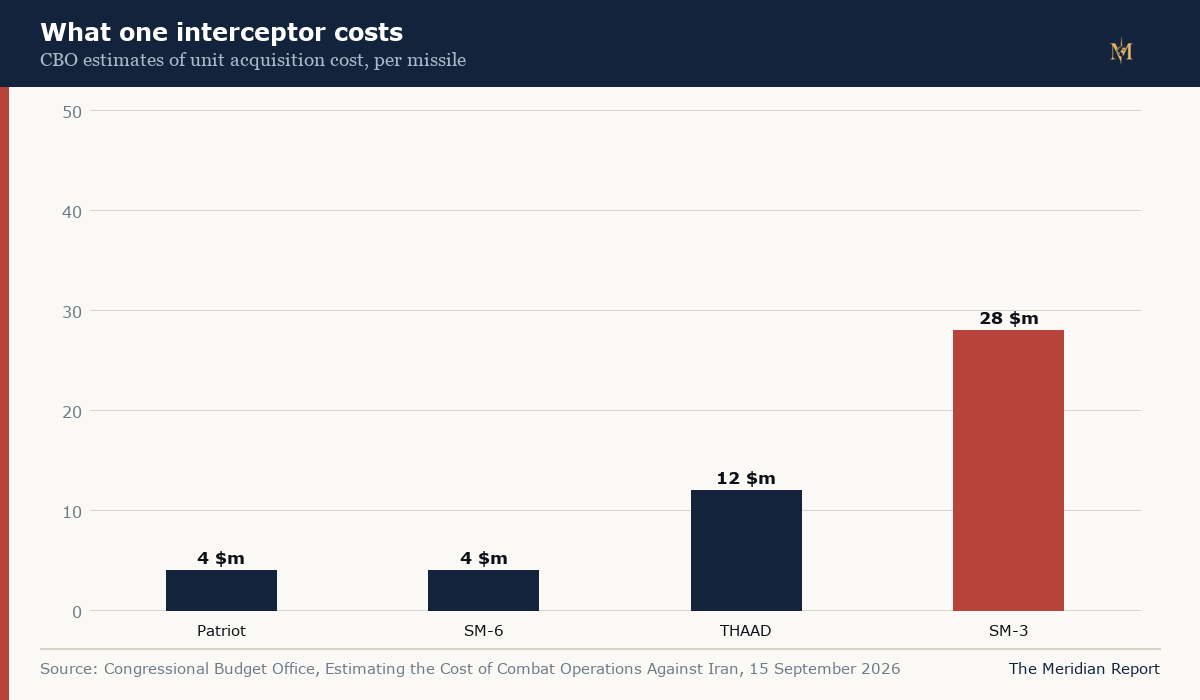
A Patriot costs roughly $4 million. So does an SM-6. A THAAD interceptor costs roughly $12 million. An SM-3, the ship-launched interceptor used against high-altitude ballistic threats, costs roughly $28 million. The FY2025 defence budget request priced an SM-6 at about $6 million for procurement alone, above the budget office's lower estimate, which is the kind of gap that matters when a department is signing multiyear contracts on the strength of the cheaper number.
These are acquisition costs, not complete costs. They exclude launchers, radars, ships, personnel, and the next annual round of procurement. They are the right numbers for the question at hand, which is what a depleted inventory must be replaced with.
Run the arithmetic and it becomes difficult to argue that "half to two-thirds" is a survivable reading of the future. A country holding several thousand SM-3s at $28 million each has, at half depletion, a replacement requirement in the tens of billions that cannot be met at any price in less than the time it takes to build the missiles. The money is the smallest part of the problem. The time is the problem.
And the time is set by production rates, which are set by industrial capacity, which is the constraint the inspector general's report names.
The three constraints, named in the department's own report
The inspector general recorded that Acquisition and Sustainment officials identified "the production of solid rocket motors, the availability of high-grade explosives and propellants, and the recruitment of skilled manufacturing labour" as key issues.
Each of those three is a bottleneck in a different sense, and the distinctions determine what a contract can fix.
Solid rocket motors are a specialist chemical and manufacturing process with a small number of qualified suppliers. Capacity here is physical. It cannot be expanded by writing a cheque in October; it requires qualified facilities and the time to qualify them.
High grade explosives and propellants are an energetic materials supply chain, where the binding constraint is frequently not the plant but the regulatory and safety regime around it, which makes new capacity slow in a different way from a new factory.
Skilled manufacturing labour is a recruitment problem at a moment when the same skills are in demand across defence, energy and advanced manufacturing. Lockheed Martin's head of missile division, Tim Cahill, described the state of missile production as "controlled chaos," which concedes a great deal more than it appears to.
A procurement contract addresses the third of these most directly and the first two hardly at all. Money is genuinely effective at attracting labour, given time. It is not obviously effective at building a solid rocket motor plant, because the constraint there is the plant and its qualification, not the payroll.
The production clock
This is where the department's own documents stop being about money and start being about time.
Research published by the Foreign Policy Research Institute in May 2026, drawing on the Pentagon's contract announcements and the manufacturers' own delivery figures, sets out the lead times for the Patriot. Every PAC-3 MSE interceptor carries a production lead time of 24 months for the missile and 30 months for its solid rocket motor. Those figures are not administrative delay. They reflect the curing time required for solid rocket motors and the multi-year process of qualifying any new component supplier.
The consequence is stated bluntly: interceptors funded under the emergency contract the Pentagon announced on 10 April 2026, worth $4.76 billion, were not expected to arrive before mid-2028 at the earliest. An emergency response, in other words, moves at a pace that has no bearing on the current crisis.
The consumption figures from the same source are the ones that ought to be quoted most often. During the first four days of the Iran war, coalition forces expended Patriot rounds at an estimated rate of 225 missiles per day. Lockheed Martin's Camden, Arkansas facility was producing about 1.7 per day. That is a ratio of roughly 132 to 1, between the rate at which the magazine is emptied and the rate at which it can be refilled.
The gap is not only at the top of the chain. Lockheed Martin assembles the PAC-3 MSE, but Boeing produces the active radar seeker for every round from a single facility in Huntsville, Alabama, and delivered only around 650 to 700 seekers in 2025. The solid rocket motor comes from L3Harris's Aerojet Rocketdyne, whose motors feed not only the Patriot but the THAAD, the Tomahawk and the Standard Missile family, which is why the Pentagon's reported $1 billion investment in that firm matters well beyond one programme. The Pentagon responded to the seeker bottleneck by signing a framework in April 2026 to triple seeker production.
A supply chain with one qualified source for an indispensable component does not possess surge capacity. It possesses an option, and the option is exercised at the contractor's pace.
The Patriot line, and a slope that is genuinely improving
It would be wrong to leave the impression that the industrial base is static. It is not, and the improvement is real and measurable.
Lockheed Martin delivered 620 PAC-3 MSE interceptors in 2025, which works out at about 1.7 missiles a day for a global network of allies. In January 2026 the Pentagon and Lockheed Martin signed a seven-year framework agreement to raise PAC-3 MSE production from 600 missiles a year to 2,000 a year by 2030. CBS News, reporting from the Camden facility in September 2026, put the current production rate at about 750 a year.
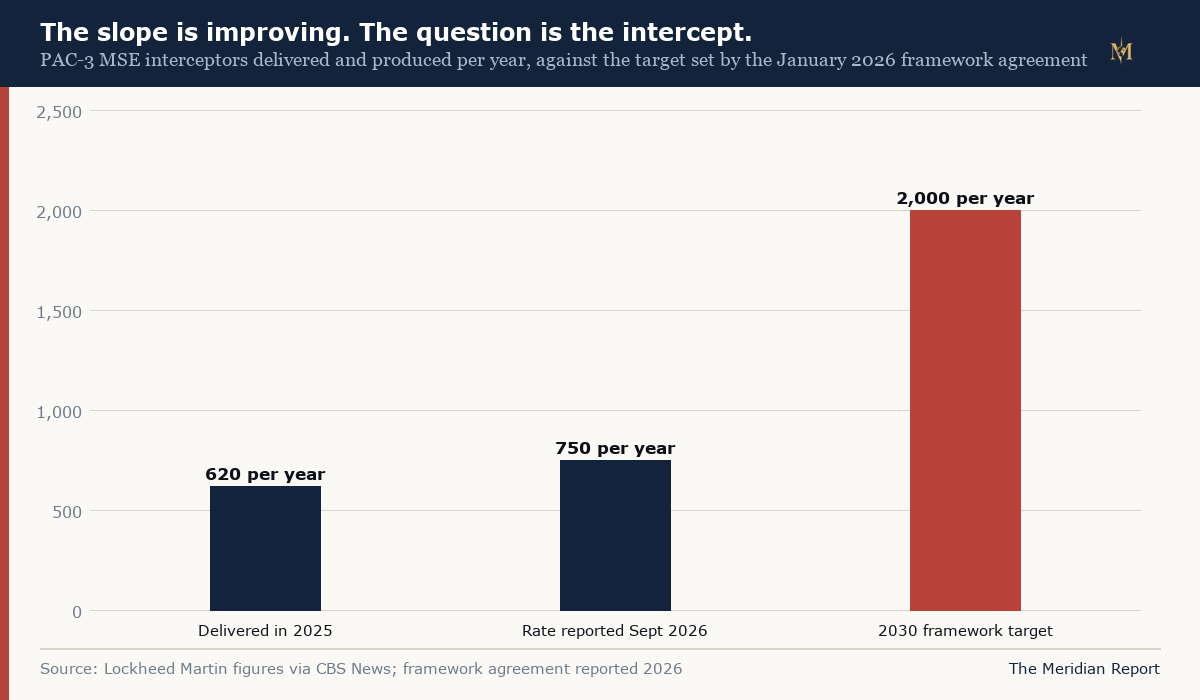
The three figures are not in conflict once their bases are made explicit. The 620 is deliveries in a completed year. The 750 is a production rate reported nine months later, which implies the ramp has begun. The 2,000 is a 2030 target under a framework agreement signed in January. Research published in May described the then-current build rate as 600 a year and noted that replacing what was used in five weeks of fighting would take three years at that rate.
That is the honest picture: a steepening slope, still far below wartime consumption, with a target that will be met or missed depending on how the slope actually behaves rather than on how much money is spent.
It is also worth noting how the demand queue has changed. The April 2026 Patriot contract was funded 94 percent by Foreign Military Sales, meaning allied governments rather than the United States supplied most of the money. Combined orders from more than a dozen countries, including Saudi Arabia, Germany and Poland, represent a backlog of over 4,300 Patriot rounds, which is roughly seven years of output at 2025 production rates.
Allies buying interceptors at that scale is a vote of confidence in the system, and it is also a queue in front of the United States in a war it might need to fight alone.
The deficit existed before the war began
The most important corrective to the depletion narrative is not an argument about method. It is a date.
By July 2025, according to research published by the Foreign Policy Research Institute, US Patriot stocks had already fallen to about 25 percent of the Pentagon's own minimum requirement, driven substantially by transfers to Ukraine. The Iran war did not create the deficit. It removed whatever slack remained.
This matters for how the current findings should be read. A stockpile that entered a seven month war at a quarter of its required minimum cannot be described as having been in good condition beforehand, and the inspector general's finding of strategic shortfalls is not the disclosure of a surprise. It is the disclosure of a condition that several outside analysts had been describing for years.
The same research attributes the underlying condition to a structural decision taken three decades ago: the hollowing out of the US defence industry following the 1993 meeting at which the last surviving Cold War era production lines were consolidated. Capacity closed because procurement stopped. Capacity does not reopen on request.
The department's response has included asking major American manufacturers, including automakers, to explore expanding weapons production. That is a notable admission. Automakers are not approached for missile capacity unless the existing defence industrial ecosystem cannot reload quickly enough.
What the SM-6 is, and what the award actually covers
The SM-6 is unusual among American interceptors, and the reason matters more than the price.
It is not a dedicated missile defence weapon. The variant covered by the Navy's new agreement is designed for long range anti-air warfare, with demonstrated capability against cruise missiles, drones and ballistic missiles, and a secondary application as an anti-ship missile, all at lower cost than an SM-3. That dual and triple use cuts two ways.
It means a large SM-6 buy does not automatically refill the interceptor pool in the way a THAAD buy would. Part of what is produced will be committed indefinitely to fleet air defence and surface warfare. A dollar spent on SM-6s is not a dollar spent restoring the inventory the Congressional Budget Office measured.
It also means the award is not, as some coverage described it, purely a missile defence procurement. It is partly a purchase of cheaper fleet air defence, which is a legitimate and sensible procurement decision that happens to address a different requirement from the one in the inspector general's report.
The scale of the change is large in percentage terms. The Navy's previous SM-6 contracts ran at about 125 units a year. A $24.4 billion award at the budget office's $4 million unit estimate, or at the FY2025 budget request's $6 million procurement figure, describes a production rate many times higher than 125 a year. The Navy has not published a missile count for the contract, and the range implied by the two available unit prices is wide, which is itself a measure of how little is publicly known about interceptor unit accounting.
What the contract does not do is touch THAAD or SM-3 production, expand solid rocket motor capacity, or resolve the combined four system inventory question. It is a serious industrial commitment aimed at the cheapest and most available end of the problem.
The Army's parallel commitment deserves the same precision. The Army has committed to pay up to $59 billion for additional Patriot interceptors. The Army's revised acquisition objective is 13,773 PAC-3 MSE interceptors at a total programme cost of more than $53 billion for 60 Patriot batteries. Those are two different numbers describing two different things, and neither is a statement about how many missiles will exist by a given date.
Set the two awards side by side and the scale of the stated commitment approaches $83 billion. Set them against the congressional position and the position is that Congress has not funded either, and that a continuing resolution is expected to run to at least early December.
The denial, and why the record matters more
President Trump addressed the stockpile question directly in a Time magazine interview published on 1 October, two weeks after the inspector general's report and on the day the contract was announced.
"Some forms of ammunition are a little bit lower than other forms," he said, adding: "We're stocking up at levels we've never done before." He called the inspector general's report "mostly fake news."
He had made a version of the same claim in late August or early September, saying the United States has "virtually unlimited amounts of Mid to High Grade Ammunition, far more than we could ever use for this, or for any other War (which is highly unlikely!), that could improbably take place," and that the country is "producing Munitions at levels never seen before."
The political objection to these claims is easy to state and easy to mock. The more serious objection is procedural. An inspector general's report to Congress is not an estimate produced by a political actor. It is the statutory product of an office whose independence exists precisely so that this kind of finding can be made.
The report does not say the United States is out of ammunition. It says there are shortfalls and that the industrial base cannot refill them quickly. That is a far narrower claim than the one being denied, and the denial has been wider than the finding.
What changed on 14 September is the status of the evidence. Before that date, no American official had published an internal document conceding a strategic inventory shortfall, and senior officials including the Secretary of Defense had denied concerns about stockpile depth. After it, the denial is no longer the only American record on the subject, and it is no longer the official one.
The contrast is sharper still because the Secretary's own Senate testimony put the war's cost at $37.5 billion, within about 2 percent of the Congressional Budget Office's external estimate of $38.1 billion. One of the two most senior officials in the department was publicly consistent with the independent estimate while the President was describing the underlying problem as fabricated.
The President's framing of the cost was that restocking would require "less than we make in Venezuela for one month." That comparison does not survive contact with the budget office's own figures, which put the conflict's monthly cost at $2 billion to $3 billion at recent intensities, and the accumulated cost at $38.1 billion and rising.
The exchange rate nobody planned to fight at
The cost of the interceptors is only half the story. The other half is how many were needed to achieve what they achieved.
Research published by the Foreign Policy Research Institute makes the arithmetic explicit. Firing a $4 million PAC-3 MSE at a $35,000 Iranian drone creates a cost ratio of about 114 to 1. It notes that the battlefield reality was sometimes worse, with Ukrainian military advisers in the Gulf reporting coalition batteries firing eight interceptors to shoot down a single Iranian drone.
That is not an accusation of incompetence. Engaging an incoming drone with an interceptor is a legitimate choice when the alternative is a base lost or an aircraft destroyed. But a defensive posture built on that exchange rate is financially and industrially exhausting, because the losing side can sustain it for weeks while the side with the deeper magazine cannot.
The emerging answer is a layered defence, in which premium interceptors are held back for threats that justify them and cheaper systems, including guns, short range missiles and dedicated anti-drone drones, absorb the drone threat. The research records more than 450 Raytheon Coyote anti-drone interceptors used in this conflict as evidence that this shift is already under way.
This is the most important thing the war taught about the interceptor inventory, and it is not the one that dominates coverage. It is not primarily that the United States ran short of missiles. It is that the way the missiles were used produced a rate of expenditure no industrial base could have sustained indefinitely, and that the correct response is as much doctrinal as industrial.
Three estimates, and why none of them is the number
Four figures circulate for the cost of this war, and they are not variants of one number. They measure different things over different periods.
| Estimate | Source | Cut off | Total | Munitions or replacement |
|---|---|---|---|---|
| Inspector general | Defense Department OIG | 29 June 2026 | $33.4bn | $22.3bn expended |
| Secretary's testimony | Pete Hegseth, Senate | Not stated publicly | $37.5bn | Not stated |
| Budget office estimate | CBO, external | 1 August 2026 | $38.1bn | $21.7bn to replace |
| Supplemental request | White House, June | Forward looking | $42.3bn direct of $87.6bn | Not stated |
The budget office itself explained why the fourth line is not comparable. The administration's request "is not directly comparable with CBO's estimate because the administration's request includes other defense priorities and funding for other departments." The $42.3 billion identified as directly conflict related is about 10 percent above the budget office's estimate of Department of Defense costs.
That $87.6 billion request, sent to Congress on 24 June, remains a request. Associated Press reporting indicates Congress has not approved it. Analysis from the Center for Strategic and International Structures published in July concluded that roughly a third of the supplemental was driven by Iran war costs, which would put the war's share nearer $29 billion of the total, and therefore lower than either official estimate, illustrating once again how much the answer depends on which costs are inside the definition.
The war is therefore more expensive than any of these figures, by an amount currently unknown, because the repair of damaged bases across eight countries carries no estimate at all. The Navy's acting secretary, Hung Cao, said of a key naval base in Bahrain that Iran "blew the hell out of" it. Officials have said they may not repair everything damaged.
What the spending has done to prices at home
The Congressional Budget Office's estimate extended beyond the Defence Department ledger, because a war of this size moves prices.
It concluded that the conflict is expected to contribute to raising inflation roughly 0.5 percentage points above its previous projection into the first quarter of 2027. The mechanism it identified was not the defence budget but the energy markets: the reduction of oil and gas shipments through the Strait of Hormuz and the disruption to shipping through the Red Sea.
That causal chain is worth stating precisely, because it is frequently misdescribed. The fiscal cost of the war is roughly $2 billion to $3 billion a month. The consumer cost runs through oil and gas flows, not through the Treasury. A defence appropriation is a transfer from American taxpayers to American manufacturers. A chokepoint closure is a transfer from every consumer of refined products in the world to whoever controls the marginal barrel.
This is also where the politics and the arithmetic converge. The budget office published on 15 September. The midterms are in November. An additional 0.5 percentage points of inflation, on top of a diesel market that has pushed US diesel to about seven dollars a gallon and forced European governments to debate opening reserve tanks for a second time in seven months, is a difficult environment in which to ask voters to approve a war that the President has said might resume after they vote.
The war is also being financed through an instrument that does not require the vote. The Department of Defense has been sustaining operations while the supplemental that would pay for them sits unapproved, which transfers the financing question from an authorisation debate to a borrowing question.
What depleted interceptors would mean for a different war
The most important passage in the Congressional Budget Office report is forward looking, and it is conditional.
The report says the large expenditure of missiles and interceptors will leave the United States with a "reduced inventory of interceptors for several years," and that this situation would "become especially problematic if a conflict arose with an opponent whose arsenal included large numbers of ballistic and cruise missiles." The report names the opponent.
The logic is straightforward. A land attack cruise missile campaign depletes munitions. A defensive campaign depletes interceptors. Only one of those depletes the specific category of weapon that defends against the other's characteristic threat. By fighting Iran with a substantial submarine launched cruise missile campaign and an intensive defensive posture against Iranian ballistic missiles, the United States has consumed a large share of the inventory most useful against a peer with large ballistic and cruise missile forces.
Mark Cancian of the Center for Strategic and International Studies put the asymmetry plainly to CBS News. "For a war against Iran, the answer is yes. The problem is a war against China. We might be able to provide enough munitions for a month, but getting on to month two or month three or month four, that's a great challenge."
The administration's position, that stocks are at levels "never done before," is not strictly inconsistent with the budget office's finding, and it is worth saying so plainly. Production can be at record levels while a stockpile is depleted. Spending more per year than ever before does not refill a hole dug over several years if the war continues, and it does not refill it faster.
The Navy's deployment posture makes the timing concrete. Three ships carrying more than 7,000 sailors and 2,000 Marines, including the carrier strike group centred on the USS Theodore Roosevelt and the amphibious readiness group built around the USS Makin Island, are heading to the region, according to a US official. Two carriers are already in the area. If the third arrives by the end of October, as the official described, more than 20,000 sailors and Marines and hundreds of aircraft will be in theatre, generating a flying hours and fuel cost of roughly $2 billion to $3 billion a month and consuming ordnance in the process.
Rebuilding an inventory against a bill that continues to arrive is the central structural difficulty. The $24.4 billion agreement begins to address it in one place. The monthly cost does not pause while it does.
Ten billion dollars of flying hours, and a tanker fleet with holes in it
The second largest line in the Congressional Budget Office's breakdown deserves more attention than it usually receives, because $10.4 billion of increased flying hours is not primarily a cost of shooting. It is a cost of being airborne, and being airborne is what a depleted tanker fleet makes expensive.
The inspector general's own operational ledger tells the same story in more granular form, and it is dominated by exactly the activities that consume fuel rather than ordnance. Airlift operations ran to $929.6 million. The Flying Hour Program, which pays for the hours themselves, cost $691.1 million. Mission and other ship operations, $647.7 million. Base support, $405.0 million. Maneuver units, $385.3 million. Fuel across the operation came to $2.7 billion, which is consistent with an air campaign of unusual intensity and duration rather than with a set of discrete strikes.
The opening posture explains the scale. The Congressional Budget Office estimated that the initial phase of Operation Epic Fury involved about 250 tactical aircraft, including roughly 90 from two carrier strike groups and an amphibious readiness group, supported by bombers, airlifters, refueling tankers, other naval vessels and Army air defence, aviation and artillery units. Two carrier groups in theatre, at the start, is an unusual posture, and sustaining one for seven months is an unusual expense.
Aerial refuelling is the hidden variable in that cost. Every extended sortie, and almost every carrier sortie beyond a few hundred miles from its ship, consumes tanker hours. The inspector general reported that seven KC-135 tanker aircraft were damaged, and that up to 30 MQ-9 Reaper drones were destroyed. Losing tankers does not just reduce capacity; it extends the chains required to reach targets that were previously within reach, which means more tankers flying more hours to deliver the same ordnance to the same place.
That is the mechanism by which a munitions shortfall converts into a fuel and flying hours bill. If the answer to a target is unavailable because interceptors have been conserved, the answer may instead have to be made by a longer route. The cost of the operation therefore rises for reasons that have nothing to do with the missiles involved.
It is also a cost that cannot be postponed. Munitions replacement is a bill for something already spent. Flying hours are a bill for something happening tonight.
Seven billion dollars of cruise missiles, and a reload that cost double
Land-attack cruise missiles account for $7.3 billion of the Congressional Budget Office's replacement estimate, the second largest munitions category, and they are the line that most directly affects naval capability.
The operational detail is more striking than the dollar figure. The same research published by the Foreign Policy Research Institute notes that after the Navy's Red Sea operations, which were a fraction of the Iran war by any measure, the service required more than $2 billion to replenish $1 billion of munitions expended. The reload cost more than twice the original purchase price.
That ratio is the clearest available demonstration that replacement cost is not a simple function of what was fired. It is a function of what can be bought, when, and at what marginal price under wartime demand. Munitions bought in peacetime at contracted unit prices cannot be replaced on the same terms after the order books have been rebuilt and the labour market has moved.
The response has been visible in the Navy's posture. Beyond the SM-6 agreement, the service is investing in a new class of long range missiles capable of tracking and hitting moving maritime targets, described as a basic requirement for a Western Pacific contingency, with a prototype award round announced in the week for competing designs from Anduril, RTX, Castelion, Lockheed Martin and Mach Industries.
That programme is worth noting for what it implies about priorities. The Army has committed up to $59 billion to additional Patriots. The Navy has committed up to $25 billion to SM-6s. The Navy is simultaneously soliciting anti-ship missile designs for a contingency it has not been tasked with, in the same fiscal environment, while a war it is conducting continues to consume ordnance at two to three billion dollars a month.
These commitments are individually defensible and collectively incoherent, in the sense that no published plan sequences them against each other or against the inventory gap the Congressional Budget Office measured. The department has not published an interceptor inventory, so it is not possible from public information to say whether the sum of these awards is sufficient. It is possible to say that the department has contracted for a great deal of future capability without publishing the requirement it is trying to meet.
Why a department contracts ahead of Congress
The funding position deserves its own analysis, because it explains the shape of the announcements and it is a genuinely unusual institutional fact.
The White House sent Congress a request on 24 June 2026 for $87.6 billion in additional funding, of which $67.1 billion was for the Department of Defense and $42.3 billion was identified as directly related to the conflict. Associated Press reporting indicates Congress has not approved it. A continuing resolution was expected to extend through at least early December without a full fiscal 2027 defence budget.
Against that backdrop, the Navy signed a five year missile contract on 1 October, and the Army had already committed to up to $59 billion for Patriots. Neither commitment is an appropriation. Both are promises about how money will be spent if it is provided.
This is not a scandal, and it is a recognisable pattern. Multiyear procurement is specifically designed to run ahead of appropriations so that industry can commit capital and labour against a funded expectation. The alternative, waiting for an appropriation, is what produces the boom and bust cycle the research literature describes, in which lines open during a build and close during a lull. The Pentagon's stated logic for the SM-6 agreement, long term predictability to expand workforce capacity and secure critical supply chains, is the correct rationale for the instrument.
The consequence, though, is that the inventory gap is being addressed on credit. A department that signs five year commitments without an appropriation in place has accepted that the policy decision has been taken and the funding question is outstanding. That is a defensible choice under time pressure. It also means that the single most effective way to judge whether Washington believes its own inspector general is whether Congress funds the rebuild, and that vote has not happened.
The politics make a funding failure plausible. Representatives including Pat Ryan of Ohio have been leading the No Funds for Iran War Act, which passed the House, and the House has voted repeatedly on measures to end US hostilities with Iran. An inspector general's finding about munitions shortfalls is, for a Congress being asked to fund a war, close to the worst possible piece of evidence for the administration's case.
What a baseline from 1991 shows
The absence of context makes these numbers harder to weigh than they should be, and a useful baseline exists in the public record.
In the 1991 Gulf War, the 806th Bombardment Wing, a B-52 unit based at RAF Fairford in Gloucestershire, flew 62 sorties and dropped 3,008 weapons in 927 combat hours: 2,193 of one type, 560 of another and 255 of a third. That figure is documented in detail elsewhere in this publication's account of why American bombers stage from Britain.
It is a large number of bombs and a small number of sorties, which is the whole point of a heavy bomber. It is also a single wing, in a campaign lasting a few months, against a much smaller opposing air defence.
Set against $22.3 billion of munitions expended by the United States and its allies in seven months of the Iran war, the comparison is instructive only if its limits are stated. These are not equivalent quantities, and the figures measure different things: precision guided munitions at unit costs in the millions against unguided bombs at unit costs in the thousands. The comparison is a mechanical one, and it establishes no ratio of capability.
What it does establish is that the American way of war has changed in a way that makes stockpiles matter in a way they once did not. A B-52 dropping 3,008 weapons consumed an amount of ordnance that a modern air campaign would expend in a fraction of a day, and the munitions were cheap enough, and produced in large enough quantity, that the industrial base could refill within the lifetime of the aircraft. The Tomahawk, the JASSM and the SM-6 are not produced in such numbers, and cannot be.
The Gulf War also supplies the historical note that American air defence expenditure is not new. Patriot batteries fired in 1991 at a scale that also strained the industrial base, and the production response then was slower than the demand response, exactly as it is now. The difference is the scale of the current bill and the fact that the current shortfall sits alongside a separate, documented deficit created by transfers to Ukraine.
What the replacement arithmetic looks like if the rates hold
It is worth doing the arithmetic transparently, because it is the kind of calculation that is usually asserted rather than shown. The inputs are all published. The outputs are conditional, and the conditions matter more than the arithmetic.
Take the Congressional Budget Office's replacement figure for missile defence interceptors, $13.1 billion. At the budget office's unit costs, that is on the order of 3,275 SM-3s at $4 million each, or a mixture of THAADs and SM-6s at higher unit prices, or a combination. The budget office does not publish a breakdown by system, and a reader cannot construct one from public information.
Take the Patriot framework target of 2,000 a year by 2030. Five years at 2,000 a year is 10,000 interceptors, which is more than three times the number implied by spending $13.1 billion at the budget office's Patriot unit cost.
Those two statements cannot both be a complete description of the problem, and the reason is the one identified earlier. The four systems are not interchangeable. A Patriot cannot intercept a high-altitude ballistic missile; a THAAD is not a fleet air defence system; an SM-3 is bought in small numbers because the missiles it intercept are themselves rare. Replacing $13.1 billion of interceptors with Patriots would spend the money and not refill the pool.
This is the analytical limit of what the public documents support, and it is a real limit rather than a rhetorical one. The Congressional Budget Office published a range for inventory consumed and a dollar total for replacement, and did not publish a missile count, because the Pentagon does not publish an inventory.
The arithmetic that can be done is this. Rebuilding at current and improving rates will take years, the budget office says at least five. Reaching the deficit requires production rates that have not yet been demonstrated at scale, on the department's own schedule. And the conflict that created the deficit continues to draw down the stock at two to three billion dollars a month while the rebuild proceeds.
Three pairs of numbers that do not reconcile
Reports about a war are usually presented with their discrepancies smoothed over, either because one figure is preferred or because a reader will not check. Three pairs in this record are worth setting side by side, because the gaps are informative and because a reader who notices them is entitled to an explanation.
Expended munitions against replacement cost. The inspector general recorded $22.3 billion of expended munitions for the period ending 30 June. The Congressional Budget Office recorded $21.7 billion as the cost of replacing munitions expended through 1 August. A longer period produces a lower number.
That is not a contradiction, and it is not an error. The two figures measure different things. The inspector general's figure is what was expended. The budget office's figure is an estimate of what it will cost to replace what was expended, valued at acquisition prices. Replacement cost is not expenditure: it is a forward looking valuation of a bill that will arrive over subsequent years, and it can be lower or higher than the historical spend depending on whether prices rose or fell and on the mix of weapons involved.
What the gap does establish is that the two agencies are not measuring the same object, and that the budget office's $21.7 billion should not be described as what the war has cost in munitions. It is what the war has cost so far, valued at today's prices, in an inventory that is still being drawn down.
Equipment losses. The inspector general recorded $3.7 billion in equipment losses. The Congressional Budget Office recorded $1.9 billion for equipment lost in battle. Again, the words differ. The inspector general's category is losses, which on its face includes equipment damaged as well as destroyed. The budget office's category is equipment lost, which on its face means destroyed rather than damaged. A radar that is destroyed and a fighter that is damaged are both real costs, and only one of them is a replacement in the strict sense, because a damaged aircraft is repaired rather than bought.
The inspector general's own ledger is consistent with the narrower reading: four F-15s destroyed, one F-35 damaged, seven KC-135s damaged, up to 30 MQ-9s destroyed. Four aircraft destroyed out of a list in which the damaged entries outnumber the destroyed ones.
Total cost. The inspector general's $33.4 billion runs to 29 June. The Congressional Budget Office's $38.1 billion runs to 1 August. The interval is roughly five weeks, so a simple subtraction gives about $4.7 billion, or a little over $4 billion a month.
That is higher than the budget office's own forward projection of $2 billion to $3 billion a month for a period at recent intensity, and it is worth being straightforward about what that means. A reconciliation here is not clean. The most likely explanation is scope rather than spending, because the inspector general's report is a report on Operation Epic Fury while the budget office's estimate covers combat operations against Iran in general, and the second is broader than the first. A reader should not treat the two totals as measuring the same perimeter.
None of this is a criticism of either agency. It is a reminder that these are two different instruments pointed at one object, and that a reader who treats any one of their figures as the cost of the war is making an assumption that the documents themselves decline to support.
What the allied order books reveal
The most under-read document in this entire story is not an American one. It is the allied order book.
Of the emergency Patriot contract the Pentagon announced on 10 April 2026, 94 percent of the funds came from Foreign Military Sales, meaning foreign governments rather than the United States supplied nearly all of the money. Combined demand from more than a dozen countries, including Saudi Arabia, Germany and Poland, represents a backlog of over 4,300 Patriot rounds, which is roughly seven years of output at 2025 production rates.
Three conclusions follow, and only the first is obvious.
The first is that the production lines will run. An order book of that size, underwritten largely by allied cash, is a stronger demand signal than any single national programme can provide, and it is the most reliable guarantee in the entire document set that the Patriot industrial base expands rather than contracts. Allies are effectively buying American industrial capacity as a strategic asset, which is a reversal of the pattern that hollowed the base out after the Cold War.
The second is that a queue of that length is a queue. Allied orders placed in 2026 are delivered years later, and some of them will be delivered into the 2030s. The United States does not queue behind its allies for its own missiles; its own requirement is met first, which is the correct order of priority and also means that the allied backlog, however large, does not directly relieve the American gap.
The third is the most consequential, and it is a claim about threat perception rather than about logistics. Governments in Europe, the Gulf and Asia have looked at seven months of sustained ballistic missile and drone attack on American and allied forces and concluded that they need Patriots in numbers that would have been unthinkable in 2024. They have drawn that conclusion on evidence, and they have acted on it with their own money.
That is a signal about Iranian behaviour, Iranian capacity and Iranian doctrine, delivered through procurement rather than through statements. It is also a signal about the American industrial base's capacity to meet demand, because an order book that cannot be filled is a queue and an empty one is a contract.
What the two new contracts say about doctrine
Read together, the SM-6 agreement and the Army's Patriot commitment describe a shift in how the United States intends to defend itself, and it is a shift away from the posture this war exposed.
The SM-6 variant being bought is a long range anti-air warfare missile with demonstrated capability against cruise missiles, drones and ballistic missiles, and a secondary anti-ship role, at lower cost than an SM-3. That is a cheap, flexible fleet air defence weapon, and it is what one builds when the requirement is volume and magazine depth rather than prestige interception.
The Patriot commitment is the opposite trade. A Patriot is a dedicated, high-value interceptor for theatres and bases, and buying more of them is a decision to deepen layered terminal defence.
Both are correct responses to what the war revealed, and together they amount to a doctrine of layered defence in which cheap systems absorb drones and cruise missiles and expensive systems are held for ballistic threats. The same research records that shift already in practice, with more than 450 Raytheon Coyote anti-drone interceptors used during the conflict.
The unresolved question is whether the layer beneath is funded. Coyote interceptors, guns and short range systems are cheap, but cheap does not mean available, and several of the world's largest manufacturers of conventional explosives and propellants are the same firms identified by the inspector general as constraints on munitions resupply. The doctrine assumes a base of cheap systems that the industrial base is not currently able to supply at volume.
That is why the inspector general's three named bottlenecks, solid rocket motors, high grade explosives and propellants, and skilled labour, are the right place to end the analysis. They are not three of the problems. They are the problem, expressed in the language of an acquisition organisation that has spent the summer discovering that its order books are longer than its supply chains.
Thirty drones, seven tankers and a radar
The inspector general's equipment list is short and easy to skim past, and three items on it deserve more attention than they have received.
Up to 30 MQ-9 Reaper drones destroyed is the largest single loss figure in the report, and it is the item most likely to be underestimated by a reader. The MQ-9 is not a front line aircraft and it is not cheap, but its significance is not its value. It is that it is one of the few American systems designed to operate at scale against numerous cheap targets, and losing thirty of them in seven months removes a substantial fraction of the deployed inventory of a class of aircraft whose value to commanders is precisely that they are numerous and expendable.
The Iranian answer to drone saturation has been, in effect, to saturate in return. A defender that must engage each incoming drone with a four million dollar missile loses far faster than an attacker that must produce drones. Whatever the United States does about interceptor stocks, the arithmetic of drone defence is unwinnable at current interceptor prices unless cheaper layers exist, which is the same point the 114 to 1 exchange rate makes from the other direction.
Seven KC-135 tankers damaged is, in pure production terms, less alarming. The tanker fleet is large and old, and damaged airframes are repaired. In operational terms it is more serious than the count suggests, because aerial refuelling is the multiplier that converts a strike capability into a reach capability, and a tanker out of service extends every chain that depended on it.
The destroyed THAAD radar is the item with the longest tail. A radar is not a consumable and its loss does not appear in any munitions line. It removes a detection and tracking capability over an entire region until it is replaced, and a THAAD radar is a long lead platform with a small production base and an export-control regime that constrains where replacements can go. The budget office counted $1.9 billion of equipment lost in battle across the whole operation, which tells a reader how little a single radar's strategic significance maps onto the financial accounts.
The pattern across all three items is the same, and it is the pattern the whole report describes. The financial ledger records what was spent and what was destroyed. The operational reality includes the sensors that were blind, the tankers that were not flying, and the drones that were no longer overhead. The gap between those two descriptions is where a war is actually won or lost, and it is the gap that the new contracts, which buy missiles, do not address.
What the personnel ledger adds
The inspector general recorded 417 service members wounded and seven killed during the operation. Those figures will be read in October as a scandal or ignored, depending on the reader's priors, and neither reaction tells us much.
What the figure does is establish a ratio that is rarely stated. The munitions expenditure of $22.3 billion and the human cost of seven dead and 417 wounded describe two entirely different theories of what a war is for. One is a war fought with machines that are cheaper than the people operating them. The other is a war fought by people, in which the machines are merely the means of delivering ordnance.
Nothing in the cost documents reconciles those two theories. The Congressional Budget Office explicitly excluded costs related to personnel killed or injured, and any future increases in outlays for veterans' health care and disability compensation. The inspector general counted the wounded and the dead but attached no dollar value.
That exclusion is methodologically standard and analytically significant. Every figure in this report is therefore a floor, and the floors differ between documents, which is the subject of an earlier section in its own right. A $38.1 billion figure that excludes the wounded, the dead, the veterans' care, the base repairs and the other federal agencies is a measure of what the Department of Defense has spent replacing and operating equipment.
It is a measure of the war that is easier to add up than the war itself.
The strongest case against this reading
An account that only accumulates the alarming evidence is not analysis, and the case against the depletion reading deserves to be put at full strength.
The Congressional Budget Office said its estimate is "subject to considerable uncertainty," and the department did not respond to its information requests. The estimate pools four interceptor systems together, so a reader cannot tell from the report whether the United States retains most of its THAAD and has spent most of its SM-6s, or the reverse. Those two worlds have very different implications.
The method infers expenditure from procurement history rather than measuring inventory, which as set out above is closer to an upper bound on the shortfall than a measurement of it.
The deficit also predates the war. Patriot stocks were already at roughly a quarter of the Pentagon's minimum requirement in July 2025. A reader who concludes that the Iran war caused the shortfall has identified the trigger rather than the condition. The appropriate inference is that a stockpile entered this war without slack, which means the war revealed a fragility rather than created one.
There is also a straightforward argument that this war used interceptors as efficiently as such weapons can be used. Every interceptor fired was fired at an incoming threat. That is the least wasteful possible employment of an expensive missile. The problem is not that missiles were wasted. It is that answering a drone with a $4 million missile is inherently a losing exchange rate, and the country has now paid that rate thousands of times.
Nor is the production picture unambiguously grim. The department asserts it is buying at record levels, and a multiyear contract is itself evidence that manufacturers have shown they can build. The 750 a year Patriot rate is a steepening slope under a framework agreement that runs to 2030. Allies are placing orders large enough to sustain the lines, which means the production base is not about to close.
And the forward risk is genuinely conditional. The budget office's warning requires a conflict with a large ballistic and cruise missile adversary. No such conflict is established. The report's language is "if," and an account that removes the conditional is misreading it.
The fair conclusion is narrower than either the alarm or the denial. The inventory is demonstrably lower than it was, and it was lower than required before the war began. Rebuilding will take years at rates that are improving but remain far below wartime consumption. The category most depleted is the one most relevant to a contingency that has not occurred. Each of those statements is true, and together they justify the contract that was announced, without justifying either the claim that nothing is wrong or the claim that the country is running out of missiles.
What the evidence settles
Three things are established by the documents themselves.
The United States expended $22.3 billion in munitions between 28 February and 30 June 2026, and the department's own acquisition organisation concluded that this created strategic inventory shortfalls and exposed industrial base bottlenecks. That finding is in an official report to Congress and has not been withdrawn.
The Congressional Budget Office, working without cooperation from the Defense Department, estimated $38.1 billion in Department of Defense costs through 1 August, of which $21.7 billion is the cost of replacing munitions expended, and found that between one-half and two-thirds of the combined Patriot, THAAD, SM-3 and SM-6 inventory has been consumed since June 2025. The budget office cautioned that the estimate is subject to considerable uncertainty and that the Pentagon does not disclose its inventory.
Rebuilding will take at least five years even with rising production rates, because the binding constraints are 24 month missile lead times, 30 month solid rocket motor lead times, supplier qualification cycles, and the availability of skilled labour.
A fourth thing is established by the spending commitments themselves rather than by any report. The Navy has signed a five year agreement worth up to $25 billion for SM-6 missiles, and the Army has committed to pay up to $59 billion for additional Patriots. Neither is funded by an appropriation. The United States has therefore contracted for the rebuild before paying for it, in the same way that a household signs for a mortgage it has not yet been approved.
What is not established is the size of the hole. The Congressional Budget Office deliberately published a range rather than a figure, and no public source converts it into one. The repair cost of bases struck across eight countries is not estimated at all. The mission statement remains classified.
Four developments would change this assessment materially. A published interceptor inventory figure, which the Pentagon does not currently disclose, would replace an inference with a measurement. An appropriation covering the SM-6 and Patriot agreements under a full fiscal 2027 defence budget rather than a continuing resolution would establish whether the commitments are real. A production rate that visibly exceeds the 2,000 a year framework target rather than tracking it would shorten the five year estimate. And a firm end to operations, which would stop the monthly $2 billion to $3 billion and freeze the drawdown, would convert a replenishment problem into a reconstruction one.
The first is cheap and entirely within the department's gift. The second is a question of appropriations, and appropriations have not happened. The third is a question of industrial performance that will be answered in the FY2027 procurement cycle. The fourth is a question of diplomacy, and as of 1 October 2026 it was not close.