
When Xi Jinping's aircraft touched down in Washington on the evening of 23 September 2026, the visit's outcome had already been announced, and it was not a treaty, not a settlement, not even a joint communique. It was a date. Treasury Secretary Scott Bessent, speaking on Fox News as the plane landed, said the American and Chinese trade truce would run until 10 January 2027, an extension of two months over the previous deadline, secured, in his phrasing, because Beijing needs to fulfil more deliverables. The world's two largest economies had spent eleven days of preparation, two hundred diplomats' hours and one state dinner to move their expiry date from early November to early January.
The date deserves to be taken seriously, because the date is the system. The United States and China have spent four years dismantling the trade relationship built over four decades and have replaced it with something without precedent at this scale: a managed separation, administered through a standing truce whose suspensions, exclusions, purchase commitments and licensing discretions expire on a rolling calendar, renewed in short instalments, and enforced not by trust but by each side's capacity to hurt the other on the next deadline. The Washington summit did not create that system. It confirmed it. What follows describes how the system actually works, reconstructs how it was built, and measures what it has done to both economies, because the numbers are more surprising, and in several directions more sobering for Washington, than the political narrative allows.
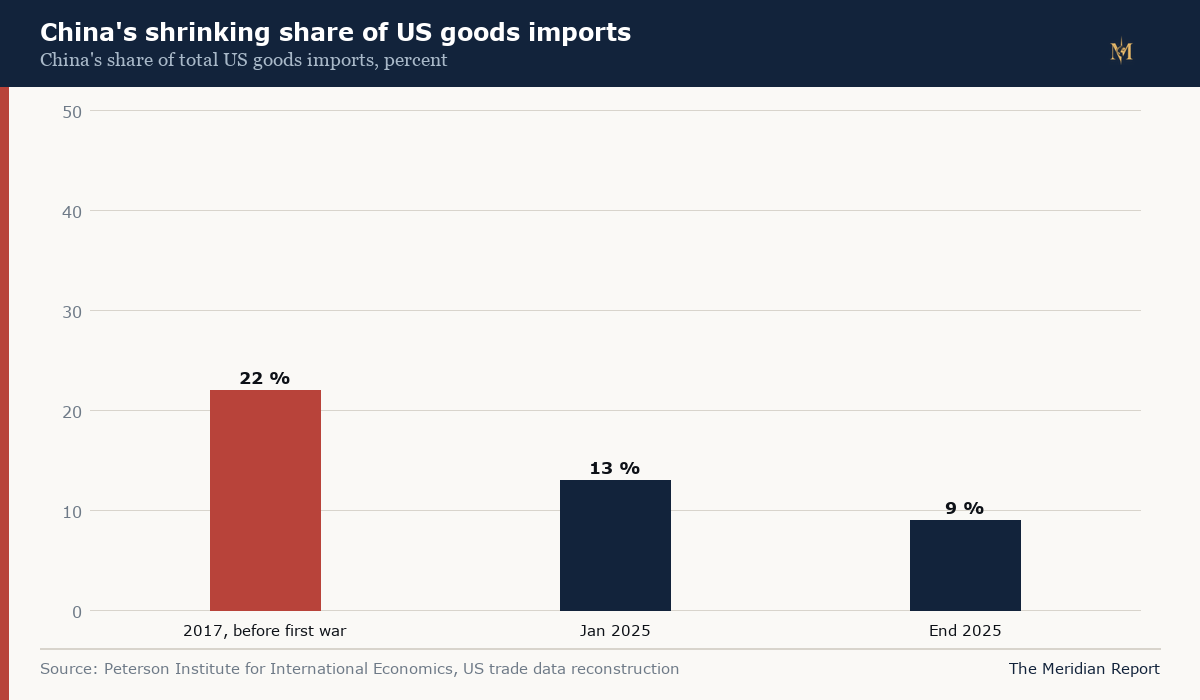
The tariff campaign achieved its narrowest objective and failed its broadest one: China's share of American goods imports has fallen from 22 percent before the first trade war to 9 percent at the end of 2025, but China's global export machine set records through the same period, its 2026 surplus tracking above the record $1.2 trillion of 2025, because the trade that left the American market re-routed everywhere else. The truce regime that now governs the relationship is not a ceasefire but an administration, a set of rolling deadlines whose enforcement relies on two specific vulnerabilities, China's monopoly on critical mineral processing and America's control of advanced semiconductors, each of which was weaponised once and is now priced permanently. And the two-month extension is not indecision; it is the design working as built, and its January deadline now carries three calendars on its back: the American midterms of November 2026, the APEC meeting in Shenzhen, and the G20 in Miami, at which Washington has separately invited the leader of a third country the truce never mentions.
From 145 percent to a truce: the war of 2025, reconstructed
The system was built in nine months, and its chronology matters because every component of today's architecture was forged in a specific escalation.
The second trade war began in February 2025, when the returning Trump administration imposed an additional 20 percent tariff on all Chinese imports, a move that by itself exceeded the average tariff increase of the entire first trade war. Beijing answered with limited retaliation and, more consequentially, with a different weapon: on 4 April, as Washington's Liberation Day tariffs of 34 percent landed on Chinese goods, China announced restrictions on the export of seven heavy rare earth elements and their magnets, the components without which the world's automobile, defence and electronics industries cannot build their products. Export licences would now be required, case by case, granted at the discretion of the Chinese state. Within a month, exports of rare earth magnets to the United States had fallen to nearly zero, and American carmakers were weeks from assembly line stoppages.
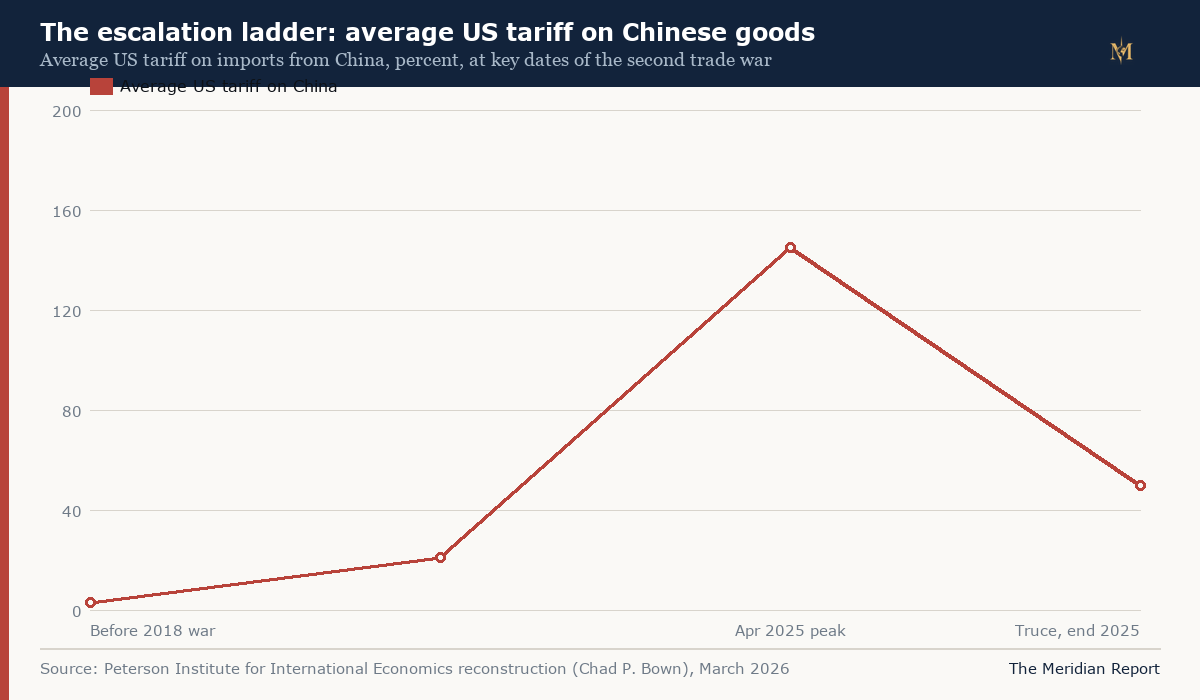
The April escalation then ran to its limit with a speed that shocked both markets and the two governments. Matching rounds of retaliation lifted America's tariffs on China to 145 percent and China's on the United States to 125 percent, levels at which bilateral trade in most goods simply stops. Shipping data showed imports collapsing on both sides of the Pacific. On 12 May, in Geneva, the two governments announced a 90-day de-escalation, cutting the peak rates by 115 percentage points, a retreat that produced the single largest week of freight booking in the decade but resolved nothing structural.
What followed was the war's true innovation, conducted in negotiating rooms rather than press conferences. Through the summer, the two sides converted the ceasefire into machinery: working groups on tariffs and technology, a licensing dialogue through which China's rare earth exports resumed under a quota-and-approval regime that has never been publicly standardised, and purchase commitments designed to answer America's farm-state politics. In late October 2025, Trump and Xi met in South Korea and converted a year of escalation into the truce that now bears their meeting's architecture: a one-year suspension of a 24-percentage-point reciprocal tariff tranche, extended through 10 November 2026 under the Coface reconstruction of the November 2025 implementing terms; an American commitment to pause further escalations; a Chinese commitment to issue general licences for rare earth exports through the same horizon; and the agricultural ledger, China agreeing to purchase 12 million metric tons of American soybeans in the season's final months, with 25 million tons annually for the following three years.
The truce held through 2026, and it held not because the underlying dispute was resolved but because each side's weapon had now been demonstrated. America's tariffs had shown they could halve China-bound trade. China's magnet embargo had shown it could idle the world's largest automakers in a month. Both demonstrations now hang permanently over the relationship, which is what makes the truce's rolling deadlines coercive rather than administrative: each side knows the other's weapon works, and each renewal is priced against the possibility of its use.
What the truce regime actually consists of
Because the truce is described in headlines as a tariff deal, its actual anatomy is easily missed. Four instruments carry it.
The most visible is the suspended tariff tranche. The American tariffs that remain in force average, on the Peterson Institute's calculation from the 2025 data, close to 50 percent on Chinese goods, against roughly 18 percent on the rest of the world and 3 percent before 2018. What the truce does is hold a further 24-point tranche in suspension, renewed each cycle, while maintaining product exclusions, most recently extended on 178 product lines to 10 November 2026. The suspension is the carrot; the 50 percent floor is the wall.
Alongside it sits the rare earth licensing regime. China's export controls, imposed as an emergency measure in April 2025, have become standing policy: general licences for compliant end users, case-by-case approval for sensitive ones, and a queue whose speed is Beijing's dial. The regime's power was demonstrated twice in 2025, when restrictions nearly stopped American auto production, and its persistence is the truce's most quietly consequential feature: no subsequent American escalation has removed it. The European Chamber of Commerce in China's president, Jens Eskelund, stated the industrial complaint plainly at the Washington summit: extending the truce does not address the absence of a standardised licensing process, which means every manufacturer's supply of magnets, gallium and related inputs still depends on administrative discretion in Beijing.
Then there is the deliverables ledger, the collection of purchase commitments and behavioural undertakings against which Bessent measures Chinese performance. Its largest item is agricultural: the soybean schedule, 12 million metric tons delivered by the deadline that slipped to February 2026 and was met, and 25 million tons annually through 2028. Its most recent item is procedural: the AI incident alert system discussed between Bessent and Vice Premier He Lifeng in New York before the summit, the first standing bilateral channel for artificial intelligence safety, which institutionalises communication precisely because the trust it substitutes for does not exist.
The last instrument is the calendar itself. Every element expires, and every expiry is a scheduled crisis. The 10 January 2027 date now in force follows the 10 November 2026 date it replaced, and each renewal cycle converts the relationship's chronic disputes into timed negotiations in which each side holds something the other needs. The system has a name in the administration's own vocabulary, the Board of Trade announced at the May Beijing summit, and its function is visible in the pattern: the truce does not reduce the two economies' interdependence; it rations it.
Geneva, Busan and the geometry of retreat
The truce's architecture is usually told forward, escalation to agreement, but its structure is clearest told as three retreats, each of which taught the other side something permanent.
Geneva came first, in May 2025, when tariffs of 145 and 125 percent were cut by 115 points in a single weekend announcement. Its lesson was physical: at escalation's peak, bilateral trade in most categories simply stopped, and the two governments discovered that the tariffs had crossed from instruments of pressure into a wall neither intended to build. The freight surge that followed the announcement, the largest single week of trans-Pacific bookings in a decade, was the market demonstrating how much commerce had been waiting behind the wall.
The next retreat was structural rather than geographic. Through the summer of 2025, the tariff confrontation disaggregated into channels: a tariff track, a minerals track, a technology track, a purchases track, each with its own negotiators, its own deadlines and its own leverage. The disaggregation mattered more than any single concession, because it converted a war into an administration. A government can suspend a war in a weekend. An administration must be staffed, scheduled and renewed, which is what the second half of 2025 built and what 2026 inherited.
The last retreat was Busan, the South Korean meeting of late October 2025 where the two leaders signed the truce's one-year architecture. Its lesson was political: both governments discovered they could sell a truce they had spent a year promising to win. The American farm ledger, the rare earth licences, the tariff suspension, each was framed domestically as achievement rather than retreat, and the framing held. Every subsequent extension has traded on that discovery. The two-month extension now in force is Busan's third repeat, and its ease, announced at an airport, defended in a television interview, unremarked by either government as extraordinary, is the measure of how far the truce has become the relationship's normal state rather than its exception.
What the campaign actually did to trade: the scorecard
The truce's renewal is defended in Washington as success and attacked as failure, and the data supports both descriptions at once, which is why the scorecard has to be built measure by measure.
Start with the narrow objective. China's share of United States goods imports has fallen from 22 percent before the first trade war in 2018 to 13 percent on the eve of the second and 9 percent by the end of 2025, the Peterson Institute's reconstruction shows, and the decline is not a rounding artefact: real American imports from China fell 28 percent in 2025 alone, leaving them 40 percent below their pre-2018 level. The first half of that decline took seven years; the second half took seven months. In the categories the campaign named, the movement is more dramatic: American imports of laptops and monitors from China fell by roughly 70 percent in 2025, smartphones by 40 percent, with Vietnam, Taiwan, Mexico and India absorbing the assembly work so quickly that total American imports of these goods barely fell. The supply chains moved, and that objective was met.
The broad objective is where the record turns. The campaign's stated purpose, in the administration's own words, was to rebalance trade, and by that measure 2026 is a failure running at record pace. China's exports rose 25 percent year on year in August to $401.44 billion, its surplus hit $119.09 billion for the month, the fourth consecutive month above $100 billion, and the first eight months' cumulative surplus now tracks above the record of roughly $1.2 trillion that 2025 set. The re-routing that saved American electronics shelves also rebuilt China's export economy around markets that did not sanction it: the European Union, ASEAN, Latin America, Africa and the Middle East now absorb what America once did, often from the same relocated factories. The trade war moved trade. It did not reduce China's role in it.
Then there is the measure Washington rarely names: cost. The tariffs are paid by American importers and consumers, and the average rate near 50 percent on the remaining bilateral trade functions as a tax concentrated on precisely the goods, footwear, furniture, apparel, consumer electronics, whose supply chains could not leave. Estimates of the annual cost to American households vary by methodology and the report does not privilege any single figure, but the direction is uncontested in the empirical literature and the 2026 retail data has made it visible: the same autumn that produced the tariff structure's anniversary produced the highest fuel and goods inflation anxiety of the administration's term. A campaign can achieve its narrow objective and still impose costs, and this one has done both.
Last is the relationship's residual strategic capacity. Even at 9 percent of American imports, China remains the largest source for categories with no substitute: rare earth magnets, certain pharmaceutical precursors, battery materials, the gallium and germanium families. The truce suspends the dispute over these; it does not resolve the dependence, which is why the licensing regime's every renewal cycle is now a matter of American industrial policy, not trade policy.
The re-routing map: who absorbed the trade
The countries that absorbed China's redirected commerce are now the tariff structure's co-authors in a way the original escalation never planned.
Vietnam's gain is the largest single story. Its share of the American import market rose 3.7 percentage points since 2017 on the Peterson Institute's accounting, and the composition tells the mechanism: laptop and console assembly relocated wholesale, with Dell, Apple, Sony, Nintendo and Microsoft's contractors standing up Vietnamese plants years before the second war made them urgent. Taiwan gained 4.1 points, an unusual profile dominated not by relocated consumer assembly but by the AI computing boom, the island's semiconductor complex shipping the servers and boards that American data centres absorbed in record volumes. Mexico's 2.3-point gain splits between automotive and the AI assembly Foxconn built at scale. The diverting flows are the trade war's quiet victors' list, and each victor negotiated early with Washington to lock its tariff advantage over China, which is why the re-routing is now permanent infrastructure rather than temporary arbitrage.
Two consequences follow, and both complicate the campaign's accounting. The diversion rebuilt China's export economy rather than shrinking it: the same multinationals that moved assembly to Vietnam and Mexico kept their supply chains sourced from Chinese components, so the value flowing through Shenzhen and Dongguan now arrives at American ports wearing three flags. Measured by content, the trade relationship the tariffs attacked has thinning direct fibres and thickening indirect ones. Measured by policy, the tariff wall applies to the flags, not the value, which is why the deficit the campaign targeted has proven so resistant.
The other consequence is strategic: the countries that gained the trade also gained the exposure. Vietnam's export economy now depends on American market access that a future escalation could revoke, and its supply chains depend on Chinese components that a future embargo could cut. The re-routing map is therefore also a vulnerability map, drawn by the campaign itself, and every future negotiation over the truce's terms will price the intermediaries' exposure as carefully as the principals'.
The vulnerability ledger: the two weapons and their standing
The truce holds because each side has demonstrated a weapon once and priced it forever, and each weapon's current state can be read from the record.
China's weapon is processing monopoly. The April 2025 embargo of rare earth magnets halted American assembly lines, but its true effect was architectural: it taught every industrial board in the West that one country's export licence desk sits upstream of their production schedules. The 2025 truce converted the embargo into a licensing regime, which is more durable precisely because it is quieter: compliant customers get their magnets, the queue moves, and the discretion that made the embargo terrifying now operates as a standing tax on any country that crosses Beijing on any other file. The embargo has not been lifted so much as refined.
America's weapon is semiconductor control, the export licensing of advanced chips and the tools that make them. Its 2025 demonstration was the AI training market, where access to advanced accelerators became a negotiation item, and its refinement has been institutional: the AI incident alert system agreed in principle this month is the chip war's first standing bilateral mechanism. The weapon's limit has also been demonstrated, in the Chinese AI model and chip advances of 2025 and 2026 that showed a total embargo accelerates the substitution it hopes to prevent. Both weapons now sit half-used, which is what the truce really records: each side keeps the other's economy inside the blast radius of a weapon already fired once, and each renewal extends the truce because firing again would cost more than it pays.
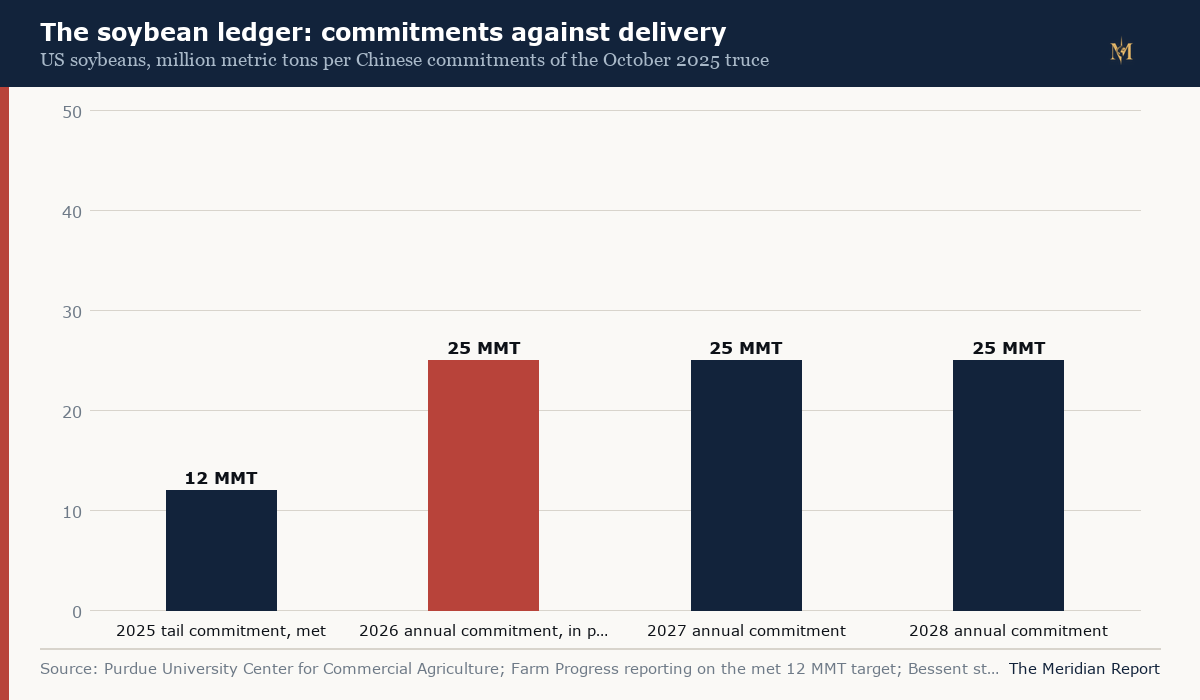
The soybean ledger is the truce's most politically load-bearing instrument. The 12 million metric ton tail commitment for 2025 slipped its deadline to February 2026 and was met, a delivery Farm Progress documented at the time, and the 25 million ton annual schedule for 2026 is, in Bessent's words at the summit, on track. On track is the fair phrase for a schedule whose first months were slow and whose autumn is the test: American soybean exports to China run against a Brazilian competitor whose own shipments to Beijing set records each year, and the commitment's value to Washington is measured less in tons than in the farm-state politics it subsidises. The ledger converts an economic relationship into a series of dated promises, which is exactly what a truce needs to survive contact with two domestic political systems.
What the soybean purchases buy politically
The agricultural file appears as a schedule of tons, but its function in the truce is political, and the political record stands on its own.
The 2018 precedent frames everything. In the first trade war, China's retaliation against American agriculture was deliberate and surgical: soybeans were targeted because their producing states, Iowa, Illinois, Indiana, Nebraska, sat at the centre of the administration's electoral map, and the industry's bailouts became a standing federal programme that outlasted the dispute. The 2025 truce's purchase commitments, 12 million tons in the 2025 tail, 25 million annually through 2028, were designed against that memory. They convert farm-state anxiety into a dated, verifiable schedule whose performance Bessent reviews publicly, and they price the countryside's loyalty at roughly the cost of the credits and guarantees that backstopped it last time.
The schedule's actual performance has been messier than the announcement, and the mess is informative. The 12 million ton tail commitment slipped its deadline to February 2026 before being met, a delay the administration absorbed because the alternative was admitting the ledger had failed its first test. The 25 million ton years run against structural headwinds no commitment removes: Brazil's export capacity, now roughly matching China's total import needs in the marketing year, prices and ships counter-seasonally to the American crop, and every month of delay in Chinese buying is a month Brazilian logistics compounds its advantage. The result is a ledger that must be re-performed every season, which is precisely its function in the truce: not a settlement of agricultural trade but a renewable political instrument whose each renewal is a negotiation, and whose each shortfall is a signal both capitals read.
The political arithmetic is straightforward. Soybeans are the largest American agricultural export to China in normal years, the crop's price tracks the commitment's credibility within days, and the states that grow it hold outsized weight in the Senate and the electoral college. A trade truce that delivers magnets to Michigan and soybeans to Iowa has purchased, at the cost of the tariff revenue and the leverage each suspension spends, a domestic coalition for its own continuation. The extension announced in September runs to January precisely so that the next instalment of that purchase falls due after the midterm vote. The farmers deliver the tons and the calendar delivers the politics; the truce holds because both arrive on schedule.
The Washington summit as a system event
The September 2026 summit was not a negotiation over the relationship's terms but an administration of its calendar, and once that is clear its every feature becomes legible.
The extension's two-month length, widely read as a slight, is the regime's native unit: short enough to keep leverage live, long enough to cross the next political event. The deliverables language, Beijing needs to fulfil more deliverables, is the ledger speaking, and its items are legible from the reporting: rare earth licence throughput through the fourth quarter, the soybean schedule's autumn cadence, the AI channel's activation. The protocol, the president greeting his counterpart at the foot of the aircraft, the state dinner, the business leaders at the summit table, is the regime's ceremonial maintenance, paid by a host whose domestic critics, from Senator Wicker to Senator Van Hollen, immediately priced it as a concession. The silences completed the picture: no American readout on Taiwan, a Chinese statement urging restraint that filled the gap, no new agricultural agreement beyond the existing ledger, and, on the war in Iran, a Chinese endorsement of the expired June memorandum that committed Beijing to nothing. A summit that produces an extension, a ledger review and a protocol payment is not a failure of diplomacy. It is the system performing its scheduled maintenance, and the schedule now runs to 10 January 2027.
The calendar that date carries is the regime's next test sequence, and each of its three events stresses a different component. The American midterms of November arrive first: an administration that has priced the truce as stability will defend it against a challenger that can attack it as dependence, and the farm-state ledger's autumn deliveries are the political collateral. APEC in Shenzhen follows, the first such meeting on Chinese soil of the truce era, where the two governments' delegations will meet in Beijing's house and the regime's face will be tested in the optics of hospitality. The G20 in Miami closes the sequence, carrying the separate complication of Washington's invitation to Vladimir Putin, which will seat the leaders of Russia and China at an American-hosted summit weeks after the midterms. The truce does not govern any of these events. It is exposed to all of them.
What would actually change the system
The regime's stability rests on four testable assumptions, each with a measurable signature, and the observations that would break the reading are all public.
The first is that China's rare earth licensing remains a slow dial rather than an embargo, watched through licence throughput data and the magnet export volumes in Chinese customs releases. A December embargo, the April 2025 pattern repeated, would break the truce more surely than any tariff, and the December date is when the export control regime's current general licences reach their own expiry.
The second is that the soybean deliveries keep their schedule. Its signature is the weekly export sales data from the United States Department of Agriculture through the autumn shipment peak. The ledger's 25 million ton year is the truce's most politically priced instrument, and its shortfall would be the deliverables language made literal.
The third is that the American tariff structure stays put through the midterm campaign. The documents to watch are the Federal Register and the exclusion list, where any pre-election escalation would appear. The regime's logic, stability before the vote, escalation after it if the politics allow, is testable in those documents.
The fourth is that the AI channel activates on its first incident, the evidence being a joint statement after any future training-run anomaly or infrastructure event. A channel that never fires is decoration; one that fires and holds is the regime's newest component proving itself.
The third front: the European Union's parallel war
The bilateral truce described here governs Washington and Beijing, but the campaign's third front ran through Brussels from its first weeks, and its record is the clearest demonstration that the trade war's methods have become a general currency.
The European Union's tariffs on Chinese electric vehicles, imposed after its 2024 anti-subsidy investigation, drew Beijing's calibrated reply across 2024 and 2025: provisional anti-dumping measures on EU brandy within days of the EV vote, with deposits reaching into the double digits and final duties up to nearly 35 percent; an anti-dumping investigation into EU pork that produced provisional duties up to 62.4 percent in September 2025; and anti-subsidy duties on EU dairy reaching 42.7 percent in early 2026, each investigation formally independent, each landing on a member state whose capital had voted prominently for the EV tariffs. The targeting precision, French brandy, Spanish pork, dairy spread across the northern members, is the technique's signature, and it mirrors the mineral and agricultural files in the American relationship: retaliation aimed at domestic constituencies rather than headline trade.
The European record matters for what it proves about the system's diffusion. The licensing regime, the constituency-directed retaliation, the calibrated escalation and de-escalation, every instrument Washington and Beijing forged has been adopted or answered by Brussels, and the truce's renewals now set the pattern the European relationship follows. When the two principals extended in Washington this September, the European Chamber of Commerce in China supplied the reminder that the system's costs are paid by firms navigating three overlapping regimes, American, Chinese, European, whose calendars do not synchronise. The managed divorce has become a multilateral condition, and no party is currently building the institutions to coordinate it.
The AI file, the newest instrument
The truce's newest component, and the one whose history is still being written, is the artificial intelligence channel, and it is the clearest window into how the two governments now build institutions in place of agreements.
The instrument began as pure confrontation: American export controls on advanced chips and chipmaking tools, imposed to slow Chinese AI training capacity, met by Chinese countermeasures and a domestic substitution programme whose 2025 and 2026 model releases demonstrated, to Washington's visible discomfort, that total embargo accelerates the substitution it hopes to prevent. The first institutional signal came earlier in 2026, when the two governments confirmed that AI talks, the first dedicated bilateral channel, had taken place. The second came at the summit's doorstep: Bessent and Vice Premier He Lifeng, meeting in New York before Xi's arrival, discussed an alert system for AI incidents, a standing mechanism through which either government would notify the other of significant safety events.
The instrument's design tells its own story. An alert system does not resolve export control policy, harmonise safety standards or allocate compute. It does one thing: it creates a standing reason for officials on both sides to speak before a crisis rather than after one, the same logic that produced Cold War crisis-management machinery in a relationship whose economic core is dissolving. The comparison is close. The United States and the Soviet Union built hotlines and incident agreements while their trade relationship atrophied; the United States and China are building incident channels while their trade relationship is administered into separation. In both cases, the institution is an admission that the underlying relationship can no longer absorb shock, and the managers have built shock absorbers instead of bridges.
What would prove the channel real is observable: its first activation, any joint statement after a training-run anomaly or infrastructure event, and any Chinese reciprocal notification obligation in the licensing dialogue. What would prove it decorative is equally observable: a year of silence. The channel's likeliest future, offered as interpretation rather than finding, is that it fires within the truce's next two cycles, because both governments have discovered the same lesson about AI that the nuclear powers learned about missiles: the weapons now move faster than the diplomacy that would follow their use.
The automotive file: the campaign's hardest case
No sector records the trade war's mixed verdict better than automobiles, the sector where the weapons were actually fired.
China's April 2025 magnet restrictions were aimed, in their immediate effect, at the world's just-in-time automotive supply chains, and the Peterson Institute's reconstruction records how close the system came to stoppage: nearly 6.5 percent of American manufacturing workers sit in automotive chains that depend on Chinese rare earth inputs, and twice in 2025 production pauses were averted only by the licence regime's partial restoration. The episode established the dependency that every subsequent truce cycle has priced, and it explains why the industry's representatives, on both sides of the Atlantic, have been the truce's most consistent constituency.
The American tariff side of the ledger records its own costs: a 25 percent tariff on automobiles from all countries from April 2025 and on parts from May produced declines in import volumes from every major source, with no winners in the year's data. Mexico's share of American vehicle imports has nonetheless risen 12 percentage points since 2017, its assembly scale absorbing what higher-cost sources lost, while Chinese vehicles, whose world-market rise has been the decade's industrial story, remain excluded from the American market by tariffs that predate this war. The sector's summary is the campaign in miniature: the tools worked, the costs landed, the dependency survived, and the arrangement that ended the firing left every underlying structure standing.
The mineral wars before the war
The truce's mineral provisions look sudden in 2025's chronology and inevitable in the longer one, and the longer one belongs in the record because it explains why the licensing regime proved so hard to remove.
China's critical minerals controls began years before the second trade war: gallium and germanium, metals the semiconductor and defence industries refine almost nowhere else, came under export licensing in 2023 with an outright ban on exports to one unnamed destination widely read as the United States; graphite, the battery anode's raw material, followed under licensing in late 2023; antimony joined in 2024. Each step was presented as protecting dual-use supply chains and each functioned as a demonstration: the minerals pipeline runs through Chinese processing at concentrations no other producer matches, and the controls' early years taught every industrial buyer the queue's existence before the 2025 embargo of magnets weaponised it openly.
The sequence matters for two judgments. The 2025 escalation did not create the vulnerability it exposed; it inherited one built across three years of quiet controls, which is why Western substitution programmes, the mine reopenings, the processing investments, the recycling schemes, are multi-year projects while the licences' discretion operates weekly. And the truce's mineral language, the general licences and the queue, is therefore not a concession China extracted in 2025 but a standing feature of its trade governance since 2023, and the truce merely set its price. The scorecard counts the minerals file as the campaign's unresolved core for exactly this reason: everything else in the system, tariffs, purchases, the AI channel, was negotiated within the last two years, but the dependency at the system's centre was built over the decade before it.
What January 10 will decide
The truce's next expiry arrives carrying the three calendars traced above, and its possible outcomes can be described conditionally, each with its own observable signature, without ranking their likelihood.
One path is a further extension, long or short. Its signature would be a renewal announcement in late December or early January, framed, like the last two, in deliverables language, and its substance would be the ledger's routine continuation: licences through the spring, purchase schedules through the crop year, the AI channel's budget of silence maintained. The conditions that would accompany it are legible in advance: soybean deliveries at or near schedule through the autumn, rare earth licence throughput steady, no pre-election American escalation in the Federal Register.
A second path is a partial deal, the conversion of one or more truce components into longer-dated commitments, most plausibly the agricultural ledger, whose three-year structure makes it the natural candidate for multi-year extension, or the exclusions list, whose product-by-product review invites consolidation. Its signature would be implementing notices rather than an expiry announcement, and its condition would be a deliverables record clean enough for both governments to bank.
The last path is rupture, the expiry lapsing into a new escalation round. Its signature would begin in the same public documents the first two paths monitor: a Chinese licence slowdown, an American escalation notice, a purchase schedule miss that the treasury secretary declines to defend. The report describes this path without assigning it probability, because the regime's own history, one full rupture in the 145 percent summer, then two years of managed retreat, shows both governments choosing the wall's edge and stepping back. The truce's design makes rupture a scheduled possibility rather than an accident. Its renewals have made continuation the habit. January 10 will be decided, as every instalment has been, by whichever government judges the other's ledger short, and the data that decides it will have been public for weeks before the announcement confirms it.
Method, and what cannot be known
The system’s parts are documented unevenly, and the limits that follow from that belong beside the findings.
The tariff levels and their dates rest on primary documentation, from the Peterson Institute's reconstruction of United States trade data and the administrative record, as do the Chinese customs figures for exports and surplus (General Administration of Customs releases as reported), the truce's implementing terms (tariff suspension notices and exclusions extensions) and the purchase commitments (the announcements and the delivery reporting that followed them).
Attribution carries the rest of the load, and it is weaker in specific ways. The deliverables language is quoted from Bessent's interview and therefore subject to the gap between a treasury secretary's phrasing and the internal ledger it summarises. The readouts' silences are read from absence rather than document. Chinese decision-making is visible only through official statements and state media reporting, never through internal records no outsider possesses.
One figure is mechanical rather than forecast: the 2026 surplus projection carried in the charts, which annualises August's monthly figure as a scale illustration. Monthly surpluses are seasonal and the fourth quarter's pattern makes August a conservative base, but the projection's purpose is scale, not prophecy, and it should be cited as such.
Nothing here models the truce's collapse, because the evidence base for probability claims about a process governed by two wills is thin, and the scenarios stay confined to what can be observed. The falsification markers named above are the substitute for forecasts: public data that will signal the answer ahead of the next extension announcement.
The divorce that administers itself
The finding stated at the opening now carries its evidence. The United States and China have not negotiated a new relationship. They have automated the old one's dissolution, and the automation is the achievement both governments point to as stability.
The numbers record the dissolution precisely. A bilateral trade relationship that was 22 percent of American imports has been cut to 9 percent, at a cost American importers and consumers pay in every tariffed category, with the trade re-routed to Vietnam, Taiwan, Mexico and India so completely that American shelves never emptied and total imports never collapsed. China's export economy absorbed the loss and set records, its 2026 surplus tracking above $1.2 trillion, its technology exports accelerating through the very AI boom that America's chip controls were built to slow. The truce that now administers this separation holds because it is the cheapest instrument both sides have: it prices the relationship's remaining interdependence, rare earths, soybeans, chips, in quarterly instalments of leverage, and its short renewals convert every political event on three continents into a negotiating deadline.
Whether this constitutes success depends entirely on which objective one audits. As a renegotiation of America's bilateral deficit, the campaign failed; the deficit moved, grew and re-routed, and the manufacturing reshoring it promised appears in the data as relocation to third countries more than as American capacity. As a management of strategic rivalry, it has so far succeeded, in the specific sense that two weapons were demonstrated once and have not been fired again, and the institutions built to substitute for trust, the Board of Trade, the licensing dialogues, the AI alert channel, are the war's real monuments. The system's founding premise is that time is on neither side's clock but the calendar's. The calendar now reads 10 January. What happens then will be neither settlement nor war, if the pattern holds. It will be the next instalment of the only great-power relationship that has learned to renew itself the way a subscription does, with no end state and no exit, at a price both sides pay on time.