
The fire at the Ilsky refinery, fifty kilometres from Krasnodar, was visible shortly after midnight, and by Saturday morning Ukraine's General Staff had confirmed what the flames suggested: drones struck the plant overnight, in an operation the military described as an exercise of its right to self defence under Article 51 of the UN Charter. The regional governor, Veniamin Kondratyev, confirmed an attack on his district and said two businesses were damaged, one of them the refinery by Astra's geolocation of eyewitness footage. Three people were killed in the region's attack, according to officials cited by Al Jazeera, and drone debris damaged a residential building.
It was the third refinery strike counted in three days. On Friday, Novoshakhtinsk, a small plant in the Rostov region near the Ukrainian border, suspended operations after an overnight attack that the regional governor confirmed, one of roughly fifty drones Russia said it destroyed over the region that night. Zelensky said Ukrainian forces hit two refineries overnight, Perm and Novoshakhtinsk, and by Saturday Kyiv Post was reporting the Perm plant, Russia's seventh largest and more than 1,200 kilometres from the front, offline after Friday's attack.
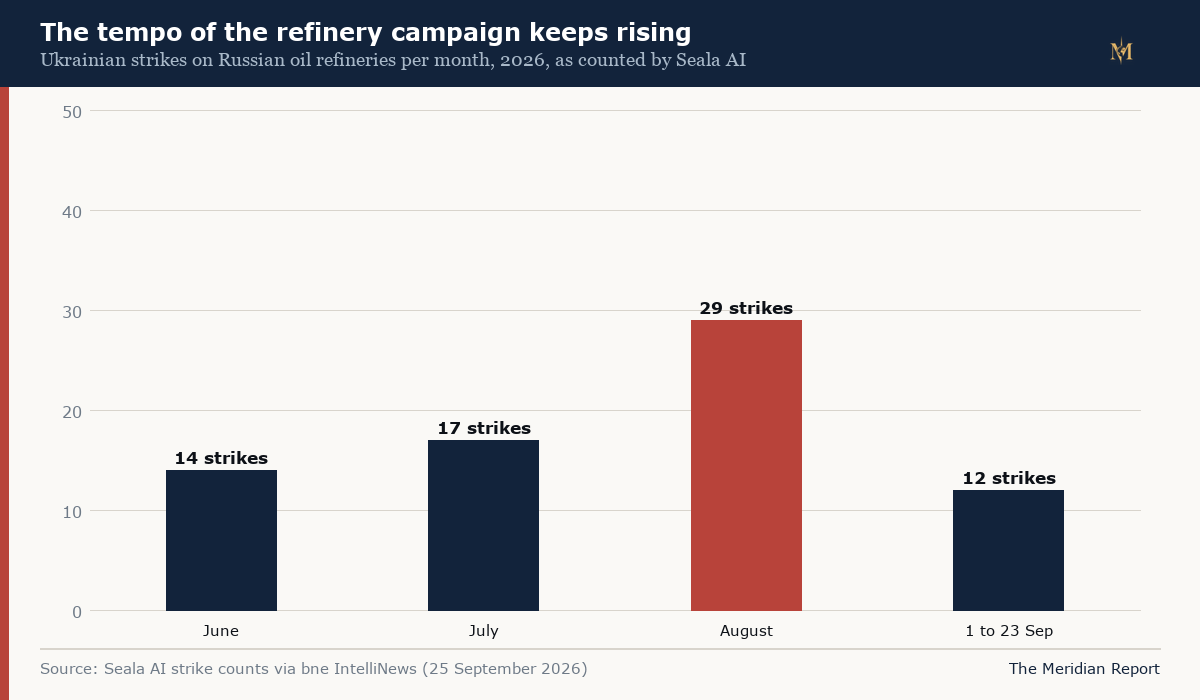
The campaign behind these three days has been running for a year and it is now at its heaviest tempo. Twelve strikes on refineries were counted between 1 and 23 September, after a record 29 in August, 17 in July and 14 in June, in the tally of the Russian consultancy Seala AI. Eight plants were damaged in September's first three weeks alone, several of them more than once.
What the drones have actually broken, and who is counting
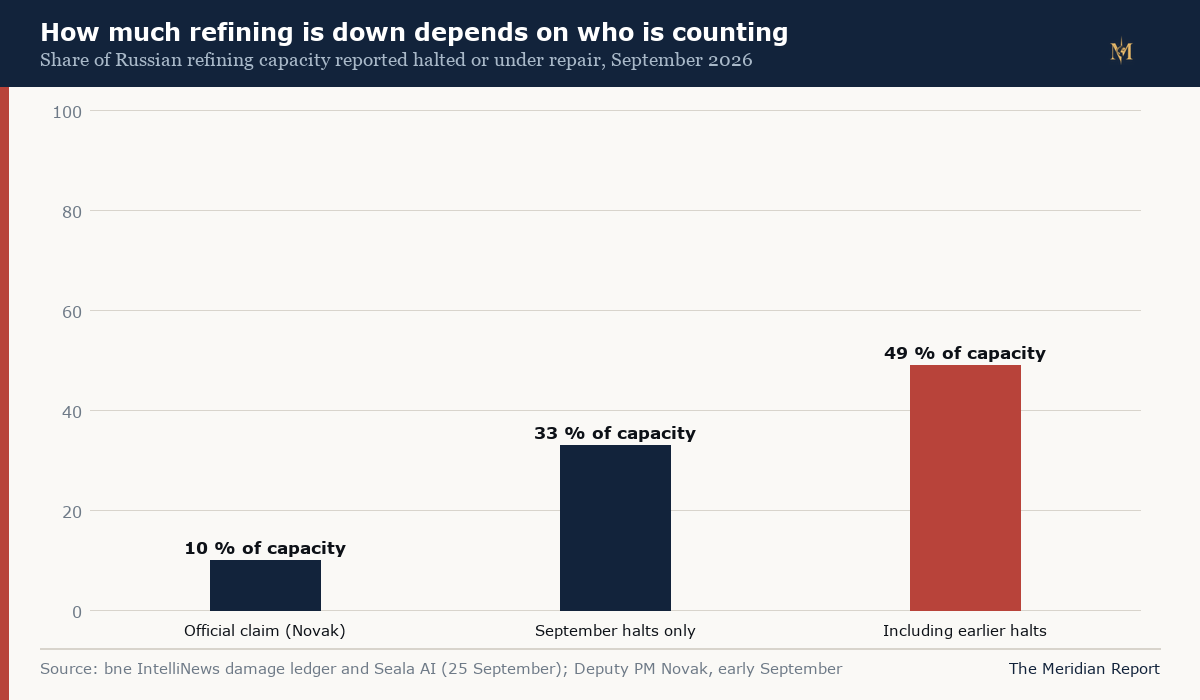
The gap between Moscow's account and the independent ledgers is now the campaign's most consequential number. Deputy Prime Minister Alexander Novak said in early September that about a tenth of Russia's refining capacity was under repair, and Putin cited a similar figure at the Eastern Economic Forum. The bne IntelliNews damage ledger, which logs every dated strike, counts plants halted or cut this month alone at about 108.5 million tonnes a year of capacity, a third of the country's nameplate 327 million tonnes, rising to about 49 percent if earlier halts at Tuapse, Salavat, Perm, Orsk and Tyumen still hold. Seala AI's estimate of primary capacity idle for unplanned repairs on 24 September came out at roughly 53 percent, just below the first wave's July peak. Only four large refineries, Achinsk, Angarsk, Komsomolsk and Khabarovsk, all in the far east and Siberia, have never been hit.
Both sets of numbers contain their own honest caveats. A drone strike usually damages units rather than whole plants, and companies do not disclose which units are down, so analysts read the damage from indirect signs such as fuel disappearing from the St Petersburg exchange, as Moscow refinery product did for three days after the 20 September strike on Russia's capital plant, the largest drone attack the city has yet seen. The official count, for its part, comes from the government whose plants are burning.
What is not in dispute is the shape of life around the shortages. At a 21 September meeting chaired by Novak, officials named Tyva, Khakassia, Yakutia, the Novosibirsk region and the Krasnoyarsk territory as problem areas, a week after St Petersburg topped the list. Deliveries to Yekaterinburg and six more regions are being organised by hand, with the energy ministry identifying gaps and Russian Railways moving fuel. Two regions have reimposed caps on petrol sales. Jet fuel is rationed at 26 airports. Rosstat's pump price for AI-95 petrol is up 21 percent since the end of December.
One price has moved the other way, and the reason is diagnostic. Exchange prices for AI-92 fell through September because traders and independent filling stations have stopped buying contracts they cannot be sure will be shipped. A falling wholesale price inside a physical shortage is what a distribution collapse looks like from the trading floor.
The request Kyiv refused
Donald Trump asked Zelensky on 15 September to stop hitting Russian diesel production, and called the strikes a serious hit on the Russians and a serious hit on the price of diesel before their meeting at the United Nations on 22 September. Zelensky's answer, delivered after the meeting, was a refusal with a counter offer attached. President Trump asked me not to respond on Russian diesel refineries, oil. We don't want this game, and I suggest neither side plays it. Putin attacks us, we respond.
The counter offer was a reciprocal energy truce: Ukraine halts its refinery campaign if Russia halts its attacks on Ukraine's power grid, the target of the strikes meant to freeze the country through a third winter. Washington agreed to carry the offer to Moscow. The Kremlin rejected it, and a truce the American president announced on 13 September never took hold. Putin's own framing, that Kyiv opened a Pandora's box by hitting Russia's economy, is a description of the campaign's success rather than an argument against it.
The shortage is now a global price
Russia kept roughly a fifth of the world's seaborne diesel trade moving before the war and has banned most exports of it since July, extensions now running to the end of October for refiners and to the end of January for everyone else. Its diesel shipments fell from 743,000 tonnes in July to 504,600 in August. Stacked on top of the Gulf war's disruption of Middle Eastern product exports, the world is missing between two and three million barrels a day of diesel, and the cracks have gone to records on S&P Global's data.
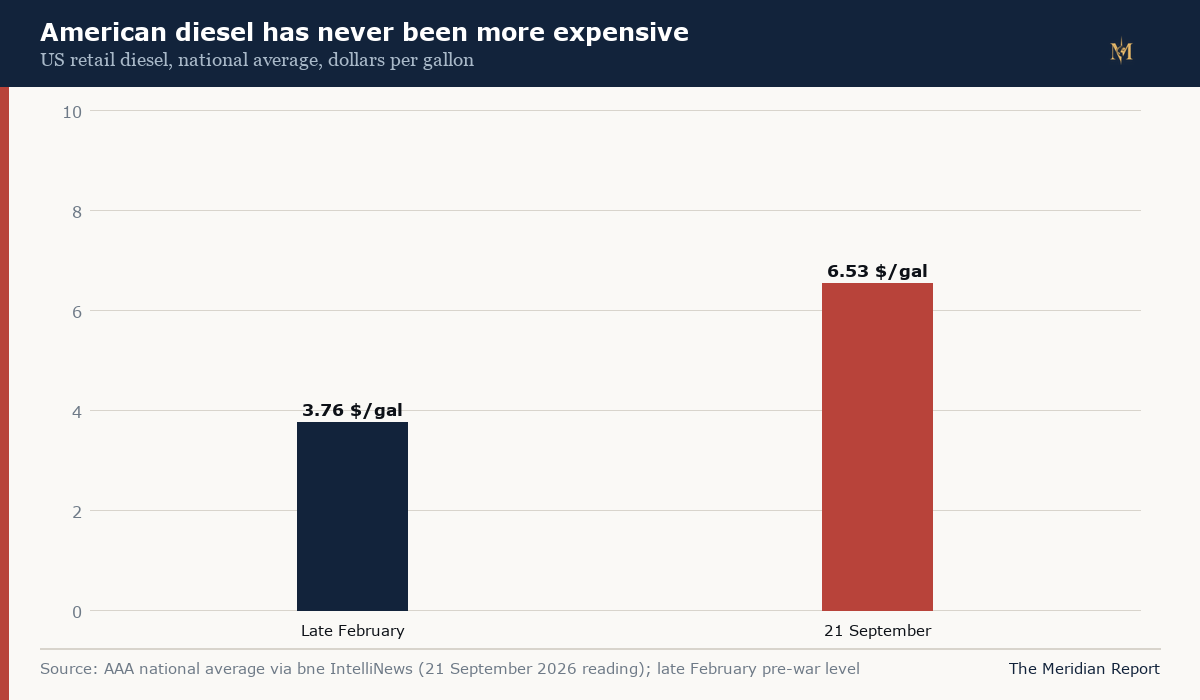
American pumps now hold the proof. Retail diesel hit a record $6.528 a gallon on 21 September by AAA's count, against $3.76 in late February, and the price has crawled into the midterms alongside gasoline. Trump has weighed an export ban, with his agriculture secretary in favour and his treasury secretary opposed, while Europe, which buys more than half its diesel from the United States, has begun lobbying against a move that would hit it hardest. Morgan Stanley's analysts calculate that a ban would fill American storage within weeks and force refiners to cut runs by about two million barrels a day, which is the kind of arithmetic that has kept the ban theoretical so far.
What the campaign has become
Twelve months in, the refinery campaign is no longer a harassment operation. Ukraine's own claim, that it had shut 43 percent of Russian refining by early July, sits inside the range the independent ledgers now support, and the knock-ons have reached far beyond fuel: Russia imported three times as much seaborne oil product in August alone as in all of 2025, its export revenue is slipping, and its shadow fleet has lost roughly 300 tankers to Ukrainian attacks in three months. The strikes also forced Moscow to choose between diesel for the harvest, diesel for the army and diesel for winter stocks, and the export ban says which choices it made.
The measurable signs to follow from here are three. Whether the exchange withdrawals spread from the Moscow plant to the plants struck this week, which would show unit damage rather than fire damage. Whether the rationing map extends from Siberian regions toward the larger cities, which would show the redistribution system running out of surplus. And whether the diesel gap meets a real supplier: China loosened its export restrictions in June and is the only large producer with room to add barrels, and Beijing's willingness to help before November remains the gap in every forecast on either side of the argument.
Ukraine struck two more refineries overnight as this was being written, in the words of its General Staff's standing formula: work against key enemy facilities continues.