
The truce that was supposed to buy a year has bought two months. When Treasury Secretary Scott Bessent told Fox News that the American and Chinese tariff truce would run until 10 January 2027, the announcement's timing carried more information than its text: he was speaking as Xi Jinping's aircraft touched down in Washington for a three-day state visit, and the extension had been settled before the ceremony began. The two leaders then spent Thursday producing photographs and avoiding announcements, and the world's largest trade relationship entered the autumn governed by an agreement whose next expiry is measured in weeks.
What was actually agreed, and what was not
The on-record ledger is short. The truce, originally struck at a leaders' meeting in South Korea in October 2025, had been due to expire in November. It now runs to 10 January. Bessent framed the short extension as a statement of unfinished business, noting that Beijing needs to fulfil more deliverables, the catch-all that covers rare earth export licensing, purchase commitments and the other files the two governments manage rather than resolve. China's official readout of Xi's arrival expressed confidence in fruitful results and described the two countries as partners rather than rivals. It did not mention tariffs, rare earths or artificial intelligence.
What did not happen is the more informative list. No new soybean agreement was announced, despite American farm groups going into the week expecting agriculture to be central and the administration's own agriculture reporting building the visit around it. No American summary of the talks was released in the first day, a gap the Taiwanese readout immediately filled: Chinese state media reported that Xi had urged Trump to oppose Taiwanese independence and handle the issue prudently, while the American side stayed silent, an asymmetry that has marked every summit of the past year. On Iran, Trump said he would raise the war with the Chinese leader, Beijing's largest trading partner being the largest standing purchaser of embargoed Iranian crude, and the readouts record Chinese support for returning to the June interim agreement without any Chinese commitment to help enforce it.
The most concrete new instrument of the week never touched the summit at all. Bessent met Vice Premier He Lifeng in New York before Xi's arrival, and the two sides discussed an alert system for AI incidents, the first institutionalisation of a channel that did not exist a year ago. Its significance is easy to miss because it is procedural: the two governments are building standing machinery for their rivalry, which is what managing a conflict looks like when neither side intends to end it.
The arithmetic underneath the ceremony
The summit's pageantry took place against the least ceremonious possible backdrop. China's exports rose 25 percent year on year in August to $401.44 billion, the General Administration of Customs reported on 8 September, accelerating from 23.9 percent in July and beating economists' forecasts by three points. Imports rose 28.2 percent, faster than exports but from a smaller base, and the month's trade surplus came in at $119.09 billion, the fourth consecutive month above $100 billion. The first eight months of 2026 have now produced a cumulative surplus on a pace to eclipse the record of roughly $1.2 trillion set in 2025, a number that has become the standing indictment in Western capitals of the current trading arrangement.
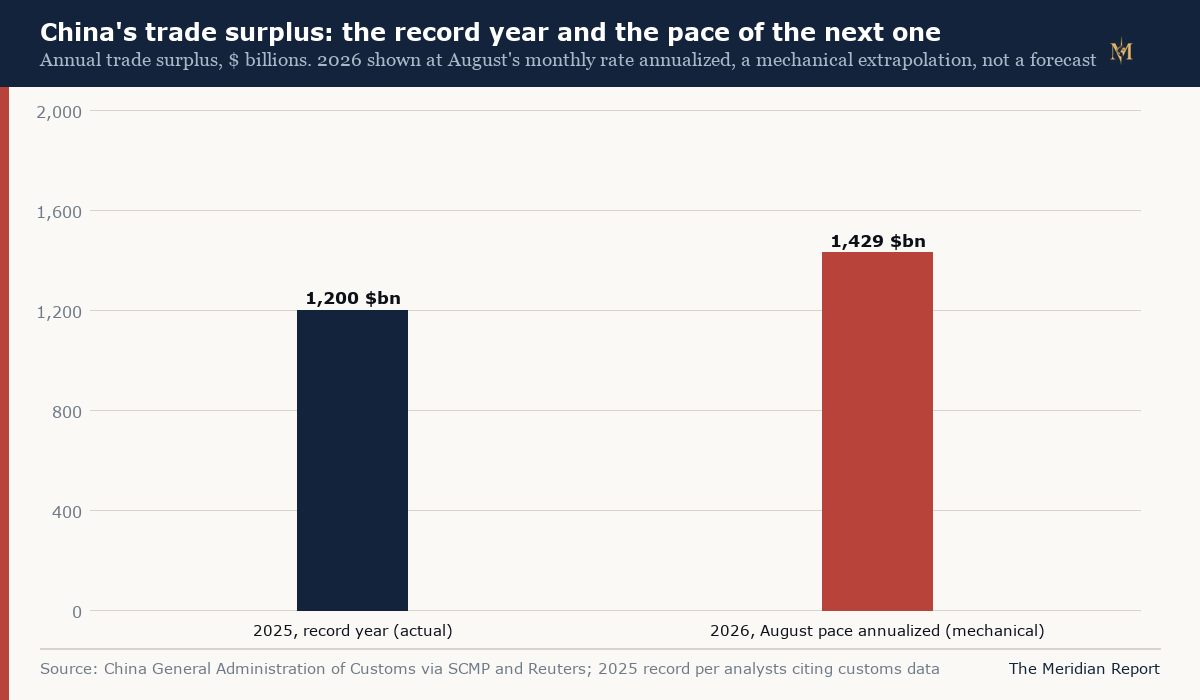
Two caveats belong next to that chart, because the data invites two different overreadings. The 2026 bar in the comparison is a mechanical extrapolation, August's monthly surplus multiplied across a year, not a forecast; monthly surpluses are seasonal, and the fourth quarter's pre-Christmas export surge makes August a conservative rather than aggressive base. And the export figure's composition matters as much as its level: analysts attributed August's beat to technology products and AI-driven demand, precisely the categories the truce's technology annexes are supposed to govern. The relationship being managed is not the relationship that produced the surplus. The surplus is now generated by the sectors each side considers strategic.
That is the quiet reason the truce keeps being renewed rather than resolved. Washington's tariff campaign was built to shrink the imbalance; the imbalance has instead grown through it, because the campaign's own exemptions and the world's re-routing of trade have left China's export machine pointing at markets that did not retaliate. Beijing has no incentive to renegotiate an arrangement it keeps winning. Washington cannot sustain the political cost of losing it. The truce is the only instrument both find cheaper than the alternative, and its renewal is therefore an event with no content beyond its own extension.
Why two months, not two years
Extensions of six months or more had been widely expected before the visit. The two-month figure that arrived instead is best read through three clocks, all of which the short extension serves.
The first is the American political calendar. The midterms fall in early November, and an agreement signed now that aged badly before election day would be an attack ad with a signature. A truce that expires on 10 January puts the next round of leverage beyond the vote, and lets the administration claim stability without binding itself to terms.
The second is the summit calendar. The two leaders could meet again alongside APEC in Shenzhen in November and at the G20 in Miami in December. Analysts at the Center for Strategic and International Studies noted that the short extension makes Xi's Miami attendance more likely, each deadline doubling as a reason to keep meeting, and each meeting doubling as a reason the previous deadline was set short.
The third is the deliverables ledger itself. Bessent's formulation, that Beijing needs to fulfil more deliverables, describes a relationship now run as a rolling scorecard: rare earth licences flow, purchase commitments accrue, chips policy holds, and the truce's expiry acts as the collection date. A short deadline is a strong one. The farmer question, pressed all week, got the same structure: Bessent said China was on track with its soybean commitments, on track being the operative phrase for an arrangement whose next test is scheduled rather than achieved.
What the extension does not touch
The visit's warmest images and its sharpest silences came from the same places. Xi landed to a breach of protocol performed as a compliment, the president greeting him at the foot of the aircraft, footage Chinese state television broadcast prominently, and senators from both parties criticised the spectacle as lavish for a strategic rival while others defended the dialogue it represented. Beneath the split sits the unchanged structure: Taiwan's arms package, reportedly $14 billion and postponed since the May meeting, remains postponed; the AI talks the two sides confirmed this summer have produced an incident hotline rather than export-policy convergence; and the war in Iran, the subject Trump said he would raise, ends the week no closer than it began, with China supporting the return of an agreement Washington has declared over.
The European Chamber of Commerce in China's president, Jens Eskelund, supplied the week's most practical criticism: extending the truce does not address the problems companies actually face, among them the absence of a standardised process for rare earth export licences. That gap is the truce in miniature. The licence regime that slowed Western manufacturers this spring continues to operate at Beijing's discretion, and the new January date does not standardise it, it merely prices the discretion for another quarter.
The truce now runs to 10 January, and its next renewal will be negotiated against three known events: the midterms, the Miami summit and the winter deadline itself. Watch three things, all observable: whether soybean purchases hit their scheduled cadence in the weekly customs data, whether rare earth licence approvals accelerate ahead of the January expiry as they did ahead of the last one, and whether the AI incident channel logs its first real test. The relationship's managers have chosen a calendar over a settlement. The calendar will now do the negotiating.