
On Saturday morning Donald Trump walked to the microphones on the South Lawn and did what a week of anonymous quotes had promised. I reject their proposal, he said of Iran's seven day roadmap, adding that the deal would not be acceptable, and then, in the same breath, that Iran wants to make a deal, and I think that's fine, and I'd like to make a deal, too. The Wall Street Journal had previewed the scene on Friday evening, reporting that the president was privately sceptical that Tehran would meet his demands and had told aides he expects a renewed bombing campaign after the November midterm elections.
The answer drew a reply within hours, and the reply was itself a negotiation document. Foreign Minister Abbas Araghchi told the Iranian news agency IRNA that Tehran had seen an initial reaction from the president but no formal response through the mediators, and that the definitive position was what Iran was waiting for. Our conditions are clear, he said. Any move toward reopening the Strait of Hormuz is contingent on these conditions being met. Only a negotiated solution can get them out of this deadlock. That is our position.
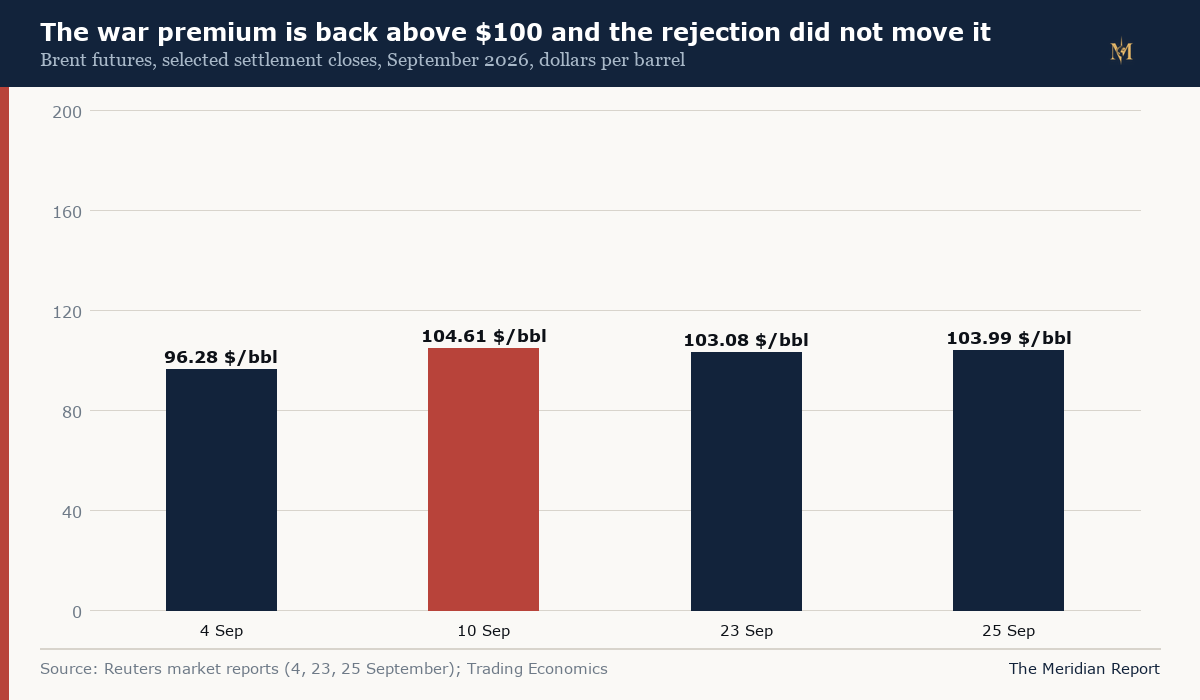
The strait stayed shut through all of it. Commodity transits, which ran at 130 to 140 vessels a day before the war, numbered nine on Thursday by Kpler's count, three the day before, fourteen the day before that, a shipping pattern that has spent three weeks pinned in single digits and low teens. Brent crude closed the week near $104, and it has now held above $100 since 9 September. The tape heard the loudest statement of the war's seventh month and priced none of it.
This report reconstructs what the rejection actually fixed, what it deliberately left open, and the domestic ceiling in Washington that both the plan and its answer were built around.
What the plan asked, in the order it asked
The roadmap Araghchi presented to reporters outside the Security Council on Friday was the week's most concrete diplomacy, and its architecture was rigid because each step was a precondition for the next. An initial phase of four to five days would carry a ceasefire covering the region's active fronts, Lebanon and Yemen included, the lifting of the naval blockade of Iranian ports, waiver of the sanctions that price Iranian crude out of legal markets, and the release of an estimated $12 billion in frozen assets. The strait would reopen on day six. On day seven, in Araghchi's words, the talks with the US will be started for the final deal on mutually agreed subjects, the nuclear file foremost among them.
The sequencing was the message. Tehran has held since spring that the blockade and the sanctions are acts of war rather than chips to trade after a ceasefire, so Washington moves first and Iran's concession comes last, at the end of a week instead of the end of two months. The June memorandum that both governments signed on 17 June, and that Trump declared over on 7 July after convoy disputes and vessel searches destroyed it, gave the parties sixty days. The new plan compressed the same sequence into seven days, which Iranian officials presented as proof of seriousness and which the American answer treated as a reason to refuse.
Washington's objections were never itemised. The president's public case ran one sentence long: Iran wants an agreement because they're losing so badly. The Journal's reporting gave the private version, scepticism that Tehran would meet his demands, and a timetable, renewed bombing after the midterms, that makes the November election the hinge of the war's next phase.
The Senate ceiling, measured in one vote
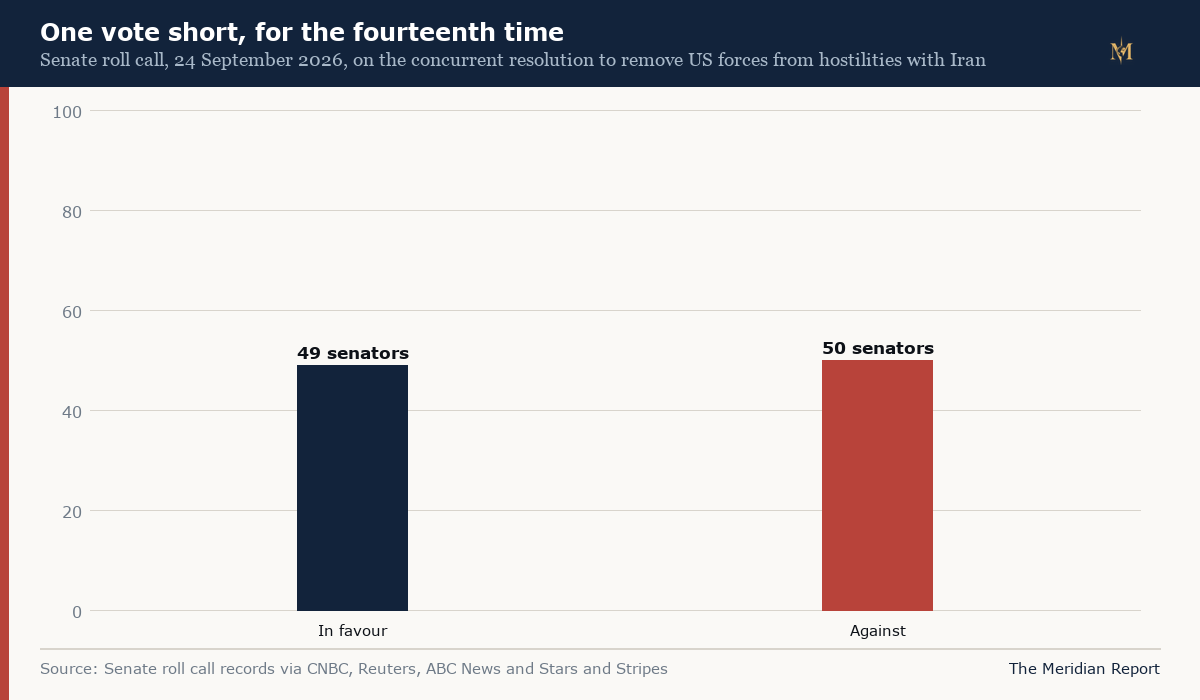
Two days before the rejection, the United States Senate held the fourteenth vote of the war on a resolution to stop it. The concurrent resolution directing the president to remove US forces from hostilities with Iran unless Congress explicitly authorised the war failed by one vote, 49 to 50, with four Republicans in favour, Thom Tillis, Susan Collins, Lisa Murkowski and Rand Paul, and one Democrat against, John Fetterman. Senator Angela Alsobrooks, who has supported every previous such measure, missed the roll call for a family matter; her office noted the resolution would have failed regardless.
The arithmetic is the story the vote tells. In June the Senate actually passed one such resolution, with four Republicans joining, and the White House ignored it on the argument that the War Powers Act is unconstitutional. This week's count reached 49, with a Republican candidate for Senate in Iowa, Ashley Hinson, joining the public call to end the war, and senators from midwestern states where diesel prices have become a farm crisis drifting toward the same position. The direction is one way. The distance is unchanged. A concurrent resolution carries no force of law, so the ceiling is not legislative but political: Congress can count the votes to express itself, and the count keeps arriving one or two short of a mandate.
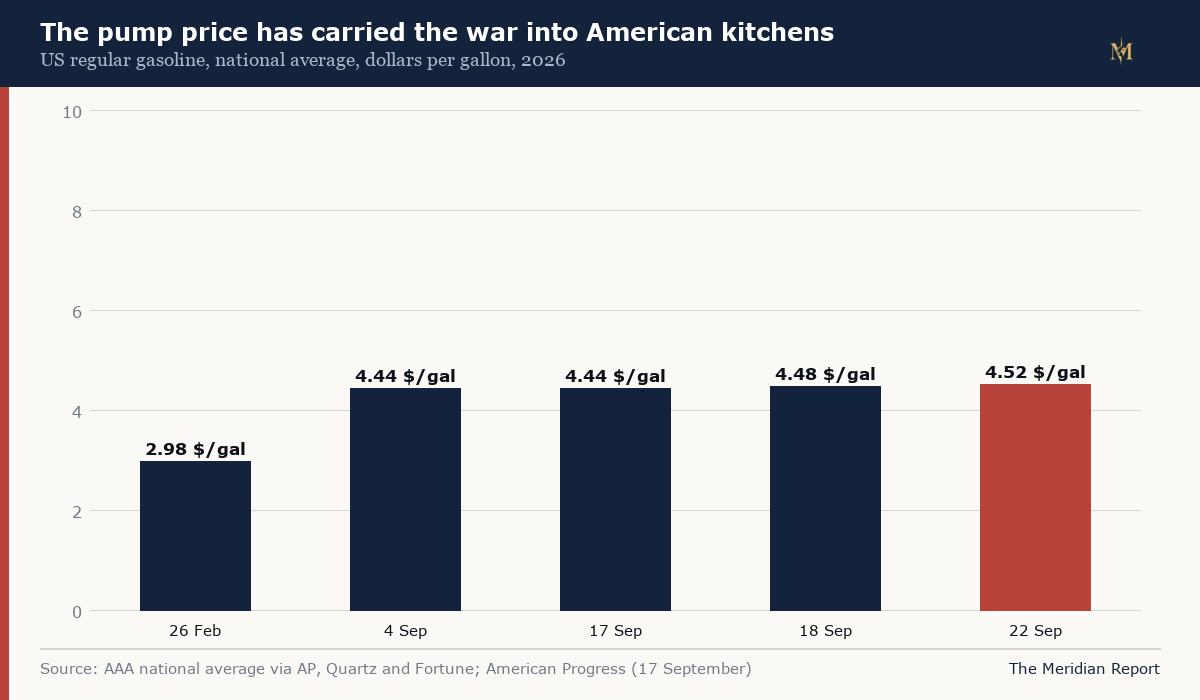
Gasoline is the force doing the eroding. The national average for regular peaked the week at $4.52 a gallon by AAA's count, against $2.98 on the eve of the war, and diesel sits at records that have moved into feed, fertiliser and freight. A Fox News poll published on 16 September found 61 percent of voters calling gas prices a major problem for their household, up from 48 percent two years ago, . The president's own answer, that the increase is a small price to pay, has been running as an advertisement for his opponents.
Both capitals are now planning around the same calendar, openly. Trump has told audiences the war will end immediately after the midterms. Iranian officials, including Araghchi, say it would be better to reach an agreement before the vote, and the Journal's account of a bombing campaign scheduled after it. The election that is supposed to constrain the war has become a parameter of it, on both sides of the Gulf.
What the oil market did with the loudest week
The week's tape was flatter than its headlines. Brent settled at $96.28 on 4 September as strikes intensified, $104.61 on the 10th, $103.08 on the 23rd when Pezeshkian vowed at the General Assembly that Iran would never surrender, $103.99 on the Friday the plan was tabled, the week's final settlement, the last print before Saturday's rejection. From the plan's announcement to the president's answer, the market moved less than a dollar.
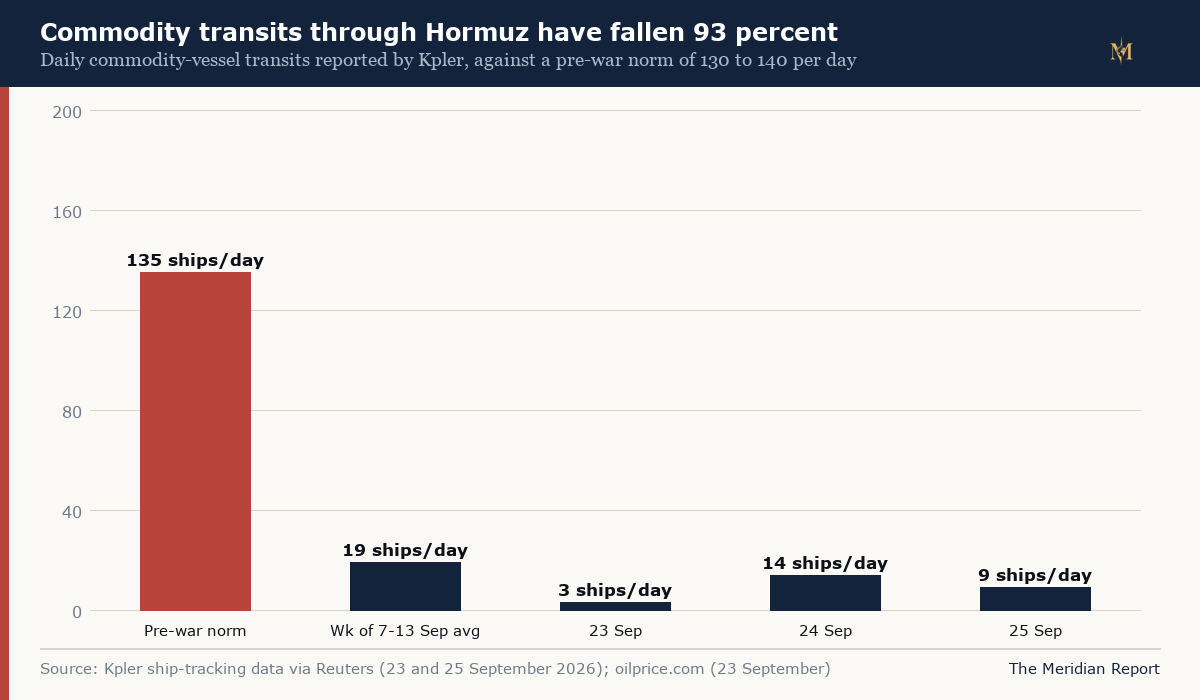
The physical market explains the calm better than the diplomacy does. Crude flows through the strait have been recovering since late August even as vessel counts collapse, because the ships that do move are carrying more: Reuters, citing Kpler, put crude exports via Hormuz at 33.7 million barrels in the week to 24 September, against 49.2 million the week before, on days when commodity transits ran in single digits. The cargo is concentrated, the insurance is repriced, and the margin for a single incident is thin, but the barrels have found a way to move at volumes that keep the futures curve from panicking. The war premium, 46 percent above January, is the price of that fragility rather than of its absence.
The American forecaster's own number, a Brent average around $90 for the second half of 2026, presumes a partial reopening that Saturday's rejection moves further away. The gap between the official forecast and the tape is the market's standing judgment that the premium has further to fall eventually and no reason to fall now.
The newest front is a country lane in Gloucestershire
The war's geography changed on Sunday, two days after the rejection, and the change arrived in the form of a 999 call from a motorist. At about 12.45am, police in Gloucestershire received a report of three suspicious vans travelling toward RAF Fairford, the British owned, American operated airfield from which B-1 and B-52 bombers have flown against Iran since March. Armed officers arrested five men in the village of Whelford, first under the Explosives Act and then on suspicion of preparation of a terrorist act. Bomb disposal robots spent the day examining what investigators' initial assessment described as materials consistent with improvised explosive devices. Some 85 households were evacuated, and the cordon was still in place on Monday morning.
The base was not a random symbol. In July, Iran's Revolutionary Guard Corps warned that any base used for aggression against Iranian territory constitutes a legitimate target for its forces, after Fairford's bombers became a fixture of the air campaign against Iranian missile sites. The Guardian reported that an Iranian motive now sits high in investigators' thinking, while sources cautioned that nothing is being ruled out and that the operation was not intelligence led: the state learned of the alleged plot from a passing driver, not from its own surveillance. President Trump told reporters the suspects had been under view for a long time, a claim the reporting contradicts. The investigation is live, no charge has been brought, and no origin has been established, which is precisely why the episode belongs in the ledger of this war rather than the file of settled facts: the IRGC's warning named this base, the arrest happened at this base, and the space between those two events is what counter terrorism detectives are now measuring.
What the episode changes is the war's cost surface. For six months the conflict's bills have been paid in Gulf shipping insurance, in the price of diesel, and in the Strait's transit counts. Fairford puts a bill on the other side of the Atlantic, in an English village that evacuated to a leisure centre, beside a base whose neighbours have complained since March that the bombers shake their houses. From Desert Storm to Allied Force to the Iraq war, the American heavy bombers that opened campaigns in the eastern hemisphere have launched from this field, and now the campaign's risks have followed them home.
What the rejection leaves standing
The refusal was total in public and partial in substance. The president rejected a timetable, not a negotiation; he said twice in the same answer that he would like a deal. Araghchi's response kept the plan alive by disputing its burial: no formal response has arrived through Qatar, the conditions stand, and the initial reaction of one elected official is not, in Tehran's reading, the position of a government. Pezeshkian went further in his Al Jazeera interview, saying Iran no longer trusts negotiations with Washington because previous rounds were followed by attacks and sanctions, and denying that Iran closed the waterway at all: the US closed the routes before us, he said, calling the closure a natural response when routes are cut off to Iran. The man responsible for reopening the strait is now on record saying his government does not trust the counterparty any reopening would require.
Three things would mark real movement, and all three are observable. A named American official, not an anonymous one, engaging the sequence on the record. Any formal answer through Qatar, of acceptance, rejection or amendment, which Araghchi says has not arrived. And the transit pattern, which at nine ships a day has further to fall if the week's rhetoric hardens into strikes. Until one of the three moves, the impasse holds on both sides of the water, and the only referee both governments have agreed to recognise is the price at the pump, $1.54 above its pre war level, six weeks before an election both of them are watching.
The moral of the week is the one the June memorandum already taught, and Saturday restated: this war's diplomacy is priced in verification, and nothing that happened in Washington verified anything.