
Somewhere in western Siberia on 7 July, drones reached the Omsk refinery, Gazprom Neft's 450 thousand barrel per day complex, the largest in Russia, roughly 2,500 kilometres from the Ukrainian border and, until that morning, comfortably beyond the known reach of Ukrainian long-range systems. The strike's significance outran its smoke. It meant that no refinery in Russia, including the eastern complexes whose distance had functioned as immunity, could any longer be considered out of the war. By late August, the International Energy Agency counted only five major Russian refineries that Ukrainian drones had never touched, all of them in eastern Siberia or the far east, between 3,500 and 6,500 kilometres from the border, all of them now inside the range conversation rather than outside it.
This report is a reconstruction of the campaign that produced those numbers, and of a market and fiscal system now absorbing them. Its evidentiary base is deliberately narrow and named: the International Energy Agency's 17 September commentary, the most detailed public assessment of the campaign's effects; Reuters' September refinery-by-refinery reporting; the Ukrainian General Staff's contested but documented capacity estimates; Rosstat's price data; and the trade press's cumulative tallies. Where the sources disagree, the disagreements are printed. Where a figure is a government's own claim, it is attributed. The subject deserves that discipline, because the campaign it describes is the first in the history of warfare in which a country's entire energy-processing system has been systematically attacked by unmanned systems, and the record being written this year will be cited for decades.
A hit every three days: the campaign's shape
The campaign's defining statistic is cadence. In the first eight months of 2026, the IEA reports, a Russian refinery was struck on average once every three days. Behind the average sits an escalation curve: the 2025 strikes, themselves a record, established feasibility; the first half of 2026 delivered range, with Ukrainian long-range drones extending their reach repeatedly; and the summer delivered intensity, with multi-wave attacks against single complexes designed to overwhelm the passive defences, nets, screens, electronic jamming, that Russia had deployed.
The census is the campaign's scoreboard, and it is close to complete. Twenty-seven of Russia's 32 major refineries have been struck at least once since 2022; facilities near the border have been hit as many as fifteen times, cycling through damage and repair until the IEA questions whether repeated repair itself degrades the units. The five untouched complexes share a single feature: geography. Every one sits in the eastern reach of the country, beyond the demonstrated range of the current drone generation.
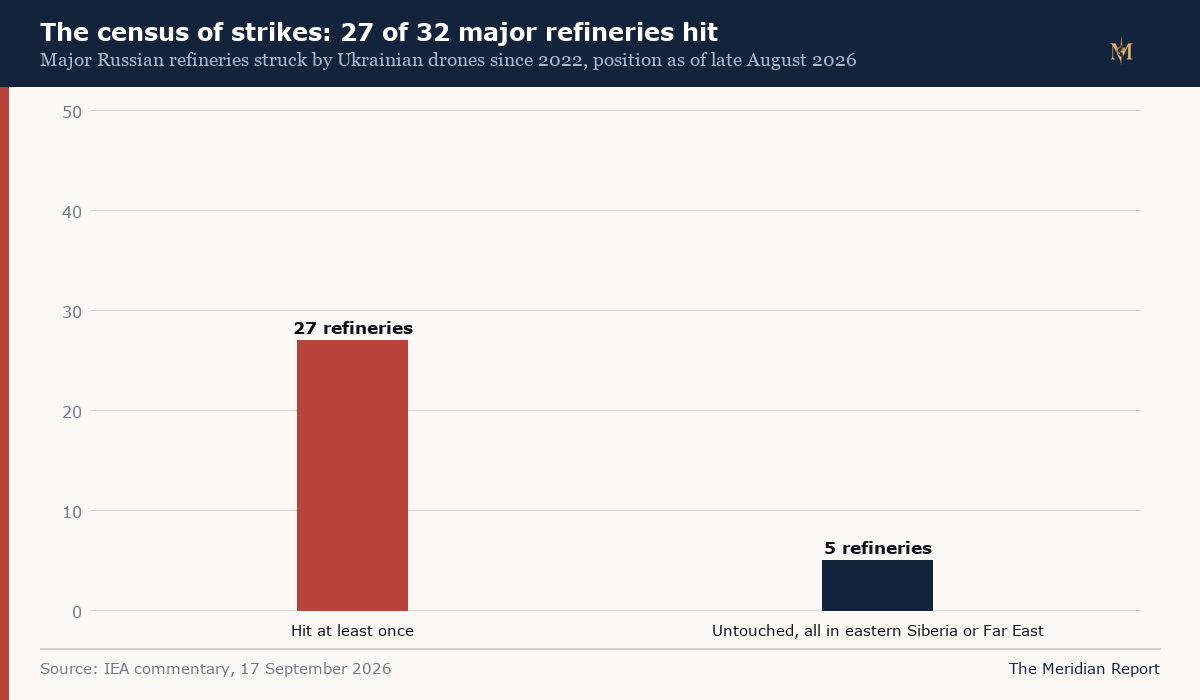
The targeting logic inside that census has evolved as fast as the range. Ukrainian operations have shifted from crude distillation units, whose damage is repairable in a week or two, to the secondary units that make modern fuels possible: fluid catalytic crackers, hydrocrackers, reformers, hydrotreaters, the machines that convert heavy fractions into gasoline, jet fuel and diesel. Damage to these is measured in months, six to eight on average when serious, longer when replacement is required, because Western sanctions have narrowed the equipment suppliers Russia can reach. The Moscow refinery, a 250 thousand barrel per day complex struck in June, is reported offline until early 2027. This is not area bombardment. It is systems engineering applied to an industrial target set, choosing the components whose loss compounds.
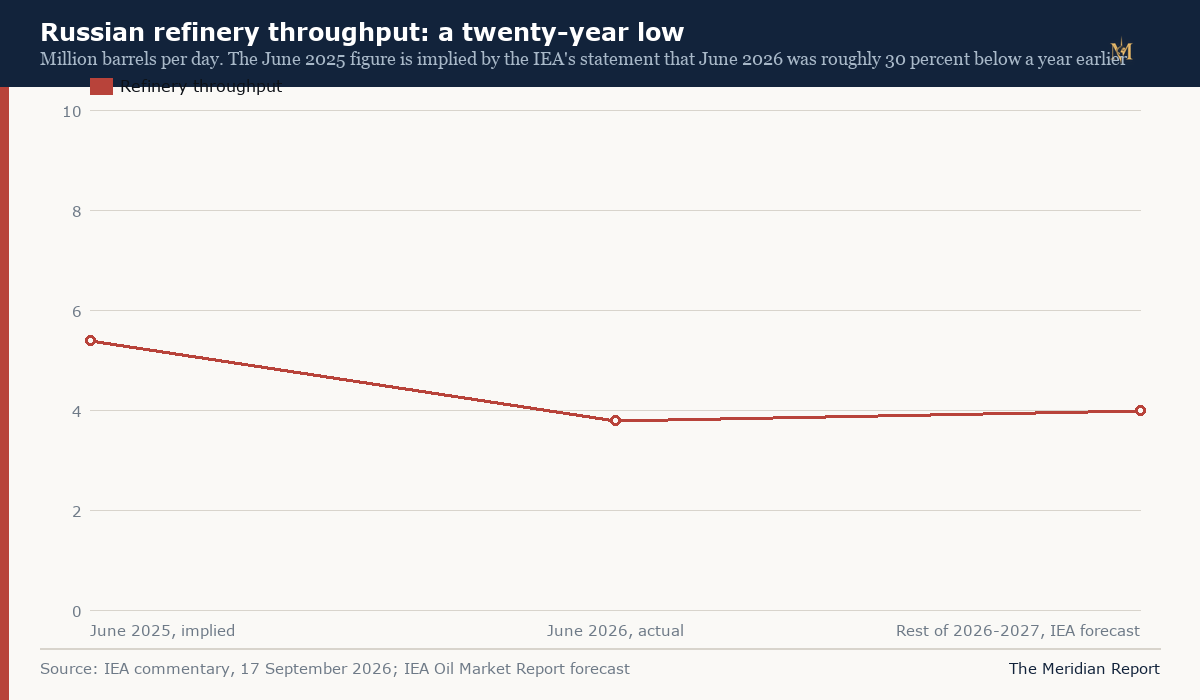
The effects, compiled by the IEA from Russian official data and industry reporting, need little commentary: Russian refinery throughput fell to 3.8 million barrels per day in June, the lowest in more than twenty years and roughly 30 percent below a year earlier. Gasoline output is down about 20 percent against 2025. Diesel production is estimated down nearly 30 percent. The IEA's forecast, lowered this month, holds throughput at an average 4 million barrels per day for the remainder of 2026 and through 2027, a projection that amounts to the judgment that the repair capacity Russia can summon cannot outrun the strike cadence it faces.
The weapon: what a refinery strike actually requires
The campaign's industrial effects rest on a weapons system whose characteristics explain both its success and its countermeasures' limits, and the engineering deserves description before the economics.
The airframe is a long-range one-way attack drone, jet or piston powered, carrying a warhead measured in tens of kilograms against targets measured in hundreds of metres. That mismatch is the design problem the campaign solved: a refinery cannot be destroyed by single detonations of that size, but it can be progressively disabled, because the complex's function concentrates in a small number of irreplaceable units whose repair takes months. The strike doctrine that emerged follows the engineering. First-generation attacks aimed at crude distillation units, whose damage burns off in a week or two; the current generation hunts secondary units, the crackers, hydrocrackers and hydrotreaters whose loss cuts the light-product yields that modern economies run on, and whose rebuild, six to eight months on average when seriously damaged, outlasts any repair mobilisation the industry can mount under sanctions.
Delivering the warhead is the lesser half of the problem; surviving the defence is the greater one. Russian refineries have been progressively wrapped in defences: nets over critical units, electronic jamming, gun batteries, patrol helicopters, and the passive geography of distance. The campaign's answer, visible in the IEA's account, is saturation: multiple waves against one complex in a night, designed to exhaust whatever interception the defence can cycle, with follow-up strikes timed to catch repair crews on site. Facilities near the border have now absorbed as many as fifteen such cycles. The economics are the war's most asymmetric: drones costing tens of thousands of dollars, costing Russia hundreds of millions in damaged units and forgone output, have converted air defence economics against the defender for the first time in the missile age.
The countermeasure ledger, for completeness, is not empty. Russia's defences have forced ranges into the thousands of kilometres, lengthened the campaign's logistics and raised Ukrainian production requirements; the strike rate's own pace, roughly one hit per three days, indicates a tempo sustained by industrial drone manufacture rather than stockpiles. And the five untouched eastern refineries demonstrate that distance still works, for now. But the Omsk strike removed the last confidence that distance is policy, and the arms-control conversations now running in European capitals about drone production ceilings are, in their way, the campaign's most surprising product: an air war whose escalation constraint is being sought in manufacturing capacity rather than treaty architecture.
Moscow's emergency ledger, item by item
Russia's response, catalogued in the IEA's assessment and the primary record, constitutes the largest set of emergency fuel measures the country has taken in the post-Soviet period, and each item tells you what the campaign broke.
The export restrictions came first and escalated in sequence: a gasoline export ban in April, a familiar instrument; the first jet fuel export ban in Russian history in mid-June; and, on 8 July, the first diesel export ban ever imposed by the world's largest diesel-exporting nation, a measure extended on 25 August to the end of September and, per the ministry's signals, likely through October. A country that exported roughly half its diesel output has withdrawn from that market entirely, and the withdrawal's global consequences are traced below.
The domestic market then required interventions no peacetime ministry would recognise. Fuel shortages spread across 92 percent of the country's regions by the end of June, with two thirds of regions imposing rationing: purchase limits, QR-code allocation systems, queues reported at up to 40 hours. Rosstat's data records gasoline prices up more than 19 percent and diesel up roughly 18 percent since January, in a market the state had kept deliberately stable for two decades. The quality standards followed the physics: in August the Energy Ministry temporarily lowered fuel specifications for the first time since 2016, permitting higher-sulphur Euro 2 through 4 grades through mid-2027, an admission, written in regulation, that the secondary units which remove sulphur have been the campaign's particular victims. Blending rules relaxed in parallel now allow naphtha with octane enhancers to count as gasoline. And the final item is the import ledger: gasoline arriving by rail from Belarus and Kazakhstan, and by sea from Morocco, South Korea, India and Turkey, the spectacle of a hydrocarbon superpower importing fuel at the margins.
The governance response completed the sequence. On 26 August, President Putin signed a decree permitting the state to take temporary control of critical private infrastructure whose owners fail to defend or repair it, a measure aimed, in the reporting, at independent refineries and at the security budgets the oil companies have been absorbing. The decree's existence is its own data point: the state is now pricing the campaign's costs as a governance problem, not merely an industrial one.
The fiscal bleed
The campaign's costs converge on the Kremlin's budget, and the arithmetic is running in one direction. Between April and August, the Finance Ministry paid Russian oil companies 1.5 trillion rubles, about 18 billion dollars, in subsidies, dominated by the damper mechanism that compensates refiners when domestic prices fall below export values, the fiscal cushion now absorbing the war's margin squeeze. Oil and gas revenues for January through August stand almost 17 percent below their year-earlier level at roughly 5 trillion rubles. The overall budget deficit has reached 5.8 trillion rubles for eight months, up 150 percent year on year, already exceeding the 5.6 trillion recorded in all of 2025.
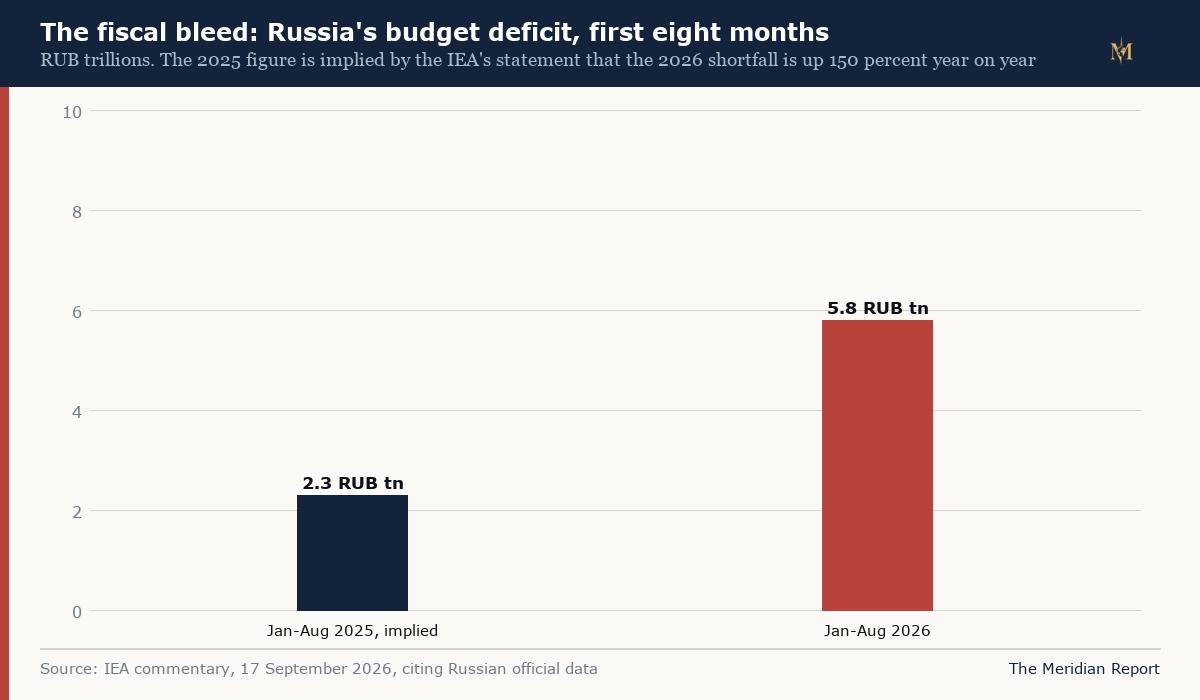
The complication that makes the picture political rather than merely arithmetic is the Middle Eastern war premium. The Gulf closure that elevated global crude prices has simultaneously cushioned Russian export revenues per barrel, which is why the fiscal damage registers in the deficit and the subsidy bill rather than in a revenue collapse. Moscow is financing the shortfall from reserves and borrowing, and the IEA's sober formulation, that barring a sustained truce the attacks are likely to continue and pressure will build, amounts to the judgment that the bleed's second derivative is the number to watch: the deficit is not merely large, it is compounding, and the campaign that causes it shows no sign of slowing.
The pricing machine: how a strike in Ryazan reaches a pump in Ohio
The global market's absorption of the campaign is a chain of specific, measurable steps, and tracing it is the clearest way to see why the diesel record has proved so persistent.
Step one is the loss itself, quantified above: Russian diesel output down nearly 30 percent against 2025, and a country that exported roughly half its diesel withdrawing behind an export ban first imposed in July and extended month by month since. Step two is the attempt to replace: global seaborne gasoil exports down 10 percent for the year despite every other supplier's effort, because the replacement suppliers' own constraints, the Gulf war's disruption of Middle East export terminals among them, bit at the same time. The IEA's single most compressed statistic is the convergence: combined Middle East and Russian diesel exports in August were 520 thousand barrels per day, 75 percent below the previous August.
Step three is the refiner margin, the mechanism by which shortage becomes price. Diesel crack spreads, the premium the product earns over the crude it is made from, crossed $100 per barrel in September on both the US Gulf Coast and in Northwest Europe, levels that have historically marked physical scarcity rather than sentiment. Cracks of that size transmit in two directions at once: they pull every marginal diesel barrel on Earth toward the Atlantic basin's shortage, and they push the cost into every downstream price, freight rates, rail tariffs, agricultural contracting, with the lag the inflation indices are now recording.
Step four is the consumer print, where the chain ends in American pump prices: on-highway diesel above $6.50 a gallon, a federal record series, with the Midwest at $6.68 and the arithmetical connection to the crack spread direct, the same scarcity in two units of measure.
The chain's remaining links are the market's open questions, and the IEA's fourth-quarter assessment frames them precisely. OECD refining is at its practical output limit, so no replacement volume exists within the system that absorbed the 2022 shock; the Asian surplus capacity that cushioned that year is not currently callable, constrained by feedstock and maintenance. The relief scenarios are therefore external to the market: a Russian repair surge that restores throughput above the IEA's 4 million barrel forecast, a Gulf settlement that returns Middle East export capacity, or demand destruction that rations the shortage. Each is observable, none is currently running, and the pricing machine keeps converting the war's every escalation into somebody's fuel invoice while they wait.
What the campaign changes, past the numbers
A struck refinery in Ryazan and a filled tank in Iowa are connected by the least glamorous machinery in energy economics, and 2026 has become the textbook year for how it works. Global seaborne diesel and gasoil exports averaged 4.7 million barrels per day over the first eight months, down 10 percent year on year, with the decline accelerating through the quarters. Middle East and Russian diesel exports combined fell to 520 thousand barrels per day in August, 75 percent below the same month a year earlier, the convergence of the Gulf war and the refinery war in a single statistic. Offsets from American and Asian refiners have been partial and are now constrained: OECD diesel output was flat in June despite near-maximal utilisation, the IEA's marker of a system at its practical limit.
The price of that tightness is the crack spread, the margin refiners earn making diesel from crude, and September's prints belong in the record: above $100 per barrel on the US Gulf Coast and in Northwest Europe. Spreads at that level signal physical scarcity rather than sentiment, and they transmit into every consumer economy: the American retail diesel records of this September, above $6.50 a gallon nationally and $6.68 in the Midwest, are the same shortage wearing a pump nozzle, and our companion coverage traces that chain to the American inflation politics it now feeds.
The IEA's closing judgment for the fourth quarter is the market's least comfortable sentence: diesel cracks could rise further as seasonal demand strengthens and the refiners who might respond have limited spare capacity, while the two supply systems that broke the market, Russia's refineries and the Gulf's export terminals, are the two whose recovery no forecaster currently models. Unless refining recovers in Russia or the Middle East, or demand weakens rapidly, global diesel markets are likely to remain under pressure for months to come.
What the campaign changes, past the numbers
The strategic ledger extends beyond the fuel statistics, and its entries are the ones historians will weigh first.
The campaign has demonstrated that long-range, cheap, attritable unmanned systems can impose operational damage on strategic industrial infrastructure at a scale previously reserved for air forces, and that air defence designed for aircraft and missiles handles them poorly. The fifteen-times-hit refineries near the border are the experiment's samples: nets, jammers, gun defences and patrol regimes slow the damage and do not stop it. Every defence ministry on Earth has read this record, and the refinery war is already reshaping procurement debates in Europe, the Gulf and East Asia about what critical infrastructure protection means when the threat is a $50,000 airframe against a $2 billion complex.
The campaign has also redefined the political economy of the war's leverage. Ukraine's strikes give Kyiv the one instrument whose effects reach every Western capital's fuel price and every Russian household's queue, and that dual reach is now the war's central bargaining structure: Washington asks Kyiv to pause the strikes while global diesel tightens, Moscow's fiscal bleed compounds while the Gulf war props its export prices, and the two wars, Gulf and refinery, now move the same market in opposite directions in the same week. The report's sibling coverage this week traces both threads through the General Assembly's diplomacy.
Three observable markers will write the campaign's next chapter, and each is public. The first is the monthly throughput prints, where any sustained recovery above 4 million barrels per day would falsify the IEA's current judgment and mark a genuine repair breakthrough. The second is the diesel export ban's extension past October, where a lifting would signal either recovery or fiscal desperation, and the two are distinguishable in the export data. The third is the first strike on one of the five untouched eastern complexes, which would complete the census and eliminate the last geography of immunity. The record of this war is being written in those three series, weekly, and the report stands as the campaign's running account.
The historical comparison: 1944, and why the rhyme is partial
The campaign's obvious historical ancestor is the Allied oil campaign of 1944 and 1945, and the comparison is illuminating precisely where it breaks down.
The Allied effort against German synthetic fuel plants and refineries remains the modern era's clearest case of an industrial energy system being struck to strategic effect: monthly aviation fuel production collapsed under repeated bombing, the Luftwaffe's training pipeline broke, and the campaign's planners measured success in the enemy's sorties not flown. The mechanism matches this year's record: target the processing units whose loss compounds, accept that single strikes repair quickly, and let the cumulative rhythm do the damage. The IEA's description of Ukraine's shift to secondary units could be lifted from the postwar analysis of the synthetic plants.
The differences are the lesson. The 1944 campaign was conducted by heavy bombers at a cost of thousands of aircrew, against defences that could be suppressed, with the attacker holding escalation dominance. Ukraine's campaign is conducted by expendable airframes at negligible cost, against defences that cannot be suppressed and must be saturated, launched by the weaker power in the air balance. And the strategic context inverts: Germany's refining collapse accompanied a general military collapse, while Russia's is occurring inside a functioning war economy whose crude exports continue by sea, whose fiscal cushion the Gulf war is propping, and whose military consumption of diesel is the demand the rationing protects. The 1944 comparison establishes that refinery campaigns can be decisive. The 2026 record establishes that decisiveness requires the rest of the war's structure to cooperate, and on the current evidence the campaign's effects are accumulating toward strategic weight without yet reaching it: throughput at a twenty-year low, a fiscal bleed compounding, a domestic market rationed, and an army still fuelled.
That last clause is the comparison's most important output. The historical record says refining campaigns decide wars when they deny the enemy's military its fuel. The 2026 campaign has so far denied the economy more than the army, and the gap between those two targets, and what it would take to close it, is the question the campaign's next phase will answer.
The playbook that did not repeat: 2022 versus 2026
Russia's fuel economy has absorbed two shocks in four years, and the contrast between its responses defines what has changed.
The 2022 shock was external, a sanctions regime aimed at export revenue and the financial system, and Russia's response, the ruble controls, the eastward re-routing of crude to China and India, the shadow fleet, worked because the refining system itself was untouched: barrels kept flowing, just to different buyers, at different discounts. The 2026 shock is internal and physical, aimed at the machines that make exportable products at all, and the playbook that saved 2022 has no page for it. Re-routing requires products to route; re-rating requires buyers to exist; neither replaces the crack, reformer or hydrotreater that a drone has hole-punched, and repair times of six to eight months under sanctions-constrained equipment access mean the damage compounds faster than it heals.
That structural difference explains why the two shocks' fiscal signatures diverge even under the same world price. In 2022, revenue fell with volumes and discounts while volumes recovered within quarters as re-routing matured. In 2026, the IEA's data shows revenues running almost 17 percent below year-earlier levels despite a Gulf-war-elevated crude price that should have buoyed them, because the bottleneck is no longer finding a buyer but refining the barrel to sell. The state's responses differ accordingly: 2022's instruments were financial, 2026's are operational, export bans, quality derogations, imports, the takeover decree, a catalogue of a government managing physical scarcity rather than financial exclusion.
The comparison's forward implication is the one the market is pricing. If the campaign's cadence holds, the 2022 playbook's absence remains the operating condition, and the IEA's flat throughput forecast for 2027 becomes the base case. If Ukrainian strike capacity falters, the recovery question becomes the market's only variable, and the five untouched eastern refineries, plus the damaged complexes' repair schedules, are the data series that will answer it first.
The social ledger: what rationing does to a war economy
The campaign's deepest effects are the ones the fiscal data only implies, and they register in Russian daily life.
The fuel crisis of summer 2026 was, by the geography of official reporting, national: shortages across 92 percent of regions at the June peak, rationing in two thirds of them, queues measured in hours at the worst stations, and the odd spectacle, documented in the regional press, of a hydrocarbon superpower's motorists waiting for tankers while its pipelines ran for export. Rosstat's price series records what the queues cost when they ended: gasoline up more than 19 percent and diesel up 18 percent since January, in a market the state has historically treated as a social contract, cheap fuel being one of the few universal subsidies the post-Soviet system preserved.
The contract's renegotiation is the campaign's quiet strategic product. Fuel price inflation in Russia is not a macroeconomic abstraction; it is a politically tracked index with a quarter century of stability behind it, and its breach coincides with the first wartime autumn in which the state has asked households to accept lower fuel quality, rationed allocation and imported gasoline simultaneously. The government's countermeasures, the export bans that protect the domestic market, the damper subsidies that hold prices below world levels, the quality derogation that stretches every barrel further, have each functioned as intended. But each is a transfer: from the budget, from export revenue, from environmental standards, from the regions furthest from Moscow where the shortage bit hardest. The IEA's subsidy arithmetic, 1.5 trillion rubles from April to August, is the ledger of those transfers, and its trajectory is the social ledger's abstract: a war economy absorbing, one mechanism at a time, costs it had built its stability on avoiding.
The comparison that matters is domestic rather than historical. Russia's 2022 stabilisation, the rubles, the rate hikes, the import substitution that absorbed the first sanctions wave, was achieved without touching the consumer fuel contract. The 2026 campaign has ended that record, and the duration of the breach, now the question the monthly price prints will answer, is the campaign's most politically legible metric inside Russia itself.
Sources, and what the evidence cannot establish
The report's discipline requires stating what its evidence cannot support, and the list is specific.
It cannot verify Russian or Ukrainian battlefield claims independently. The capacity-offline percentages attributed to the Ukrainian General Staff are a belligerent's estimates, presented as an upper bound consistent with, but not confirmed by, the IEA's throughput data. Russian official statements about damage, repair and output are themselves interested, and the IEA's census, built from satellite observation, shipping data and industry reporting, serves as the arbiter precisely because it is neither government's.
It cannot predict the campaign's endpoint. The scenarios the market prices, repair surge, settlement, escalation to the eastern refineries, are conditional descriptions whose probabilities no public evidence base can rank, and the report declines to rank them.
It cannot separate the refinery war's price effects from the Gulf war's. Both move crude, both constrain diesel, and the crack spreads and retail records this report traces carry both wars' signatures. The report's compression, that the two conflicts now share one market, is an observed convergence, not a decomposition; no public method cleanly attributes the autumn's diesel price between them, and any figure that claims to should be treated with suspicion.
What the report does claim, it claims on the named record: the IEA's 17 September assessment for the campaign's structure and effects, Reuters' refinery-level reporting for the September state of the complexes, Rosstat and Finance Ministry data as relayed for the domestic and fiscal prices, and the EIA series for the American consumer end of the chain. The campaign is the first of its kind, and this report has kept its own uncertainty visible in every section, because the record being written this year will be read against exactly this kind of account, and the account's honesty is the only thing its author controls.