
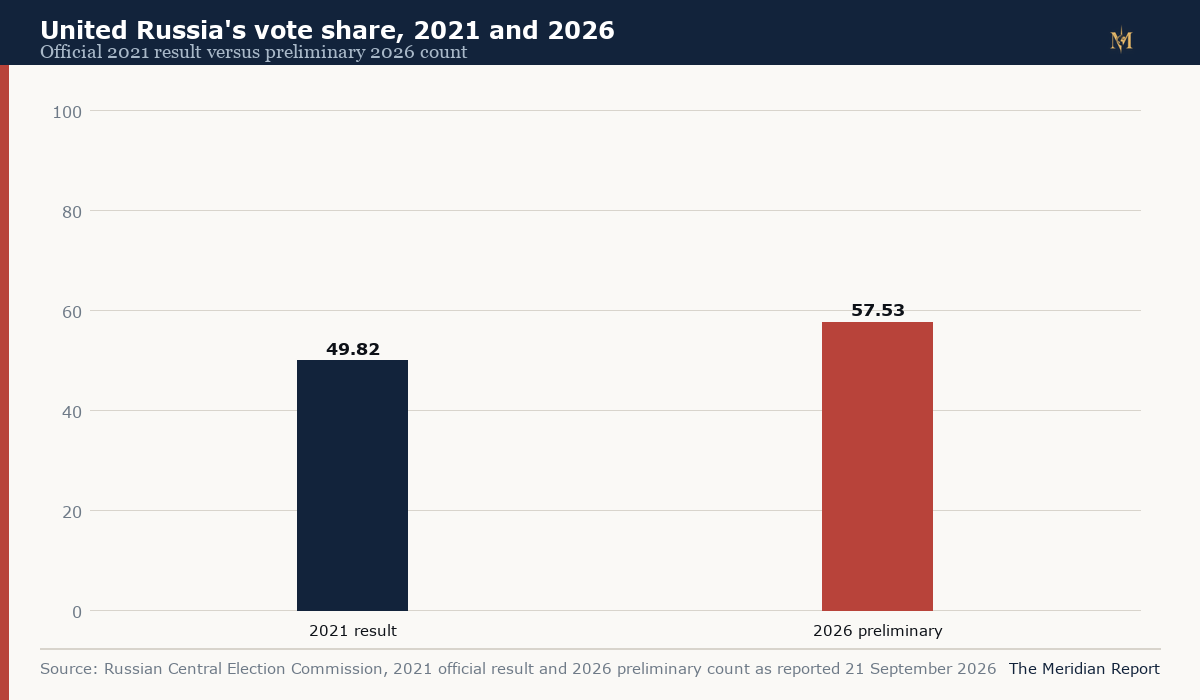
The arithmetic of Russia's first wartime parliamentary election closed on Sunday with a precision the Kremlin will enjoy repeating: United Russia at 57.53 percent of the party vote with most ballots counted, a projected 355 of 450 seats, turnout at 56.66 percent. Every headline number is higher than 2021's. The context in which they arrived was not.
A campaign that ran inside a closed information space
The 2021 election, the last before the invasion, was fought over contested but existing ground: opposition candidates could register in some races, observers could sit in some rooms, and independent media could report. The 2026 campaign ran in none of those conditions. Anti-war candidates were barred wholesale. Golos, the monitoring movement that has documented Russian elections since 2000, operates under designation with its people exposed to prosecution. The war defines the news, and the state defines the war's news.
Against that baseline, the headline finding is not the win, which was never in doubt, but the size of it. Seven points above the 2021 share is a number the party has never recorded in a freer environment and did not need to record in this one. What the count measures is support plus the shape of the field the support ran in, and the two cannot be separated from the outside.
What 355 seats actually change
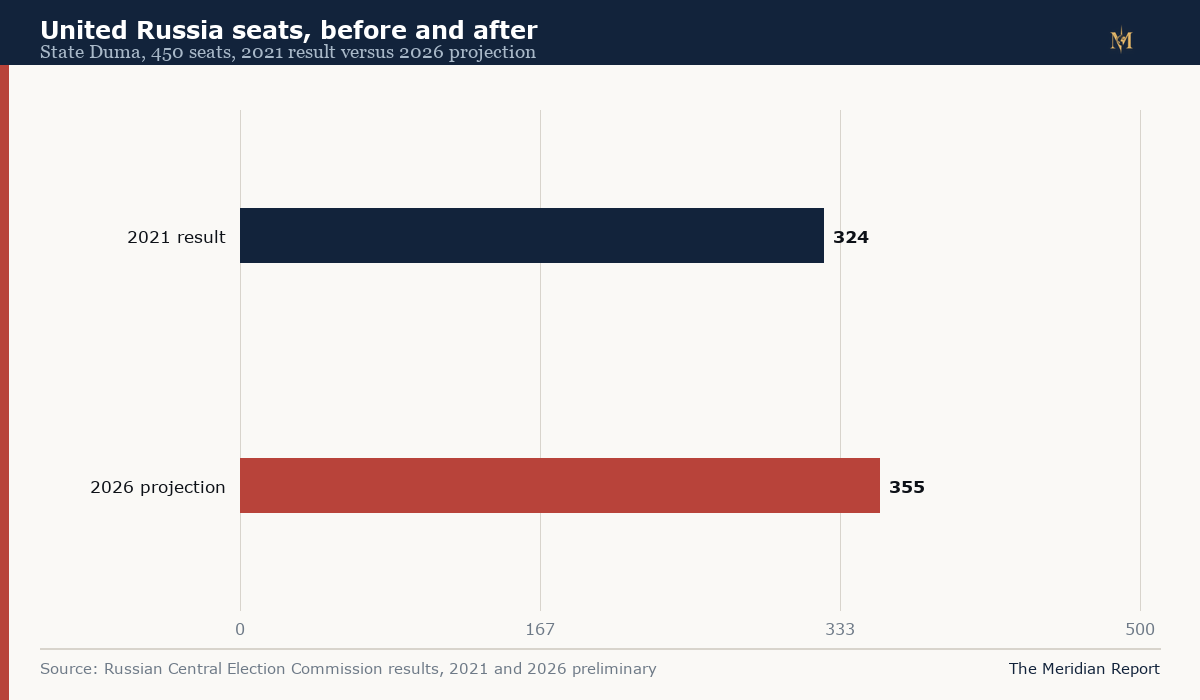
The Duma's arithmetic makes the size consequential. Constitutional amendment requires a two-thirds supermajority, 301 seats. United Russia's projected 355 clears that bar alone, without the minor parties it has previously leaned on. The 2021 result of 324 already cleared it. What the fifth Duma of the war era adds is not capability but independence: the ruling party can now amend the constitution, confirm or dismiss governments and pass any law without needing a single coalition vote.
The practical significance sits in the calendar. The next presidential election falls in 2028, inside this Duma's term. The 2020 amendments that reset presidential term counts were passed by the previous supermajority; a chamber 31 seats larger has more, not less, procedural capacity for whatever the administration frames next.
The turnout claim, taken seriously and held at arm's length
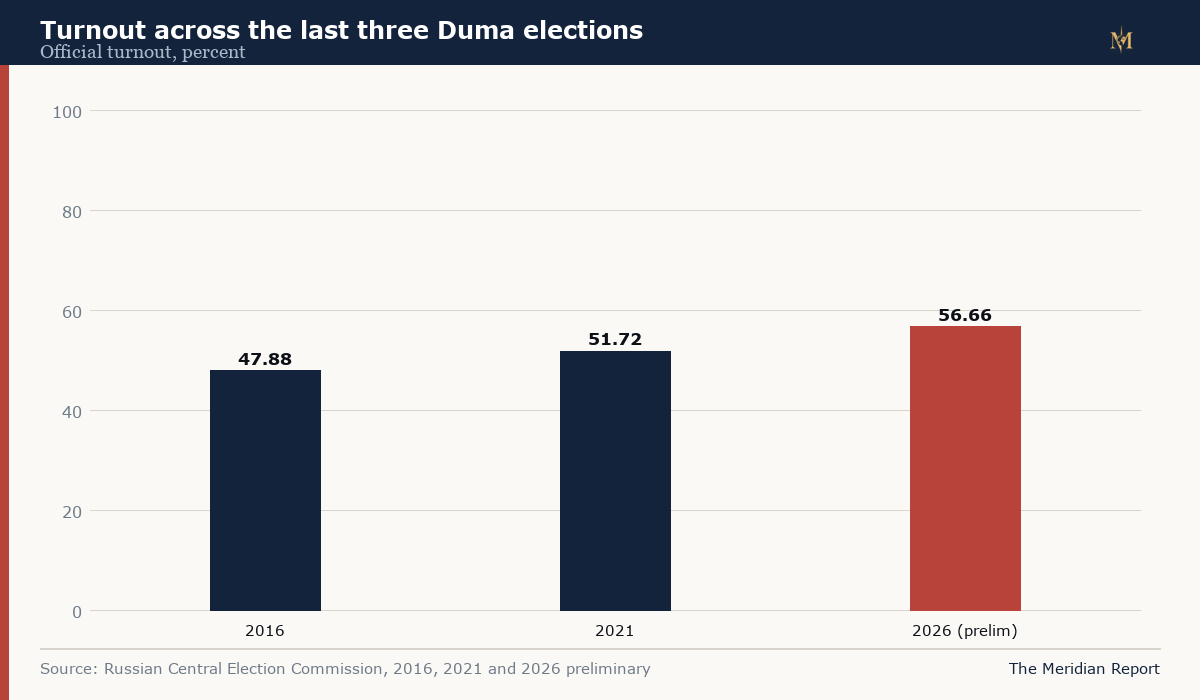
The official story of this election is participation: 56.66 percent, the highest in two decades, credited by officials to three-day voting, online ballots and national purpose. The number is preliminary and it is presented without external audit, and it is the highest official figure since the 2007 election. Electronic voting, expanded again this year, cannot be independently verified, and the observer space that once made Russian turnout numbers partly checkable has been eliminated. The claim is reported here as the claim.
What can be said independently is what the number is for. A turnout record is a legitimacy performance aimed at three audiences: a domestic audience whose participation is being performed for it, an elite audience being shown that the system mobilises, and the outside world being shown normality under fire. Whether the performance reflects behaviour is precisely the question the closed system exists to prevent anyone from answering.
The attack that closed the campaign
The strike wave that reached Moscow as the count closed was, by the Moscow mayor's count, the largest of the war: more than 1,600 drones intercepted since Saturday across Russia, roughly 450 of them toward the capital, three people killed in the Moscow region, part of the Moscow oil refinery in Kapotnya damaged and burned. Ukraine's general staff named the refinery as the wave's main target. The attack killed three people, damaged the capital's main refinery and did not stop the vote, and all of those facts together are the point: the state presented continuity under fire as the campaign's closing image.
The refinery matters beyond symbolism. It is among the systems serving the capital's fuel supply, and Ukrainian strikes on Russian refining capacity have been a deliberate campaign all year, the economic wing of the war. A wartime election that ends with the capital's refinery on fire is the clearest possible statement that the war is not a distant administrative project but a condition of Russian life, arriving overhead on the weekend the country was asked to endorse its management.
What the numbers cannot show, stated plainly
Three questions matter more than any headline share, and the official data cannot answer any of them.
The first is the size of the actual vote. The count runs through protocols that no independent body audits, through electronic ballots that cannot be recounted, in a system whose last internationally regarded competitive observation ended years ago. The true distribution of preference between 49 and 58 percent is unknowable from outside, and honest reporting says so.
The second is what the abstainers would have said. Turnout's rise is presented as enthusiasm; it is equally consistent with mobilised state employees, online-voting mechanics that streamline managed participation, and the difficulty of visible abstention in wartime. The data cannot distinguish a motivated electorate from an efficiently administered one.
The third is whether any of it binds. The Duma's supermajority is real procedure, but power in Russia runs through the presidential administration. The parliament's composition matters at the margin, for laws, confirmations and any future constitutional framing, not at the centre, where the war and the peace that ends it will be decided by a circle that no election this weekend touched.
The finding worth keeping
Strip away the theatre and one durable fact remains. Russia has produced, by its own count, a parliament more dominated by the war party than any in the invasion's era, installed at the exact moment the war reached the capital's skyline and its principal refinery. Whatever combination of consolidation and management produced the number, the record that now exists, the one the next five years of Russian law will cite, is 57.53 percent and 355 seats. The count is preliminary until the commission's final protocol. The composition it describes is not in doubt.