
The call that appears to have broken the plot was made by a woman driving home. Late on Saturday night she noticed three vans moving through the countryside near Whelford, a Cotswolds village that backs onto RAF Fairford, and judged the behaviour unusual enough to dial 999. At about 12.45am on Sunday, police received the report: three suspicious vehicles, appearing to travel toward the airbase.
Armed officers moved quickly. Five men were arrested in the Whelford area in the early hours, first on suspicion of offences under the Explosives Act, and later the same day on suspicion of preparation of a terrorist act under section 5 of the Terrorism Act. The vans were stopped minutes from a base that has hosted American bomber missions against Iran since the spring.
What the bomb squads found, and what they still do not know
By daylight, three white vans stood in a dark country lane under a 400 metre cordon, their rear doors open on two of them, large black items scattered inside, an army bomb disposal robot working its way between them. Images from the scene showed the men being led away shirtless, which the Guardian noted could point to a precaution against suicide vests or concealed weapons.
The Guardian's understanding of the materials found in the vans is that investigators' initial view was that they were consistent with improvised explosive devices. Tests continued through Sunday to establish whether the suspected devices were viable, and police have given no details of the men's nationality.
One detail in the vans has its own story. At least one carried the logo of a fuel company and a phone number missing a digit. A real company of the same name rejected any connection, saying its name had been used without its knowledge or permission and that it was cooperating with the authorities, the kind of small fabrication that investigators will read alongside everything else.
The cost of the response landed on the village itself. About 85 households in Whelford were evacuated, many to Cirencester leisure centre, where residents said on Sunday evening they had been asked whether they had anywhere else to stay. By Monday morning the cordon remained in place and the BBC reported that residents of more than 80 houses would not return home that night. Gloucestershire's assistant chief constable, Richard Ocone, said police appreciated the disruption and were working to get people back into their properties as quickly as possible.
Why Fairford is the base this would have mattered to
Fairford is not an ordinary RAF station. It is British owned and American operated under an agreement dating to the Cold War, and its runway, at almost three kilometres one of the longest in Europe, is reinforced for the heaviest aircraft in the American fleet: the B-1 Lancer and B-52 Stratofortress, bombers capable of carrying the largest payloads, including the bunker busting class.
In March this year, then prime minister Sir Keir Starmer granted permission for defensive American action against Iranian missile sites from UK bases, and four American bombers landed at Fairford shortly afterwards. The base has hosted B-1 and B-52 operations connected to the conflict since, at a tempo that residents described to the BBC in March as shaking their houses. Iran's Revolutionary Guard Corps took note. In July it warned that any base used for aggression against Iranian territory constitutes a legitimate target for its forces, a statement that now sits at the centre of the investigation's reasoning.
The base's role made an Iranian motive high in investigators' and government's thinking, the Guardian reported, while sources cautioned that nothing is being ruled out, including a jihadist or other motive. British security officials have said proxies linked to Iran were behind a string of arson and sabotage attempts in the UK, many targeting the Jewish community, and warned that Tehran could widen its target set if the Middle East conflict continued. Any proven link to the Fairford plot would be a dramatic escalation: the first alleged attack on the base itself, rather than the pattern of arson and assault that has preceded it.
What the police can do now, and what they cannot say
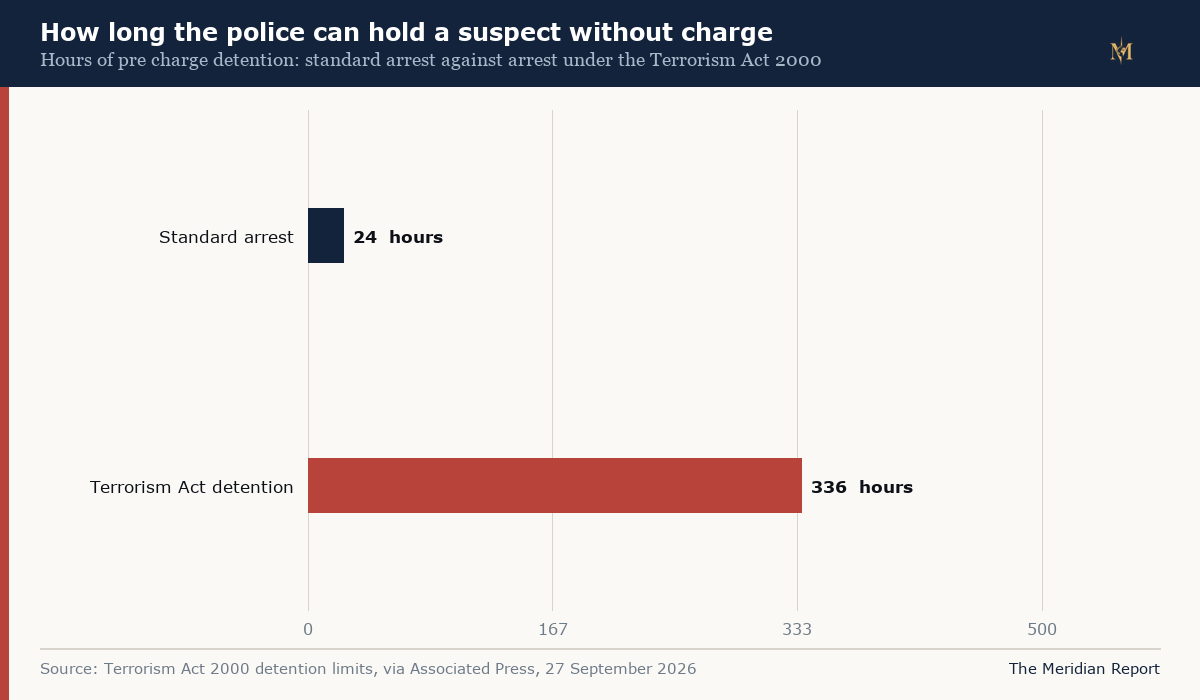
The five men are in custody, and the clock they are held on is the Terrorism Act's. Suspects arrested under it can be detained for up to 14 days without charge, against the 24 hours that apply to a standard arrest, time the Metropolitan Police's counter terrorism command will use to trace the vans' movements, the men's contacts and the provenance of the materials. Vicki Evans, the Met's counter terrorism senior national coordinator, described the investigation as at an early stage, with the men remaining in custody.
The politics arrived faster than the evidence. Donald Trump told reporters in Chicago that the suspects had been under view for a long time, that they were looking to do big damage to our fort, and that working with Britain worked out great. The Guardian's understanding is different: the operation was not intelligence led, and police moved only after the resident's call. Andy Burnham, the prime minister, cut short his plans at the Labour conference in Liverpool to take calls on the incident, calling it deeply concerning and urging people not to speculate while the authorities establish the full facts. The defence secretaries of both countries, Pete Hegseth and Wes Streeting, have spoken about the case. The US embassy in London warned Americans to be cautious and mindful of their personal security.
What the investigation will have to settle
Three questions will define what this becomes. Whether the devices were viable, which the laboratories will answer and which determines whether Sunday's stop prevented a bombing or something less. Whether there was foreign direction, which turns on communications evidence the men left behind and on the long record of Iranian linked activity on British soil that officials have catalogued. And whether the security services missed it, which is the question raised by the uncomfortable fact that the state's first knowledge of the alleged plot appears to have been a passing motorist's instinct on a country lane.
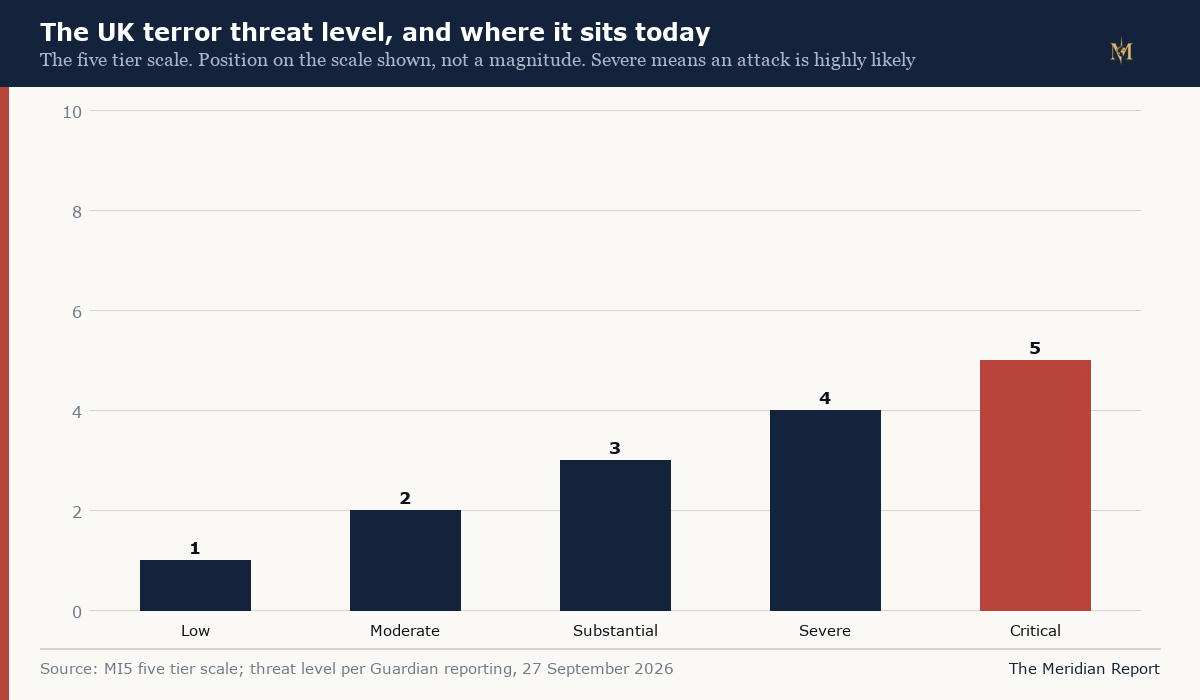
The UK threat level stood at severe before Sunday, the second highest of five, meaning an attack was already judged highly likely. That judgement did not change with the arrests. What changed is that one specific plot, aimed at one specific base, at the centre of one specific war, is now in a police station in the west of England, and the war it belongs to has found a front line in the Cotswolds.