
Monday began with the reckoning from Sunday. Ukrainian prosecutors say drones hit a market in Sofiiska Borshchahivka, on the western outskirts of Kyiv, killing two people and injuring about ten; pictures posted online showed installations and vehicles burning. In the capital itself Mayor Vitali Klitschko counted nine injured, including a child, after drones struck a high rise apartment building in an eastern suburb, set it alight, then hit a second high rise in a central district. Among the targets, prosecutors noted, was a building used as a residence by the Saudi Arabian ambassador. Three glide bombs near a family support centre killed two people in Sumy; in Kharkiv a drone struck a car and killed its driver.
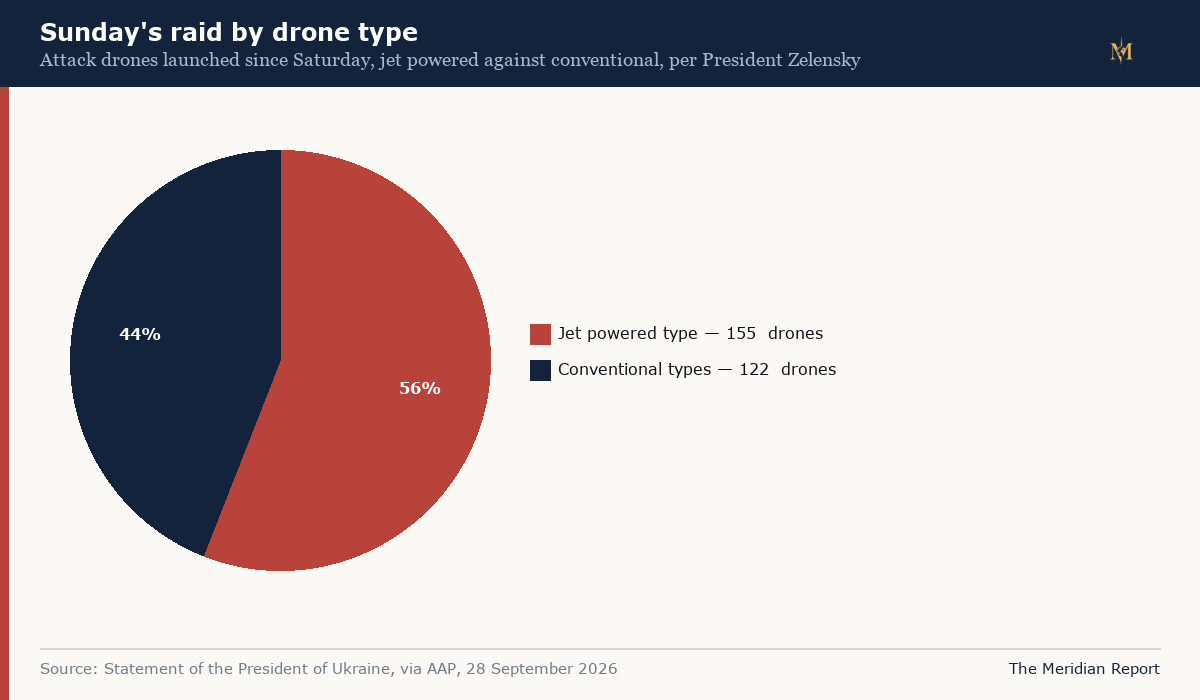
The president's military tally ran alongside the casualty list: 277 attack drones of various types since Saturday, 155 of them of the jet powered variety that flies higher and is far harder to intercept. Zelensky called the targeting of civilians terrorism, writing that Russia has no military objective whatsoever in doing this, and that it is purely an attempt to break people and inflict as much harm as possible on Ukrainian society.
But the strike that will be studied came earlier on Sunday morning, and Moscow all but signed it. A data centre in the capital was hit twice within hours, injuring three people, two of them children, according to Zelensky. The same day, Russia's defence ministry published a photograph of one of its strike drones with a caption that read, in Russian, "Digital detox. By force!"
Six days of strikes on the invisible city
The campaign has a visible start date. On 23 September drones hit facilities in different parts of Kyiv, disrupting the internet providers Utel and Pavutyna, the online systems of a bookstore chain and a file sharing service. One strike destroyed a data centre housing the infrastructure of the hosting company MiroHost; its founder, Oleksandr Olshanskyi, told the trade outlet dev.ua that ninety to ninety five percent of his customers were unaffected precisely because their infrastructure sat outside Ukraine, and the remainder counted the cost of being hosted on Ukrainian soil. The same day, a fire engulfed the power system and backup generator of a Starlink ground station at Wola Krobowska, south of Warsaw, one of the stations carrying Ukrainian military traffic; Poland's deputy prime minister Krzysztof Gawkowski called it an act of sabotage, and prosecutors are still investigating.
Ukraine's Ministry of Digital Transformation put the effect of the opening strikes at about 100,000 households in Kyiv and the region with temporary outages. Crazy Network reported a damaged central traffic exchange, with disruptions reaching as far as Vinnytsia and Khmelnytskyi. Etherlink relocated the core of its network after its main node was struck. Television channels suspended broadcasting, and the public broadcaster Suspilne lost its video players.
Then the strikes reached the top of the tower. On 25 September a drone hit the offices of Datagroup, one of Ukraine's largest telecommunications companies, killing four people, the Guardian reported from Kyiv. On 26 September strikes forced the channels Novyny Live and Armiia TV off the air and hit the Darnytsia pharmaceutical plant for the second time in a week. Russia's defence ministry said it had also hit a data centre belonging to Vodafone Ukraine, the country's second largest network, which did not respond to requests for comment. Over the weekend Ukraine's largest mobile operator confirmed its own headquarters had been struck, with no casualties, and the ministry claimed two data centres in Kyiv, a logistics hub in Odesa and two cargo vessels headed for the port.
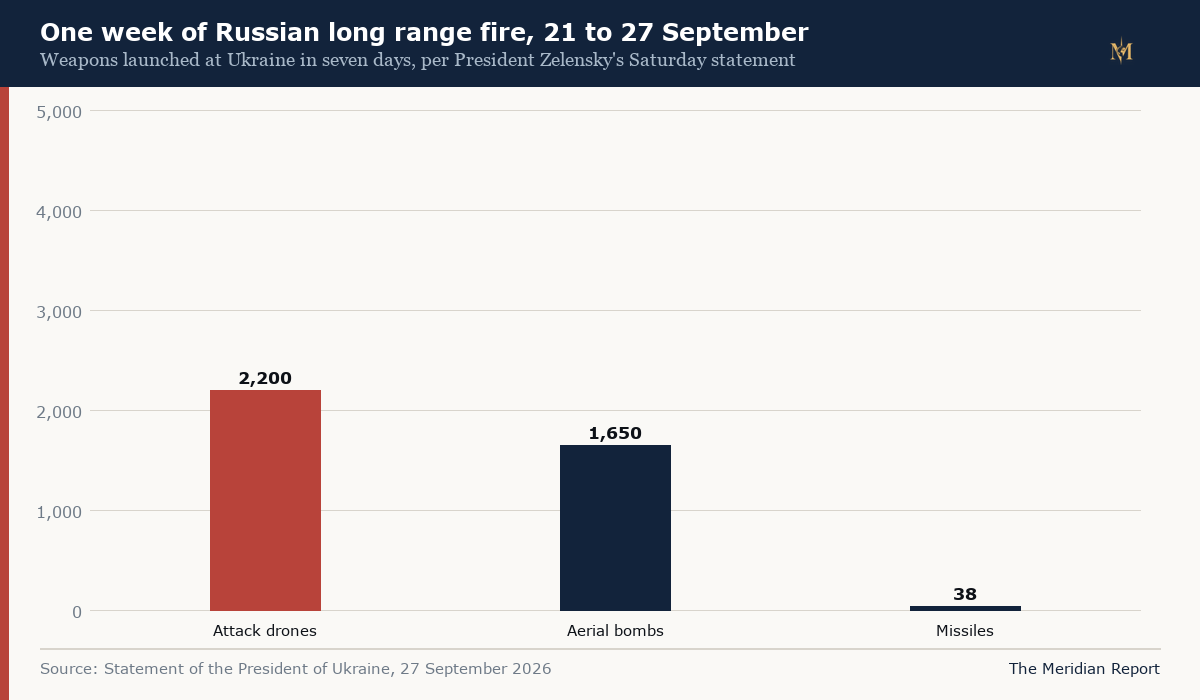
The scale of the surrounding bombardment explains why telecom buildings are being reached at all. Zelensky said on Saturday that Russia had launched more than 2,200 attack drones, around 1,650 aerial bombs and 38 missiles of various types over the week, a weapon count approaching 3,900 in seven days fired at a country whose air defences are, in his own words, critically short of interceptors.
What the defence ministry is now saying out loud
Attacks on communications infrastructure are not new in this war. What changed in September is the admission. The Institute for the Study of War noted that Russia's defence ministry explicitly described strikes on data centres and telecommunications infrastructure, and has claimed the New-Telco and United DC facilities it hit on 23 September served Ukraine's defence ministry and security agencies, assertions Ukrainian officials reject and which no independent source has verified.
The claim matters less than the timing. ISW's assessment is that Russian forces have heavily targeted data centres in Kyiv every day since 23 September, and that the campaign is a search for what the analysts called alternative defeat mechanisms. The front has not moved Russia's way this autumn; its offensives have failed to reach their objectives, and Ukrainian forces have advanced north of Lyman. The strike campaign against ports, railways and now the digital economy is the Kremlin's answer to a stalemate it cannot break on the ground.
There is a cost of living logic to it as well. The Guardian's reporting from Kyiv sets the strikes against a wider economic bombardment: warehouses, petrol stations, a McDonald's distribution centre. Ukraine produced not a single tonne of steel this month, the first such failure in a century, according to a senior industry official. Banks, payment systems and public services all run on the networks now being hit. As winter approaches, the pressure point is deliberate.
Why the whole country will not go dark
Ukraine's internet was decentralised by accident of history and by design of necessity. The country has hundreds of internet providers, and providers duplicate equipment, maintain backup routes and distribute infrastructure across locations, including abroad. Serhii Beskrestnov, the presidential adviser on defence technologies known as Flash, put it in terms the strikes have since tested: Ukraine is unlikely to face a complete internet blackout because it has some of the most widely distributed internet channels anywhere.
Anatolii Frolenkov of the 1-IX internet exchange point told the Kyiv Independent the same thing from the inside. The internet will not disappear completely, he said; there will be outages, things will glitch, operators may go down for hours, because the infrastructure is being physically destroyed. His warning concerned price rather than availability: repairs cost money, and the providers pay for them.
The weapon behind the switchboard campaign
The shift in target sets coincides with a shift in the weapon. Of the 277 drones Russia launched since Saturday, 155 were of the jet powered type that flies higher and is difficult to intercept, by Zelensky's count, a majority share that would have been unthinkable in the war's first four years when propeller driven drones filled the sky. The faster, higher generation compresses the defender's timeline: radar sees it later, interceptor crews get seconds instead of minutes, and the same finite magazine of interceptors must cover ballistic missiles, cruise missiles and now fast jet drones.
That is the military arithmetic behind the Patriot announcement that landed amid this week's strikes. Zelensky said on Friday that Donald Trump had made a final decision to grant Ukraine licences to produce Patriot interceptor missiles, including in negotiations for the more capable PAC-3 type and the simpler PAC-2. Trump has not personally confirmed it, and experts quoted by the Guardian caution that establishing domestic production could take years. The urgency is not abstract: each night of the data centre campaign tests which target class the defenders can afford to cover.
What would tell us the campaign is working, or failing
Three things are observable from the outside, and each has been moving in the attacker's favour only at the margin. Households offline is the first: 100,000 after the opening strikes is real damage, but restoration has been continuous, and no provider has reported a permanent loss of service. The second is cost: repair bills will find their way into Ukrainian internet prices, as provider representatives told Suspilne, a slower tax than an outage but a real one. The third is the migration of hosting abroad, which MiroHost's ninety five percent foreign based customer base already illustrates; every company that moves its servers out of Ukraine takes tax revenue and jobs with it, which is, in the end, the effect the campaign is calibrated to produce.
None of that has produced a blackout. What Sunday's double strike on the data centre demonstrated instead is intent: the same defence ministry that once denied targeting civilian networks is now printing the words on the side of the drone. The message is for Kyiv's residents, and it is the crudest form of the winter campaign that has been telegraphed since summer, that ordinary life itself is the target.
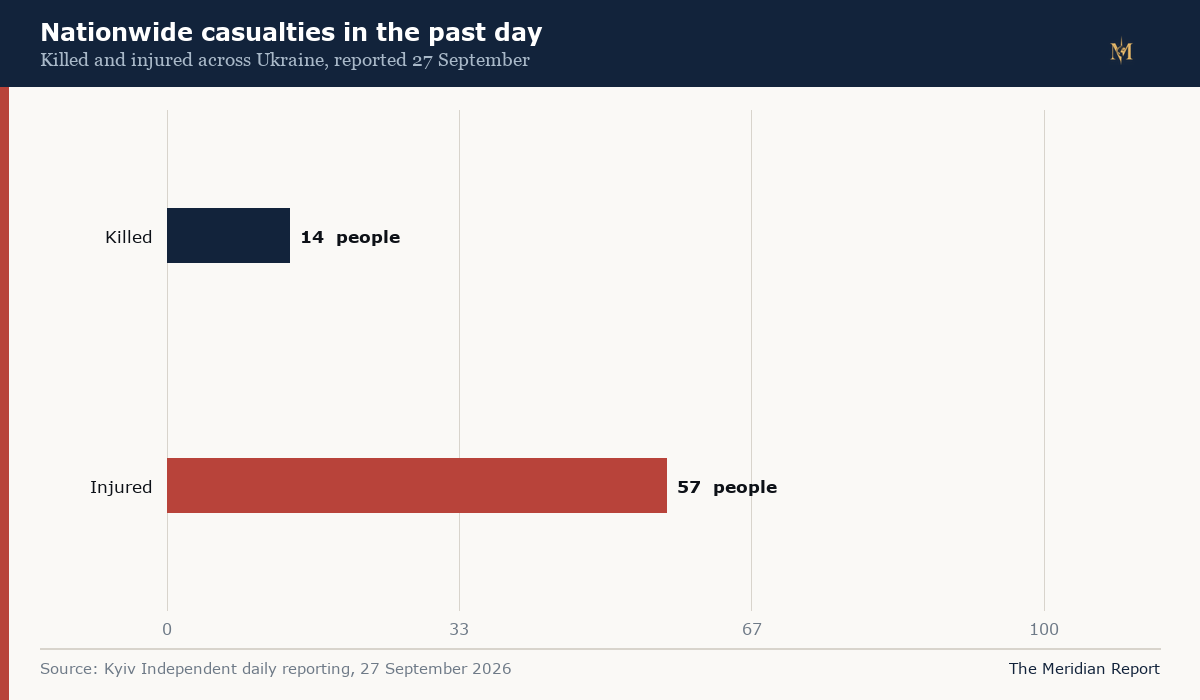
The capital's answer was visible on Sunday afternoon, when residents of the damaged districts picked through the glass and the cables were re spliced overnight, and it was audible in Zelensky's remark, after a week in which the capital was battered almost continuously, that the attacks are terrorism with no military objective. The networks are holding. The bill, in money and in the fourteen killed and fifty seven injured nationwide that the past day's reporting counted, is being paid in the meantime.