
Israel votes on 27 October 2026. It is the first Knesset election since the attacks of October 2023 and the wars in Gaza, Lebanon and Iran that followed, and it arrives in the middle of a ceasefire that is neither peace nor war. On 14 October, Reuters reported Prime Minister Benjamin Netanyahu saying that a pre-emptive strike before the election was not convenient, while also saying Israel would respond forcefully if attacked.
That sentence is the most useful thing said about the month. It does not describe a strategy. It describes a calendar. A pre-emptive strike is a decision with consequences that arrive immediately and votes that arrive on 27 October, and the calculation that governs it is the distance between the two. The same logic applies to the ceasefire's next phase, to the Lebanese file and to the reconstruction money that has been pledged and not spent.
None of those decisions has been taken. All of them are waiting for the same date, and the date is a fortnight away.
What the election date does to the war
An election does not stop a war, and it can start one. What it does reliably is change the cost of visible decisions in the weeks before polling. A decision that produces casualties, a hostage outcome or a new front has an electoral price that is paid within days. A decision that is deferred has a price that is paid after the government is formed, which may be weeks after the vote and is in any case someone else's problem if the coalition changes.
The deferral has a cost of its own, and it is being paid in Gaza. The ceasefire's later phases require decisions that are politically expensive in a campaign: the disarmament of Hamas, a full Israeli withdrawal and the entry of an international stabilisation force. Each of those decisions loses part of the coalition that a caretaker prime minister needs. Each of them is therefore optimally postponed, which is precisely what has happened. The Security Council Report noted on 14 October that the plan's next phases had not been implemented, that Hamas had accepted a roadmap announced on 30 July, that Israel had reportedly rejected it, and that disarmament had not started.
The caretaker period is not a legal vacuum. An Israeli government retains wide authority over security during an election campaign, and the 14 October statement explicitly reserved the right to respond. What changes is the political price of initiating, and a government that expects to be judged on 27 October will initiate only when the alternative is worse.
A ceasefire that is real and incomplete
The first phase of the US-brokered plan was agreed on 8 October 2025. It provided for a ceasefire, the release of the remaining hostages, a partial Israeli withdrawal and an increase in humanitarian aid. A year later, the Security Council Report's assessment is that the first phase held in the narrow sense while the rest of the plan stalled.
Holding in the narrow sense is not nothing. The full-scale war did not resume, the hostage exchange happened, and the death rate fell by an order of magnitude. The ceasefire is the single most consequential thing that has happened to Gaza's mortality in three years, and the numbers support that claim rather than contradict it.
What the ceasefire did not do is end the killing. The Gaza Health Ministry's figures, as reported on 13 October, put the toll since the ceasefire at 1,493 killed and 5,299 wounded as of 12 October. UNRWA's 7 October report cited in the same Security Council document put the figure at over 1,400. The cumulative death toll since October 2023 is 74,382 on the ministry's count.
The ministry's figures are attributed to a party to the conflict, and they are the only continuous series available. Independent verification of individual incidents has not been possible for most of the war. The numbers should be read as the best available record rather than as an audited count, and the direction and scale of the change are large enough that the attribution issue does not alter the conclusion.
The arithmetic of the last year
The two totals allow a comparison that neither side in the political argument has an incentive to make. Take the ministry's cumulative figure of 74,382 deaths from October 2023 to 12 October 2026, and subtract the 1,493 deaths recorded since the ceasefire began on 8 October 2025. The pre-ceasefire period accounts for 72,889 deaths across roughly 732 days, which is an average of about 100 deaths a day. The ceasefire period accounts for 1,493 deaths across about 369 days, which is an average of about four a day.
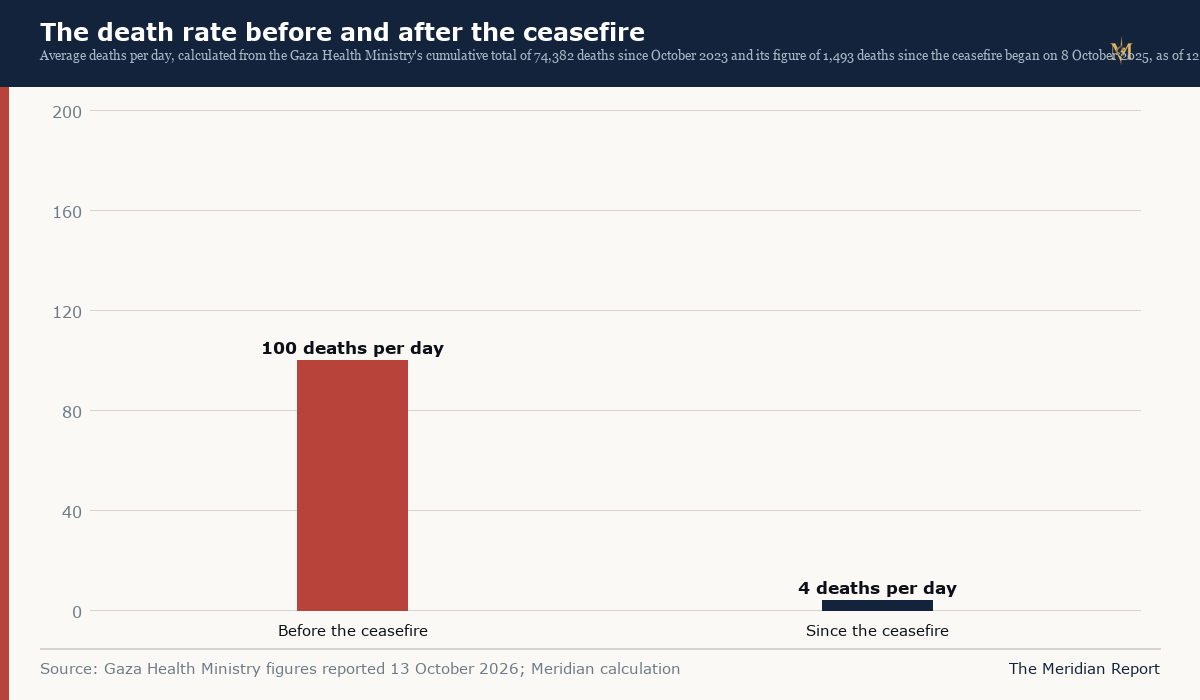
That is a reduction of roughly 96 percent, and it is the strongest available evidence that the ceasefire is doing the work it was designed to do. It is also a body every six hours. Both statements are true, and a political system that can only hold one of them at a time is a system that cannot decide what to do next.
The comparison is an average over a period in which the intensity varied, and an average smooths over the worst days and the quietest. It also mixes a war period that included full-scale ground operations with a period that included none. The purpose of the calculation is not precision. It is to replace two rival narratives, that the ceasefire ended the killing and that nothing changed, with a single number that describes the actual state: a 96 percent reduction from a very high base, sustained for a year, and still not zero.
The shelter pipeline is the binding constraint
The humanitarian arithmetic is different from the mortality arithmetic, and its constraint is not money.
The Security Council Report cited an IOM report of 9 October stating that almost 2 million people needed shelter assistance, that the shelter pipeline covered barely 17 percent of identified winter needs, that nearly 1.8 million people were living in displacement sites, and that about 8,600 shelter kits were being turned away at crossings.
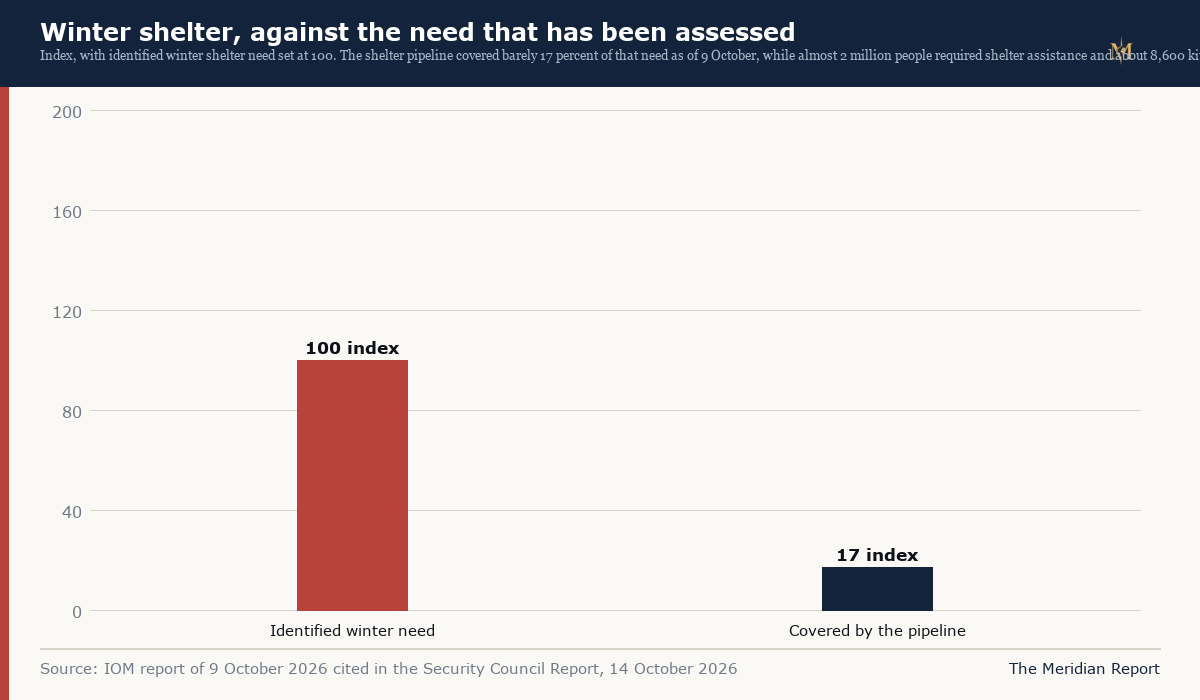
The 17 percent figure is the one to hold. Winter in Gaza is wet, windy and cold, and shelter is the difference between a difficult season and a dangerous one. A pipeline that covers less than a fifth of assessed need is not a funding shortfall in the ordinary sense. It is a delivery failure, and the 8,600 kits turned away at crossings are the proof, because a kit that is refused entry at a crossing has already been purchased.
The arithmetic of the blockage is worth stating with its assumptions. A shelter kit typically serves a family, and a family in Gaza averages five to six people. At five people per kit, 8,600 kits represent roughly 43,000 people who have been identified, supplied and stopped. At six, it is about 52,000. The kits are not a rounding error against a population of 1.8 million displaced, but they are a measurable share of the winter need that the pipeline says it cannot reach, and every day they sit at a crossing is a day of winter.
The reason the kits are refused is a coordination problem rather than a funding one: inspections, permits, designated crossing points and the identity of the organisations clearing the cargo. Those are administrative decisions, and administrative decisions are exactly the kind that a caretaker government makes slowly.
The reconstruction money that is pledged but not moving
The reconstruction numbers are the clearest example of a system whose constraint is not finance. The Board of Peace announced a 2.45 billion dollar recovery plan covering 66 programmes over six months on 24 September. The BBC reported that 18 billion dollars had been pledged and 280 million dollars handed over, against an estimated requirement of about 71 billion dollars over a decade.
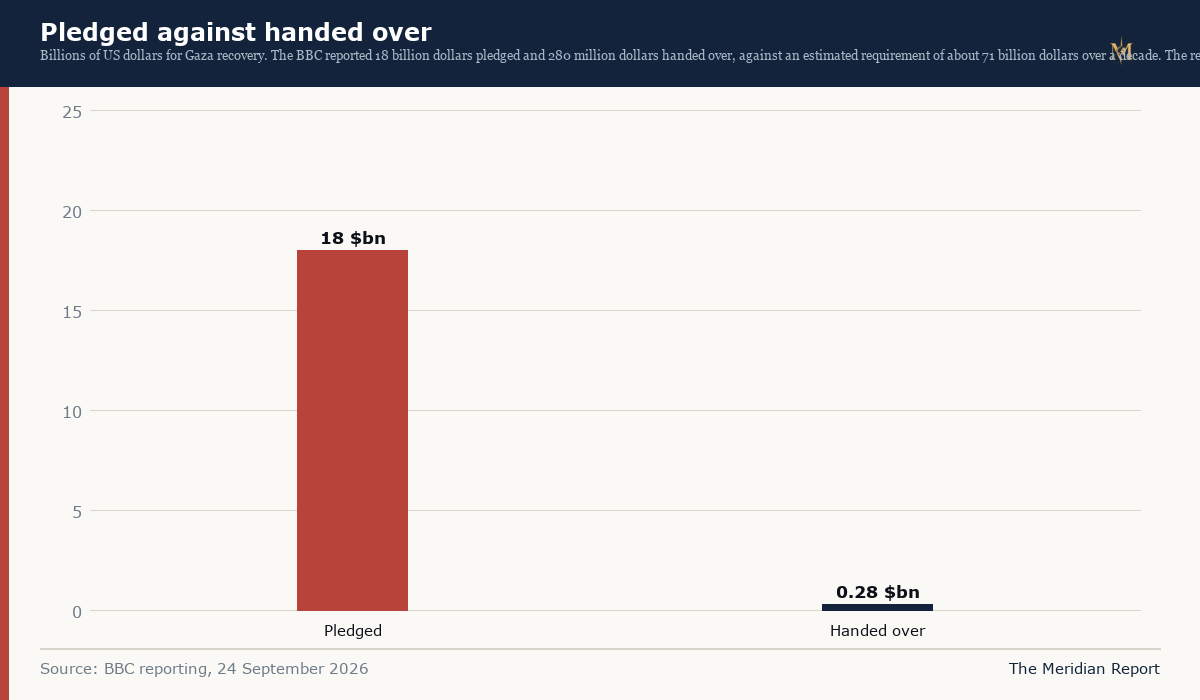
The ratios are stark. The money handed over is 1.6 percent of the money pledged and 0.4 percent of the estimated requirement. The recovery plan is 13.6 percent of the amount pledged, which means the system has more pledged money than it currently has a plan to spend. And reconstruction had not begun almost a year after the ceasefire.
A government that reads those numbers might conclude that the problem is donor reluctance. The ratios suggest something more specific. The 2.45 billion dollar plan covers six months and 66 programmes, and it was announced a year after the fighting stopped. The gap between the announcement and the disbursement of 280 million dollars is the measure of how long it takes to build the institutions that spend money in a war zone, and the 18 billion dollars pledged against a 2.45 billion dollar plan is the measure of how far the pledging has run ahead of the plumbing.
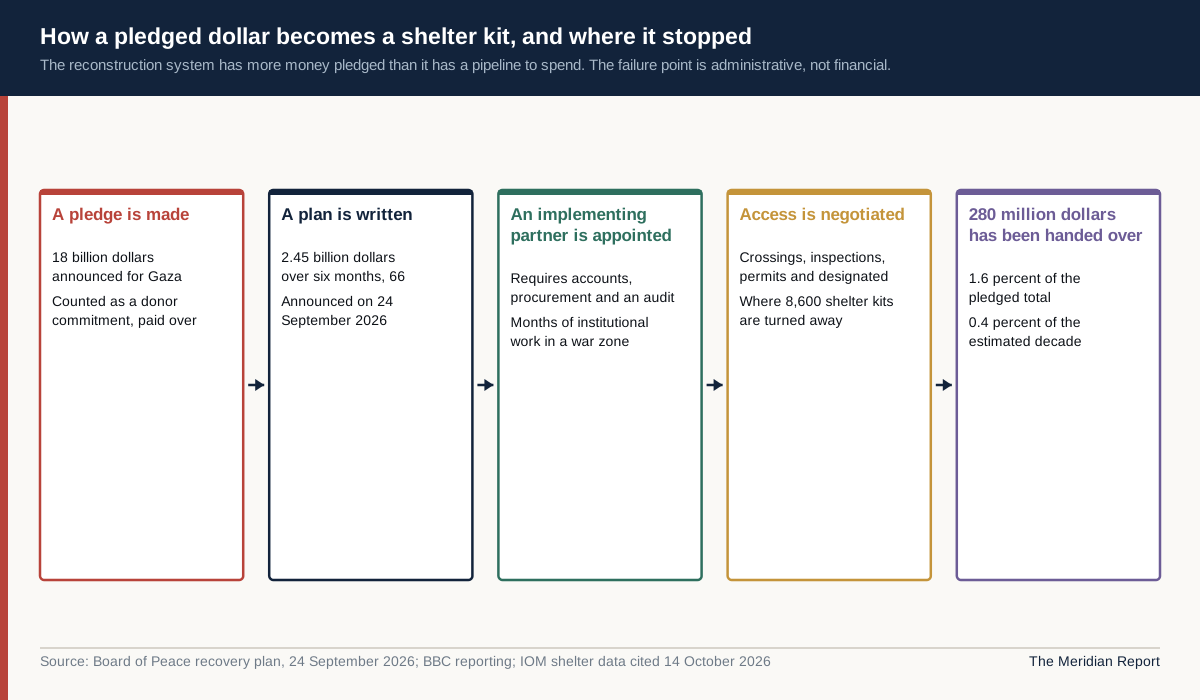
This is the standard pattern in post-conflict reconstruction, and it is worth naming because it is used as evidence of bad faith by both sides. Pledges are political instruments: they are announced at conferences, they count toward a donor's commitments, and they are paid over years subject to conditions. Disbursements are administrative: they require an implementing partner, a bank account, an access route, a procurement system and an audit trail. A system with 18 billion dollars pledged and 280 million dollars disbursed is not necessarily a system of broken promises. It is a system with no pipeline, and a pipeline takes longer to build than a pledge takes to make.
Commercial goods stopped on 15 October
The pipeline got worse in the week before this article. Reuters reported on 15 October that Israel said commercial goods were no longer entering Gaza after merchants suspended coordination, amid an Israeli allegation of a tax dispute involving Hamas. The report could not be independently verified in full, and both parties' accounts differ.
The significance is structural rather than factual. Commercial goods are the part of Gaza's supply that does not depend on humanitarian appeals. Importers, distributors and retailers move food, fuel, medicine and building materials through a system that pays for itself, and it is the only part of the economy that can scale without a donor. When the commercial channel stops, the entire burden transfers to the humanitarian channel, which is already delivering 17 percent of assessed winter shelter need.
A ceasefire that halts the fighting but interrupts the commercial economy produces a strange outcome: the mortality rate falls and the living standard falls with it, because the war economy has been replaced by an aid economy that is smaller and more fragile. The merchants who suspended coordination are the same actors whose margins fund the distribution network. A dispute that sidelines them converts a market into a queue.
The Lebanese file is waiting for 28 October
The second front has its own calendar, and it is also pointed at 27 October. On 15 October, Lebanese state media reported Israeli shelling of al-Mansouri and Majdal Zoun in the Tyre district. On the same day, Hezbollah's Hassan Fadlallah said that a consignment of explosives seized by Lebanese security forces on 5 October, described as hundreds of kilograms including TNT and C-4, belonged to Hezbollah and demanded its return. Lebanon's prime minister cited concern that C-4 had been used in assassinations, while investigators had not established that the seized shipment was intended for one.
The episode is a small case with a large meaning. A state that is trying to assert a monopoly on the use of force has found a strategic arsenal in a vehicle, and the armed movement that owns it has claimed it publicly. The government cannot return the material without conceding that a non-state actor holds weapons outside its control, and it cannot keep it without confronting the movement whose disarmament is the central unresolved question on both fronts.
Israel's defence minister, Israel Katz, said in the same Reuters report that Hezbollah would lose additional territory in southern Lebanon and described a permanent Israeli security zone. That is a threat rather than a decision, and it is the kind of threat that is cheap to issue before an election and expensive to execute after one.
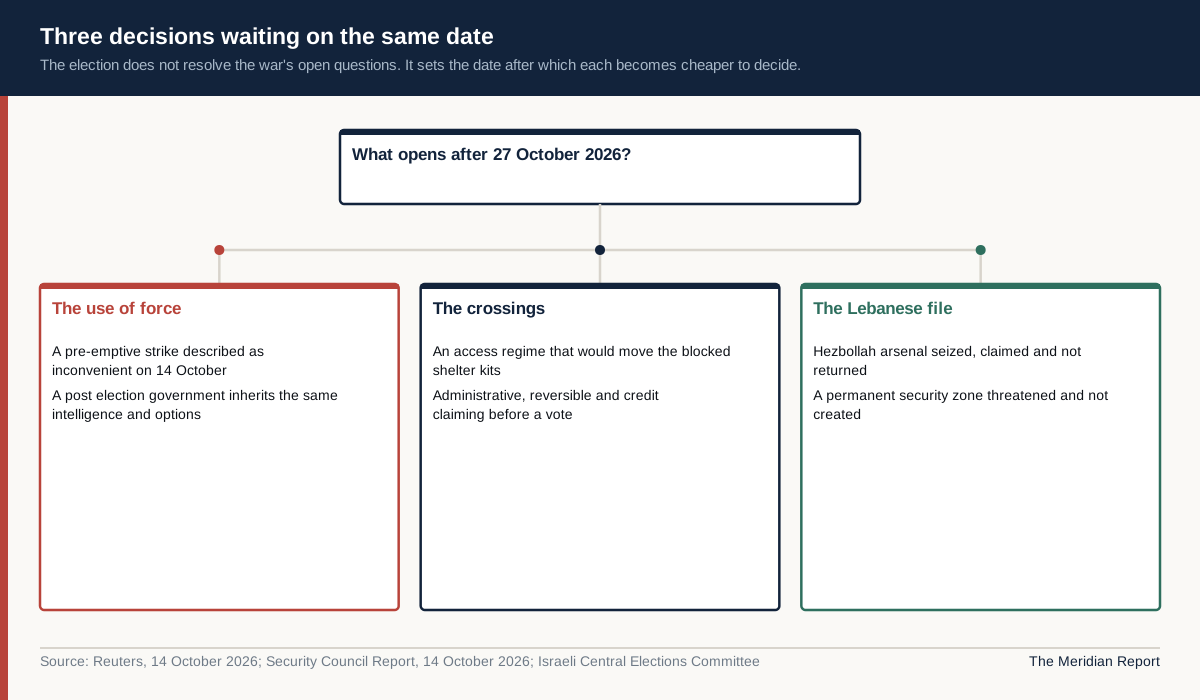
The three fronts, Gaza, Lebanon and Iran, are therefore on the same political clock. The election does not resolve any of them. It gates them, and the gate opens on 28 October.
Why the disarmament phase has no implementer
The second phase of the ceasefire has a logical problem that no amount of political will resolves on its own. Disarmament requires a security environment, the security environment requires a force that is not a party to the conflict, the force requires a mandate and rules of engagement, and the mandate requires the consent of the parties whose weapons are in question. Each step depends on the one before it, and the first step is the one that has not happened.
The Security Council Report's assessment that the later phases had not been implemented is a description of this chain rather than a criticism of any single party. Hamas accepted a roadmap announced on 30 July, and Israel reportedly rejected it. The disarmament had not started by 14 October, a year after the ceasefire began.
The sequence matters because the alternative orderings are worse. Disarming before a stabilisation force arrives leaves the territory without a security provider, which invites the factions that are not disarming to fill the space. Deploying a force before disarmament puts international troops between armed movements that have not agreed to stand down, which is the mission profile that produces casualties and political collapse. Waiting for both produces the current situation, in which the ceasefire holds and the plan does not advance.
A stabilisation force also has to answer questions that the ceasefire text can defer: who commands it, which countries contribute, what it may do when it is fired on, and how long it stays. Those are recruiting questions, and the pool of contributing states willing to put troops between Hamas and the Israeli military during an Israeli election campaign is not large. The force is the missing institution, and institutions take longer to build than ceasefires take to sign.
The crossings are the policy
If the analysis above is right, the binding variable in Gaza is not money and not diplomacy. It is access, and access is decided at a small number of crossings by a small number of officials, which makes it the most reversible policy in the entire file.
The evidence is in the numbers already cited. Winter shelter coverage at barely 17 percent of assessed need. Nearly 1.8 million people in displacement sites. About 8,600 shelter kits turned away at crossings. Commercial goods stopping on 15 October after merchants suspended coordination. Each of those is an access outcome, and each could change in a week if the administrative decisions changed.
That reversibility cuts both ways, and it is the reason the crossings are a poor target for a long-term strategy on either side. For Israel, controlling access is a security instrument that can be tightened or relaxed in response to events, which makes it useful as leverage and unstable as a policy. For the humanitarian system, a pipeline that can be closed at a crossing is a pipeline that cannot be planned, and planning horizons are what procurement requires. A shelter kit ordered in September for a December delivery is useless if it arrives in February.
The 17 percent figure should therefore be read as a planning outcome rather than a delivery failure in the narrow sense. The organisations that buy and ship shelter have learned to discount access, and they order against the access they expect rather than the need they measure. The gap between 2 million people needing shelter and a pipeline covering 17 percent of winter need is the accumulated result of that discount, and it will not close while the crossings remain a variable.
The one decision that would move both the kits and the money is administrative and cheap: a sustained, published access regime with a guaranteed volume and a predictable inspection process. It requires no donor conference, no Security Council resolution and no disarmament. It requires a signature, and it is the kind of decision that a caretaker government has no incentive to make because it would be credited to whoever wins on 27 October.
What 28 October changes
An election result is not a government. Coalition negotiations in Israel have historically taken weeks, and the caretaker government that continues in the interval has the same incentive to defer that it has now. The window in which a new government can take costly decisions opens when the coalition agreements are signed, not when the votes are counted.
That window has its own constraints. A new coalition is bound by the commitments in its agreements, and those commitments are the price of seats. A government that has promised a harder line on Gaza is a government that cannot easily open the crossings, and a government that has promised to prioritise the hostages is a government that has to make a deal that a harder line would forbid. The election does not just defer the decisions. It determines which decisions are cheap and which are expensive for the next four years.
The strategic environment also does not wait for the coalition talks. The Hormuz campaign, the Russian refinery war and the American sanctions calendar are all moving in the same month, and the Israeli file is one of several that the same American administration is managing. An Israeli government that takes three weeks to form will inherit a region that has moved, and the deferral that looks free on 17 October may look expensive by the time a coalition is sworn in.
That is the strongest argument against the current pause, and it is an argument that both camps in the election can make. The government can say that quiet before a vote is worth the delay. The opposition can say that a delay in a region where the strait is under attack is a decision in favour of whatever happens next. Both are describing the same fortnight, and neither can prove the counterfactual.
What the election cannot decide
The campaign will produce a coalition, and the coalition will inherit the same arithmetic that the caretaker government is deferring.
It cannot decide the disarmament of Hamas, because no Israeli government can disarm a movement that does not consent, and the roadmap that Hamas accepted on 30 July had already been rejected. It can decide whether to attempt it, which is a decision about the use of force and the risk of returning to full-scale war.
It cannot decide the reconstruction of Gaza, because the money is pledged by other governments and the access is controlled by Israel. It can decide to open the crossings, which is the one variable that would move the 8,600 kits and the $280 million, and it is a decision that requires no donor conference.
It cannot decide the future of Lebanon, because the Lebanese state, Hezbollah and Iran each hold a veto. It can decide whether to expand the security zone, which is a decision that would consume the next government's first year and produce the next election's central issue.
And it cannot decide the price of oil, the flow through the Strait of Hormuz or the willingness of the insurance market to cover the Gulf, all of which are being decided in a different theatre this month. The election is a local decision with regional consequences, and the region is not waiting for it.
Three ways the next ninety days could go
The variables are few enough to arrange into three paths, each with an observable signature.
The first is continuation. A coalition forms, the ceasefire's later phases remain unimplemented, the crossings stay restrictive and the death rate stays near its current level. The signature would be a stable count of weekly deaths in the low tens, no movement on shelter coverage above roughly a fifth of need, and no disbursement of the reconstruction money beyond the existing 280 million dollars. This is the path of least resistance, and it is the one the arithmetic of incentives favours.
The second is a negotiated phase two. A new government opens the crossings, a stabilisation force is mandated with a defined contributor list and the disarmament question is deferred into a longer timetable in exchange for reconstruction money moving. The signature would be a published access regime, shelter coverage rising toward half of assessed need over a winter, and the first tranches of the pledged 18 billion dollars appearing in implementing partners' accounts. This path requires a coalition that can absorb the political cost of restraint, which is the least likely outcome of a wartime election.
The third is escalation. The Lebanese file or the Iranian file produces an incident that a new government answers with force, the ceasefire's first phase is suspended or collapses, and the region acquires a second active front while the Gulf is already contested. The signature would be a return of the daily death rate toward double digits, renewed evacuation orders and an insurance market repricing the eastern Mediterranean on top of the Gulf. The probability is not the highest of the three, and the consequence is by far the largest, which is why the fortnight of quiet is worth more than it looks.
None of the three is determined by the vote alone. The vote determines who makes the decision, and the decision determines which path the year takes. The 1.8 million people in the displacement sites are not deciding any of it.
What the record does not establish
The record does not establish the precise death toll, either since the ceasefire or across the war. The figures come from the Gaza Health Ministry, whose counts are the only continuous series and whose access to records has been degraded. UNRWA's figure of over 1,400 deaths since the ceasefire is close to the ministry's 1,493 but not identical, and the difference illustrates the measurement problem rather than resolving it.
The record does not establish the cause or the pattern of every death since the ceasefire. Al Jazeera reported that the Israeli military has claimed some of those killed were fighters, that at least one such claim was rejected by Hamas and had not been independently verified, and that the accounting of combatant and civilian deaths has been contested throughout. The ministry's totals do not distinguish between them.
The record does not establish that the reconstruction money will arrive. The 18 billion dollars pledged and the 280 million dollars handed over are two different measures at two different dates, and no published schedule connects them. The 71 billion dollar requirement over a decade is an estimate from the BBC's reporting of the plan, not a contracted budget.
The record does not establish that the ceasefire will survive the post-election period. It establishes that it has survived a year, that the first phase was largely implemented and that the later phases were not. The next phase is a decision, and decisions are what an election defers.
What the month established
The month established that the ceasefire is doing the work it can do. It reduced the death rate by roughly 96 percent and it kept the war from resuming. It established that the humanitarian system is constrained by access rather than by money, and that the evidence for this is 8,600 shelter kits sitting at crossings while 17 percent of assessed winter need is covered.
It established that the reconstruction has a plumbing problem rather than a pledge problem, and that a system with 18 billion dollars pledged against a 2.45 billion dollar six-month plan has more money available than it can currently spend.
It established that the war's unresolved questions are being held in place by one date. A pre-emptive strike that is not convenient on 17 October may be convenient on 28 October, and the same applies to the disarmament phase, the crossings and the Lebanese security zone. The election is the reason the war has been quiet and the reason it may not stay quiet, and the people paying for the pause are the 1.8 million in the displacement sites, waiting for a pipeline that a caretaker government is not rushing to open.