
The Lindsey O. Graham Sanctioning Russia and Iran Act was signed into law on 18 September 2026. It sets a 500 percent ad valorem duty on goods from Russia, a 100 percent duty on goods from the five largest importers of Russian crude oil and natural gas, and a 100 percent duty on goods from the top five facilitators of Russian oil sanctions evasion. It also extends existing Iran sanctions authorities, which a legal analysis of the Act puts out to 2031.
On 16 October, the White House issued the executive order implementing it. The order sets out the rates, the trigger conditions, the monitoring duties of the United States Trade Representative and the delegation of authorities to the State, Treasury, Energy and trade departments. Then, in section 4, it waives the application of the duties and a long list of the Act's sanctions, citing section 115 and a certification to Congress that the waiver is in the national interest.
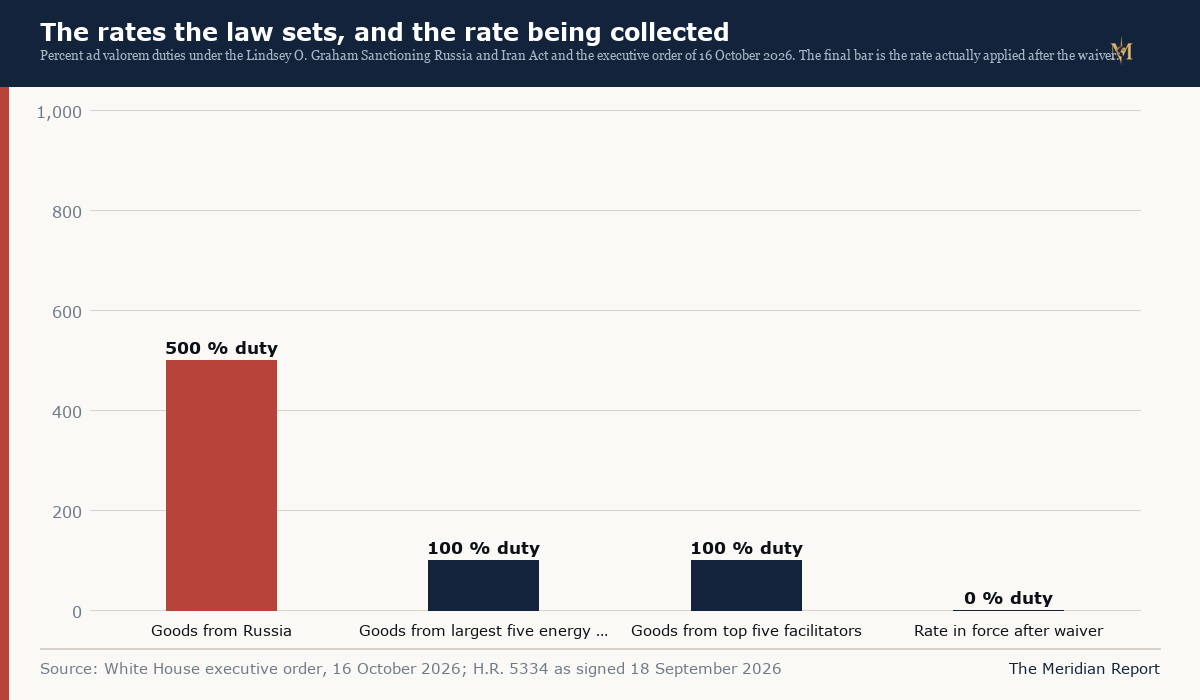
The result is a statute that is fully in force and entirely suspended. The 500 percent tariff exists. It is not being collected. The 100 percent tariff on the largest energy importers exists, with a trigger date of 18 October for new purchases. It is not being collected either. What the law has created is not a policy but a tripwire, and the question that matters for every trader, bank and government affected is who can pull it and when.
What the order actually does
Five sections matter.
Section 2 sets the rates. Russian goods face 500 percent. Goods from the largest five importers of Russian crude oil and natural gas face 100 percent if the country knowingly makes new purchases on or after 18 October 2026. Goods from the top five facilitators of Russian oil sanctions evasion face 100 percent. The section adds that these duties stack on top of any other duty, fee, tax or charge, including duties under title VII of the Tariff Act of 1930 and sections 122, 201, 232 and 301 of the trade acts. That stacking provision is the part that turns a headline rate into a customs problem, because a country already facing section 301 duties would face them plus the new duty, not instead of them.
Section 3 gives the Trade Representative the monitoring job. The USTR, in consultation with State, Treasury and Energy, is to track imports and purchases of Russian oil and gas and the facilitation of evasion, report to the President regularly, and identify which countries fall into the two categories. The identification is an administrative act, not a legislative one, which means the list of the largest importers and the top five facilitators is a document the executive branch produces rather than a fact written into the statute.
Section 4 is the waiver. It waives the duties provided for in sections 112 and 113 of the Act and in the order itself, the sanctions in section 102(d), and the sanctions in sections 102(a), 102(e) and 103 through 111 and 117. It preserves sanctions issued under earlier Russia-related executive orders, expressly including the national emergency continued on 24 March 2026. And it says the waivers remain in effect until the President or the Secretary of State, in consultation with Treasury and the USTR, determines that further action is appropriate.
Section 5 delegates the authorities across four departments and their sub-units, including the power under section 115 to the Secretary of State. Section 6 is a standard severability clause.
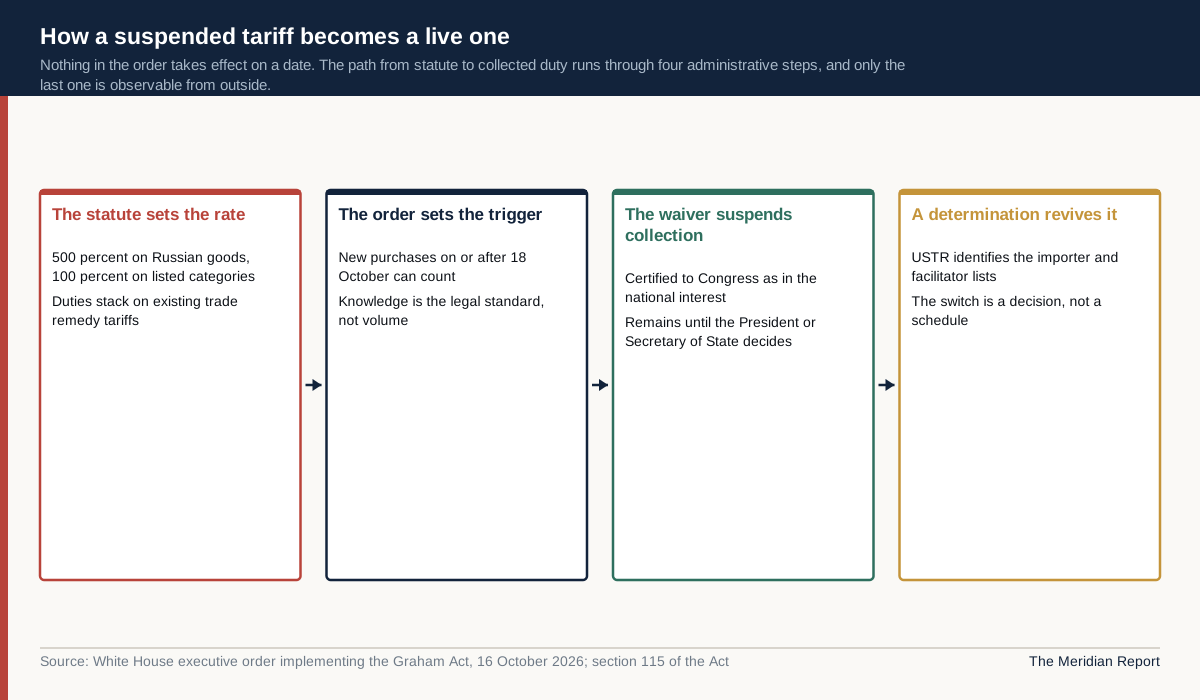
The architecture is a switch, not a schedule. Nothing in the order takes effect on a date. Everything takes effect on a decision.
Why a 500 percent tariff on Russia is close to symbolic
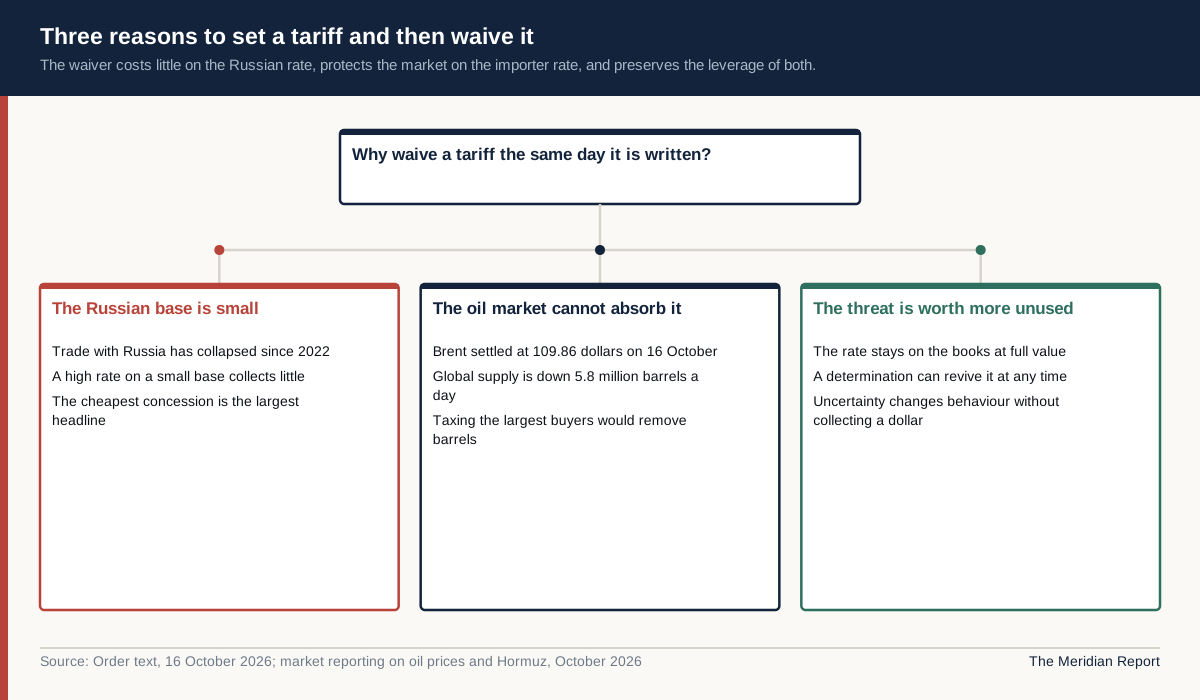
The 500 percent rate is the most quoted number in the Act and the least consequential. A tariff is a charge on goods entering the United States, and the volume of Russian goods entering the United States has collapsed since 2022. A 500 percent duty on a small trade base collects a small amount of revenue and changes few decisions.
That does not make it pointless. A high nominal rate on a small base is a political instrument with three functions. It signals the intended direction of policy, it creates a legal basis to penalise any future recovery in trade, and it satisfies a domestic audience that wants to see maximal pressure applied to Russia. The rate is a message about intent rather than a working instrument of economic pressure, and its practical effect sits in the second and third tariffs rather than the first.
The same logic applies to the waiver. Waiving the 500 percent duty costs the United States almost nothing in foregone revenue because there is almost no trade to tax. It is the cheapest concession in the order, and it is the one that looks largest in a headline. A reader comparing the size of the concession to the size of its effect would draw the opposite conclusion from the one the numbers support.
The 100 percent tariff is aimed at the countries keeping the oil flowing
The second tariff is the one that would bite. It applies to goods from the five largest importers of Russian crude oil and natural gas, conditional on new purchases on or after 18 October. The list is not published in the order. The statute directs the USTR to identify it.
On any plausible reading of global oil trade since 2022, the list is dominated by the two largest buyers of discounted Russian barrels, with several more countries following. The precise ranking depends on whether the measure is crude, gas or both, on whether it counts seaborne cargoes or pipeline deliveries, and on the reference period. Those choices are the USTR's to make, which means the tariff's coverage is a policy variable rather than a fixed fact.
The economics of the tariff are straightforward and brutal. For an economy that exports tens of billions of dollars of manufactured goods to the United States, a 100 percent duty is a multiple of any discount it earns by buying Russian crude. The discount on a discounted barrel is measured in a few dollars per barrel. The duty is measured as a percentage of the total value of an export sector that is many times larger. The tariff is therefore not calibrated to the size of the discount. It is calibrated to compliance, which is a different objective.
That is also why the waiver is doing real work. If the tariff were live, it would fall on the export sectors of the countries that have kept Russian oil moving while the coalition's price cap was in place. Those countries are also major participants in the global goods trade whose demand is holding up forecasts from the WTO and the IMF. A 100 percent duty on them would be a shock to the trade system in the same quarter as an energy shock, which is why the order keeps the threat and removes the collection.
The trigger date is 18 October, and it is already here
The order's most consequential line is the definition of when a purchase counts. The 100 percent duty on the largest importers applies if the country knowingly makes new purchases of Russian crude oil or natural gas on or after 18 October 2026.
Every cargo is a new purchase. A country that continues buying Russian oil after 18 October is making new purchases from that date onward, which means the condition is continuously satisfied for any continuing trade. The requirement of knowledge is a legal standard about intent and awareness rather than a factual threshold about volume, and it is the kind of standard that is proved in a determination rather than observed in a statistic.
The practical effect is that the trigger date does not start a clock. It draws a line that determines whether the existing trade is the relevant conduct. From 18 October, any cargo loaded for a listed country's account can be cited in a determination, and the delay between conduct and determination is a matter of political choice. The waiver means a determination has not been made. It does not mean the conduct has stopped.
For a trader, that is the worst of both worlds. The tariff is not being collected, so the immediate cost is zero. The tariff is legally available, so the tail risk is large, and the risk is concentrated in a decision process the trader cannot observe, influence or insure against in a normal commercial market. Uncertainty that cannot be priced shows up as a higher required return on any trade with the affected countries, which is a cost even when the tariff is zero.
Why the waiver is the policy, not a pause
The order's waiver provision has an unusual structure. It does not lapse after a period, and it does not require a periodic recertification. It remains in effect until the President or the Secretary of State determines that further action is appropriate.
That is a permanent suspension with an open door. The statute's tools stay on the books, the duties stay at their stated rates, the monitoring continues, and the switch can be flipped by a determination at any time. The administration gets the leverage of the law without the cost of using it, and the Congress that passed the law gets the credit for passing it without owning the consequences of a tariff on Chinese, Indian or Turkish goods during an oil crisis.
The order is also explicit that pre-existing sanctions survive. The national emergency with respect to harmful Russian foreign activities, continued on 24 March 2026, and every person sanctioned under the executive orders that implement it remain designated. A reader who treats the waiver as an amnesty would misread it. The waiver covers the new instruments in the Graham Act. It leaves the old architecture intact, and the old architecture is what has produced most of the designations actually in force against Russian banks, companies and individuals.
The consequence is that the visible policy has not changed much. What changed on 16 October is that the statutory ceiling was raised and the executive ceiling was left where it was. The gap between the two is the measure of how much further the administration could go if it decides to.
The cap is now far below the market
The European Union's crude price cap stands at 44.10 dollars a barrel, set on 15 January 2026 and effective from 1 February. The 21st sanctions package in July paused the cap's automatic adjustment mechanism until July 2027, which locks the level in place for the coming year.
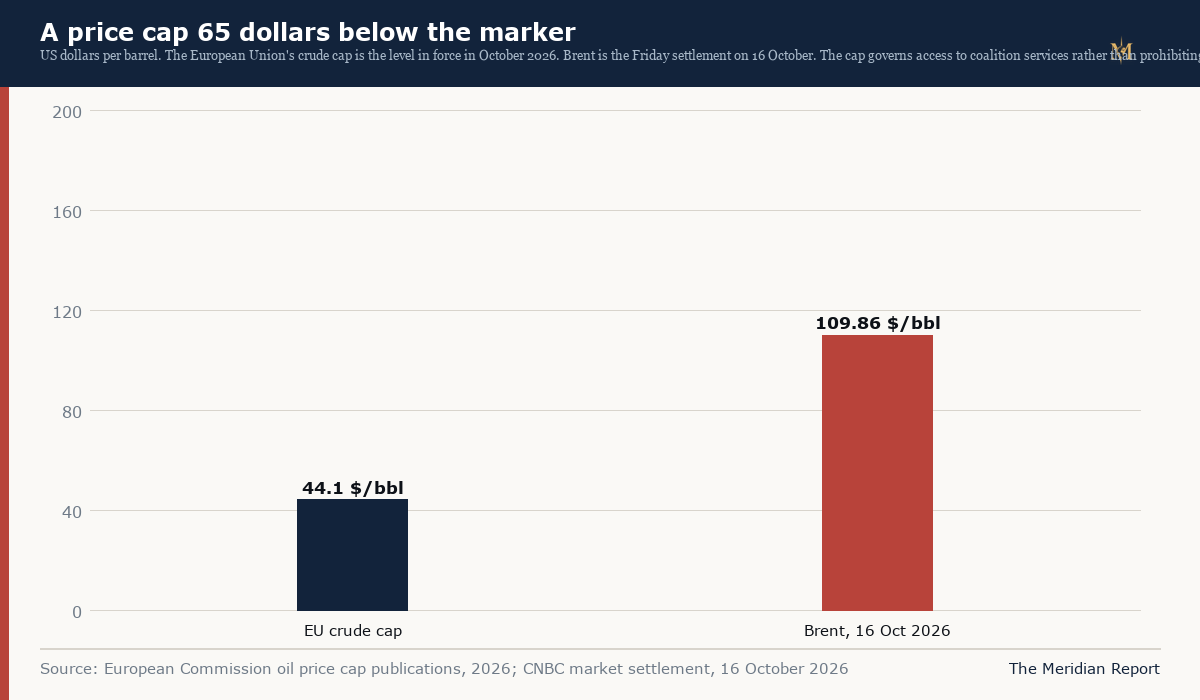
Brent settled at 109.86 dollars on 16 October. On a benchmark comparison, the cap sits 65 dollars below the international marker, and Russian barrels have been trading far above the cap for most of the year. A price cap that is set 60 percent below the market is not restricting revenue. It is defining a service economy: the cap conditions access to coalition shipping, insurance, financing and brokering, and it only binds a cargo that needs those services.
This is the connection between the cap and the Graham Act that matters. The cap binds the service side, where the coalition still has leverage because it owns the insurers and the major flag registries. The tariff binds the goods side, where the coalition's leverage is the size of its own import market. One instrument restricts the ability to move a barrel; the other restricts the ability to sell the goods that pay for it. They are aimed at the same target through different doors, and both were, as of 17 October, set below the level that would impose a real cost.
The EU listed 1,569 entities and did not move the cap
On 12 October, the Council of the European Union adopted additional restrictive measures against 1,569 individuals and entities, including 826 Russian companies and 743 individuals. The Commission described it as the single largest set of listings ever agreed by the EU, bringing the total under the regime to close to 4,600. The targets are mid-level suppliers in the Russian military industrial complex, with combined annual turnover of at least 20 billion euros and more than 250,000 employees. Listed entities face asset freezes and listed individuals face travel bans.
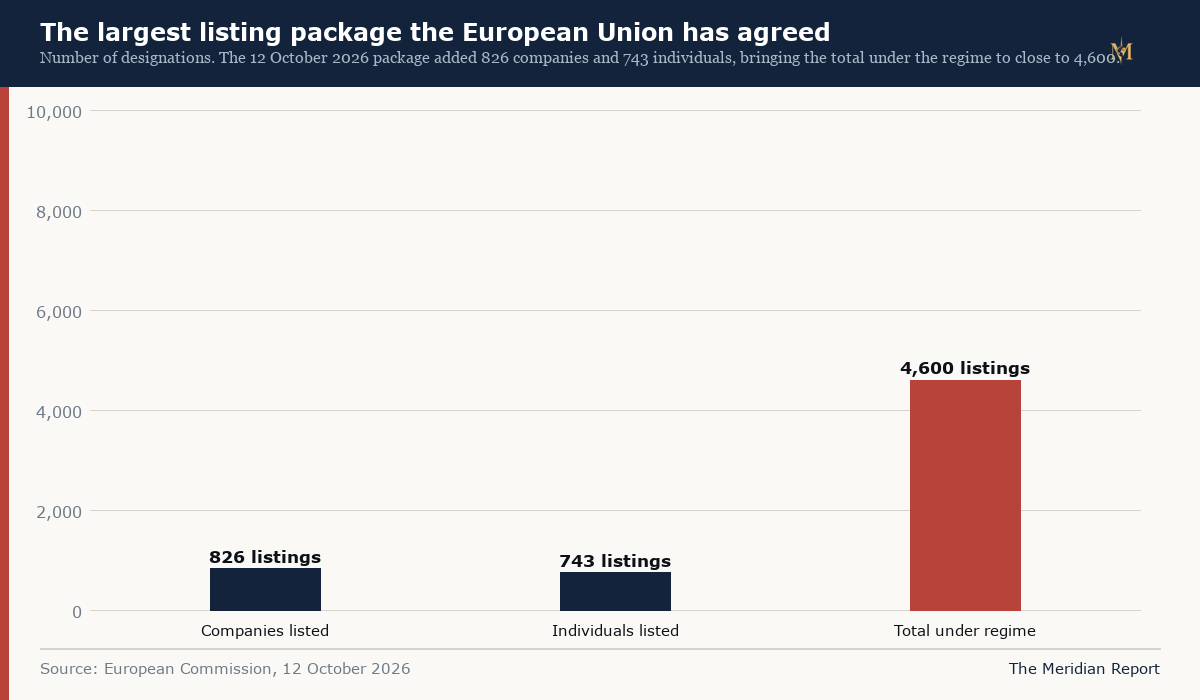
The package is a listing exercise rather than a sectoral measure. It expands the population of designated names, which changes what European banks, insurers and logistics firms must screen and refuse. It does not change the price cap, does not add a new import ban on Russian energy and does not touch the shadow fleet's access to services beyond what earlier packages did.
Listing 1,569 entities in one act has a real cost for the enforcement system. Each listing creates a screening obligation and an asset freeze duty, and the population of names that financial institutions must check grows faster than their compliance capacity. The Commission's own framing, that these are the core suppliers of electronics, microcircuits, radar, antennas and navigation systems to Russian missiles, drones and aircraft, suggests the intent is to raise the transaction cost of procurement rather than to stop any single shipment. A procurement network that has to route around 826 newly designated companies pays more and moves more slowly, which is a real effect even when every individual shipment finds a way through.
The missing piece is the cap. With the crude cap frozen at 44.10 dollars and the market at 109.86, the price instrument is inactive. The EU's October action added names to the service restriction regime without reconnecting the price to the market it is supposed to govern. The listing package and the cap are now two instruments operating at different levels of intensity, and the one with the broader coverage is doing the less economic work.
The pro-cyclical trap
The Graham Act has a feature that its authors may not have intended. The trigger is hardest to pull when oil is most expensive.
A 100 percent duty on the countries buying Russian crude would reduce their incentive to buy it, which would reduce the volume of Russian barrels reaching the market, which would raise the oil price further in a market where Brent is already above 110 dollars and the IEA reports global supply down 5.8 million barrels a day. In a crisis, the United States needs barrels to flow, including Russian barrels, to keep the price from spiralling. The tariff that is designed to stop the flow is most costly to use when the flow matters most.
That is a structural conflict between two objectives: reducing Russian revenue and stabilising the oil market. The price cap was designed to square the circle by allowing Russian oil to flow at a capped price. When the cap is 65 dollars below the market, the circle is no longer squared, and the choice becomes a direct trade-off. Every escalation in the Middle East makes the trade-off worse and the tariff less likely to be triggered.
The same logic explains the timing of the waiver. The order was signed on 16 October, the day after Brent's weekly gain of nearly 5 percent and in a week when nine ships were attacked in the Strait of Hormuz. Activating a secondary tariff on the world's largest buyers of Russian crude in that environment would have added a demand shock to a supply shock. The waiver is not only a diplomatic instrument. It is a recognition that the oil market could not absorb the tariff at this moment.
The shadow fleet is the test the listings do not answer
The instrument that has actually moved Russian oil is the tanker. The Centre for Research on Energy and Clean Air classified 52 percent of Russian seaborne oil exports onto sanctioned shadow tankers, 42 percent onto tonnage owned or insured by the coalition, and 6 percent onto undesignated shadow tankers in August 2026. The coalition's own tonnage carried a minority of the trade, which is the direct measure of what a service-based cap can control.
The October listing package does not change that distribution. It adds 826 Russian companies to the designated population, but it does not add the hundreds of tankers that are already operating outside the coalition's insurance, classification and flag registries. A vessel that never calls at a European port, never uses a European insurer and never needs a European bank is not affected by a European listing, and the entities that charter it are often incorporated in jurisdictions where the designation has no practical reach.
The freight market shows how the workaround prices. Reuters reported that freight rates for Russian Urals shipments to India hit fresh records in early October, with a figure around 30 dollars a barrel cited in that coverage. That is the cost of the detour, the risk and the fleet, and it is paid out of the discount on the barrel. Sanctions have not stopped the trade. They have made it expensive and invisible, which is the same outcome as a tax that is collected by the carrier rather than the treasury.
Against that background, the tariff is a different kind of instrument. It does not try to stop a tanker. It tries to make the buying country's export sector pay for the purchase, which reaches the decision maker through a channel the shadow fleet cannot reroute. That is the strongest argument for the Act, and it is the reason the waiver matters. A tariff that is not collected does not reach anyone.
What a compliance officer has to do on Monday
The order's practical effect on a bank, insurer, trader or manufacturer outside the United States is a set of screening and documentation duties that changed on 16 October without a date on which anything became prohibited.
Consider what a European trade finance desk faces. It has to screen against the EU's roughly 4,600 designations, which grew by 1,569 in one act on 12 October. It has to determine whether any counterparty falls within the US Act's categories, which requires knowing whether a customer is among the largest five importers of Russian energy or a top five facilitator, and the lists are unpublished. It has to decide whether a Russian-origin consignment entering the United States is subject to a 500 percent duty that is currently waived, and to advise a client on the stacking rules if it is not. And it has to price the tail risk that a determination changes everything between contract signature and delivery.
None of those duties is impossible. All of them add cost, time and legal exposure, and they fall hardest on mid-sized firms that do not have a sanctions team. The largest banks and trading houses have the staff to handle an expanding designated population and an unpublished list. Smaller exporters, which are the firms most likely to be in the supply chains that the listing package is aimed at, do not.
That asymmetry is a sanctions effect in its own right, and it does not appear in any official measure of the sanctions' impact. The intended target is the Russian procurement network. The incidental effect is a compliance moat around the largest financial institutions, which favours consolidation in the very sectors that sanctions are meant to keep competitive. Whether that is a cost worth paying is a policy judgement. That it is a cost is not in dispute.
What would make the tripwire live
Four things could flip the switch, and they are worth naming because each leaves a different signature.
A determination by the Secretary of State that further action is appropriate would end the waiver for the new instruments, either generally or for specific countries. That is the cleanest legal path, and it requires no new legislation.
A congressional pressure cycle could make the waiver politically expensive. The Act passed with a waiver provision built in, which means its authors accepted that a suspension was possible. If the political cost of maintaining it rises, the administration can be pushed toward a partial activation, and partial activation against one country is administratively simpler than a global trigger.
A change in the oil market could remove the economic objection. If Brent falls back below the level where a supply reduction is tolerable, the tariff's market cost falls with it, and the case for activating strengthens. This is the mirror image of the pro-cyclical trap: the same feature makes the switch easiest to flip in exactly the conditions when Russian revenue is already low.
A sanctions failure that becomes public would create the evidentiary basis for a determination. The waiver rests on a national interest certification. A documented evasion network or a named facilitator country would give the USTR the material it needs to publish the lists the order contemplates, and once published, the lists create their own momentum.
None of those is imminent. All are possible, and the point of a tripwire is that it is cheap to maintain and expensive to cross.
What the record does not establish
The record does not establish which countries are on either list. The order directs the USTR to identify the largest importers and the top facilitators, and no published list appeared with the order. Any specific country named in commentary is an inference from trade data, not a designation.
The record does not establish the amount of revenue the tariffs would raise. The rates are stated; the trade bases are not, and the largest categories of Russian goods entering the United States are small after four years of restrictions. A revenue estimate would require customs data that the order does not provide.
The record does not establish how the waiver interacts with the Act's Iran provisions. The order cites the Act's authority over Russia and Iran, but the waiver text addresses the Russia-related sections by number. The Iran sanctions provisions are extended by the Act and preserved by the order's general provisions, and the boundaries between what was waived and what was merely extended are not set out in a way that a non-lawyer can read.
The record does not establish that Russian oil revenue is falling because of sanctions. The Kyiv School of Economics Institute's September tracker reported export volumes at their lowest since 2018 while higher prices lifted export revenues by just 0.3 percent, which is a volume story with a price offset rather than a clean sanctions success. A lower cap that no one observes and a tariff that no one collects do not produce a measurable effect, and the effect that is measurable has other causes.
What the order established
The order established that the United States has built a legal instrument capable of taxing the trade of the countries that buy Russian energy, and that it has chosen not to use it. It established that the choice is reversible by a determination rather than by legislation, which makes the threat durable and the timing unpredictable. And it established that the statutory ceiling is now far above the executive floor, which is the definition of unused leverage.
For the governments on the receiving end, the rational response is not to change behaviour in response to a tariff that is not being collected. It is to reduce exposure to the decision, which means diversifying suppliers, rerouting trade and building the legal and financial capacity to absorb a sudden change. The uncertainty itself does the work that the tariff would have done, at a fraction of the diplomatic cost, and it does so without collecting a dollar.
That is the tripwire's real function. It does not need to be crossed to change behaviour. It needs only to be visible, and to be attached to a date that has already passed.